
Homework Answers

Add Answer to:
A force of 14 lb is required to hold a 37-lb crate on a hill. What...
12. A crate is pulled across a horizontal floor by a rope tied to the crate....
 12. A crate is pulled across a horizontal floor by a rope tied to the crate. The rope makes an angle of 37 degrees with the horizontal. Find the frictional force if the tension in the rope is 10N and the crate moves with constant velocity. a. 3.0 N b. 5.0 N c. 7.0 N d. 8.0 N e. None of them 13. A 1500 kg car travels at a speed of 20 m/s. What is its kinetic energy? a....
Determine the minimum force, P, required to lift the 200 lb crate. The two wedges are...
 Determine the minimum force, P, required to lift the 200 lb crate. The two wedges are separated by smooth rollers; both wedge surface from 20° angles from a horizontal surface. The coefficient of friction between the wedges and all other surfaces is 0.4. 20° Р
Determine the minimum force, P, required to lift the 200 lb crate. The two wedges are...
 Determine the minimum force, P, required to lift the 200 lb crate. The two wedges are separated by smooth rollers, both wedge surface from 20° angles from a horizontal surface. The coefficient of friction between the wedges and all other surfaces is 0.4. 20" Р
Determine the minimum force, P, required to lift the 200 lb crate. The two wedges are...
 Determine the minimum force, P, required to lift the 200 lb crate. The two wedges are separated by smooth rollers; both wedge surface from 20° angles from a horizontal surface. The coefficient of friction between the wedges and all other surfaces is 0.4. 20° P-
Determine the minimum force, P, required to lift the 200 lb crate. The two wedges are...
 Determine the minimum force, P, required to lift the 200 lb crate. The two wedges are separated by smooth rollers; both wedge surface from 20° angles from a horizontal surface. The coefficient of friction between the wedges and all other surfaces is 0.4. 20° Р
1. A 50 lb uniform crate that is 1.5 ft wide is being pushed with a...
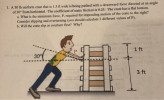 1. A 50 lb uniform crate that is 1.5 ft wide is being pushed with a downward force directed at an angle of 30° from horizontal. The coefficient of static friction is 0.25. The crate has a flat bottom. a. What is the minimum force, P, required for impending motion of the crate to the right? Consider slipping and overturning (you should calculate 2 different values of P). b. Will the crate slip or overturn first? Why? - 11 ft...
9. Friction & Wedges Determine the minimum force, P, required to lift the 200 lb crate....
 9. Friction & Wedges Determine the minimum force, P, required to lift the 200 lb crate. The two wedges are separated by smooth rollers; both wedge surface from 20° angles from a horizontal surface. The coefficient of friction between the wedges and all other surfaces is 0.4. 20°
What is the MAXIMUM weight ww that can be used to hold this crate stationary on...
 What is the MAXIMUM weight ww that can be used to hold
this crate stationary on the ramp? Include free-body diagrams of
the two masses.
Now assume that the weight w=3000N. What is the acceleration of
the crate?
Find the speed of the masses after the weight w=3000N has
dropped a distance of 1.6m after being released from rest. Find
this speed two ways: using kinetmatics and the acceleration derived
in the previous subquestion, and using energy considerations.
A 2000-N...
What is the MAXIMUM weight ww that can be used to hold
this crate stationary on the ramp? Include free-body diagrams of
the two masses.
Now assume that the weight w=3000N. What is the acceleration of
the crate?
Find the speed of the masses after the weight w=3000N has
dropped a distance of 1.6m after being released from rest. Find
this speed two ways: using kinetmatics and the acceleration derived
in the previous subquestion, and using energy considerations.
A 2000-N...
A crate of mass m = 1.12 kg is on a frictionless incline that makes an...
A crate of mass m = 1.12 kg is on a frictionless incline that makes an angle of θ = 27.6 degrees with horizontal. A force of magnitude P = 7.24 N is applied to the crate in a direction parallel and up the incline, as shown. Write an expression for the acceleration ax of the crate, where positive x is up the incline. Your answer should be in terms of m, P, θ, and g (9.80 m/s2).
A 1,440-N crate is being pushed across a level floor at a constant speed by a...
A 1,440-N crate is being pushed across a level floor at a constant speed by a force F of 280 N at an angle of 20.0 degrees below the horizontal. a.) What is the coefficient of kinetic friction between the crate and the floor? (Enter your answer to at least three decimal places.) b.) If the 280-N force is instead pulling the block at an angle of 20.0 degrees ABOVE the horizontal, what will be the acceleration of the crate?...
 12. A crate is pulled across a horizontal floor by a rope tied to the crate. The rope makes an angle of 37 degrees with the horizontal. Find the frictional force if the tension in the rope is 10N and the crate moves with constant velocity. a. 3.0 N b. 5.0 N c. 7.0 N d. 8.0 N e. None of them 13. A 1500 kg car travels at a speed of 20 m/s. What is its kinetic energy? a....
 Determine the minimum force, P, required to lift the 200 lb crate. The two wedges are separated by smooth rollers; both wedge surface from 20° angles from a horizontal surface. The coefficient of friction between the wedges and all other surfaces is 0.4. 20° Р
 Determine the minimum force, P, required to lift the 200 lb crate. The two wedges are separated by smooth rollers, both wedge surface from 20° angles from a horizontal surface. The coefficient of friction between the wedges and all other surfaces is 0.4. 20" Р
 Determine the minimum force, P, required to lift the 200 lb crate. The two wedges are separated by smooth rollers; both wedge surface from 20° angles from a horizontal surface. The coefficient of friction between the wedges and all other surfaces is 0.4. 20° P-
 Determine the minimum force, P, required to lift the 200 lb crate. The two wedges are separated by smooth rollers; both wedge surface from 20° angles from a horizontal surface. The coefficient of friction between the wedges and all other surfaces is 0.4. 20° Р
 1. A 50 lb uniform crate that is 1.5 ft wide is being pushed with a downward force directed at an angle of 30° from horizontal. The coefficient of static friction is 0.25. The crate has a flat bottom. a. What is the minimum force, P, required for impending motion of the crate to the right? Consider slipping and overturning (you should calculate 2 different values of P). b. Will the crate slip or overturn first? Why? - 11 ft...
 9. Friction & Wedges Determine the minimum force, P, required to lift the 200 lb crate. The two wedges are separated by smooth rollers; both wedge surface from 20° angles from a horizontal surface. The coefficient of friction between the wedges and all other surfaces is 0.4. 20°
 What is the MAXIMUM weight ww that can be used to hold
this crate stationary on the ramp? Include free-body diagrams of
the two masses.
Now assume that the weight w=3000N. What is the acceleration of
the crate?
Find the speed of the masses after the weight w=3000N has
dropped a distance of 1.6m after being released from rest. Find
this speed two ways: using kinetmatics and the acceleration derived
in the previous subquestion, and using energy considerations.
A 2000-N...
What is the MAXIMUM weight ww that can be used to hold
this crate stationary on the ramp? Include free-body diagrams of
the two masses.
Now assume that the weight w=3000N. What is the acceleration of
the crate?
Find the speed of the masses after the weight w=3000N has
dropped a distance of 1.6m after being released from rest. Find
this speed two ways: using kinetmatics and the acceleration derived
in the previous subquestion, and using energy considerations.
A 2000-N...
Most questions answered within 3 hours.
-
Where is the error in this code sequence?
String s1 = "Hello";
String s2 = "ello";...
asked 11 months ago -
Financial data for Joel de Paris, Inc., for last year
follow:
Joel de Paris, Inc.
Balance...
asked 11 months ago -
Consider this reaction:
Al2(SO4)3 (aq)+ BaCl3
(aq) Al2Cl6 (aq)- +
3BaSO4(s) . What is the...
asked 11 months ago -
Suppose that Savneet is considering increasing her
recent random sample from 20 car rentals to 40...
asked 11 months ago -
Trucks arrive at an unloading terminal at an average rate of 120
per hour.
Trucks arrive...
asked 11 months ago -
Why are methanol and ethanol completely soluble in water while
octanol is not very little soluble....
asked 11 months ago -
A facilities manager at a university reads in a research report
that the mean amount of...
asked 11 months ago -
When the CuSO4 is rehydrated by adding water to the anhydrous
compound, is this an endothermic...
asked 11 months ago -
A ray of sunlight is passing from diamond into crown glass; the
angle of incidence is...
asked 11 months ago -
A block of mass 0.249 kg is placed on top of a light, vertical
spring of...
asked 11 months ago -
how do the kidneys compensate in the presences of acidosis
a) trigger hyperventilate
b) reserve acid...
asked 11 months ago -
Question 501 pts
The rental rate of capital to the firm increases. Which of the
following...
asked 11 months ago