the material is structural steel with σf = 220 MPa, E = 200 GPa, ν = 0.3, and α = 12x10-6/oC. please help, provide clear and correct answers
Homework Answers
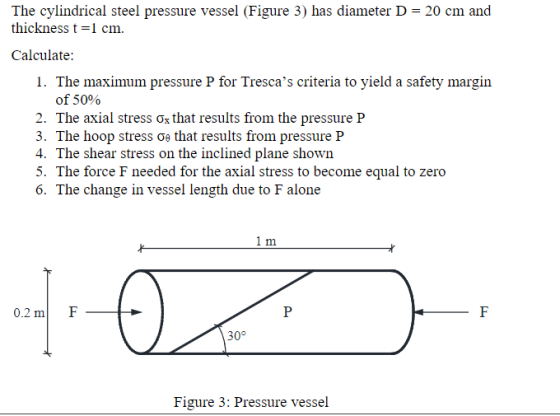
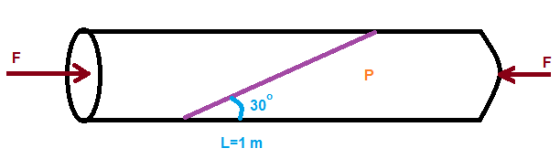
Solution:- the values and figure(diagram) given in the question are as follows:
diameter of vessel(D)=20 cm
thickness of vessel(t)=1 cm
length of vessel(L)=1 m
failure stress of steel( f)=220
MPa
f)=220
MPa
modulus of elasticity(E)=200 GPa
v=0.3
thermal expanson coefficient of
steel( )=12*10^6
/oC
)=12*10^6
/oC
(1)
Maximum pressure according to tresca's theory:-
safety margin is 50% means the factor of safety is 1.5
 max=y/2

where,
1=P ,
2=0
FOS=1.5
y=f=220
MPa
P=220/1.5
P=146.667 MPa
maximum pressure (P)=146.667 MPa
(2)
Axial(longitudinal)
stress(x)
dure to pressure P:-
axial(longitudinal)
stress(x)=P*d/4t
where, d=internal diameter=D-2t
t=thickness of vessel
if , P=146.67 MPa
d=D-2t=20-2*1=18 cm, or 0.18 m
axial(longitudinal) stress(x)=(146.67*0.18)/(4*0.01)
axial(longitudinal)
stress(x)=660.015
MPa
(3)
Hoop stress( )
dure to pressure P:-
)
dure to pressure P:-
hoop stress()=P*d/2t
where, d=internal diameter=D-2t
t=thickness of vessel
if , P=146.67 MPa
d=D-2t=20-2*1=18 cm, or 0.18 m
hoop stress()=(146.67*0.18)/(2*0.01)
hoop stress()=1318.203
MPa
(4)
let shear stress on incline
pale is
shear stress()=[(1-2)/2]*sin2
where,
1=-stress due to force F+ axial stress(x)
due pressure P
stress()
due to force F is compressive and axial stress(x)
due pressure P is tensile
1=-+x
1=-{F/(Pi/4)*d^2}+P*d/4t
y=0
=30o
shear stress()=[[-{F/( /4)*d^2}+P*d/4t]/2]*sin60o
shear stress()=[[-{4F/(d^2}+P*d/4t]/2]*sin60o
shear stress()=[[-{0.5513F/(d^2}+0.10825P*d/t]
put t=0.01 m and d=D-2t=0.18 m
shear stress()=-541618*F+1.948*P
, MPa
[where, F=MN and P=MPa]
(5)
axial stress due to force
F()=F/{(/4)*d^2}
, [nature of stress is
compressive]
axial(longitudinal) stress
due to pressure P(x)=P*d/4t
, [tensile stress]
net axial stress=-axial stress
due to force F()+axial(longitudinal)
stress due to pressure P(x)
calculatinf force F is required for net axial stress is zero
0=-F/{(/4)*d^2}+P(x)=P*d/4t
F=(*P*d^3)/(16*t)
if, P=146.667 MPa
t=0.01 m
d=D-2t=0.18 cm
F=(3.14159*146.667*0.18^3)/(16*0.01)
F=16.79499 MN
F=16794.99 kN
(6)
let change in length due to F
alone is 
=(F*L)/(AE)
wherte, A=(3.14159/4)*d^2
A=(3.14159/4)*0.18^2
A=0.0254468 m^2
E=200 GPa
L=1 m
F=16.79499*10^6 N
=(16.79499*10^6*1)/(0.0254468*200*10^9)
=3.300*10^-3
m
=3.3
mm
change in length due to F
alone()=3.3
mm
[Ans]
Add Answer to:
the material is structural steel with σf = 220 MPa, E = 200 GPa,
ν =...
the material is structural steel with σf = 220 MPa, E = 200 GPa, ν =...
 the material is structural steel with σf = 220 MPa, E = 200 GPa,
ν = 0.3, and α = 12x10-6/oC.
please have correct answers
The steel shaft AD is subjected to the torques shown in Figure 2. Calculate: 1. The internal reaction in AB 2. The internal reaction in BC 3. The internal reaction in CD 4. The maximum shaft diameter consistent with a safety margin of 50% (Tresca's criteria) 5. If points A, B, C and D are...
the material is structural steel with σf = 220 MPa, E = 200 GPa,
ν = 0.3, and α = 12x10-6/oC.
please have correct answers
The steel shaft AD is subjected to the torques shown in Figure 2. Calculate: 1. The internal reaction in AB 2. The internal reaction in BC 3. The internal reaction in CD 4. The maximum shaft diameter consistent with a safety margin of 50% (Tresca's criteria) 5. If points A, B, C and D are...
Find the maximum pressure P in the cylindrical steel vessel, using Tresca to yield a 50%...
 Find the maximum pressure P in the cylindrical steel vessel,
using Tresca to yield a 50% safety margin.
Then find the axial stress σx and hoop stress σθ that results
from P.
Calculate the shear stress on the inclined plane.
Calculate the force F needed for the axial stress to equal zero
and the change in vessel length due to F alone.
diameter = 20 cm, thickness =1 cm, σf = 220
MPa, E = 200 GPa, ν = 0.3,...
Find the maximum pressure P in the cylindrical steel vessel,
using Tresca to yield a 50% safety margin.
Then find the axial stress σx and hoop stress σθ that results
from P.
Calculate the shear stress on the inclined plane.
Calculate the force F needed for the axial stress to equal zero
and the change in vessel length due to F alone.
diameter = 20 cm, thickness =1 cm, σf = 220
MPa, E = 200 GPa, ν = 0.3,...
In all the questions below, the material is structural steel with σf = 220 MPa, E...
 In all the questions below, the material is structural steel
with σf = 220 MPa, E = 200 GPa, ν = 0.3, and α = 12×10-6
/℃.
Question 3 The circular steel rod (D = 0.1 m) in Figure 3 is constrained by end plates and is subjected to axial load P. Calculate: 1. The internal reaction in AB 2. The internal reaction in BC 3. The maximum value for P for the rod to carry the load with a...
In all the questions below, the material is structural steel
with σf = 220 MPa, E = 200 GPa, ν = 0.3, and α = 12×10-6
/℃.
Question 3 The circular steel rod (D = 0.1 m) in Figure 3 is constrained by end plates and is subjected to axial load P. Calculate: 1. The internal reaction in AB 2. The internal reaction in BC 3. The maximum value for P for the rod to carry the load with a...
σf = 220 MPa, E = 200 GPa, ν = 0.3, and α = 12×10-6/°C Find...
 σf = 220 MPa, E = 200 GPa, ν = 0.3, and α = 12×10-6/°C
Find the maximum torque with a 30% safety margin using
Tresca
Calculate the resulting angle of twist of plane B relative to A,
C relative to B, and C relative to A
Calculate σ1 and σ2 in AB
Find the change in length of BC if ΔT = +100°C
-4T +T A 0.5 m B. 0.2 m Go С X X 1 m 1 m
σf = 220 MPa, E = 200 GPa, ν = 0.3, and α = 12×10-6/°C
Find the maximum torque with a 30% safety margin using
Tresca
Calculate the resulting angle of twist of plane B relative to A,
C relative to B, and C relative to A
Calculate σ1 and σ2 in AB
Find the change in length of BC if ΔT = +100°C
-4T +T A 0.5 m B. 0.2 m Go С X X 1 m 1 m
Please provide a correct answer to these questions. The material is structural steel with of =...
 Please provide a correct answer to these questions.
The material is structural steel with of = 220 MPa, E = 200 GPa, v = 0.3, and a = 12x10-6 / 0 C The steel rod (Figure 1) is constrained between two rigid surfaces. It has a diameter D = 20 mm and is subjected to load P = 20 kN. Consider the following value below The reaction at 'A' = 13.13 KN(t) The reaction at 'B' = 6.67 KN(t) The...
Please provide a correct answer to these questions.
The material is structural steel with of = 220 MPa, E = 200 GPa, v = 0.3, and a = 12x10-6 / 0 C The steel rod (Figure 1) is constrained between two rigid surfaces. It has a diameter D = 20 mm and is subjected to load P = 20 kN. Consider the following value below The reaction at 'A' = 13.13 KN(t) The reaction at 'B' = 6.67 KN(t) The...
em 35? ? A cylindrical pressure vessel is constructed from a long, narrow steel plate by...
 em 35? ? A cylindrical pressure vessel is constructed from a long, narrow steel plate by wrapping the plate around a mandrel and then welding along the edges of the plate to make a helical joint. The helical weld makes an angle ? 350 with the axial direction. The vessel has inner radius r = 1.8 m and wall thickness 20 mm. The material is steel with E 200 GPa and Poisson ratio 0.3. The internal pressure p = 800...
0.10m Assuming the surface of an Aluminum (E-70 Gpa and v = 0.30) cylindrical pressure vessel...
 0.10m Assuming the surface of an Aluminum (E-70 Gpa and v = 0.30) cylindrical pressure vessel is in a state of plain stress, with an internal gas pressure of P - 8 MPa. Determine the strain in the z-direction (z) if the "hoop" stress and "longitudinal" stress of the vessel are defined as: OLA P-r Pr and ơL--2t if the radius of the pressure vessel is r-0.04 m and the wall thickness is t 0.004 mm. Note: the image to...
In all the questions below, the material is structural steel with or= 220 MPa, E =...
 In all the questions below, the material is structural steel with or= 220 MPa, E = 200 GPa, v=0.3, and a = 12x10-6/°C. Question 1 The steel shaft in Figure 1 is subjected to the torques shown. Calculate: 1. The maximum torque (Tmax) that can be applied for the shaft to operate with a safety margin of 30% (Tresca). 2. The resulting angle of twist of plane B relative to A 3. The resulting angle of twist of plane C...
In all the questions below, the material is structural steel with or= 220 MPa, E =...
 In all the questions below, the material is structural steel with or= 220 MPa, E = 200 GPa, v=0.3, and a = 12x10-6/°C. Question 1 The steel shaft in Figure 1 is subjected to the torques shown. Calculate: 1. The maximum torque (Tmax) that can be applied for the shaft to operate with a safety margin of 30% (Tresca). 2. The resulting angle of twist of plane B relative to A 3. The resulting angle of twist of plane C...
MATERIAL HAS SIGMA F = 220 MPa, E = 200 GPa, Poisson's ratio v = 0.3,...
 MATERIAL HAS SIGMA F = 220 MPa, E = 200 GPa, Poisson's ratio v =
0.3, and alpha = 12 x 10^-6 /degrees C
Question 3 The circular steel rod (D=0.1 m) in Figure 3 is constrained by end plates and is subjected to axial load P. Calculate: 1. The internal reaction in AB 2. The internal reaction in BC 3. The maximum value for P for the rod to carry the load with a safety margin of 30%. 4....
MATERIAL HAS SIGMA F = 220 MPa, E = 200 GPa, Poisson's ratio v =
0.3, and alpha = 12 x 10^-6 /degrees C
Question 3 The circular steel rod (D=0.1 m) in Figure 3 is constrained by end plates and is subjected to axial load P. Calculate: 1. The internal reaction in AB 2. The internal reaction in BC 3. The maximum value for P for the rod to carry the load with a safety margin of 30%. 4....
 the material is structural steel with σf = 220 MPa, E = 200 GPa,
ν = 0.3, and α = 12x10-6/oC.
please have correct answers
The steel shaft AD is subjected to the torques shown in Figure 2. Calculate: 1. The internal reaction in AB 2. The internal reaction in BC 3. The internal reaction in CD 4. The maximum shaft diameter consistent with a safety margin of 50% (Tresca's criteria) 5. If points A, B, C and D are...
the material is structural steel with σf = 220 MPa, E = 200 GPa,
ν = 0.3, and α = 12x10-6/oC.
please have correct answers
The steel shaft AD is subjected to the torques shown in Figure 2. Calculate: 1. The internal reaction in AB 2. The internal reaction in BC 3. The internal reaction in CD 4. The maximum shaft diameter consistent with a safety margin of 50% (Tresca's criteria) 5. If points A, B, C and D are...
 Find the maximum pressure P in the cylindrical steel vessel,
using Tresca to yield a 50% safety margin.
Then find the axial stress σx and hoop stress σθ that results
from P.
Calculate the shear stress on the inclined plane.
Calculate the force F needed for the axial stress to equal zero
and the change in vessel length due to F alone.
diameter = 20 cm, thickness =1 cm, σf = 220
MPa, E = 200 GPa, ν = 0.3,...
Find the maximum pressure P in the cylindrical steel vessel,
using Tresca to yield a 50% safety margin.
Then find the axial stress σx and hoop stress σθ that results
from P.
Calculate the shear stress on the inclined plane.
Calculate the force F needed for the axial stress to equal zero
and the change in vessel length due to F alone.
diameter = 20 cm, thickness =1 cm, σf = 220
MPa, E = 200 GPa, ν = 0.3,...
 In all the questions below, the material is structural steel
with σf = 220 MPa, E = 200 GPa, ν = 0.3, and α = 12×10-6
/℃.
Question 3 The circular steel rod (D = 0.1 m) in Figure 3 is constrained by end plates and is subjected to axial load P. Calculate: 1. The internal reaction in AB 2. The internal reaction in BC 3. The maximum value for P for the rod to carry the load with a...
In all the questions below, the material is structural steel
with σf = 220 MPa, E = 200 GPa, ν = 0.3, and α = 12×10-6
/℃.
Question 3 The circular steel rod (D = 0.1 m) in Figure 3 is constrained by end plates and is subjected to axial load P. Calculate: 1. The internal reaction in AB 2. The internal reaction in BC 3. The maximum value for P for the rod to carry the load with a...
 σf = 220 MPa, E = 200 GPa, ν = 0.3, and α = 12×10-6/°C
Find the maximum torque with a 30% safety margin using
Tresca
Calculate the resulting angle of twist of plane B relative to A,
C relative to B, and C relative to A
Calculate σ1 and σ2 in AB
Find the change in length of BC if ΔT = +100°C
-4T +T A 0.5 m B. 0.2 m Go С X X 1 m 1 m
σf = 220 MPa, E = 200 GPa, ν = 0.3, and α = 12×10-6/°C
Find the maximum torque with a 30% safety margin using
Tresca
Calculate the resulting angle of twist of plane B relative to A,
C relative to B, and C relative to A
Calculate σ1 and σ2 in AB
Find the change in length of BC if ΔT = +100°C
-4T +T A 0.5 m B. 0.2 m Go С X X 1 m 1 m
 Please provide a correct answer to these questions.
The material is structural steel with of = 220 MPa, E = 200 GPa, v = 0.3, and a = 12x10-6 / 0 C The steel rod (Figure 1) is constrained between two rigid surfaces. It has a diameter D = 20 mm and is subjected to load P = 20 kN. Consider the following value below The reaction at 'A' = 13.13 KN(t) The reaction at 'B' = 6.67 KN(t) The...
Please provide a correct answer to these questions.
The material is structural steel with of = 220 MPa, E = 200 GPa, v = 0.3, and a = 12x10-6 / 0 C The steel rod (Figure 1) is constrained between two rigid surfaces. It has a diameter D = 20 mm and is subjected to load P = 20 kN. Consider the following value below The reaction at 'A' = 13.13 KN(t) The reaction at 'B' = 6.67 KN(t) The...
 em 35? ? A cylindrical pressure vessel is constructed from a long, narrow steel plate by wrapping the plate around a mandrel and then welding along the edges of the plate to make a helical joint. The helical weld makes an angle ? 350 with the axial direction. The vessel has inner radius r = 1.8 m and wall thickness 20 mm. The material is steel with E 200 GPa and Poisson ratio 0.3. The internal pressure p = 800...
 0.10m Assuming the surface of an Aluminum (E-70 Gpa and v = 0.30) cylindrical pressure vessel is in a state of plain stress, with an internal gas pressure of P - 8 MPa. Determine the strain in the z-direction (z) if the "hoop" stress and "longitudinal" stress of the vessel are defined as: OLA P-r Pr and ơL--2t if the radius of the pressure vessel is r-0.04 m and the wall thickness is t 0.004 mm. Note: the image to...
 In all the questions below, the material is structural steel with or= 220 MPa, E = 200 GPa, v=0.3, and a = 12x10-6/°C. Question 1 The steel shaft in Figure 1 is subjected to the torques shown. Calculate: 1. The maximum torque (Tmax) that can be applied for the shaft to operate with a safety margin of 30% (Tresca). 2. The resulting angle of twist of plane B relative to A 3. The resulting angle of twist of plane C...
 In all the questions below, the material is structural steel with or= 220 MPa, E = 200 GPa, v=0.3, and a = 12x10-6/°C. Question 1 The steel shaft in Figure 1 is subjected to the torques shown. Calculate: 1. The maximum torque (Tmax) that can be applied for the shaft to operate with a safety margin of 30% (Tresca). 2. The resulting angle of twist of plane B relative to A 3. The resulting angle of twist of plane C...
 MATERIAL HAS SIGMA F = 220 MPa, E = 200 GPa, Poisson's ratio v =
0.3, and alpha = 12 x 10^-6 /degrees C
Question 3 The circular steel rod (D=0.1 m) in Figure 3 is constrained by end plates and is subjected to axial load P. Calculate: 1. The internal reaction in AB 2. The internal reaction in BC 3. The maximum value for P for the rod to carry the load with a safety margin of 30%. 4....
MATERIAL HAS SIGMA F = 220 MPa, E = 200 GPa, Poisson's ratio v =
0.3, and alpha = 12 x 10^-6 /degrees C
Question 3 The circular steel rod (D=0.1 m) in Figure 3 is constrained by end plates and is subjected to axial load P. Calculate: 1. The internal reaction in AB 2. The internal reaction in BC 3. The maximum value for P for the rod to carry the load with a safety margin of 30%. 4....
Most questions answered within 3 hours.
-
Where is the error in this code sequence?
String s1 = "Hello";
String s2 = "ello";...
asked 10 months ago -
Financial data for Joel de Paris, Inc., for last year
follow:
Joel de Paris, Inc.
Balance...
asked 10 months ago -
Consider this reaction:
Al2(SO4)3 (aq)+ BaCl3
(aq) Al2Cl6 (aq)- +
3BaSO4(s) . What is the...
asked 10 months ago -
Suppose that Savneet is considering increasing her
recent random sample from 20 car rentals to 40...
asked 10 months ago -
Trucks arrive at an unloading terminal at an average rate of 120
per hour.
Trucks arrive...
asked 10 months ago -
Why are methanol and ethanol completely soluble in water while
octanol is not very little soluble....
asked 10 months ago -
A facilities manager at a university reads in a research report
that the mean amount of...
asked 10 months ago -
When the CuSO4 is rehydrated by adding water to the anhydrous
compound, is this an endothermic...
asked 10 months ago -
A ray of sunlight is passing from diamond into crown glass; the
angle of incidence is...
asked 10 months ago -
A block of mass 0.249 kg is placed on top of a light, vertical
spring of...
asked 10 months ago -
how do the kidneys compensate in the presences of acidosis
a) trigger hyperventilate
b) reserve acid...
asked 10 months ago -
Question 501 pts
The rental rate of capital to the firm increases. Which of the
following...
asked 10 months ago