25. Calculate the potential of the reduction of 1.25 mM of cadmium ions.
25. Calculate the potential of the reduction of 1.25 mM of cadmium ions.
Homework Answers
Request Answer!
We need at least 10 more requests to produce the answer.
0 / 10 have requested this problem solution
The more requests, the faster the answer.
Add Answer to:
25. Calculate the potential of the reduction of 1.25 mM of
cadmium ions.
Calculate the potential of the reduction of 1.25 mM of cadmium ions. (please show work)
Calculate the potential of the reduction of 1.25 mM of cadmium ions. (please show work)
Calculate E°cell for the reaction of nickel(II) ions with cadmium metal at 25°C. K = 1.17...
Calculate E°cell for the reaction of nickel(II) ions with cadmium metal at 25°C. K = 1.17 x10⁵ Ni2+(aq) + Cd(aq) ----- Cd2+(aq) + Ni(s) answer is 0.15 can you show the worked out solution?
Using a table of standard reduction potentials, calculate the X-cell potential for the reduction of aqueous...
 Using a table of standard reduction potentials, calculate the X-cell potential for the reduction of aqueous lead(10) ions to lead metal in a saturated solution of lead() sulfate with a concentration of 1.5x10⁵ M. The temperature is 27.0°C. b) What is the AG of the above reaction?
Calculate the reduction potential of the H+/H2 half reaction at 25 °C at pH 3.00 and...
Calculate the reduction potential of the H+/H2 half reaction at 25 °C at pH 3.00 and PH2 = 0.20 bar. Assuming E° is unchanged, whatwould the potential be at 20 °C?
Question 11 of 16 > A galvanic (voltaic) cell consists of an electrode composed of cadmium...
 Question 11 of 16 > A galvanic (voltaic) cell consists of an electrode composed of cadmium in a 1.0 M cadmium ion solution and a second electrode composed of cobalt in a 1.0 M cobalt(II) ion solution, connected by a salt bridge. Calculate the standard potential for this cell at 25 °C. Use this list of standard reduction potentials. V Ecel =
(a) Compute the voltage at 25˚C of an electrochemical cell consisting of pure cadmium immersed in...
(a) Compute the voltage at 25˚C of an electrochemical cell consisting of pure cadmium immersed in a 2 × 10⁻³ M solution of Cd2+ ions and pure iron in a 0.2 M solution of Fe2+ ions. (b)Determine the spontaneous electrochemical reaction for iron (reduced/oxidized) and cadmium (reduced/oxidized).
Calculate the cell potential for the reaction below when the concentrations of ions are: [Ag+ ]...
Calculate the cell potential for the reaction below when the concentrations of ions are: [Ag+ ] = 0.010 M and [Cu2+] = 0.750 M, at 25 °C. Cu(s) + 2Ag+ (aq) --> Cu2+(aq) + 2Ag(s) Given the standard reduction potentials: Cu2+(aq) + 2e– → Cu(s) Eϴ = 0.34 V Ag+ (aq) + e– → Ag(s) Eϴ = 0.80 V (A) 0.35 V (B) 0.44 V (C) 0.46 V (D) 0.48 V (E) 0.57 V
Worksheet 17c (Gen Chem) Other Equilibria 236- The ton cadmium ) is toxic. To remove cadmium(II)ions (255 L. 121 x...
 Worksheet 17c (Gen Chem) Other Equilibria 236- The ton cadmium ) is toxic. To remove cadmium(II)ions (255 L. 121 x 10M ) from wastewater (res from mining and metal processing) it is precipitated with hydroxide ions (1.00 L, 6.00 M). What mass of cadmium hydroxide will precipitate? How much cadmium(II) ion is left in the wastewater?
3. For a voltammetric measurement, calculate the decomposition potential relative to SCE, for the reduction of Sr to Sr in a solution containing 2.23 mM of Sr(NOs)h and a total ionic strength of 0.01...
 3. For a voltammetric measurement, calculate the decomposition potential relative to SCE, for the reduction of Sr to Sr in a solution containing 2.23 mM of Sr(NOs)h and a total ionic strength of 0.01 M. Be sure to account for effects of activity
3. For a voltammetric measurement, calculate the decomposition potential relative to SCE, for the reduction of Sr to Sr in a solution containing 2.23 mM of Sr(NOs)h and a total ionic strength of 0.01 M. Be sure...
3. For a voltammetric measurement, calculate the decomposition potential relative to SCE, for the reduction of Sr to Sr in a solution containing 2.23 mM of Sr(NOs)h and a total ionic strength of 0.01 M. Be sure to account for effects of activity
3. For a voltammetric measurement, calculate the decomposition potential relative to SCE, for the reduction of Sr to Sr in a solution containing 2.23 mM of Sr(NOs)h and a total ionic strength of 0.01 M. Be sure...
Based on the reduction potentials provided below, calculate the the cell potential at 25°C under the...
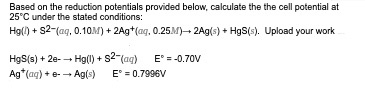 Based on the reduction potentials provided below, calculate the the cell potential at 25°C under the stated conditions: Hg() + 92-aq, 0.10M) + 2Ag+(aq, 0.25M)+ 2Ag(s) + HgS(s). Upload your work HgS(s) + 2e- + Hg() + S2-aq) E' = -0.70V Ag+ (aq) +- Ag(s) E = 0.7996V
 Using a table of standard reduction potentials, calculate the X-cell potential for the reduction of aqueous lead(10) ions to lead metal in a saturated solution of lead() sulfate with a concentration of 1.5x10⁵ M. The temperature is 27.0°C. b) What is the AG of the above reaction?
 Question 11 of 16 > A galvanic (voltaic) cell consists of an electrode composed of cadmium in a 1.0 M cadmium ion solution and a second electrode composed of cobalt in a 1.0 M cobalt(II) ion solution, connected by a salt bridge. Calculate the standard potential for this cell at 25 °C. Use this list of standard reduction potentials. V Ecel =
 Worksheet 17c (Gen Chem) Other Equilibria 236- The ton cadmium ) is toxic. To remove cadmium(II)ions (255 L. 121 x 10M ) from wastewater (res from mining and metal processing) it is precipitated with hydroxide ions (1.00 L, 6.00 M). What mass of cadmium hydroxide will precipitate? How much cadmium(II) ion is left in the wastewater?
 3. For a voltammetric measurement, calculate the decomposition potential relative to SCE, for the reduction of Sr to Sr in a solution containing 2.23 mM of Sr(NOs)h and a total ionic strength of 0.01 M. Be sure to account for effects of activity
3. For a voltammetric measurement, calculate the decomposition potential relative to SCE, for the reduction of Sr to Sr in a solution containing 2.23 mM of Sr(NOs)h and a total ionic strength of 0.01 M. Be sure...
3. For a voltammetric measurement, calculate the decomposition potential relative to SCE, for the reduction of Sr to Sr in a solution containing 2.23 mM of Sr(NOs)h and a total ionic strength of 0.01 M. Be sure to account for effects of activity
3. For a voltammetric measurement, calculate the decomposition potential relative to SCE, for the reduction of Sr to Sr in a solution containing 2.23 mM of Sr(NOs)h and a total ionic strength of 0.01 M. Be sure...
 Based on the reduction potentials provided below, calculate the the cell potential at 25°C under the stated conditions: Hg() + 92-aq, 0.10M) + 2Ag+(aq, 0.25M)+ 2Ag(s) + HgS(s). Upload your work HgS(s) + 2e- + Hg() + S2-aq) E' = -0.70V Ag+ (aq) +- Ag(s) E = 0.7996V
Most questions answered within 3 hours.
-
Where is the error in this code sequence?
String s1 = "Hello";
String s2 = "ello";...
asked 11 months ago -
Financial data for Joel de Paris, Inc., for last year
follow:
Joel de Paris, Inc.
Balance...
asked 11 months ago -
Consider this reaction:
Al2(SO4)3 (aq)+ BaCl3
(aq) Al2Cl6 (aq)- +
3BaSO4(s) . What is the...
asked 11 months ago -
Suppose that Savneet is considering increasing her
recent random sample from 20 car rentals to 40...
asked 11 months ago -
Trucks arrive at an unloading terminal at an average rate of 120
per hour.
Trucks arrive...
asked 11 months ago -
Why are methanol and ethanol completely soluble in water while
octanol is not very little soluble....
asked 11 months ago -
A facilities manager at a university reads in a research report
that the mean amount of...
asked 11 months ago -
When the CuSO4 is rehydrated by adding water to the anhydrous
compound, is this an endothermic...
asked 11 months ago -
A ray of sunlight is passing from diamond into crown glass; the
angle of incidence is...
asked 11 months ago -
A block of mass 0.249 kg is placed on top of a light, vertical
spring of...
asked 11 months ago -
how do the kidneys compensate in the presences of acidosis
a) trigger hyperventilate
b) reserve acid...
asked 11 months ago -
Question 501 pts
The rental rate of capital to the firm increases. Which of the
following...
asked 11 months ago