
Homework Answers
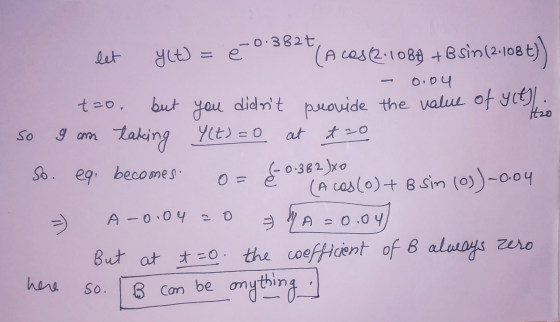
Find the charge on the capacitor in an LRC-series circuit at t = 0.04 s when L = 0.05 h, R = 2 Ω, C = 0.04 f, E(t) = 0 V, q(0) = 6 C, and i(0) = 0 A. (Round your answer to four decimal places.) C Dete...
Find the charge on the capacitor in an LRC-series circuit at t = 0.04 s when L = 0.05 h, R = 2 Ω, C = 0.04 f, E(t) = 0 V, q(0) = 6 C, and i(0) = 0 A. (Round your answer to four decimal places.) C Determine the first time at which the charge on the capacitor is equal to zero. (Round your answer to four decimal places.) s
Find the currents in the figure below when R=2.5 ohm, L=1 H, C=0.04 F, E(t)=169sint, I1(0)=0, I2(0)=0. Plot the I1 and...
 Find the currents in the figure below when R=2.5 ohm, L=1 H,
C=0.04 F, E(t)=169sint, I1(0)=0, I2(0)=0. Plot the I1 and I2 as a
function of time t. Also plot the phase plane.
C R E L
C R E L
Find the currents in the figure below when R=2.5 ohm, L=1 H,
C=0.04 F, E(t)=169sint, I1(0)=0, I2(0)=0. Plot the I1 and I2 as a
function of time t. Also plot the phase plane.
C R E L
C R E L
Find the %OS of the system T(S) 0.04 52 + 0.02s +0.04
 Find the %OS of the system
T(S) 0.04 52 + 0.02s +0.04
Find the %OS of the system
T(S) 0.04 52 + 0.02s +0.04
Find the charge on the capacitor in an LRC-series circuit at t = 0.04 s when...
Find the charge on the capacitor in an LRC-series circuit at t = 0.04 s when L = 0.05 h, R = 3 Ω, C = 0.02 f, E(t) = 0 V, q(0) = 7 C, and i(0) = 0 A. (Round your answer to four decimal places.) C Determine the first time at which the charge on the capacitor is equal to zero. (Round your answer to four decimal places.) s
Evaluate the following definite integral to two decimal places. 25 20.061 0.04(25 – t)dt e 0...
 Evaluate the following definite integral to two decimal places. 25 20.061 0.04(25 – t)dt e 0 25 s 0 061 0.04(25 - dt = 1 (Round to two decimal places as needed.)
On an RC circuit where: the units of E (t) are Volts. Find the charge in...
 On an RC circuit where:
the units of E (t) are Volts. Find the charge in Colulombs on
the Capacitor at time t = 9 seconds. Take q (0) = 0.
1 4.- En un circuito RC donde Cr. 400 F, R=600 N2 , y Elt) 4 si 0 <t < 3, -4 si 3 <t < 6, 0 si 6 <t las unidades de E(t) son Voltios. Encuentre la carga en Colulombs en el Condensador en el tiempo t=9...
On an RC circuit where:
the units of E (t) are Volts. Find the charge in Colulombs on
the Capacitor at time t = 9 seconds. Take q (0) = 0.
1 4.- En un circuito RC donde Cr. 400 F, R=600 N2 , y Elt) 4 si 0 <t < 3, -4 si 3 <t < 6, 0 si 6 <t las unidades de E(t) son Voltios. Encuentre la carga en Colulombs en el Condensador en el tiempo t=9...
the process x(t) is WSS and normal with E[x(t)]=0 and R(t)= 4e^-2(t) a) find P[X(t)<=3] b)...
the process x(t) is WSS and normal with E[x(t)]=0 and R(t)= 4e^-2(t) a) find P[X(t)<=3] b) find E([x(t+1)-x(t-1)]2)
Question 2 (3 marks) Function f(t) is described as a sudden change of 1 SI unit...
 Question 2 (3 marks) Function f(t) is described as a sudden change of 1 SI unit at t-0 followed by a sudden change of -1 SI unit after 0.2 seconds. Assume f(t)-0 for t<0. (a) Write the analytical form of f(t). Sketch its graph indicating clearly all relevant values. (b) Find the Laplace transform of f(t) (c) Derive the expression for F, (s) if f(t) f(t)dt (d) Please see over
Question 2 (3 marks) Function f(t) is described as a...
Question 2 (3 marks) Function f(t) is described as a sudden change of 1 SI unit at t-0 followed by a sudden change of -1 SI unit after 0.2 seconds. Assume f(t)-0 for t<0. (a) Write the analytical form of f(t). Sketch its graph indicating clearly all relevant values. (b) Find the Laplace transform of f(t) (c) Derive the expression for F, (s) if f(t) f(t)dt (d) Please see over
Question 2 (3 marks) Function f(t) is described as a...
3. Consider the differential equation ty" - (t+1)y + y = t?e?', t>0. (a) Find a...
 3. Consider the differential equation ty" - (t+1)y + y = t?e?', t>0. (a) Find a value ofr for which y = et is a solution to the corresponding homogeneous differential equation. (b) Use Reduction of Order to find a second, linearly independent, solution to the correspond- ing homogeneous differential equation. (c) Use Variation of Parameters to find a particular solution to the nonhomogeneous differ- ential equation and then give the general solution to the differential equation.
(0. mswered of 1.00 t<1; Suppose FX(t) = 3 (t+1), <1<t< 3; (1, t>3. Find E[X]...
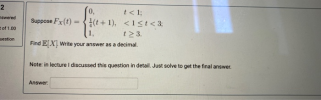 (0. mswered of 1.00 t<1; Suppose FX(t) = 3 (t+1), <1<t< 3; (1, t>3. Find E[X] Write your answer as a decimal. uestion Note: in lecture I discussed this question in detail. Just solve to get the final answer. Answer:
 Find the currents in the figure below when R=2.5 ohm, L=1 H,
C=0.04 F, E(t)=169sint, I1(0)=0, I2(0)=0. Plot the I1 and I2 as a
function of time t. Also plot the phase plane.
C R E L
C R E L
Find the currents in the figure below when R=2.5 ohm, L=1 H,
C=0.04 F, E(t)=169sint, I1(0)=0, I2(0)=0. Plot the I1 and I2 as a
function of time t. Also plot the phase plane.
C R E L
C R E L
 Find the %OS of the system
T(S) 0.04 52 + 0.02s +0.04
Find the %OS of the system
T(S) 0.04 52 + 0.02s +0.04
 Evaluate the following definite integral to two decimal places. 25 20.061 0.04(25 – t)dt e 0 25 s 0 061 0.04(25 - dt = 1 (Round to two decimal places as needed.)
 On an RC circuit where:
the units of E (t) are Volts. Find the charge in Colulombs on
the Capacitor at time t = 9 seconds. Take q (0) = 0.
1 4.- En un circuito RC donde Cr. 400 F, R=600 N2 , y Elt) 4 si 0 <t < 3, -4 si 3 <t < 6, 0 si 6 <t las unidades de E(t) son Voltios. Encuentre la carga en Colulombs en el Condensador en el tiempo t=9...
On an RC circuit where:
the units of E (t) are Volts. Find the charge in Colulombs on
the Capacitor at time t = 9 seconds. Take q (0) = 0.
1 4.- En un circuito RC donde Cr. 400 F, R=600 N2 , y Elt) 4 si 0 <t < 3, -4 si 3 <t < 6, 0 si 6 <t las unidades de E(t) son Voltios. Encuentre la carga en Colulombs en el Condensador en el tiempo t=9...
 Question 2 (3 marks) Function f(t) is described as a sudden change of 1 SI unit at t-0 followed by a sudden change of -1 SI unit after 0.2 seconds. Assume f(t)-0 for t<0. (a) Write the analytical form of f(t). Sketch its graph indicating clearly all relevant values. (b) Find the Laplace transform of f(t) (c) Derive the expression for F, (s) if f(t) f(t)dt (d) Please see over
Question 2 (3 marks) Function f(t) is described as a...
Question 2 (3 marks) Function f(t) is described as a sudden change of 1 SI unit at t-0 followed by a sudden change of -1 SI unit after 0.2 seconds. Assume f(t)-0 for t<0. (a) Write the analytical form of f(t). Sketch its graph indicating clearly all relevant values. (b) Find the Laplace transform of f(t) (c) Derive the expression for F, (s) if f(t) f(t)dt (d) Please see over
Question 2 (3 marks) Function f(t) is described as a...
 3. Consider the differential equation ty" - (t+1)y + y = t?e?', t>0. (a) Find a value ofr for which y = et is a solution to the corresponding homogeneous differential equation. (b) Use Reduction of Order to find a second, linearly independent, solution to the correspond- ing homogeneous differential equation. (c) Use Variation of Parameters to find a particular solution to the nonhomogeneous differ- ential equation and then give the general solution to the differential equation.
 (0. mswered of 1.00 t<1; Suppose FX(t) = 3 (t+1), <1<t< 3; (1, t>3. Find E[X] Write your answer as a decimal. uestion Note: in lecture I discussed this question in detail. Just solve to get the final answer. Answer:
Most questions answered within 3 hours.
-
Where is the error in this code sequence?
String s1 = "Hello";
String s2 = "ello";...
asked 11 months ago -
Financial data for Joel de Paris, Inc., for last year
follow:
Joel de Paris, Inc.
Balance...
asked 11 months ago -
Consider this reaction:
Al2(SO4)3 (aq)+ BaCl3
(aq) Al2Cl6 (aq)- +
3BaSO4(s) . What is the...
asked 11 months ago -
Suppose that Savneet is considering increasing her
recent random sample from 20 car rentals to 40...
asked 11 months ago -
Trucks arrive at an unloading terminal at an average rate of 120
per hour.
Trucks arrive...
asked 11 months ago -
Why are methanol and ethanol completely soluble in water while
octanol is not very little soluble....
asked 11 months ago -
A facilities manager at a university reads in a research report
that the mean amount of...
asked 11 months ago -
When the CuSO4 is rehydrated by adding water to the anhydrous
compound, is this an endothermic...
asked 11 months ago -
A ray of sunlight is passing from diamond into crown glass; the
angle of incidence is...
asked 11 months ago -
A block of mass 0.249 kg is placed on top of a light, vertical
spring of...
asked 11 months ago -
how do the kidneys compensate in the presences of acidosis
a) trigger hyperventilate
b) reserve acid...
asked 11 months ago -
Question 501 pts
The rental rate of capital to the firm increases. Which of the
following...
asked 11 months ago