
Homework Answers
 plz
do like i Badly need it
plz
do like i Badly need it
Add Answer to:
this is one question with many parts, thanks for the
help!
A Imagine a negatively charged...
this is one question with many parts, thanks for the help! D. Imagine a negatively charged...
 this is one question with many parts, thanks for the
help!
D. Imagine a negatively charged particle (9--0.2 C) free to move back and forth along a straight line. There are other nearby charged particles that create electric potential and electric field at all points on the line. The system is made up of the negatively charged particle and the other particles that created the potential and field. As usual, we will assume an isolated system, so that this system's...
this is one question with many parts, thanks for the
help!
D. Imagine a negatively charged particle (9--0.2 C) free to move back and forth along a straight line. There are other nearby charged particles that create electric potential and electric field at all points on the line. The system is made up of the negatively charged particle and the other particles that created the potential and field. As usual, we will assume an isolated system, so that this system's...
this is one question with many parts C. Here are some equipotential lines. OV 1 cm...
 this is one question with many parts
C. Here are some equipotential lines. OV 1 cm 1. Calculate the strength of the electric field at point X. Show your calculation. 2. At point X, the electric field points [t, , 1,7,7,7,V, KI 3. A negatively charged particle at X will feel a force pointing (4, 6, 1, 7, 1, 1, 3 4. Assume that the potential and field that the particle feels at X are caused by positive charges. Therefore,...
this is one question with many parts
C. Here are some equipotential lines. OV 1 cm 1. Calculate the strength of the electric field at point X. Show your calculation. 2. At point X, the electric field points [t, , 1,7,7,7,V, KI 3. A negatively charged particle at X will feel a force pointing (4, 6, 1, 7, 1, 1, 3 4. Assume that the potential and field that the particle feels at X are caused by positive charges. Therefore,...
please ansa all A car travels around a curve with constant speed. The correct statement from...
 please ansa all
A car travels around a curve with constant speed. The correct statement from the following is the car has an acceleration directed inward toward the center of the curve. the velocity of the car is constant. the car has an acceleration direction outward from the center of the curve. the car has zero acceleration. the car has an acceleration directed in the instantaneous direction of the velocity vector. A ball is whirled on the end of a...
please ansa all
A car travels around a curve with constant speed. The correct statement from the following is the car has an acceleration directed inward toward the center of the curve. the velocity of the car is constant. the car has an acceleration direction outward from the center of the curve. the car has zero acceleration. the car has an acceleration directed in the instantaneous direction of the velocity vector. A ball is whirled on the end of a...
D. Since the proton is moving while feeling a force, work is done on the proton:...
 D. Since the proton is moving while feeling a force, work is done on the proton: Won P = Felec Mlax Icoso, where lax is the magnitude of the proton's displacement and is the angle between the direction of that displacement straight to the left in this case) and the direction of the force on the proton. While the proton is approaching the nucleus the work done on it is positive, negative, zero). Important: our attention is now focused on...
answer all the above the car has an acceleration directed in the instantaneous direction of the...
 answer all the above
the car has an acceleration directed in the instantaneous direction of the velocity vector. A ball is whirled on the end of a string in a horizontal circle at constant speed. Suddenly string breaks. Immediately after the string breaks, the ball will have a horizontal velocity away from the center of the circle have a horizontal velocity that is tangential to the circle. have a horizontal velocity toward the center of the circle. have a horizontal...
answer all the above
the car has an acceleration directed in the instantaneous direction of the velocity vector. A ball is whirled on the end of a string in a horizontal circle at constant speed. Suddenly string breaks. Immediately after the string breaks, the ball will have a horizontal velocity away from the center of the circle have a horizontal velocity that is tangential to the circle. have a horizontal velocity toward the center of the circle. have a horizontal...
Two oppositely charged particles are far, far apart – so far apart that they just barely...
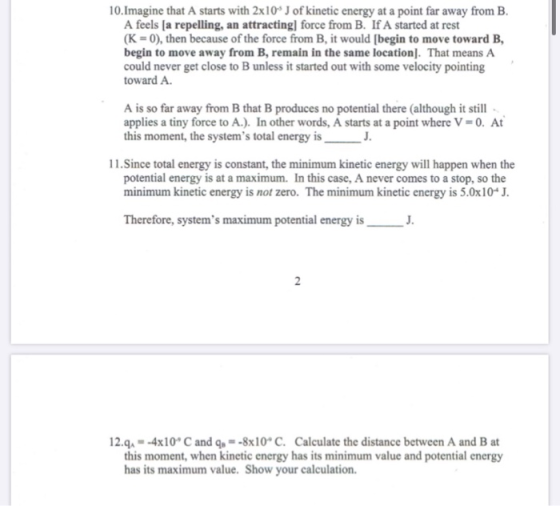
Two oppositely charged particles are far, far apart – so far apart that they just barely interact at all; the force each feels is tiny. They are interacting so weakly that the potential energy of this two-particle system is just about zero. (Potential energies happen because of interactions between two or more things.) As in previous questions, imagine one particle to be stationary and the other one to be moving. a. At this moment, what is the system’s kinetic energy...
Learning Goal: To be able to interpret potential energy diagrams and predict the corresponding motion of...
 Learning Goal: To be able to interpret potential energy diagrams
and predict the corresponding motion of a particle. Potential
energy diagrams for a particle are useful in predicting the motion
of that particle. These diagrams allow one to determine the
direction of the force acting on the particle at any point, the
points of stable and unstable equilibrium, the particle's kinetic
energy, etc. Consider the potential energy diagram shown. (Figure
1) The curve represents the value of potential energy U...
Learning Goal: To be able to interpret potential energy diagrams
and predict the corresponding motion of a particle. Potential
energy diagrams for a particle are useful in predicting the motion
of that particle. These diagrams allow one to determine the
direction of the force acting on the particle at any point, the
points of stable and unstable equilibrium, the particle's kinetic
energy, etc. Consider the potential energy diagram shown. (Figure
1) The curve represents the value of potential energy U...
direction while particle 2 travels along the positive y direction, Two positively charged particles are travelling...
 direction while particle 2 travels along the positive y direction, Two positively charged particles are travelling through space in each others' vicinity. Using the standard r-y-z coordinate grid, particle 1 travels along the positive heading directly for the first particle from below. 3) Which combination of options below are the most accurate combination of statements. [Enter your answer as a string of the letter options you believe are correct. For instance, if you think options A, D, and E are...
Imagine three electrically charged particles, all within five centimeters of each other. Assume that the space...
Imagine three electrically charged particles, all within five centimeters of each other. Assume that the space around the charged particles is a vacuum. 5) Which options below are true? A) The strength of the total electric field extremely far away from the collection of particles is close to zero. B) Electric field vectors only exist in the space right next to the charged particles. C) The electric force on a negatively charged target particle a small distance away from the...
Consider a positive source charge Q, that is being held in place. A nearby negative test...
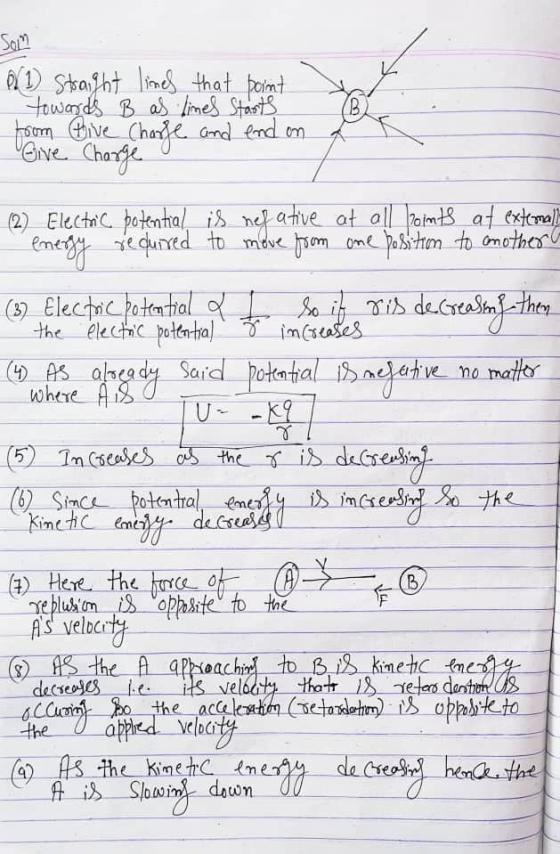
 Consider a positive source charge Q, that is being held in
place. A nearby negative test charge q moves from point A to point
B.
a) What is the direction of the electric force that the source
charge exerts on the test charge?
b) As the negative test charge moves from point A to point B,
does the electric force cause it to speed up, slow down, or move at
a constant velocity?
c) As the negative test charge moves...
Consider a positive source charge Q, that is being held in
place. A nearby negative test charge q moves from point A to point
B.
a) What is the direction of the electric force that the source
charge exerts on the test charge?
b) As the negative test charge moves from point A to point B,
does the electric force cause it to speed up, slow down, or move at
a constant velocity?
c) As the negative test charge moves...
 this is one question with many parts, thanks for the
help!
D. Imagine a negatively charged particle (9--0.2 C) free to move back and forth along a straight line. There are other nearby charged particles that create electric potential and electric field at all points on the line. The system is made up of the negatively charged particle and the other particles that created the potential and field. As usual, we will assume an isolated system, so that this system's...
this is one question with many parts, thanks for the
help!
D. Imagine a negatively charged particle (9--0.2 C) free to move back and forth along a straight line. There are other nearby charged particles that create electric potential and electric field at all points on the line. The system is made up of the negatively charged particle and the other particles that created the potential and field. As usual, we will assume an isolated system, so that this system's...
 this is one question with many parts
C. Here are some equipotential lines. OV 1 cm 1. Calculate the strength of the electric field at point X. Show your calculation. 2. At point X, the electric field points [t, , 1,7,7,7,V, KI 3. A negatively charged particle at X will feel a force pointing (4, 6, 1, 7, 1, 1, 3 4. Assume that the potential and field that the particle feels at X are caused by positive charges. Therefore,...
this is one question with many parts
C. Here are some equipotential lines. OV 1 cm 1. Calculate the strength of the electric field at point X. Show your calculation. 2. At point X, the electric field points [t, , 1,7,7,7,V, KI 3. A negatively charged particle at X will feel a force pointing (4, 6, 1, 7, 1, 1, 3 4. Assume that the potential and field that the particle feels at X are caused by positive charges. Therefore,...
 please ansa all
A car travels around a curve with constant speed. The correct statement from the following is the car has an acceleration directed inward toward the center of the curve. the velocity of the car is constant. the car has an acceleration direction outward from the center of the curve. the car has zero acceleration. the car has an acceleration directed in the instantaneous direction of the velocity vector. A ball is whirled on the end of a...
please ansa all
A car travels around a curve with constant speed. The correct statement from the following is the car has an acceleration directed inward toward the center of the curve. the velocity of the car is constant. the car has an acceleration direction outward from the center of the curve. the car has zero acceleration. the car has an acceleration directed in the instantaneous direction of the velocity vector. A ball is whirled on the end of a...
 D. Since the proton is moving while feeling a force, work is done on the proton: Won P = Felec Mlax Icoso, where lax is the magnitude of the proton's displacement and is the angle between the direction of that displacement straight to the left in this case) and the direction of the force on the proton. While the proton is approaching the nucleus the work done on it is positive, negative, zero). Important: our attention is now focused on...
 answer all the above
the car has an acceleration directed in the instantaneous direction of the velocity vector. A ball is whirled on the end of a string in a horizontal circle at constant speed. Suddenly string breaks. Immediately after the string breaks, the ball will have a horizontal velocity away from the center of the circle have a horizontal velocity that is tangential to the circle. have a horizontal velocity toward the center of the circle. have a horizontal...
answer all the above
the car has an acceleration directed in the instantaneous direction of the velocity vector. A ball is whirled on the end of a string in a horizontal circle at constant speed. Suddenly string breaks. Immediately after the string breaks, the ball will have a horizontal velocity away from the center of the circle have a horizontal velocity that is tangential to the circle. have a horizontal velocity toward the center of the circle. have a horizontal...
 Learning Goal: To be able to interpret potential energy diagrams
and predict the corresponding motion of a particle. Potential
energy diagrams for a particle are useful in predicting the motion
of that particle. These diagrams allow one to determine the
direction of the force acting on the particle at any point, the
points of stable and unstable equilibrium, the particle's kinetic
energy, etc. Consider the potential energy diagram shown. (Figure
1) The curve represents the value of potential energy U...
Learning Goal: To be able to interpret potential energy diagrams
and predict the corresponding motion of a particle. Potential
energy diagrams for a particle are useful in predicting the motion
of that particle. These diagrams allow one to determine the
direction of the force acting on the particle at any point, the
points of stable and unstable equilibrium, the particle's kinetic
energy, etc. Consider the potential energy diagram shown. (Figure
1) The curve represents the value of potential energy U...
 direction while particle 2 travels along the positive y direction, Two positively charged particles are travelling through space in each others' vicinity. Using the standard r-y-z coordinate grid, particle 1 travels along the positive heading directly for the first particle from below. 3) Which combination of options below are the most accurate combination of statements. [Enter your answer as a string of the letter options you believe are correct. For instance, if you think options A, D, and E are...
 Consider a positive source charge Q, that is being held in
place. A nearby negative test charge q moves from point A to point
B.
a) What is the direction of the electric force that the source
charge exerts on the test charge?
b) As the negative test charge moves from point A to point B,
does the electric force cause it to speed up, slow down, or move at
a constant velocity?
c) As the negative test charge moves...
Consider a positive source charge Q, that is being held in
place. A nearby negative test charge q moves from point A to point
B.
a) What is the direction of the electric force that the source
charge exerts on the test charge?
b) As the negative test charge moves from point A to point B,
does the electric force cause it to speed up, slow down, or move at
a constant velocity?
c) As the negative test charge moves...
Most questions answered within 3 hours.
-
Where is the error in this code sequence?
String s1 = "Hello";
String s2 = "ello";...
asked 10 months ago -
Financial data for Joel de Paris, Inc., for last year
follow:
Joel de Paris, Inc.
Balance...
asked 10 months ago -
Consider this reaction:
Al2(SO4)3 (aq)+ BaCl3
(aq) Al2Cl6 (aq)- +
3BaSO4(s) . What is the...
asked 10 months ago -
Suppose that Savneet is considering increasing her
recent random sample from 20 car rentals to 40...
asked 10 months ago -
Trucks arrive at an unloading terminal at an average rate of 120
per hour.
Trucks arrive...
asked 10 months ago -
Why are methanol and ethanol completely soluble in water while
octanol is not very little soluble....
asked 10 months ago -
A facilities manager at a university reads in a research report
that the mean amount of...
asked 10 months ago -
When the CuSO4 is rehydrated by adding water to the anhydrous
compound, is this an endothermic...
asked 10 months ago -
A ray of sunlight is passing from diamond into crown glass; the
angle of incidence is...
asked 10 months ago -
A block of mass 0.249 kg is placed on top of a light, vertical
spring of...
asked 10 months ago -
how do the kidneys compensate in the presences of acidosis
a) trigger hyperventilate
b) reserve acid...
asked 10 months ago -
Question 501 pts
The rental rate of capital to the firm increases. Which of the
following...
asked 10 months ago