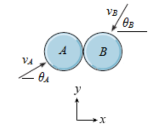
Two disks collide with the initial velocities just before the collision as shown in (Figure 1).
Learning Goal: To use the conservation of momentum and the coefficient of restitution to determine the speeds of two disks after a collision
Two disks collide with the initial velocities just before the collision as shown in (Figure 1). What are the speeds of the two disks just after impact if the coefficient of restitution is e = 0.9? The masses of the disks are mA = 5 kg and mB = 7.5 kg, the initial velocities are vA = 3 m/s and vB = 3.2 m/s and the angles shown are θA = 33° and θB = 54°
Part A
What is the final velocity of disk A in the x-direction?
Part B
What is the final velocity of disk A in the y-direction?
Part C
What is the magnitude of the velocity of disk A after the collision?
Part D
What is the final velocity of disk B in the x-direction?
Part E
What is the final velocity of disk B in the y direction?
Part F
What is the magnitude of the velocity of disk B after the collision?
Homework Answers


Add Answer to:
Two disks collide with the initial velocities just before the collision as shown in (Figure 1).
Two smooth disks A and B have the initial velocities shown just before they collide. If...
 Two smooth disks A and B have the initial velocities shown just before they collide. If they have masses ma = 6 kg and mB = 3 kg, determine their speeds just after impact. The coefficient of restitution is e = 0.6 VA = 20 m/s VR = 12 m/s
Two smooth disks A and Beach have a mass of 0.5 kg
 Two smooth disks A and Beach have a mass of 0.5 kg. Both disks are moving with the velocities shown when they collide. The coefficient of restitution is e = 0.7. Suppose that (vA)1 = 7 m/s, (vB)1 = 3 m/s.(Figure 1) Part A Determine the magnitude of the final velocity of A just after collision. Part B Determine the angle between the x axis and the final velocity of A just after the collision measured counterclockwise from the positive r axis.Part C Determine the magnitude...
Two disks A and B each have a mass of 1 kg and the initial velocities...
 Two disks A and B each have a mass of 1 kg and the initial velocities shown just before they collide. The coefficient of restitution is e = 0.6. Suppose that (vA)1 -4 m/s, (vB)1-3 m/s. (Figure 1) Part A Determine the speed of the disk A just after impact. Express your answer to three significant figures and include the appropriate units. (vA2 2.7 SubmitPr ious Ans uest Answer × Incorrect, Try Again; 8 attempts remaining Figure ▼ Part B...
Disks A and B having a mass of 1 and 1.2 kg, collide with the initial...
 Disks A and B having a mass of 1 and 1.2 kg, collide with the initial velocities shown. Determine the magnitude and direction (measured from horizontal) of their velocity after they collide if the coefficient of restitution is 0.8. Take 0 = 10°. V. = 16 m/s VA8 m/s
Two smooth disks A and B have the initial velocities shown just before they collide. They...
 Two smooth disks A and B have the initial velocities shown just before they collide. They have masses ma = 6 kg and mp = 2 kg. The coefficient of restitution is e = 0.8. (Figure 1) Figure 1 of 1 2 = 15 m/s Determine the speed of A just after impact. Express your answer to three significant figures and include the appropriate units. (14), = Value Units | Submit Request Answer 2014 Submit Request Answer Part B Determine...
Two identical hockey pucks moving with initial velocities vA and vB collide as shown. If the...
 Two identical hockey pucks
moving with initial velocities vA and vB collide as shown. If the
coefficient of restitution is e = 0.79, determine the velocity of
each puck just after impact. Also calculate the percentage loss n
of system kinetic energy.
Chapter 3, Problem 3/212 Incorrect Two identical hockey pucks moving withinitial velocities vA and vB collide as shown. If the coefficient of restitution is e = 0.79, determine the velocity of each puck just after impact. Also calculate...
Two identical hockey pucks
moving with initial velocities vA and vB collide as shown. If the
coefficient of restitution is e = 0.79, determine the velocity of
each puck just after impact. Also calculate the percentage loss n
of system kinetic energy.
Chapter 3, Problem 3/212 Incorrect Two identical hockey pucks moving withinitial velocities vA and vB collide as shown. If the coefficient of restitution is e = 0.79, determine the velocity of each puck just after impact. Also calculate...
15-83. Two coins A and B have the initial velocities shown just before they collide at...
 15-83. Two coins A and B have the initial velocities shown just before they collide at point. If they have weights of WA 13.2(10-)) Ib and Wg = 6.60(10")) Ib and the surface upon which they slide is smooth, determine their speeds just after impact. The cocfficient of restitution is e-0.65 2 ft/s 3 fts -30° Line of impact
The two disks A and B have a mass of 3 kg and 6 kg. respectively.
 The two disks A and B have a mass of 3 kg and 6 kg. respectively. They collide with the initial velocities shown. The coefficient of restitution is e = 0.7. Suppose that (VA)1 = 5 m/s, (vB)1 = 7 m/s. (Figure 1) Part D Determine the angle between the x axis and the velocity of B just after impact, measured clockwise from the positive x axis.
Two identical hockey pucks moving with initial velocities collide as shown. It the coefficient of restitution...
 Two identical hockey pucks moving with initial velocities collide as shown. It the coefficient of restitution is e = 0.75, determine: What is the velocity of A after collision? a. 2 m/s b. 4 m/s c. 14 m/s d. 8 m/s What is the velocity of B after collision? a. 2m/s b. 4 m/s c. 14 m/s d. 8 m/s What is the direction of B after collision? a. left b. Right c. Not enough information d. B doesn't more...
help For the perfectly inelastic collision shown in the figure below, the two meteoroids collide Find...
 help
For the perfectly inelastic collision shown in the figure below, the two meteoroids collide Find the x- and y-components of each of the initial velocities. Use momentum conservation to determine the magnitude vf and direction 6 of the final velocity of the debris as they move off together.
help
For the perfectly inelastic collision shown in the figure below, the two meteoroids collide Find the x- and y-components of each of the initial velocities. Use momentum conservation to determine the magnitude vf and direction 6 of the final velocity of the debris as they move off together.
 Two smooth disks A and B have the initial velocities shown just before they collide. If they have masses ma = 6 kg and mB = 3 kg, determine their speeds just after impact. The coefficient of restitution is e = 0.6 VA = 20 m/s VR = 12 m/s
 Two disks A and B each have a mass of 1 kg and the initial velocities shown just before they collide. The coefficient of restitution is e = 0.6. Suppose that (vA)1 -4 m/s, (vB)1-3 m/s. (Figure 1) Part A Determine the speed of the disk A just after impact. Express your answer to three significant figures and include the appropriate units. (vA2 2.7 SubmitPr ious Ans uest Answer × Incorrect, Try Again; 8 attempts remaining Figure ▼ Part B...
 Disks A and B having a mass of 1 and 1.2 kg, collide with the initial velocities shown. Determine the magnitude and direction (measured from horizontal) of their velocity after they collide if the coefficient of restitution is 0.8. Take 0 = 10°. V. = 16 m/s VA8 m/s
 Two smooth disks A and B have the initial velocities shown just before they collide. They have masses ma = 6 kg and mp = 2 kg. The coefficient of restitution is e = 0.8. (Figure 1) Figure 1 of 1 2 = 15 m/s Determine the speed of A just after impact. Express your answer to three significant figures and include the appropriate units. (14), = Value Units | Submit Request Answer 2014 Submit Request Answer Part B Determine...
 Two identical hockey pucks
moving with initial velocities vA and vB collide as shown. If the
coefficient of restitution is e = 0.79, determine the velocity of
each puck just after impact. Also calculate the percentage loss n
of system kinetic energy.
Chapter 3, Problem 3/212 Incorrect Two identical hockey pucks moving withinitial velocities vA and vB collide as shown. If the coefficient of restitution is e = 0.79, determine the velocity of each puck just after impact. Also calculate...
Two identical hockey pucks
moving with initial velocities vA and vB collide as shown. If the
coefficient of restitution is e = 0.79, determine the velocity of
each puck just after impact. Also calculate the percentage loss n
of system kinetic energy.
Chapter 3, Problem 3/212 Incorrect Two identical hockey pucks moving withinitial velocities vA and vB collide as shown. If the coefficient of restitution is e = 0.79, determine the velocity of each puck just after impact. Also calculate...
 15-83. Two coins A and B have the initial velocities shown just before they collide at point. If they have weights of WA 13.2(10-)) Ib and Wg = 6.60(10")) Ib and the surface upon which they slide is smooth, determine their speeds just after impact. The cocfficient of restitution is e-0.65 2 ft/s 3 fts -30° Line of impact
 Two identical hockey pucks moving with initial velocities collide as shown. It the coefficient of restitution is e = 0.75, determine: What is the velocity of A after collision? a. 2 m/s b. 4 m/s c. 14 m/s d. 8 m/s What is the velocity of B after collision? a. 2m/s b. 4 m/s c. 14 m/s d. 8 m/s What is the direction of B after collision? a. left b. Right c. Not enough information d. B doesn't more...
 help
For the perfectly inelastic collision shown in the figure below, the two meteoroids collide Find the x- and y-components of each of the initial velocities. Use momentum conservation to determine the magnitude vf and direction 6 of the final velocity of the debris as they move off together.
help
For the perfectly inelastic collision shown in the figure below, the two meteoroids collide Find the x- and y-components of each of the initial velocities. Use momentum conservation to determine the magnitude vf and direction 6 of the final velocity of the debris as they move off together.
Most questions answered within 3 hours.
-
Where is the error in this code sequence?
String s1 = "Hello";
String s2 = "ello";...
asked 11 months ago -
Financial data for Joel de Paris, Inc., for last year
follow:
Joel de Paris, Inc.
Balance...
asked 11 months ago -
Consider this reaction:
Al2(SO4)3 (aq)+ BaCl3
(aq) Al2Cl6 (aq)- +
3BaSO4(s) . What is the...
asked 11 months ago -
Suppose that Savneet is considering increasing her
recent random sample from 20 car rentals to 40...
asked 11 months ago -
Trucks arrive at an unloading terminal at an average rate of 120
per hour.
Trucks arrive...
asked 11 months ago -
Why are methanol and ethanol completely soluble in water while
octanol is not very little soluble....
asked 11 months ago -
A facilities manager at a university reads in a research report
that the mean amount of...
asked 11 months ago -
When the CuSO4 is rehydrated by adding water to the anhydrous
compound, is this an endothermic...
asked 11 months ago -
A ray of sunlight is passing from diamond into crown glass; the
angle of incidence is...
asked 11 months ago -
A block of mass 0.249 kg is placed on top of a light, vertical
spring of...
asked 11 months ago -
how do the kidneys compensate in the presences of acidosis
a) trigger hyperventilate
b) reserve acid...
asked 11 months ago -
Question 501 pts
The rental rate of capital to the firm increases. Which of the
following...
asked 11 months ago