

Homework Answers
Request Answer!
We need at least 10 more requests to produce the answer.
0 / 10 have requested this problem solution
The more requests, the faster the answer.
Add Answer to:
Question 14 of 27 Save A Question 14 12 points Consider this exothermic reaction at equilibrium:...
H2X is a stronger acid than H2Y. What can be said about the relative base strength...
 H2X is a stronger acid than H2Y. What can be said about the relative base strength of HX" and HY? HX" is a stronger base than HY. HY" is a stronger base than HX". HX and HY" have equal strength.
Consider this exothermic reaction at equilibrium: C(s) + 2H2(g) - CH2(g). Predict whether the reaction will...
 Consider this exothermic reaction at equilibrium: C(s) + 2H2(g) - CH2(g). Predict whether the reaction will shift left, right, or will not shift after each disturbance. Use the drop down to answer. When some H2 is removed, the reaction will When some C is added, the reaction will When the volume of the reaction mixture is decreased the reaction will When the temperature is increased, the reaction will shift right shift left not shift
Page Chp 14 28. This reaction has an equilibrium constant of K,- 22 x 10 at...
 Page Chp 14 28. This reaction has an equilibrium constant of K,- 22 x 10 at 298 K 2COFg)CO(g)+CFA Calculate K, for each reaction and predict whether reactants or products will be favored at equilibrium. An equilibrium mixture of this reaction at a certain temperature has INH,J- 0.278 M and [H S]- 0.355 M. What is the value of the equilibrium constant (K) at this temperature? 66. Consider this reaction at equilibrium: 60. Consider the reaction Predict whether the reaction...
ch15 answer all 3 please Consider the following reaction at equilibrium: Predict whether the reaction will...
 ch15
answer all 3 please
Consider the following reaction at equilibrium: Predict whether the reaction will shift left, shift right, or remain unchanged after each disturbance. Drag the appropriate items to their respective bins. O2 is added to the reaction mixture KCIO3 is added to the reaction mixture KCl is added to the reaction mixture O2 is removed from the reaction mixture Shifts left Shifts right Remains unchanged Consider the following reaction: HC2H3O2(aq) + H2O(l) =H30+(aq) + C2H307- (aq) where...
ch15
answer all 3 please
Consider the following reaction at equilibrium: Predict whether the reaction will shift left, shift right, or remain unchanged after each disturbance. Drag the appropriate items to their respective bins. O2 is added to the reaction mixture KCIO3 is added to the reaction mixture KCl is added to the reaction mixture O2 is removed from the reaction mixture Shifts left Shifts right Remains unchanged Consider the following reaction: HC2H3O2(aq) + H2O(l) =H30+(aq) + C2H307- (aq) where...
QUESTION 4 The following exothermic reaction is allowed to reach equilibrium. 2H2(g) + O2(g) = 2H20(g)...
 QUESTION 4 The following exothermic reaction is allowed to reach equilibrium. 2H2(g) + O2(g) = 2H20(g) What happens to the reaction when the temperature is decreased? o Favors forward reaction Favors reverse reaction The reaction is still at equilibrium. 2 points Saved
QUESTION 9 Consider this reaction at equilibrium: 12(g) + Cl2(g) = 2 1019) to the reaction...
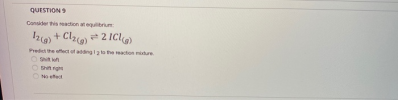 QUESTION 9 Consider this reaction at equilibrium: 12(g) + Cl2(g) = 2 1019) to the reaction mixture. Predict the effect of adding Shift left Shift right No effect
13. Consider the following reaction which is al equilibrium at 25 "C: NH4(NH2CO2X) - 2 NH3(e)...
 13. Consider the following reaction which is al equilibrium at 25 "C: NH4(NH2CO2X) - 2 NH3(e) + CO2(e), 41° -152.2 In which direction will the reaction shift if (a) the pressure is increased (b) the pressure is decreased (c) the temperature is increased (d) the temperature is decreased? (e) some CO2 is added? (0) NH3 is removed? ® a catalyst is added ? (h) some NH4(NH3CO) is added? (1) some Ne is added? the volume is increased? 14. Solid (NH),...
ilTempesab 2The con centeation 2) The surface area of a solid lid 13. Write the equilibrium expression for the following reaction. Mole o Nao5.52 Cl2COCI2 is run and at equilibrium the concentra...
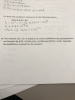 ilTempesab 2The con centeation 2) The surface area of a solid lid 13. Write the equilibrium expression for the following reaction. Mole o Nao5.52 Cl2COCI2 is run and at equilibrium the concentrations 14. The reaction: CO are found to be [CO] 0.15M, [Cl2] 0.10M and [COCl2] 0.30. Calculate the equilibrium constant for the reaction. 15. For the following endothermic reaction, use Le Chatelier's principle to determine the direction of equilibrium shift when the indicated stress is applied. 2 HBr H2+Br2...
True or False t. For an exothermic reaction, the equilibrium constant, Kc, becomes smaller as the...
 True or False
t. For an exothermic reaction, the equilibrium constant, Kc, becomes smaller as the temperature increases and larger as the temperature decreases. u. The gas-phase equilibrium shown below is used to produce ammonia, NH3, for commercial applications. The NH3 yield can be increased by decreasing the temperature, increasing the pressure, and removing some NH; from the mixture. N2(g) + 3H2(g) - 2NH3() AH = -94 kJ. v. For the gas-phase equilibrium described above (see problemlu), an increase in...
True or False
t. For an exothermic reaction, the equilibrium constant, Kc, becomes smaller as the temperature increases and larger as the temperature decreases. u. The gas-phase equilibrium shown below is used to produce ammonia, NH3, for commercial applications. The NH3 yield can be increased by decreasing the temperature, increasing the pressure, and removing some NH; from the mixture. N2(g) + 3H2(g) - 2NH3() AH = -94 kJ. v. For the gas-phase equilibrium described above (see problemlu), an increase in...
#1000K? 12. The equilibrium constant,ke, for the reaction H() + 12(g) 2 HI(g) 13542 0 40...
 #1000K? 12. The equilibrium constant,ke, for the reaction H() + 12(g) 2 HI(g) 13542 0 40 mol sample of HI was introduced into a 1,00 mL reaction vessel at 125 °C, what are the equibrium concentrations of H2. 12, and HI? 13. Consider the following reaction which is at equilibrium at 25°C: 2NH3(g) + CO2(g), Alº - 152.2 kJ (c) the temperature is increased In which direction will the reaction shini (a) the pressure is increased (b) the pressure is...
 H2X is a stronger acid than H2Y. What can be said about the relative base strength of HX" and HY? HX" is a stronger base than HY. HY" is a stronger base than HX". HX and HY" have equal strength.
 Consider this exothermic reaction at equilibrium: C(s) + 2H2(g) - CH2(g). Predict whether the reaction will shift left, right, or will not shift after each disturbance. Use the drop down to answer. When some H2 is removed, the reaction will When some C is added, the reaction will When the volume of the reaction mixture is decreased the reaction will When the temperature is increased, the reaction will shift right shift left not shift
 Page Chp 14 28. This reaction has an equilibrium constant of K,- 22 x 10 at 298 K 2COFg)CO(g)+CFA Calculate K, for each reaction and predict whether reactants or products will be favored at equilibrium. An equilibrium mixture of this reaction at a certain temperature has INH,J- 0.278 M and [H S]- 0.355 M. What is the value of the equilibrium constant (K) at this temperature? 66. Consider this reaction at equilibrium: 60. Consider the reaction Predict whether the reaction...
 ch15
answer all 3 please
Consider the following reaction at equilibrium: Predict whether the reaction will shift left, shift right, or remain unchanged after each disturbance. Drag the appropriate items to their respective bins. O2 is added to the reaction mixture KCIO3 is added to the reaction mixture KCl is added to the reaction mixture O2 is removed from the reaction mixture Shifts left Shifts right Remains unchanged Consider the following reaction: HC2H3O2(aq) + H2O(l) =H30+(aq) + C2H307- (aq) where...
ch15
answer all 3 please
Consider the following reaction at equilibrium: Predict whether the reaction will shift left, shift right, or remain unchanged after each disturbance. Drag the appropriate items to their respective bins. O2 is added to the reaction mixture KCIO3 is added to the reaction mixture KCl is added to the reaction mixture O2 is removed from the reaction mixture Shifts left Shifts right Remains unchanged Consider the following reaction: HC2H3O2(aq) + H2O(l) =H30+(aq) + C2H307- (aq) where...
 QUESTION 4 The following exothermic reaction is allowed to reach equilibrium. 2H2(g) + O2(g) = 2H20(g) What happens to the reaction when the temperature is decreased? o Favors forward reaction Favors reverse reaction The reaction is still at equilibrium. 2 points Saved
 QUESTION 9 Consider this reaction at equilibrium: 12(g) + Cl2(g) = 2 1019) to the reaction mixture. Predict the effect of adding Shift left Shift right No effect
 13. Consider the following reaction which is al equilibrium at 25 "C: NH4(NH2CO2X) - 2 NH3(e) + CO2(e), 41° -152.2 In which direction will the reaction shift if (a) the pressure is increased (b) the pressure is decreased (c) the temperature is increased (d) the temperature is decreased? (e) some CO2 is added? (0) NH3 is removed? ® a catalyst is added ? (h) some NH4(NH3CO) is added? (1) some Ne is added? the volume is increased? 14. Solid (NH),...
 ilTempesab 2The con centeation 2) The surface area of a solid lid 13. Write the equilibrium expression for the following reaction. Mole o Nao5.52 Cl2COCI2 is run and at equilibrium the concentrations 14. The reaction: CO are found to be [CO] 0.15M, [Cl2] 0.10M and [COCl2] 0.30. Calculate the equilibrium constant for the reaction. 15. For the following endothermic reaction, use Le Chatelier's principle to determine the direction of equilibrium shift when the indicated stress is applied. 2 HBr H2+Br2...
 True or False
t. For an exothermic reaction, the equilibrium constant, Kc, becomes smaller as the temperature increases and larger as the temperature decreases. u. The gas-phase equilibrium shown below is used to produce ammonia, NH3, for commercial applications. The NH3 yield can be increased by decreasing the temperature, increasing the pressure, and removing some NH; from the mixture. N2(g) + 3H2(g) - 2NH3() AH = -94 kJ. v. For the gas-phase equilibrium described above (see problemlu), an increase in...
True or False
t. For an exothermic reaction, the equilibrium constant, Kc, becomes smaller as the temperature increases and larger as the temperature decreases. u. The gas-phase equilibrium shown below is used to produce ammonia, NH3, for commercial applications. The NH3 yield can be increased by decreasing the temperature, increasing the pressure, and removing some NH; from the mixture. N2(g) + 3H2(g) - 2NH3() AH = -94 kJ. v. For the gas-phase equilibrium described above (see problemlu), an increase in...
 #1000K? 12. The equilibrium constant,ke, for the reaction H() + 12(g) 2 HI(g) 13542 0 40 mol sample of HI was introduced into a 1,00 mL reaction vessel at 125 °C, what are the equibrium concentrations of H2. 12, and HI? 13. Consider the following reaction which is at equilibrium at 25°C: 2NH3(g) + CO2(g), Alº - 152.2 kJ (c) the temperature is increased In which direction will the reaction shini (a) the pressure is increased (b) the pressure is...
Most questions answered within 3 hours.
-
Where is the error in this code sequence?
String s1 = "Hello";
String s2 = "ello";...
asked 11 months ago -
Financial data for Joel de Paris, Inc., for last year
follow:
Joel de Paris, Inc.
Balance...
asked 11 months ago -
Consider this reaction:
Al2(SO4)3 (aq)+ BaCl3
(aq) Al2Cl6 (aq)- +
3BaSO4(s) . What is the...
asked 11 months ago -
Suppose that Savneet is considering increasing her
recent random sample from 20 car rentals to 40...
asked 11 months ago -
Trucks arrive at an unloading terminal at an average rate of 120
per hour.
Trucks arrive...
asked 11 months ago -
Why are methanol and ethanol completely soluble in water while
octanol is not very little soluble....
asked 11 months ago -
A facilities manager at a university reads in a research report
that the mean amount of...
asked 11 months ago -
When the CuSO4 is rehydrated by adding water to the anhydrous
compound, is this an endothermic...
asked 11 months ago -
A ray of sunlight is passing from diamond into crown glass; the
angle of incidence is...
asked 11 months ago -
A block of mass 0.249 kg is placed on top of a light, vertical
spring of...
asked 11 months ago -
how do the kidneys compensate in the presences of acidosis
a) trigger hyperventilate
b) reserve acid...
asked 11 months ago -
Question 501 pts
The rental rate of capital to the firm increases. Which of the
following...
asked 11 months ago