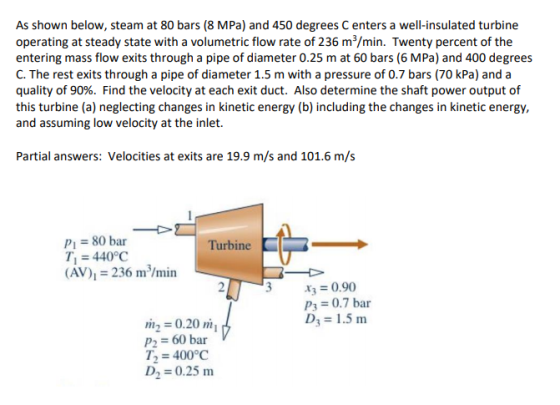
please answer specifically the second part of the problem, concerning the shaft power output of the turbine
Homework Answers
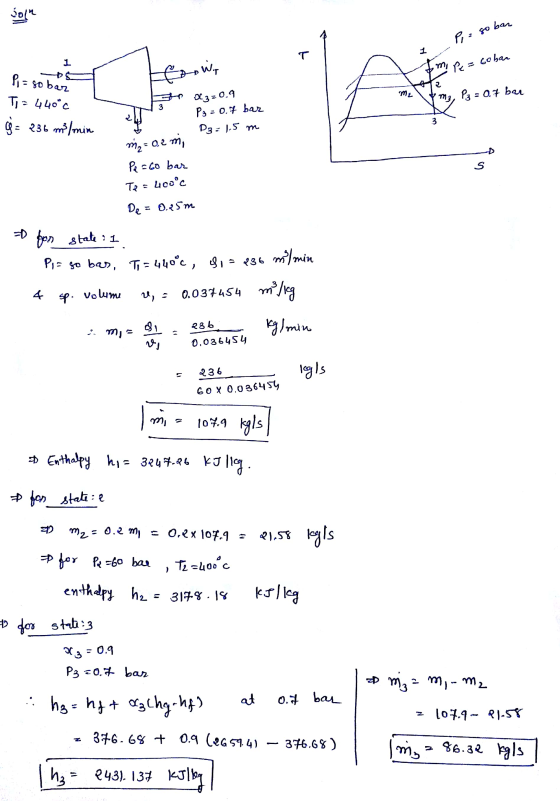
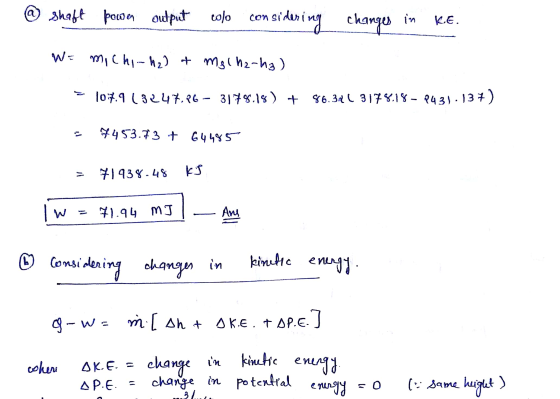
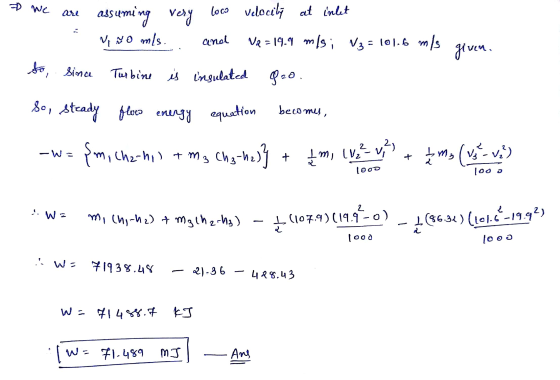
If you find my work helpful please give thumbs up
If you have any query regarding solution please let me know in comment box
Add Answer to:
please answer specifically the second part of the problem,
concerning the shaft power output of the...
Steam enters a turbine operating at steady state at 30 bar, 400 °C with a mass flow rate of 126 kg/min and exits as saturated vapor at 0.2 bar, producing power at a rate of 1.5 MW. Kinetic and po...
 Steam enters a turbine operating at steady state at 30 bar, 400 °C with a mass flow rate of 126 kg/min and exits as saturated vapor at 0.2 bar, producing power at a rate of 1.5 MW. Kinetic and potential energy effects can be ignored. Determine the followings. (a) (5 points) The rate of heat transfer, in kW. (b) (15 points) The rate of entropy production, in kW/K, for an enlarged control volume that includes the turbine and enough of...
Mechanical lab please answer all steps 2. A Pelton wheel is used to produce hydroelectric power...
 Mechanical lab please answer all steps
2. A Pelton wheel is used to produce hydroelectric power and the performance 62.4 lb/ft data are collected in the following table. Specific weight of water 1 hp 550 ftlb/s. Water supply line pressure Turbine speed Shaft torque (lbft) Flow rate (cfm) (psig 80 300 50 If water supply pipe diameter is 20 inches and turbine wheel radius is 20 inches, calculate the hydraulic head in ft, jet velocity, speed ratio, hydraulic horse power,...
Mechanical lab please answer all steps
2. A Pelton wheel is used to produce hydroelectric power and the performance 62.4 lb/ft data are collected in the following table. Specific weight of water 1 hp 550 ftlb/s. Water supply line pressure Turbine speed Shaft torque (lbft) Flow rate (cfm) (psig 80 300 50 If water supply pipe diameter is 20 inches and turbine wheel radius is 20 inches, calculate the hydraulic head in ft, jet velocity, speed ratio, hydraulic horse power,...
ANSWER PLEASE PROBLEM #2 (68 pts.) Steam at 200 psia, 600°F (State 1) enters an adiabatic...
 ANSWER PLEASE
PROBLEM #2 (68 pts.) Steam at 200 psia, 600°F (State 1) enters an adiabatic turbine cperating at steady state with a mass flow rate of 16.5 lbm/min and exits at 15 psia, 240°F (State 2), Neglecting the changes in kinetic and potential energies and assuming the surroundings to be at T.- 537 R. Determine: a) the actual power output, in Btu/min. b) the reversible (or maximum) power output, in Btu/min. c) the rate of exergy destruction, in Btu/min....
ANSWER PLEASE
PROBLEM #2 (68 pts.) Steam at 200 psia, 600°F (State 1) enters an adiabatic turbine cperating at steady state with a mass flow rate of 16.5 lbm/min and exits at 15 psia, 240°F (State 2), Neglecting the changes in kinetic and potential energies and assuming the surroundings to be at T.- 537 R. Determine: a) the actual power output, in Btu/min. b) the reversible (or maximum) power output, in Btu/min. c) the rate of exergy destruction, in Btu/min....
please clearly indicate answer(s) 1. As shown in the figure, using a 6-m-long, 100 mm diameter...
 please clearly indicate answer(s)
1. As shown in the figure, using a 6-m-long, 100 mm diameter pipe and assuming a friction factor f-0.02, investigate the likelhood of cavitation if h-4 m and h = 3m Water temperature is 25 degrees Centigrade, 5101325 KP kinematic viscosity =156 m2/sec, flow velocity = 4 m/sec, neglect minor losses using 2. At the deign flow rate read the pump characteristics if the 6 in impeller is used (power, efficiency, head) 3. If the angular...
please clearly indicate answer(s)
1. As shown in the figure, using a 6-m-long, 100 mm diameter pipe and assuming a friction factor f-0.02, investigate the likelhood of cavitation if h-4 m and h = 3m Water temperature is 25 degrees Centigrade, 5101325 KP kinematic viscosity =156 m2/sec, flow velocity = 4 m/sec, neglect minor losses using 2. At the deign flow rate read the pump characteristics if the 6 in impeller is used (power, efficiency, head) 3. If the angular...
5-30 Air enters an adiabatic nozzle steadily at 300 kPa, 200°C, and 30 m/s and leaves...
 5-30 Air enters an adiabatic nozzle steadily at 300 kPa, 200°C, and 30 m/s and leaves at 100 kPa and 180 m/s. The inlet area of the nozzle is 80 cm². Determine (a) the mass flow rate through the nozzle, (b) the exit temperature of the air, and (c) the exit area of the nozzle. Answers: (a) 0.5304 kg/s, (b) 184.6°C, (c) 38.7 cm P = 300 kPa T, = 200°C Vi = 30 m/s A = 80 cm AIR...
08 % Problem 4 (25 points) A 38-in pump is installed for the system below. The...
 08 % Problem 4 (25 points) A 38-in pump is installed for the system below. The pipe (100-cm diameter) has a friction factor of 0.012 and a total length of 20 km. Given that Ke = 0.5 (pipe entrance) and Ke = 1.0 (pipe exit). For water at 80 degrees Fahrenheit, estimate the flow rate (in gpm), the power required (in horsepower, HP), and the net positive suction head required (in ft) to avoid cavitation for the system when the...
120; = ? 2 (P2 = 1000 kPa; T2 = 65 °C) Problem 5. A compression...
 120; = ? 2 (P2 = 1000 kPa; T2 = 65 °C) Problem 5. A compression refrigeration cycle (see Figure) has R-134a as the refrigerant. The mass flow rate is 3 kg/min. The refrigerant goes through isothermal evaporation in the evaporator and leaves the evaporator at -20 °C as saturated vapor. It enters the condenser with a pressure of 1 MPa and a temperature of 65 °C. Assume no losses in the pipelines connecting different components. Also assume steady state...
find v belt drive design power select belt type determine shive size (belt speed 4000 ft/min)...
 find v belt drive
design power
select belt type
determine shive size (belt speed 4000 ft/min)
find shive size from power rating figure
find rated power
find estimated centre distance
find belt length (by selecting standard belt length)
calculate actual centre distance
find contact angle for small shieve
determine correct factors
calculate correct power per belt
no. of belt needed
V-Belt Designing Sample Problem . Given: A 4 cylinder diesel engine runs at 80 hp, 1800 rpm, to drive a...
find v belt drive
design power
select belt type
determine shive size (belt speed 4000 ft/min)
find shive size from power rating figure
find rated power
find estimated centre distance
find belt length (by selecting standard belt length)
calculate actual centre distance
find contact angle for small shieve
determine correct factors
calculate correct power per belt
no. of belt needed
V-Belt Designing Sample Problem . Given: A 4 cylinder diesel engine runs at 80 hp, 1800 rpm, to drive a...
summarizr the followung info and write them in your own words and break them into different...
summarizr the followung info and write them in your own words and break them into different key points. 6.5 Metering Chamber: 6.5.1 The minimum size of the metering box is governed by the metering area required to obtain a representative test area for the specimen (see 7.2) and for maintenance of reasonable test accuracy. For example, for specimens incorporating air spaces or stud spaces, the metering area shall span an integral number of spaces (see 5.5). The depth of...
summatize the following info and break them into differeng key points. write them in yojr own...
 summatize the following info and break them into differeng key points. write them in yojr own words
apartus
6.1 Introduction—The design of a successful hot box appa- ratus is influenced by many factors. Before beginning the design of an apparatus meeting this standard, the designer shall review the discussion on the limitations and accuracy, Section 13, discussions of the energy flows in a hot box, Annex A2, the metering box wall loss flow, Annex A3, and flanking loss, Annex...
summatize the following info and break them into differeng key points. write them in yojr own words
apartus
6.1 Introduction—The design of a successful hot box appa- ratus is influenced by many factors. Before beginning the design of an apparatus meeting this standard, the designer shall review the discussion on the limitations and accuracy, Section 13, discussions of the energy flows in a hot box, Annex A2, the metering box wall loss flow, Annex A3, and flanking loss, Annex...
 Steam enters a turbine operating at steady state at 30 bar, 400 °C with a mass flow rate of 126 kg/min and exits as saturated vapor at 0.2 bar, producing power at a rate of 1.5 MW. Kinetic and potential energy effects can be ignored. Determine the followings. (a) (5 points) The rate of heat transfer, in kW. (b) (15 points) The rate of entropy production, in kW/K, for an enlarged control volume that includes the turbine and enough of...
 Mechanical lab please answer all steps
2. A Pelton wheel is used to produce hydroelectric power and the performance 62.4 lb/ft data are collected in the following table. Specific weight of water 1 hp 550 ftlb/s. Water supply line pressure Turbine speed Shaft torque (lbft) Flow rate (cfm) (psig 80 300 50 If water supply pipe diameter is 20 inches and turbine wheel radius is 20 inches, calculate the hydraulic head in ft, jet velocity, speed ratio, hydraulic horse power,...
Mechanical lab please answer all steps
2. A Pelton wheel is used to produce hydroelectric power and the performance 62.4 lb/ft data are collected in the following table. Specific weight of water 1 hp 550 ftlb/s. Water supply line pressure Turbine speed Shaft torque (lbft) Flow rate (cfm) (psig 80 300 50 If water supply pipe diameter is 20 inches and turbine wheel radius is 20 inches, calculate the hydraulic head in ft, jet velocity, speed ratio, hydraulic horse power,...
 ANSWER PLEASE
PROBLEM #2 (68 pts.) Steam at 200 psia, 600°F (State 1) enters an adiabatic turbine cperating at steady state with a mass flow rate of 16.5 lbm/min and exits at 15 psia, 240°F (State 2), Neglecting the changes in kinetic and potential energies and assuming the surroundings to be at T.- 537 R. Determine: a) the actual power output, in Btu/min. b) the reversible (or maximum) power output, in Btu/min. c) the rate of exergy destruction, in Btu/min....
ANSWER PLEASE
PROBLEM #2 (68 pts.) Steam at 200 psia, 600°F (State 1) enters an adiabatic turbine cperating at steady state with a mass flow rate of 16.5 lbm/min and exits at 15 psia, 240°F (State 2), Neglecting the changes in kinetic and potential energies and assuming the surroundings to be at T.- 537 R. Determine: a) the actual power output, in Btu/min. b) the reversible (or maximum) power output, in Btu/min. c) the rate of exergy destruction, in Btu/min....
 please clearly indicate answer(s)
1. As shown in the figure, using a 6-m-long, 100 mm diameter pipe and assuming a friction factor f-0.02, investigate the likelhood of cavitation if h-4 m and h = 3m Water temperature is 25 degrees Centigrade, 5101325 KP kinematic viscosity =156 m2/sec, flow velocity = 4 m/sec, neglect minor losses using 2. At the deign flow rate read the pump characteristics if the 6 in impeller is used (power, efficiency, head) 3. If the angular...
please clearly indicate answer(s)
1. As shown in the figure, using a 6-m-long, 100 mm diameter pipe and assuming a friction factor f-0.02, investigate the likelhood of cavitation if h-4 m and h = 3m Water temperature is 25 degrees Centigrade, 5101325 KP kinematic viscosity =156 m2/sec, flow velocity = 4 m/sec, neglect minor losses using 2. At the deign flow rate read the pump characteristics if the 6 in impeller is used (power, efficiency, head) 3. If the angular...
 5-30 Air enters an adiabatic nozzle steadily at 300 kPa, 200°C, and 30 m/s and leaves at 100 kPa and 180 m/s. The inlet area of the nozzle is 80 cm². Determine (a) the mass flow rate through the nozzle, (b) the exit temperature of the air, and (c) the exit area of the nozzle. Answers: (a) 0.5304 kg/s, (b) 184.6°C, (c) 38.7 cm P = 300 kPa T, = 200°C Vi = 30 m/s A = 80 cm AIR...
 08 % Problem 4 (25 points) A 38-in pump is installed for the system below. The pipe (100-cm diameter) has a friction factor of 0.012 and a total length of 20 km. Given that Ke = 0.5 (pipe entrance) and Ke = 1.0 (pipe exit). For water at 80 degrees Fahrenheit, estimate the flow rate (in gpm), the power required (in horsepower, HP), and the net positive suction head required (in ft) to avoid cavitation for the system when the...
 120; = ? 2 (P2 = 1000 kPa; T2 = 65 °C) Problem 5. A compression refrigeration cycle (see Figure) has R-134a as the refrigerant. The mass flow rate is 3 kg/min. The refrigerant goes through isothermal evaporation in the evaporator and leaves the evaporator at -20 °C as saturated vapor. It enters the condenser with a pressure of 1 MPa and a temperature of 65 °C. Assume no losses in the pipelines connecting different components. Also assume steady state...
 find v belt drive
design power
select belt type
determine shive size (belt speed 4000 ft/min)
find shive size from power rating figure
find rated power
find estimated centre distance
find belt length (by selecting standard belt length)
calculate actual centre distance
find contact angle for small shieve
determine correct factors
calculate correct power per belt
no. of belt needed
V-Belt Designing Sample Problem . Given: A 4 cylinder diesel engine runs at 80 hp, 1800 rpm, to drive a...
find v belt drive
design power
select belt type
determine shive size (belt speed 4000 ft/min)
find shive size from power rating figure
find rated power
find estimated centre distance
find belt length (by selecting standard belt length)
calculate actual centre distance
find contact angle for small shieve
determine correct factors
calculate correct power per belt
no. of belt needed
V-Belt Designing Sample Problem . Given: A 4 cylinder diesel engine runs at 80 hp, 1800 rpm, to drive a...
 summatize the following info and break them into differeng key points. write them in yojr own words
apartus
6.1 Introduction—The design of a successful hot box appa- ratus is influenced by many factors. Before beginning the design of an apparatus meeting this standard, the designer shall review the discussion on the limitations and accuracy, Section 13, discussions of the energy flows in a hot box, Annex A2, the metering box wall loss flow, Annex A3, and flanking loss, Annex...
summatize the following info and break them into differeng key points. write them in yojr own words
apartus
6.1 Introduction—The design of a successful hot box appa- ratus is influenced by many factors. Before beginning the design of an apparatus meeting this standard, the designer shall review the discussion on the limitations and accuracy, Section 13, discussions of the energy flows in a hot box, Annex A2, the metering box wall loss flow, Annex A3, and flanking loss, Annex...
Most questions answered within 3 hours.
-
Where is the error in this code sequence?
String s1 = "Hello";
String s2 = "ello";...
asked 10 months ago -
Financial data for Joel de Paris, Inc., for last year
follow:
Joel de Paris, Inc.
Balance...
asked 10 months ago -
Consider this reaction:
Al2(SO4)3 (aq)+ BaCl3
(aq) Al2Cl6 (aq)- +
3BaSO4(s) . What is the...
asked 10 months ago -
Suppose that Savneet is considering increasing her
recent random sample from 20 car rentals to 40...
asked 10 months ago -
Trucks arrive at an unloading terminal at an average rate of 120
per hour.
Trucks arrive...
asked 10 months ago -
Why are methanol and ethanol completely soluble in water while
octanol is not very little soluble....
asked 10 months ago -
A facilities manager at a university reads in a research report
that the mean amount of...
asked 10 months ago -
When the CuSO4 is rehydrated by adding water to the anhydrous
compound, is this an endothermic...
asked 10 months ago -
A ray of sunlight is passing from diamond into crown glass; the
angle of incidence is...
asked 10 months ago -
A block of mass 0.249 kg is placed on top of a light, vertical
spring of...
asked 10 months ago -
how do the kidneys compensate in the presences of acidosis
a) trigger hyperventilate
b) reserve acid...
asked 10 months ago -
Question 501 pts
The rental rate of capital to the firm increases. Which of the
following...
asked 10 months ago