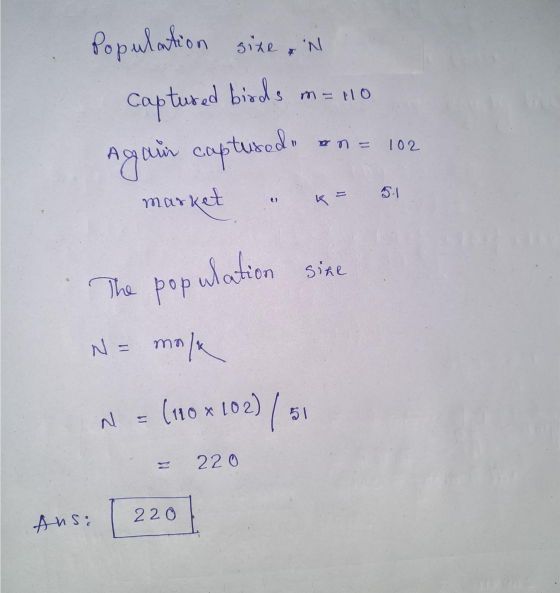
estimate the population size: 110 birds captured are marked, then released back in the population. the...
Homework Answers
Add Answer to:
estimate the population size:
110 birds captured are marked, then released back in the
population.
the...
In mark-recapture studies a certain number of individuals in a population are captured, tagged, and then...
In mark-recapture studies a certain number of individuals in a population are captured, tagged, and then released. The population is then sampled again, and the fraction of tagged individuals in the sample (That is, the fraction of individuals in the sample that have been ‘recaptured’) is used to estimate the population size. Suppose 4 moose out of a population of 20 are captured, tagged, & released. If 4 individuals from this population are then subsequntly captured, what is the probability...
There are N birds in a population. The first day we captured and tagged 60, di...
 There are N birds in a population. The first day we captured and tagged 60, di 60. The following day we capture 50, d2=50. Of these 50, D = 20 had tags from dı i.e had been captured on di and d2. Treating D as the data, find an expression for the sampling distribution P(D|dı, d2, N)
Results (Data) Table 1. Population guess and count, and calculated population estimate based on numbers of...
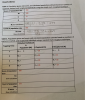 Results (Data) Table 1. Population guess and count, and calculated population estimate based on numbers of captured, marked, and recaptured individuals using the simple mark recapture technique. Guess of population size = 390 M 148 C 21 RE7 148X21, 3,108 : +++ N Show calculations Count of population size = 592 % error = 390 1444) 592=269 Show colculations 592 Table 2. Population guess and count, and calculated population estimate based on numbers of captured, marked, and recaptured individuals usinga...
You conduct a mark and recapture experiment to measure the size of a population of birds...
You conduct a mark and recapture experiment to measure the size of a population of birds in your area. In your initial capture, you tag 173 birds. In your second capture, you observe 212 birds and find that 15 of them are tagged. What is the estimated size of the population? (Note: round to the nearest individual, but only at the end of the calculation.)
6. Suppose it is needed to estimate the number of turtles in a lake. One day...
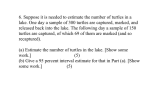 6. Suppose it is needed to estimate the number of turtles in a lake. One day a sample of 300 turtles are captured, marked, and released back into the lake. The following day a sample of 150 turtles are captured, of which 69 of them are marked (and so recaptured). (a) Estimate the number of turtles in the lake. [Show some work.] (5) (b) Give a 95 percent interval estimate for that in Part (a). [Show some work.] (5)
A population of birds has a mean beak-size of 5cm. A drought occurs such that a...
A population of birds has a mean beak-size of 5cm. A drought occurs such that a large beaked birds survived better than small-beaked birds. The large-beaked birds that survived had an average beak size of 7 cm, and their offspring had an average beak size of 6cm. What is the selection differential? 1 2 3 4 None of the abov * Selection differential= large beaked birds that survive – population mean beak sized What is the response to selection in...
1. A biologist wanted to estimate the size of the trout population in a lake. She...
1. A biologist wanted to estimate the size of the trout population in a lake. She marked and released 109 trout, and in a second sample a few days later caught 177 trout, of which 57 were marked. What is the best estimate of total population size? 2. A mouse species has a maximum lifespan of four years. Two-year-old mice (between the ages of 2 and 3) produce 2 babies per year, and three-year-old mice produce 3 babies per year....
5. Mike wishes to estimate the mean number birds that visit his bird feeder each day....
 5. Mike wishes to estimate the mean number birds that visit his bird feeder each day. The population standard deviation (0) is known from past studies to equal 12 birds. If Mike wishes to be 90% confident of getting an estimate within 3 birds of the true mean, what sample size is required?
Use the following information to calculate turtle population size using the Lincoln-Peterson Method. Thirty turtles were...
 Use the following information to calculate turtle population size using the Lincoln-Peterson Method. Thirty turtles were captured and marked in the first sample. In the second sample, a total of 20 turtles were captured, of which, 10 were recaptures or previously marked. Show your work for partial credit. (6 pts)
A student collected and marked 66 ground beetles in a city park surrounded by urban property,...
A student collected and marked 66 ground beetles in a city park surrounded by urban property, and released them back into the park. Several days later, the student resampled the population and collected a total of 115 beetles (23 marked and 92 unmarked). What is the estimated size of the ground beetle population?
 There are N birds in a population. The first day we captured and tagged 60, di 60. The following day we capture 50, d2=50. Of these 50, D = 20 had tags from dı i.e had been captured on di and d2. Treating D as the data, find an expression for the sampling distribution P(D|dı, d2, N)
 Results (Data) Table 1. Population guess and count, and calculated population estimate based on numbers of captured, marked, and recaptured individuals using the simple mark recapture technique. Guess of population size = 390 M 148 C 21 RE7 148X21, 3,108 : +++ N Show calculations Count of population size = 592 % error = 390 1444) 592=269 Show colculations 592 Table 2. Population guess and count, and calculated population estimate based on numbers of captured, marked, and recaptured individuals usinga...
 6. Suppose it is needed to estimate the number of turtles in a lake. One day a sample of 300 turtles are captured, marked, and released back into the lake. The following day a sample of 150 turtles are captured, of which 69 of them are marked (and so recaptured). (a) Estimate the number of turtles in the lake. [Show some work.] (5) (b) Give a 95 percent interval estimate for that in Part (a). [Show some work.] (5)
 5. Mike wishes to estimate the mean number birds that visit his bird feeder each day. The population standard deviation (0) is known from past studies to equal 12 birds. If Mike wishes to be 90% confident of getting an estimate within 3 birds of the true mean, what sample size is required?
 Use the following information to calculate turtle population size using the Lincoln-Peterson Method. Thirty turtles were captured and marked in the first sample. In the second sample, a total of 20 turtles were captured, of which, 10 were recaptures or previously marked. Show your work for partial credit. (6 pts)
Most questions answered within 3 hours.
-
Where is the error in this code sequence?
String s1 = "Hello";
String s2 = "ello";...
asked 10 months ago -
Financial data for Joel de Paris, Inc., for last year
follow:
Joel de Paris, Inc.
Balance...
asked 10 months ago -
Consider this reaction:
Al2(SO4)3 (aq)+ BaCl3
(aq) Al2Cl6 (aq)- +
3BaSO4(s) . What is the...
asked 10 months ago -
Suppose that Savneet is considering increasing her
recent random sample from 20 car rentals to 40...
asked 10 months ago -
Trucks arrive at an unloading terminal at an average rate of 120
per hour.
Trucks arrive...
asked 10 months ago -
Why are methanol and ethanol completely soluble in water while
octanol is not very little soluble....
asked 10 months ago -
A facilities manager at a university reads in a research report
that the mean amount of...
asked 10 months ago -
When the CuSO4 is rehydrated by adding water to the anhydrous
compound, is this an endothermic...
asked 10 months ago -
A ray of sunlight is passing from diamond into crown glass; the
angle of incidence is...
asked 10 months ago -
A block of mass 0.249 kg is placed on top of a light, vertical
spring of...
asked 10 months ago -
how do the kidneys compensate in the presences of acidosis
a) trigger hyperventilate
b) reserve acid...
asked 10 months ago -
Question 501 pts
The rental rate of capital to the firm increases. Which of the
following...
asked 10 months ago