
Homework Answers
Add Answer to:
(a) Calculate the linear acceleration of a car, the 0.260-m radius tires of which have an...
(a) Calculate the linear acceleration of a car, the 0.260-m radius tires of which have an...
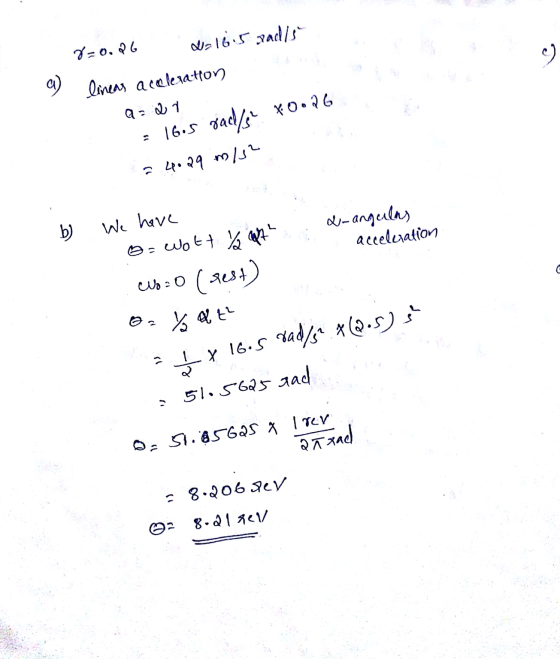
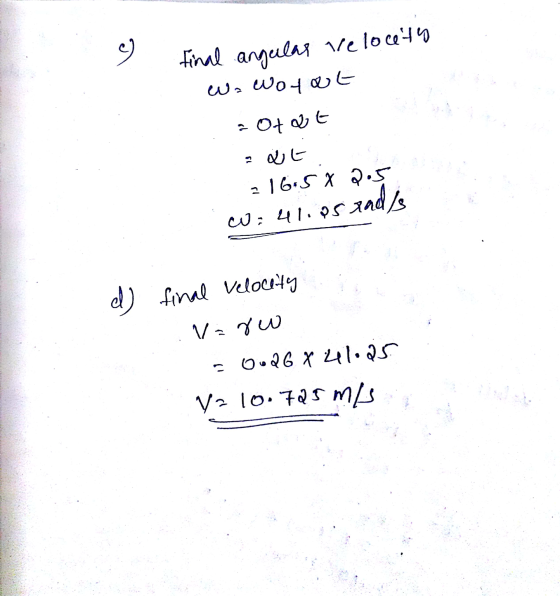
 (a) Calculate the linear acceleration of a car, the 0.260-m radius tires of which have an angular acceleration of 16.5 rad/s2. Assume no slippage. m/s2 (b) How many revolutions do the tires make in 2.50 s if they start from rest? rev (c) What is their final angular velocity? rad/s (d) What is the final velocity of the car? m/s
(a) Calculate the linear acceleration of a car, the 0.300-m radius tires of which have an...
(a) Calculate the linear acceleration of a car, the 0.300-m radius tires of which have an angular acceleration of 13.0 rad/s2. Assume no slippage and give your answer in m/s2. (b) How many revolutions do the tires make in 2.50 s if they start from rest? (c) What is their final angular velocity in rad/s? rad/s (d) What is the final velocity of the car in m/s? m/s
(a) Calculate the linear acceleration of a car, the 0.250-m radius tires of which have an...
 (a) Calculate the linear acceleration of a car, the 0.250-m radius tires of which have an angular acceleration of 14.5 rad/s2. Assume no slippage. m/s² (b) How many revolutions do the tires make in 2.50 s if they start from rest? rev (c) What is their final angular velocity? rad/s (d) What is the final velocity of the car? m/s
Calculate the linear acceleration of a car, the 0.210-m radius tires of which have an angular...
Calculate the linear acceleration of a car, the 0.210-m radius tires of which have an angular acceleration of 11.0 rad/s2. Assume no slippage and give your answer in m/s2. (b). How many revolutions do the tires make in 2.50 s if they start from rest? (c). What is their final angular velocity in rad/s? (d). What is the final velocity of the car in m/s?
With the aid of a string, a gyroscope is accelerated from rest to 33 rad/s in...
With the aid of a string, a gyroscope is accelerated from rest to 33 rad/s in 0.6 s. (a) What is its angular acceleration in rad/s2? Consider the known variables to determine which rotational kinematic equation should be used here. Check units for consistency. rad/s2 (b) How many revolutions does it go through in the process? 1.58 Correct: Your answer is correct. rev Need help with part a
A racing car travels on a circular track with a radius of 200 m. If the...
 A racing car travels on a circular track with a radius of 200 m. If the car moves with a constant linear speed of 51.0 m/s, find (a) its angular speed and (b) the magnitude and directions of its acceleration. (a) 0.255 rad/s; (b) 51.0 m/s2 in the direction of tangential velocity (a) 0.255 rad/s; (b) 13.0 m/s2 in the direction of tangential velocity (a) 7.25 rad/s; (b) 13.0 m/s2 in the direction of tangential velocity (a) 0.255 rad/s; (b)...
A racing car travels on a circular track with a radius of 225 m. If the...
 A racing car travels on a circular track with a radius of 225 m. If the car moves with a constant linear speed of 47.0 m/s, find (a) its angular speed and (b) the magnitude and directions of its acceleration. O(a) 0.209 rad/s; (b) 9.82 m/s2 in the direction of tangential velocity i O(a) 0.709 rad/s; (b) 47.0 m/s2 in the direction of tangential velocity • (a) 0.209 rad/s; (b) 9.82 m/s2 toward the center of the track O(a) 4.79...
During a very quick stop, a car decelerates at 7.8 m/s2. Assume the forward motion of...
 During a very quick stop, a car
decelerates at 7.8 m/s2. Assume the forward motion of
the car corresponds to a positive direction for the rotation of the
tires (and that they do not slip on the pavement).
Randomized Variablesat = 7.8
m/s2
r = 0.29 m
ω0 = 93 rad/s
Part (a) What is the angular acceleration of
its tires in rad/s2, assuming they have a radius of 0.29
m and do not slip on the pavement?
Part (b)...
During a very quick stop, a car
decelerates at 7.8 m/s2. Assume the forward motion of
the car corresponds to a positive direction for the rotation of the
tires (and that they do not slip on the pavement).
Randomized Variablesat = 7.8
m/s2
r = 0.29 m
ω0 = 93 rad/s
Part (a) What is the angular acceleration of
its tires in rad/s2, assuming they have a radius of 0.29
m and do not slip on the pavement?
Part (b)...
3. During a very quick stop, a car decelerates at 6.2 m/s2. Assume the forward motion...
 3. During a very quick stop, a car decelerates at 6.2 m/s2. Assume the forward motion of the car corresponds to a positive direction for the rotation of the tires (and that they do not slip on the pavement). a. What is the angular acceleration of its tires in rad/s2, assuming they have a radius of 0.28 m and do not slip on the pavement? b. How many revolutions do the tires make before coming to rest, given their initial...
A car initially traveling at 25.4 m/s undergoes a constant negative acceleration of magnitude 1.80 m/s2...
A car initially traveling at 25.4 m/s undergoes a constant negative acceleration of magnitude 1.80 m/s2 after its brakes are applied. (a) How many revolutions does each tire make before the car comes to a stop, assuming the car does not skid and the tires have radii of 0.330 m? _______ rev (b) What is the angular speed of the wheels when the car has traveled half the total distance? ________ rad/s
 (a) Calculate the linear acceleration of a car, the 0.260-m radius tires of which have an angular acceleration of 16.5 rad/s2. Assume no slippage. m/s2 (b) How many revolutions do the tires make in 2.50 s if they start from rest? rev (c) What is their final angular velocity? rad/s (d) What is the final velocity of the car? m/s
 (a) Calculate the linear acceleration of a car, the 0.250-m radius tires of which have an angular acceleration of 14.5 rad/s2. Assume no slippage. m/s² (b) How many revolutions do the tires make in 2.50 s if they start from rest? rev (c) What is their final angular velocity? rad/s (d) What is the final velocity of the car? m/s
 A racing car travels on a circular track with a radius of 200 m. If the car moves with a constant linear speed of 51.0 m/s, find (a) its angular speed and (b) the magnitude and directions of its acceleration. (a) 0.255 rad/s; (b) 51.0 m/s2 in the direction of tangential velocity (a) 0.255 rad/s; (b) 13.0 m/s2 in the direction of tangential velocity (a) 7.25 rad/s; (b) 13.0 m/s2 in the direction of tangential velocity (a) 0.255 rad/s; (b)...
 A racing car travels on a circular track with a radius of 225 m. If the car moves with a constant linear speed of 47.0 m/s, find (a) its angular speed and (b) the magnitude and directions of its acceleration. O(a) 0.209 rad/s; (b) 9.82 m/s2 in the direction of tangential velocity i O(a) 0.709 rad/s; (b) 47.0 m/s2 in the direction of tangential velocity • (a) 0.209 rad/s; (b) 9.82 m/s2 toward the center of the track O(a) 4.79...
 During a very quick stop, a car
decelerates at 7.8 m/s2. Assume the forward motion of
the car corresponds to a positive direction for the rotation of the
tires (and that they do not slip on the pavement).
Randomized Variablesat = 7.8
m/s2
r = 0.29 m
ω0 = 93 rad/s
Part (a) What is the angular acceleration of
its tires in rad/s2, assuming they have a radius of 0.29
m and do not slip on the pavement?
Part (b)...
During a very quick stop, a car
decelerates at 7.8 m/s2. Assume the forward motion of
the car corresponds to a positive direction for the rotation of the
tires (and that they do not slip on the pavement).
Randomized Variablesat = 7.8
m/s2
r = 0.29 m
ω0 = 93 rad/s
Part (a) What is the angular acceleration of
its tires in rad/s2, assuming they have a radius of 0.29
m and do not slip on the pavement?
Part (b)...
 3. During a very quick stop, a car decelerates at 6.2 m/s2. Assume the forward motion of the car corresponds to a positive direction for the rotation of the tires (and that they do not slip on the pavement). a. What is the angular acceleration of its tires in rad/s2, assuming they have a radius of 0.28 m and do not slip on the pavement? b. How many revolutions do the tires make before coming to rest, given their initial...
Most questions answered within 3 hours.
-
Where is the error in this code sequence?
String s1 = "Hello";
String s2 = "ello";...
asked 11 months ago -
Financial data for Joel de Paris, Inc., for last year
follow:
Joel de Paris, Inc.
Balance...
asked 11 months ago -
Consider this reaction:
Al2(SO4)3 (aq)+ BaCl3
(aq) Al2Cl6 (aq)- +
3BaSO4(s) . What is the...
asked 11 months ago -
Suppose that Savneet is considering increasing her
recent random sample from 20 car rentals to 40...
asked 11 months ago -
Trucks arrive at an unloading terminal at an average rate of 120
per hour.
Trucks arrive...
asked 11 months ago -
Why are methanol and ethanol completely soluble in water while
octanol is not very little soluble....
asked 11 months ago -
A facilities manager at a university reads in a research report
that the mean amount of...
asked 11 months ago -
When the CuSO4 is rehydrated by adding water to the anhydrous
compound, is this an endothermic...
asked 11 months ago -
A ray of sunlight is passing from diamond into crown glass; the
angle of incidence is...
asked 11 months ago -
A block of mass 0.249 kg is placed on top of a light, vertical
spring of...
asked 11 months ago -
how do the kidneys compensate in the presences of acidosis
a) trigger hyperventilate
b) reserve acid...
asked 11 months ago -
Question 501 pts
The rental rate of capital to the firm increases. Which of the
following...
asked 11 months ago