


Homework Answers
Problem 1:
1.) True
Growth in the labour of a small country can cause increase in the output level, but since it is a small country, the growth in output might not be enough to increase standard of living of the entire population. Hence, it is an ambiguous effect. On the other hand, increase in capital makes it possible for each worker's productivity to increase, so it has definitive positive effects on the per capita gdp.
2.) False
If the labour is scarce, then increasing capital is not going to increase output endlessly. There is diminishing returns to capital, which means indefinitely increasing capital without increasing labour will not produde ultra-protrade effects on the economy.
3.) True
If a country exports a capital intensive commodity, and if the capital increases in the country, then the effect will be protrade as the output of the capital intensive commodity will increase and that of the labour intensive commodity will reduce. If the labour increases in the country, then the effect will be antitrade as the output of the labour intensive commodity will increase and that of the capital intensive commodity will reduce.
4.) True
Eurasian Union is an economic as well as a monetary union with the same common currency.
5.) True
If a country has elastic demand, then the demand changes more (increases more) when the price of the commodity reduces due to reduction in the tariffs. Hence, the welfare of the consumers increases. Since the supply is inelastic, the domestic production will not reduce as much, which means the welfare of the domestic producers will not reduce more. Hence, the overall welfare will increase.
(Please consider posting as separate questions.)
Add Answer to:
Problem I. True or False. Please support your answers with proper reasoning, mathematical arguments, or graphs....
Problem I. True or False. Please support your answers with proper reasoning, mathematical arguments, or graphs....
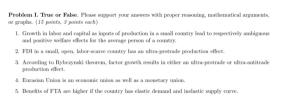 Problem I. True or False. Please support your answers with proper reasoning, mathematical arguments, or graphs. (15 points, 3 points each) 1. Growth in labor and capital as inputs of production in a small country lead to respectively ambiguous and positive welfare effects for the average person of a country. 2. FDI in a small, open, labor-scarce country has an ultra-protrade production effect. 3. According to Rybczynski theorem, factor growth results in either an ultra-protrade or ultra-antitrade production effect. 4....
True or false and give reasoning for these questions. 1) Growth in labor and capital as...
True or false and give reasoning for these questions. 1) Growth in labor and capital as inputs of production in a small country lead to respectively ambiguous and positive welfare effects for the average person of a country. 2. FDI in a small, open, labor-scarce country has an ultra-protrade production effect. 3. According to Rybczynski theorem, factor growth results in either an ultra-protrade or ultra-antitrade production effect. 4. Eurasian Union is an economic union as well as a monetary union....
Suppose that the UK is a small open country producing only cars and crude petroleum. For...
Suppose that the UK is a small open country producing only cars and crude petroleum. For simplicity assume that cars and crude petroleum are labor-intensive and capital-intensive respectively. Now, suppose there is an inflow of workers from Eurozone to the UK. Using the theories we discussed in class, answer the following questions with proper arguments, equations, or graphs. (10 points) 1. How would the wage in the UK change as a result of incoming workers? Why? (2 points) 2. How...
Problem IV. Demand and supply curves for two large countries are given by figure 1. Answer...
 Problem IV. Demand and supply curves for two large countries are given by figure 1. Answer the following 1. Consider the autarky situation. (a) Calculate CS, PS, GS, and TS for both countries (3 points) 2. Now, suppo countries open to trade (a) Which country imports and which exports? (0.5 point) (b) Derive import demand for importer and export supply for exporter. You can either drawe both curves with appropriate labeling and placing numbers or write equations. ( points) (e)...
GS eans government surplus Problem IV. Demand and supply curves for two large countries are given...
 GS
eans government surplus
Problem IV. Demand and supply curves for two large countries are given by figure 1. Answer the following questions. (38 points) 1. Consider the autarky situation. (a) Calculate CS, PS, GS, and TS for both countries. (3 povints) 2. Now, suppose countries open to trade. (a) Which country imports and which exports? (0.5 point) (1) Derive import demand for importer and export supply for exporter. You can either draw both curves with appropriate labeling and placing...
GS
eans government surplus
Problem IV. Demand and supply curves for two large countries are given by figure 1. Answer the following questions. (38 points) 1. Consider the autarky situation. (a) Calculate CS, PS, GS, and TS for both countries. (3 povints) 2. Now, suppose countries open to trade. (a) Which country imports and which exports? (0.5 point) (1) Derive import demand for importer and export supply for exporter. You can either draw both curves with appropriate labeling and placing...
Problem IV. Demand and supply curves for two large countries are given by figure 1. Answer...
 Problem IV. Demand and supply curves for two large countries are given by figure 1. Answer the following questions. (38 points) 1. Consider the autarky situation. (a) Calculate CS, PS, GS, and TS for both countries. (3 povints) 2. Now, suppose countries open to trade. (a) Which country imports and which exports? (0.5 point) (1) Derive import demand for importer and export supply for exporter. You can either draw both curves with appropriate labeling and placing numbers or write equations....
7 to 12 answers I need please this is MCQ )Assume that only two countries, A...
 7 to 12 answers I need please this is MCQ
)Assume that only two countries, A and B, exist Consider the following data Factor Endowments 45 15 Labor 10 Cepited Stck If good S is capital intensive, then following the Heckscher-Ohlin Theory A) country A will export good S. B) country B will export good S C) both countries will export good S D) trade will not occur between these two countries. E) Insufficient information is given. 8) Continuing from...
7 to 12 answers I need please this is MCQ
)Assume that only two countries, A and B, exist Consider the following data Factor Endowments 45 15 Labor 10 Cepited Stck If good S is capital intensive, then following the Heckscher-Ohlin Theory A) country A will export good S. B) country B will export good S C) both countries will export good S D) trade will not occur between these two countries. E) Insufficient information is given. 8) Continuing from...
Part I: True or False. If false, briefly explain your answer (2 points each). Answer all...
 Part I: True or False. If false, briefly explain your answer (2 points each). Answer all five. 1. An intra industry trade index of 1 indicates that very little intra industry trade is taking place. 2. External economies of scale occurs when a firm's average costs fall as the total industry output rises Foreign Direct Investment includes the hiring of workers in foreign countries as well as purchase of equipment and software. Quotas are generally preferred to tariffs because they...
PROBLEM 1 Consider the typical HO setting: 2 countries, the United States and Canada, produce two goods,...
PROBLEM 1 Consider the typical HO setting: 2 countries, the United States and Canada, produce two goods, maiz (corn) and cloth, with two factors, land and labor. Both countries share the same tastes and the same technology. Maiz production is land intensive, and therefore cloth production is labor intensive. Furthermore, resource endowments are as follows: in the US there are 100 units of labor and 100 of land, in Canada there are 60 units of labor and 90 of land. Which...
Suppose two countries, Grainland and Carsland, use only capital and labor to produce two goods, Grain (G) and Cars (C). Grainland has 2,050 units of capital and 916 units of labor, and Carland has 816 units of capital and 270 units of labor. In Carsland,
Suppose two countries, Grainland and Carsland, use only capital and labor to produce two goods, Grain (G) and Cars (C). Grainland has 2,050 units of capital and 916 units of labor, and Carland has 816 units of capital and 270 units of labor. In Carsland, there are 366 units of capital and 135 units of labor employed in the Grain industry. In Grainland, there are 926 units of capital and 618 units of labor employed in the Grain industry.A. Which...
 Problem I. True or False. Please support your answers with proper reasoning, mathematical arguments, or graphs. (15 points, 3 points each) 1. Growth in labor and capital as inputs of production in a small country lead to respectively ambiguous and positive welfare effects for the average person of a country. 2. FDI in a small, open, labor-scarce country has an ultra-protrade production effect. 3. According to Rybczynski theorem, factor growth results in either an ultra-protrade or ultra-antitrade production effect. 4....
 Problem IV. Demand and supply curves for two large countries are given by figure 1. Answer the following 1. Consider the autarky situation. (a) Calculate CS, PS, GS, and TS for both countries (3 points) 2. Now, suppo countries open to trade (a) Which country imports and which exports? (0.5 point) (b) Derive import demand for importer and export supply for exporter. You can either drawe both curves with appropriate labeling and placing numbers or write equations. ( points) (e)...
 GS
eans government surplus
Problem IV. Demand and supply curves for two large countries are given by figure 1. Answer the following questions. (38 points) 1. Consider the autarky situation. (a) Calculate CS, PS, GS, and TS for both countries. (3 povints) 2. Now, suppose countries open to trade. (a) Which country imports and which exports? (0.5 point) (1) Derive import demand for importer and export supply for exporter. You can either draw both curves with appropriate labeling and placing...
GS
eans government surplus
Problem IV. Demand and supply curves for two large countries are given by figure 1. Answer the following questions. (38 points) 1. Consider the autarky situation. (a) Calculate CS, PS, GS, and TS for both countries. (3 povints) 2. Now, suppose countries open to trade. (a) Which country imports and which exports? (0.5 point) (1) Derive import demand for importer and export supply for exporter. You can either draw both curves with appropriate labeling and placing...
 Problem IV. Demand and supply curves for two large countries are given by figure 1. Answer the following questions. (38 points) 1. Consider the autarky situation. (a) Calculate CS, PS, GS, and TS for both countries. (3 povints) 2. Now, suppose countries open to trade. (a) Which country imports and which exports? (0.5 point) (1) Derive import demand for importer and export supply for exporter. You can either draw both curves with appropriate labeling and placing numbers or write equations....
 7 to 12 answers I need please this is MCQ
)Assume that only two countries, A and B, exist Consider the following data Factor Endowments 45 15 Labor 10 Cepited Stck If good S is capital intensive, then following the Heckscher-Ohlin Theory A) country A will export good S. B) country B will export good S C) both countries will export good S D) trade will not occur between these two countries. E) Insufficient information is given. 8) Continuing from...
7 to 12 answers I need please this is MCQ
)Assume that only two countries, A and B, exist Consider the following data Factor Endowments 45 15 Labor 10 Cepited Stck If good S is capital intensive, then following the Heckscher-Ohlin Theory A) country A will export good S. B) country B will export good S C) both countries will export good S D) trade will not occur between these two countries. E) Insufficient information is given. 8) Continuing from...
 Part I: True or False. If false, briefly explain your answer (2 points each). Answer all five. 1. An intra industry trade index of 1 indicates that very little intra industry trade is taking place. 2. External economies of scale occurs when a firm's average costs fall as the total industry output rises Foreign Direct Investment includes the hiring of workers in foreign countries as well as purchase of equipment and software. Quotas are generally preferred to tariffs because they...
Most questions answered within 3 hours.
-
Where is the error in this code sequence?
String s1 = "Hello";
String s2 = "ello";...
asked 11 months ago -
Financial data for Joel de Paris, Inc., for last year
follow:
Joel de Paris, Inc.
Balance...
asked 11 months ago -
Consider this reaction:
Al2(SO4)3 (aq)+ BaCl3
(aq) Al2Cl6 (aq)- +
3BaSO4(s) . What is the...
asked 11 months ago -
Suppose that Savneet is considering increasing her
recent random sample from 20 car rentals to 40...
asked 11 months ago -
Trucks arrive at an unloading terminal at an average rate of 120
per hour.
Trucks arrive...
asked 11 months ago -
Why are methanol and ethanol completely soluble in water while
octanol is not very little soluble....
asked 11 months ago -
A facilities manager at a university reads in a research report
that the mean amount of...
asked 11 months ago -
When the CuSO4 is rehydrated by adding water to the anhydrous
compound, is this an endothermic...
asked 11 months ago -
A ray of sunlight is passing from diamond into crown glass; the
angle of incidence is...
asked 11 months ago -
A block of mass 0.249 kg is placed on top of a light, vertical
spring of...
asked 11 months ago -
how do the kidneys compensate in the presences of acidosis
a) trigger hyperventilate
b) reserve acid...
asked 11 months ago -
Question 501 pts
The rental rate of capital to the firm increases. Which of the
following...
asked 11 months ago