
Homework Answers
Add Answer to:
please explain the answer
7) A box of mass m slides down a ramp, starting at...
7) A box of mass m slides down a ramp, starting at the top. The ramp...
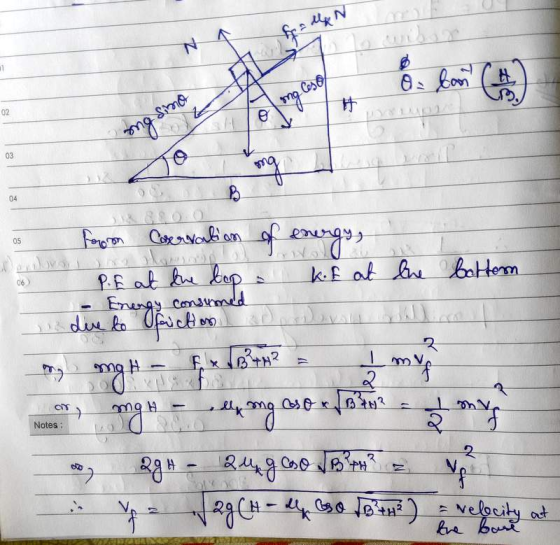
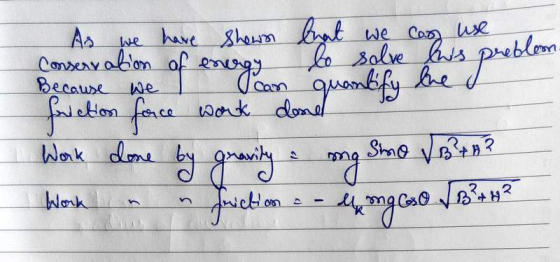
 7) A box of mass m slides down a ramp, starting at the top. The ramp has a base of length B and height of H. There is friction between the box and the surface of the ramp. The coefficient of frictions are up and pls. What is the velocity of the box when it reaches the end of the ramp? Can you use conservation of energy to solve this problem, why or why not? What is the work done...
please explain the answer 6) A small ball of mass m sit atop a large hemisphere...
 please explain the answer
6) A small ball of mass m sit atop a large hemisphere (a dome) of radius R. The ball begins to roll down the hemisphere. The location of the ball on the hemisphere makes an angle with the vertical. What is when the ball rolls off the hemisphere (the ball can not ride the surface of the hemisphere all the way down). 7) A box of mass m slides down a ramp, starting at the top....
please explain the answer
6) A small ball of mass m sit atop a large hemisphere (a dome) of radius R. The ball begins to roll down the hemisphere. The location of the ball on the hemisphere makes an angle with the vertical. What is when the ball rolls off the hemisphere (the ball can not ride the surface of the hemisphere all the way down). 7) A box of mass m slides down a ramp, starting at the top....
A box weighing 24.0 N slides down a ramp with a height of 3.60 m and...
A box weighing 24.0 N slides down a ramp with a height of 3.60 m and a length of 6.00 m. The coefficient of kinetic friction between the box and the ramp is Uk= 0.375. (a) What is the magnitude of the frictional force on the box? (b) How much work does gravity do on the box when it slides 6.00 m down the ramp? (c) How much work does friction do on the box when it slides 6.00 m...
oblem 2: A 5-kg box slides down a ramp. The ramp is l m in length...
 oblem 2: A 5-kg box slides down a ramp. The ramp is l m in length and inclined at an angle of 30° as shown. The box starts from rest at the top. The surface friction coefficient is 0.25 1. Use energy methods to determine the speed of the box at the bottom of the ramp 2. How far does the box slide before stopping on the horizontal floor if it continues to experience the same friction coefficient. 1.00 m...
As shown below (not to scale), a block of mass starts from rest and slides down...
 As shown below (not to scale), a block of mass starts from rest
and slides down a frictionless ramp of height h. Upon reaching the
bottom of the ramp, it continues to slide across a flat
frictionless surface. It then crosses a "rough patch" on the
surface of length d=10m. This rough patch has a coefficient of
kinetic friction uK=.1. After crossing the rough patch, the block's
final speed is vf=2m/s. What is the height of the ramp? Hint: I...
As shown below (not to scale), a block of mass starts from rest
and slides down a frictionless ramp of height h. Upon reaching the
bottom of the ramp, it continues to slide across a flat
frictionless surface. It then crosses a "rough patch" on the
surface of length d=10m. This rough patch has a coefficient of
kinetic friction uK=.1. After crossing the rough patch, the block's
final speed is vf=2m/s. What is the height of the ramp? Hint: I...
3. Starting from rest, a box of mass M slides through a distance d down a...
 3. Starting from rest, a box of mass M slides through a distance d down a incline. The coefficient of friction on the plane is ple (a) Draw a free body diagram. (b) Determine the work done by the gravity- express this in terms of M, g, e, d. (c) Determine the work done by the friction-express this in terms of M, g, 0, d, u. (d) Use Work-Energy theorem to determine the final velocity of the box.
A 600 N box is sliding down a ramp. I am in front of the ramp...
A 600 N box is sliding down a ramp. I am in front of the ramp pushing uphill, so that the box slides with a constant velocity. The top of the ramp is 1.5 m above the bottom of the ramp and the ramp is 5.0 m long. As the box slides down, friction does work and 500 J are added to the thermal energy of the ramp and box. a. Calculate the work done by one external force in...
A 5 Kg box initially at rest slides down a ramp with friction acting on the...
A 5 Kg box initially at rest slides down a ramp with friction acting on the box. At the top of the ramp the box has a potential energy of 120 J. At the bottom, its kinetic energy is 30 J and the work done by the friction has a magnitude of 20 J. What is the mechanical energy of the box at the bottom of the ramp? A. 120J B. 150J C. 110J D . 140J E. None of...
A 5.00-kg package slides 2.60 m down a long ramp that is inclined at 25.0 ∘...
A 5.00-kg package slides 2.60 m down a long ramp that is inclined at 25.0 ∘ below the horizontal. The coefficient of kinetic friction between the package and the ramp is μk = 0.370. A)Calculate the work done on the package by friction. B)Calculate the work done on the package by gravity. C)Calculate the work done on the package by the normal force. D)Calculate the total work done on the package. E)If the package has a speed of 2.60 m/s...
A box slides down a ramp with a constant acceleration of 0.300 m/s2. The ramp is...
A box slides down a ramp with a constant acceleration of 0.300 m/s2. The ramp is raised 18.0o above the horizontal. Calculate the coefficient of kinetic friction between the ramp and the box. HINT: Notice that the velocity is not constant as it was in the previous problem. However, the free body diagrams for both of these problems are the same. Use the free body diagram to write out the corresponding Newton's Law equations for x and y in the...
 7) A box of mass m slides down a ramp, starting at the top. The ramp has a base of length B and height of H. There is friction between the box and the surface of the ramp. The coefficient of frictions are up and pls. What is the velocity of the box when it reaches the end of the ramp? Can you use conservation of energy to solve this problem, why or why not? What is the work done...
 please explain the answer
6) A small ball of mass m sit atop a large hemisphere (a dome) of radius R. The ball begins to roll down the hemisphere. The location of the ball on the hemisphere makes an angle with the vertical. What is when the ball rolls off the hemisphere (the ball can not ride the surface of the hemisphere all the way down). 7) A box of mass m slides down a ramp, starting at the top....
please explain the answer
6) A small ball of mass m sit atop a large hemisphere (a dome) of radius R. The ball begins to roll down the hemisphere. The location of the ball on the hemisphere makes an angle with the vertical. What is when the ball rolls off the hemisphere (the ball can not ride the surface of the hemisphere all the way down). 7) A box of mass m slides down a ramp, starting at the top....
 oblem 2: A 5-kg box slides down a ramp. The ramp is l m in length and inclined at an angle of 30° as shown. The box starts from rest at the top. The surface friction coefficient is 0.25 1. Use energy methods to determine the speed of the box at the bottom of the ramp 2. How far does the box slide before stopping on the horizontal floor if it continues to experience the same friction coefficient. 1.00 m...
 As shown below (not to scale), a block of mass starts from rest
and slides down a frictionless ramp of height h. Upon reaching the
bottom of the ramp, it continues to slide across a flat
frictionless surface. It then crosses a "rough patch" on the
surface of length d=10m. This rough patch has a coefficient of
kinetic friction uK=.1. After crossing the rough patch, the block's
final speed is vf=2m/s. What is the height of the ramp? Hint: I...
As shown below (not to scale), a block of mass starts from rest
and slides down a frictionless ramp of height h. Upon reaching the
bottom of the ramp, it continues to slide across a flat
frictionless surface. It then crosses a "rough patch" on the
surface of length d=10m. This rough patch has a coefficient of
kinetic friction uK=.1. After crossing the rough patch, the block's
final speed is vf=2m/s. What is the height of the ramp? Hint: I...
 3. Starting from rest, a box of mass M slides through a distance d down a incline. The coefficient of friction on the plane is ple (a) Draw a free body diagram. (b) Determine the work done by the gravity- express this in terms of M, g, e, d. (c) Determine the work done by the friction-express this in terms of M, g, 0, d, u. (d) Use Work-Energy theorem to determine the final velocity of the box.
Most questions answered within 3 hours.
-
Where is the error in this code sequence?
String s1 = "Hello";
String s2 = "ello";...
asked 10 months ago -
Financial data for Joel de Paris, Inc., for last year
follow:
Joel de Paris, Inc.
Balance...
asked 10 months ago -
Consider this reaction:
Al2(SO4)3 (aq)+ BaCl3
(aq) Al2Cl6 (aq)- +
3BaSO4(s) . What is the...
asked 10 months ago -
Suppose that Savneet is considering increasing her
recent random sample from 20 car rentals to 40...
asked 10 months ago -
Trucks arrive at an unloading terminal at an average rate of 120
per hour.
Trucks arrive...
asked 10 months ago -
Why are methanol and ethanol completely soluble in water while
octanol is not very little soluble....
asked 10 months ago -
A facilities manager at a university reads in a research report
that the mean amount of...
asked 10 months ago -
When the CuSO4 is rehydrated by adding water to the anhydrous
compound, is this an endothermic...
asked 10 months ago -
A ray of sunlight is passing from diamond into crown glass; the
angle of incidence is...
asked 10 months ago -
A block of mass 0.249 kg is placed on top of a light, vertical
spring of...
asked 10 months ago -
how do the kidneys compensate in the presences of acidosis
a) trigger hyperventilate
b) reserve acid...
asked 10 months ago -
Question 501 pts
The rental rate of capital to the firm increases. Which of the
following...
asked 10 months ago