
Homework Answers
Request Answer!
We need at least 10 more requests to produce the answer.
0 / 10 have requested this problem solution
The more requests, the faster the answer.
Add Answer to:
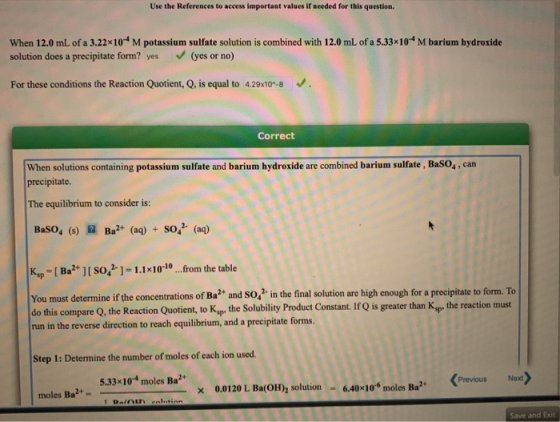
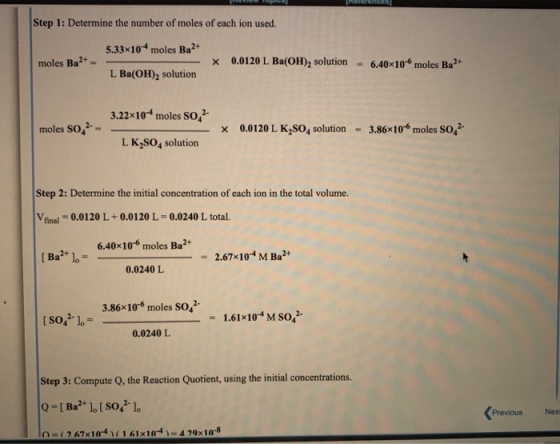
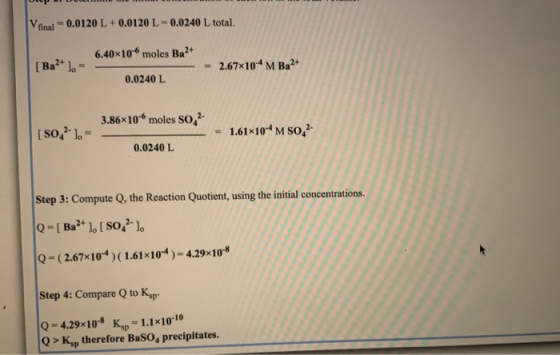
The answer is not 2.4 x 10^-9.
Here is an example on how to do these...
When 18.0 mL of a 1.10*10* M barium hydroxide solution is combined with 12.0 mL of...
 When 18.0 mL of a 1.10*10* M barium hydroxide solution is combined with 12.0 mL of a 9.74x10M form? (yes or no) potassium sulfate solution does a precipitate For these conditions the Reaction Quotient, Q, is equal to When 25.0 mL of a 6.47x10M chromium(III) nitrate solution is combined with 22.0 mL of a 7.94x10-M potassium phosphate solution does a precipitate form? (yes or no) For these conditions the Reaction Quotient, Q, is equal to .
When 22.0 mL of a 2.34*10-4 M ammonium sulfate solution is combined with 25.0 mL of...
 When 22.0 mL of a 2.34*10-4 M ammonium sulfate solution is combined with 25.0 mL of a 7.42x10⁻⁴ M barium bromide solution does a precipitate form? (yes or no) For these conditions the Reaction Quotient, Q, is equal to
********PLEASE PLEASE PLEASE ANSWER 1-3****** THANK YOUU!!! 1a.When 22.0 mL of a 8.66×10⁻⁴ M cobalt(II) iodide...
********PLEASE PLEASE PLEASE ANSWER 1-3****** THANK YOUU!!! 1a.When 22.0 mL of a 8.66×10⁻⁴ M cobalt(II) iodide solution is combined with 25.0 mL of a 1.92×10⁻⁴ M ammonium sulfidesolution does a precipitate form? (yes or no) For these conditions the Reaction Quotient, Q, is equal to______ 1b.When 22.0 mL of a 6.52×10⁻⁴M ammonium iodide solution is combined with 12.0 mL of a 1.05×10⁻⁴M lead acetatesolution does a precipitate form? (yes or no) For these conditions the Reaction Quotient, Q, is equal to_____. 2a.A...
this is one question with 4 parts. please answer all or leave it to another tutor...
 this is one question with 4 parts. please answer all or leave it to
another tutor who will
The volume of water needed to dissolve 0.0552 grams of magnesium carbonate is L. Assume no volume change upon addition of the solid. Submit Answer Retry Entire Group 8 more group attempts remaining The volume of water needed to dissolve 0.0715 grams of barium fluoride is L. Assume no volume change upon addition of the solid. Submit Answer Retry Entire Group 8...
this is one question with 4 parts. please answer all or leave it to
another tutor who will
The volume of water needed to dissolve 0.0552 grams of magnesium carbonate is L. Assume no volume change upon addition of the solid. Submit Answer Retry Entire Group 8 more group attempts remaining The volume of water needed to dissolve 0.0715 grams of barium fluoride is L. Assume no volume change upon addition of the solid. Submit Answer Retry Entire Group 8...
Can you help me with the questions? Thanks The solubility of AgBr is measured and found...
 Can you help me with the questions? Thanks
The solubility of AgBr is measured and found to be 1.12*10* g/L. Use this information to calculate a Kyp value for silver bromide. In the laboratory you are given the task of separating Ba²+ and Agions in aqueous solution. For each reagent listed below indicate if it can be used to separate the ions. Type "Y" for yes or "N" for no. If the reagent CAN be used to separate ions, give...
Can you help me with the questions? Thanks
The solubility of AgBr is measured and found to be 1.12*10* g/L. Use this information to calculate a Kyp value for silver bromide. In the laboratory you are given the task of separating Ba²+ and Agions in aqueous solution. For each reagent listed below indicate if it can be used to separate the ions. Type "Y" for yes or "N" for no. If the reagent CAN be used to separate ions, give...
When 25.0 mL of a 4.80×10⁻⁴M potassium sulfate solution is combined with 15.0 mL of a 4.27×10⁻⁴M calcium acetate solutio...
 When 25.0 mL of a
4.80×10⁻⁴M potassium
sulfate solution is combined with 15.0 mL
of a 4.27×10⁻⁴M calcium
acetate solution does a precipitate
form? (yes or no)
For these conditions the Reaction Quotient, Q, is equal to ?
The molar solubility of calcium sulfite in a
0.158 M potassium sulfite
solution is ? M.
Solid cobalt(II) acetate is slowly added to
50.0 mL of a 0.0327 M
potassium carbonate solution. The concentration of
cobalt(II) ion required to just initiate
precipitation is...
When 25.0 mL of a
4.80×10⁻⁴M potassium
sulfate solution is combined with 15.0 mL
of a 4.27×10⁻⁴M calcium
acetate solution does a precipitate
form? (yes or no)
For these conditions the Reaction Quotient, Q, is equal to ?
The molar solubility of calcium sulfite in a
0.158 M potassium sulfite
solution is ? M.
Solid cobalt(II) acetate is slowly added to
50.0 mL of a 0.0327 M
potassium carbonate solution. The concentration of
cobalt(II) ion required to just initiate
precipitation is...
1) A solution contains 0.14 M potassium hydroxide and 0.14 M potassium chloride. Solid silver acetate...
1) A solution contains 0.14 M potassium hydroxide and 0.14 M potassium chloride. Solid silver acetate is added slowly to this mixture. What ionic compound precipitates first from the solution? (Solubility product constant data is found in the Chemistry References.) Formula of first precipitate = 2) A solution contains 5.12×10⁻³ M chromium(III) nitrate and 1.22×10⁻² M calcium acetate. Solid sodium phosphate is added slowly to this mixture. A. What is the formula of the substance that precipitates first? formula =...
Experiment 8 Double Replacement Reactions Background: Some reactions have the net effect of causing the cation...
 Experiment 8 Double Replacement Reactions Background: Some reactions have the net effect of causing the cation of each reactant to trade places, forming a compound with the other anion. These reactions are known as double replacement reactions. In the example below (unbalanced equation), the barium and sodium cations switch places so that barium forms a product with sulfate while sodium forms a product with chloride. Note that the formula of each product is determined by the charges of the ions,...
When you write the answers, please write the page number for which the question is located....
 When you write the answers, please write the page number for
which the question is located. Thank you!
Experiment 8 Name: Double Replacement Reactions Background: Some reactions have the net effect of causing the cation of cach reactant to trade places, forming a compound with the other anion. These reactions are known as double replacement reactions. In the example below (unbalanced equation), the barium and sodium cations switch places so that barium forms a product with sulfate while sodium forms...
When you write the answers, please write the page number for
which the question is located. Thank you!
Experiment 8 Name: Double Replacement Reactions Background: Some reactions have the net effect of causing the cation of cach reactant to trade places, forming a compound with the other anion. These reactions are known as double replacement reactions. In the example below (unbalanced equation), the barium and sodium cations switch places so that barium forms a product with sulfate while sodium forms...
Model I: The Dissolution of Magnesium Hydroxide in Water When solid Mg(OH)2 dissolves in water, the...
Model I: The Dissolution of Magnesium Hydroxide in Water When solid Mg(OH)2 dissolves in water, the chemical reaction is: Mg(OH)2(s) Mg2+(aq) + 2OH-(aq) (1) Table I. These are the results after equilibrium has been established for the addition of solid Mg(OH)2(s) to water yielding a final volume of 10.0 L of solution. Total amount of Mg(OH)2 added Mg2+ concentration in the resulting solution at eq OH- concentration in the resulting solution at eq Mass of Mg(OH)2 that does not dissolve...
 When 18.0 mL of a 1.10*10* M barium hydroxide solution is combined with 12.0 mL of a 9.74x10M form? (yes or no) potassium sulfate solution does a precipitate For these conditions the Reaction Quotient, Q, is equal to When 25.0 mL of a 6.47x10M chromium(III) nitrate solution is combined with 22.0 mL of a 7.94x10-M potassium phosphate solution does a precipitate form? (yes or no) For these conditions the Reaction Quotient, Q, is equal to .
 When 22.0 mL of a 2.34*10-4 M ammonium sulfate solution is combined with 25.0 mL of a 7.42x10⁻⁴ M barium bromide solution does a precipitate form? (yes or no) For these conditions the Reaction Quotient, Q, is equal to
 this is one question with 4 parts. please answer all or leave it to
another tutor who will
The volume of water needed to dissolve 0.0552 grams of magnesium carbonate is L. Assume no volume change upon addition of the solid. Submit Answer Retry Entire Group 8 more group attempts remaining The volume of water needed to dissolve 0.0715 grams of barium fluoride is L. Assume no volume change upon addition of the solid. Submit Answer Retry Entire Group 8...
this is one question with 4 parts. please answer all or leave it to
another tutor who will
The volume of water needed to dissolve 0.0552 grams of magnesium carbonate is L. Assume no volume change upon addition of the solid. Submit Answer Retry Entire Group 8 more group attempts remaining The volume of water needed to dissolve 0.0715 grams of barium fluoride is L. Assume no volume change upon addition of the solid. Submit Answer Retry Entire Group 8...
 Can you help me with the questions? Thanks
The solubility of AgBr is measured and found to be 1.12*10* g/L. Use this information to calculate a Kyp value for silver bromide. In the laboratory you are given the task of separating Ba²+ and Agions in aqueous solution. For each reagent listed below indicate if it can be used to separate the ions. Type "Y" for yes or "N" for no. If the reagent CAN be used to separate ions, give...
Can you help me with the questions? Thanks
The solubility of AgBr is measured and found to be 1.12*10* g/L. Use this information to calculate a Kyp value for silver bromide. In the laboratory you are given the task of separating Ba²+ and Agions in aqueous solution. For each reagent listed below indicate if it can be used to separate the ions. Type "Y" for yes or "N" for no. If the reagent CAN be used to separate ions, give...
 When 25.0 mL of a
4.80×10⁻⁴M potassium
sulfate solution is combined with 15.0 mL
of a 4.27×10⁻⁴M calcium
acetate solution does a precipitate
form? (yes or no)
For these conditions the Reaction Quotient, Q, is equal to ?
The molar solubility of calcium sulfite in a
0.158 M potassium sulfite
solution is ? M.
Solid cobalt(II) acetate is slowly added to
50.0 mL of a 0.0327 M
potassium carbonate solution. The concentration of
cobalt(II) ion required to just initiate
precipitation is...
When 25.0 mL of a
4.80×10⁻⁴M potassium
sulfate solution is combined with 15.0 mL
of a 4.27×10⁻⁴M calcium
acetate solution does a precipitate
form? (yes or no)
For these conditions the Reaction Quotient, Q, is equal to ?
The molar solubility of calcium sulfite in a
0.158 M potassium sulfite
solution is ? M.
Solid cobalt(II) acetate is slowly added to
50.0 mL of a 0.0327 M
potassium carbonate solution. The concentration of
cobalt(II) ion required to just initiate
precipitation is...
 Experiment 8 Double Replacement Reactions Background: Some reactions have the net effect of causing the cation of each reactant to trade places, forming a compound with the other anion. These reactions are known as double replacement reactions. In the example below (unbalanced equation), the barium and sodium cations switch places so that barium forms a product with sulfate while sodium forms a product with chloride. Note that the formula of each product is determined by the charges of the ions,...
 When you write the answers, please write the page number for
which the question is located. Thank you!
Experiment 8 Name: Double Replacement Reactions Background: Some reactions have the net effect of causing the cation of cach reactant to trade places, forming a compound with the other anion. These reactions are known as double replacement reactions. In the example below (unbalanced equation), the barium and sodium cations switch places so that barium forms a product with sulfate while sodium forms...
When you write the answers, please write the page number for
which the question is located. Thank you!
Experiment 8 Name: Double Replacement Reactions Background: Some reactions have the net effect of causing the cation of cach reactant to trade places, forming a compound with the other anion. These reactions are known as double replacement reactions. In the example below (unbalanced equation), the barium and sodium cations switch places so that barium forms a product with sulfate while sodium forms...
Most questions answered within 3 hours.
-
Where is the error in this code sequence?
String s1 = "Hello";
String s2 = "ello";...
asked 10 months ago -
Financial data for Joel de Paris, Inc., for last year
follow:
Joel de Paris, Inc.
Balance...
asked 10 months ago -
Consider this reaction:
Al2(SO4)3 (aq)+ BaCl3
(aq) Al2Cl6 (aq)- +
3BaSO4(s) . What is the...
asked 10 months ago -
Suppose that Savneet is considering increasing her
recent random sample from 20 car rentals to 40...
asked 10 months ago -
Trucks arrive at an unloading terminal at an average rate of 120
per hour.
Trucks arrive...
asked 10 months ago -
Why are methanol and ethanol completely soluble in water while
octanol is not very little soluble....
asked 10 months ago -
A facilities manager at a university reads in a research report
that the mean amount of...
asked 10 months ago -
When the CuSO4 is rehydrated by adding water to the anhydrous
compound, is this an endothermic...
asked 10 months ago -
A ray of sunlight is passing from diamond into crown glass; the
angle of incidence is...
asked 10 months ago -
A block of mass 0.249 kg is placed on top of a light, vertical
spring of...
asked 10 months ago -
how do the kidneys compensate in the presences of acidosis
a) trigger hyperventilate
b) reserve acid...
asked 10 months ago -
Question 501 pts
The rental rate of capital to the firm increases. Which of the
following...
asked 10 months ago