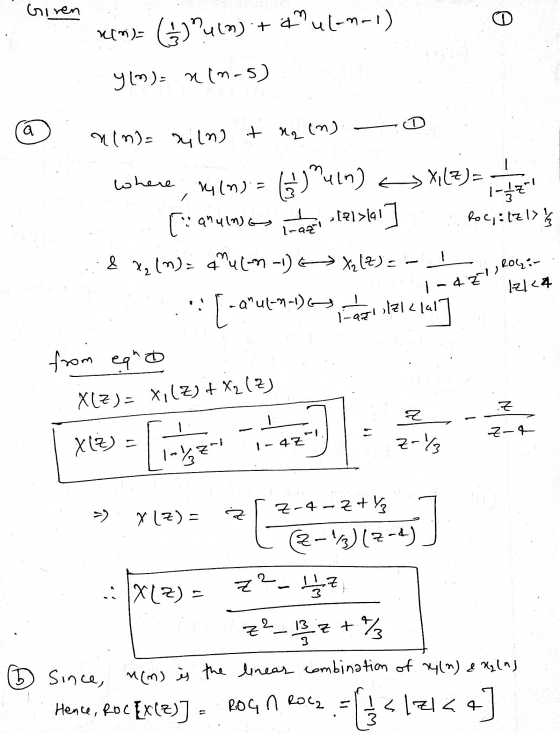
![Question 1: (35 points: Consider the following sequences: x[n] = u[n] + 4 u[-n- 1] y[n] = x[n - 5) a) [10 points| Determine](http://img.homeworklib.com/questions/c5685eb0-0198-11eb-80cc-71af270be5f9.png?x-oss-process=image/resize,w_560)
Homework Answers
![90m) = (-) YLE) = 2 5 x.2) 근 Y (²) = (-5) 크유 3 [ +) Y (2) - (2 - [ 근 한 물든 2] @ from each -5 Y(2) : 키 피트 25 (2)](http://img.homeworklib.com/questions/eb43b6c0-0198-11eb-b350-dde6838c833d.png?x-oss-process=image/resize,w_560)
Add Answer to:
Question 1: (35 points: Consider the following sequences: x[n] = u[n] + 4" u[-n- 1] y[n]...
em 2: Given two sequences x[n] = 8 8[n - 8] and h[n] = (0.7)"u[n] Determine...
 em 2: Given two sequences x[n] = 8 8[n - 8] and h[n] = (0.7)"u[n] Determine the z-transform of the convolution of the two sequences using the convolution property of the Z-transform Y(z) = X(z) H(2) Determine the convolution y[n] = x[n] * h[n] by using the inverse z-transform Problem 3: Find the inverse z-transform for the functions below. 4z-1 2-4 z-8 X(Z) = + 2-5 Z - 1 2-05 X(Z) = Z 2z2 + 2.7 z + 2
Question 1 10 points Using the definition of the transform, determine the transforms for each of...
 Question 1 10 points Using the definition of the transform, determine the transforms for each of the following signals. Sketch the pole-zero plot and indicate the region of convergence. (a) (5 points) (-3)"[n-2 () (5 points) "0(9) 15 points transforms for each of Question 2... Using 3-transform pairs and properties tables, determine the the following signals. (a) (5 points) un-un-2 (b) (5 points) -- [n - 2 (e) (5 points) nyin-1 ... 10 points Question 3 Find the inverse (a)...
Consider an LTI system with input sequence x[n] and output sequence y[n] that satisfy the difference equation
Consider an LTI system with input sequence x[n] and output sequence y[n] that satisfy the difference equation 3y[n] – 7y[n – 1] + 2y[n – 2] = 3x[n] – 3x[n – 1] (2.1) The fact that sequences x[ ] and y[ ] are in input-output relation and satisfy (2.1) does not yet determine which LTI system. a) We assume each possible input sequence to this system has its Z-transform and that the impulse response of this system also has its Z-transform. Express the...
Linear Systems and Signals ECEN 400 [2096] Two sequences, a(n) and htn) are given by: 1....
 Linear Systems and Signals ECEN 400
[2096] Two sequences, a(n) and htn) are given by: 1. (1) Represent the x(n) and hin) in sequence format and label 1 for n-0 position. (2) Determine the output sequence yín) using the convolution sum, and represent the yín) in sequence (3) Plot (Stem) xn), hin) and y(n) format and label 1for -0 position. s) x(n hln) y ln) 0-3 0-4, 0.4 2. [2096] Given a following system, (1) Find the transfer function H...
Linear Systems and Signals ECEN 400
[2096] Two sequences, a(n) and htn) are given by: 1. (1) Represent the x(n) and hin) in sequence format and label 1 for n-0 position. (2) Determine the output sequence yín) using the convolution sum, and represent the yín) in sequence (3) Plot (Stem) xn), hin) and y(n) format and label 1for -0 position. s) x(n hln) y ln) 0-3 0-4, 0.4 2. [2096] Given a following system, (1) Find the transfer function H...
Q1-20 points) a) Find the transform of the following signals and plot the ROC. 1 x(n)=(-0,357u(n-4)+(0.25?u(n+2)...
 Q1-20 points) a) Find the transform of the following signals and plot the ROC. 1 x(n)=(-0,357u(n-4)+(0.25?u(n+2) IL- x(n)=-cu-n-1) b) Find the Inverse Z-transform of: z(2-1.5) for (2-0.33)(2-0.5) ROC: z>0.5
[2 Marks] 18. If (z) and u[n]-cos(2n)지지 the correct value of V(z) will be (2z-1) js 2 2zei5-1 2ze-15-1 2 2zel5-12ze-15-1 19. Determine the Z-transform of x[n]. [2 Marks each] n] sinl0n)u[n]0.3"...
 [2 Marks] 18. If (z) and u[n]-cos(2n)지지 the correct value of V(z) will be (2z-1) js 2 2zei5-1 2ze-15-1 2 2zel5-12ze-15-1 19. Determine the Z-transform of x[n]. [2 Marks each] n] sinl0n)u[n]0.3" n] 0.5" cos (10n)u[n] In]-(0.3) u[/n] The transfer function of a discrete time system is H(z)- 20. 1+2z3z Use the inverse Z-transform to determine the system difference equation [4 Marks] 21. An LTI system is described by the following input/output difference equation: yln] 0.12yln x[n] (assume zero initial...
3. For each of the following discrete-time sequences: (i) Find the Z-transform (ZT), if it exists,...
 3. For each of the following discrete-time sequences: (i) Find the Z-transform (ZT), if it exists, and plot the region of convergence (ROC) in the Z-plane (ii) Find the poles and zeros and plot them in the 2-plane (iii) Determine whether the DTFT of the sequence exists (a) x[n] = 8[n – 1] + 28[n – 3] (b) [n] = (0.9e-j*)" u[n + 2] – 2-ul-n - 1] (c) x[n] = 2-" un + 1]
If the input to the system described by the difference equation y(n+1) (1/2)x(n+) -x(n) is a)...
 If the input to the system described by the difference equation y(n+1) (1/2)x(n+) -x(n) is a) Does it matter what are the initial conditions for nc0 in order to find y(n) for n20? Explain your b) x(n) -u(n) answer. (3 points). Determine the transfer function H(z) and the Frequency Response (H(est) (10 points). Find the amplitude lH(epT)I and the phase He*') as a function of co. Evaluate both for normalized frequency ω T=z/4. ( 10 points) c) Find the steady...
Q.4) [25 Marks] a) [15] Consider a CT LTI system described by the following differential equation...
 Q.4) [25 Marks] a) [15] Consider a CT LTI system described by the following differential equation (assume zero initial conditions): dºy(t) _6dy(t) + 3 dy(t) = 2x(6) dt3-6 dt2 +8 dt = 2x(t) [5] Using Laplace transform and its properties determine the transfer function H(s) [5] Draw the pole-zero diagram of H(s) (5) Write down all possible Region-of-Convergence (ROC) for the H(s) (iii) [5] white b) (10) Determine the signal x(t) ( assume it to be right-sided signal) when the...
3) Compute the Z-Transforms of the following time series: (a) x(n)k2"u(n) (b) + 1) x(n) =...
 3) Compute the Z-Transforms of the following time series: (a) x(n)k2"u(n) (b) + 1) x(n) = u(-n (c) x(n) -k2"u-1) (d) x(n) 0.5%1(n) + 3"11(-n) (e) x(n) = 4-nu(n) + 5-nu(n + 1) In the above, u(n) stand for the unit step signal in the discrete time domain. Also, if you can in each case determine the region of convergence of the Z-Transform you obtain.
 em 2: Given two sequences x[n] = 8 8[n - 8] and h[n] = (0.7)"u[n] Determine the z-transform of the convolution of the two sequences using the convolution property of the Z-transform Y(z) = X(z) H(2) Determine the convolution y[n] = x[n] * h[n] by using the inverse z-transform Problem 3: Find the inverse z-transform for the functions below. 4z-1 2-4 z-8 X(Z) = + 2-5 Z - 1 2-05 X(Z) = Z 2z2 + 2.7 z + 2
 Question 1 10 points Using the definition of the transform, determine the transforms for each of the following signals. Sketch the pole-zero plot and indicate the region of convergence. (a) (5 points) (-3)"[n-2 () (5 points) "0(9) 15 points transforms for each of Question 2... Using 3-transform pairs and properties tables, determine the the following signals. (a) (5 points) un-un-2 (b) (5 points) -- [n - 2 (e) (5 points) nyin-1 ... 10 points Question 3 Find the inverse (a)...
 Linear Systems and Signals ECEN 400
[2096] Two sequences, a(n) and htn) are given by: 1. (1) Represent the x(n) and hin) in sequence format and label 1 for n-0 position. (2) Determine the output sequence yín) using the convolution sum, and represent the yín) in sequence (3) Plot (Stem) xn), hin) and y(n) format and label 1for -0 position. s) x(n hln) y ln) 0-3 0-4, 0.4 2. [2096] Given a following system, (1) Find the transfer function H...
Linear Systems and Signals ECEN 400
[2096] Two sequences, a(n) and htn) are given by: 1. (1) Represent the x(n) and hin) in sequence format and label 1 for n-0 position. (2) Determine the output sequence yín) using the convolution sum, and represent the yín) in sequence (3) Plot (Stem) xn), hin) and y(n) format and label 1for -0 position. s) x(n hln) y ln) 0-3 0-4, 0.4 2. [2096] Given a following system, (1) Find the transfer function H...
 Q1-20 points) a) Find the transform of the following signals and plot the ROC. 1 x(n)=(-0,357u(n-4)+(0.25?u(n+2) IL- x(n)=-cu-n-1) b) Find the Inverse Z-transform of: z(2-1.5) for (2-0.33)(2-0.5) ROC: z>0.5
 [2 Marks] 18. If (z) and u[n]-cos(2n)지지 the correct value of V(z) will be (2z-1) js 2 2zei5-1 2ze-15-1 2 2zel5-12ze-15-1 19. Determine the Z-transform of x[n]. [2 Marks each] n] sinl0n)u[n]0.3" n] 0.5" cos (10n)u[n] In]-(0.3) u[/n] The transfer function of a discrete time system is H(z)- 20. 1+2z3z Use the inverse Z-transform to determine the system difference equation [4 Marks] 21. An LTI system is described by the following input/output difference equation: yln] 0.12yln x[n] (assume zero initial...
 3. For each of the following discrete-time sequences: (i) Find the Z-transform (ZT), if it exists, and plot the region of convergence (ROC) in the Z-plane (ii) Find the poles and zeros and plot them in the 2-plane (iii) Determine whether the DTFT of the sequence exists (a) x[n] = 8[n – 1] + 28[n – 3] (b) [n] = (0.9e-j*)" u[n + 2] – 2-ul-n - 1] (c) x[n] = 2-" un + 1]
 If the input to the system described by the difference equation y(n+1) (1/2)x(n+) -x(n) is a) Does it matter what are the initial conditions for nc0 in order to find y(n) for n20? Explain your b) x(n) -u(n) answer. (3 points). Determine the transfer function H(z) and the Frequency Response (H(est) (10 points). Find the amplitude lH(epT)I and the phase He*') as a function of co. Evaluate both for normalized frequency ω T=z/4. ( 10 points) c) Find the steady...
 Q.4) [25 Marks] a) [15] Consider a CT LTI system described by the following differential equation (assume zero initial conditions): dºy(t) _6dy(t) + 3 dy(t) = 2x(6) dt3-6 dt2 +8 dt = 2x(t) [5] Using Laplace transform and its properties determine the transfer function H(s) [5] Draw the pole-zero diagram of H(s) (5) Write down all possible Region-of-Convergence (ROC) for the H(s) (iii) [5] white b) (10) Determine the signal x(t) ( assume it to be right-sided signal) when the...
 3) Compute the Z-Transforms of the following time series: (a) x(n)k2"u(n) (b) + 1) x(n) = u(-n (c) x(n) -k2"u-1) (d) x(n) 0.5%1(n) + 3"11(-n) (e) x(n) = 4-nu(n) + 5-nu(n + 1) In the above, u(n) stand for the unit step signal in the discrete time domain. Also, if you can in each case determine the region of convergence of the Z-Transform you obtain.
Most questions answered within 3 hours.
-
Where is the error in this code sequence?
String s1 = "Hello";
String s2 = "ello";...
asked 10 months ago -
Financial data for Joel de Paris, Inc., for last year
follow:
Joel de Paris, Inc.
Balance...
asked 10 months ago -
Consider this reaction:
Al2(SO4)3 (aq)+ BaCl3
(aq) Al2Cl6 (aq)- +
3BaSO4(s) . What is the...
asked 10 months ago -
Suppose that Savneet is considering increasing her
recent random sample from 20 car rentals to 40...
asked 10 months ago -
Trucks arrive at an unloading terminal at an average rate of 120
per hour.
Trucks arrive...
asked 10 months ago -
Why are methanol and ethanol completely soluble in water while
octanol is not very little soluble....
asked 10 months ago -
A facilities manager at a university reads in a research report
that the mean amount of...
asked 10 months ago -
When the CuSO4 is rehydrated by adding water to the anhydrous
compound, is this an endothermic...
asked 10 months ago -
A ray of sunlight is passing from diamond into crown glass; the
angle of incidence is...
asked 10 months ago -
A block of mass 0.249 kg is placed on top of a light, vertical
spring of...
asked 10 months ago -
how do the kidneys compensate in the presences of acidosis
a) trigger hyperventilate
b) reserve acid...
asked 10 months ago -
Question 501 pts
The rental rate of capital to the firm increases. Which of the
following...
asked 10 months ago