A subsidy is a benefit given by the government to groups or individuals, usually in the...
- A subsidy is a benefit given by the government to groups or
individuals, usually in the form of cash payment or tax reduction
to encourage production. We can think of a subsidy as a “negative”
tax. Suppose the government gives producers a specific subsidy of
$4 per unit. (35 points)
- Using supply and demand curves, draw a diagram that clearly shows what happens when the specific $4 subsidy is implemented.
- What price do sellers receive and what do the consumers pay?
- On the diagram from part a, label the areas with letters like we have in class. [BE CAREFUL: there are a lot of areas to the label – make sure your drawing is clear] Indicate the change in consumer surplus, producer surplus, government expenditure, and welfare based on these labeled areas; i.e. compare CS, PS, government expenditure, and W before and after the subsidy to find the change. If there is a DWL, label that too.
- Now suppose we know the supply and demand functions:
QD=200-10p and QS=10p.
Find how much the equilibrium price and quantity changes after the subsidy. [Hint: Be careful how you incorporate the per-unit subsidy in the function that changes.]
- Continuing with the above supply and demand functions, find the values for ∆CS, ∆PS, ∆W, the cost of the subsidy to the government, and the DWL.
- Who gains and who loses from the subsidy? Why is there a deadweight loss?
Homework Answers
a.)
A subsudy will cause the supply curve to shift to the right, from OC to ED in the diagram. This is because the cost to the producers reduces when the subsidy is given to the producers. The diagram is as follows -
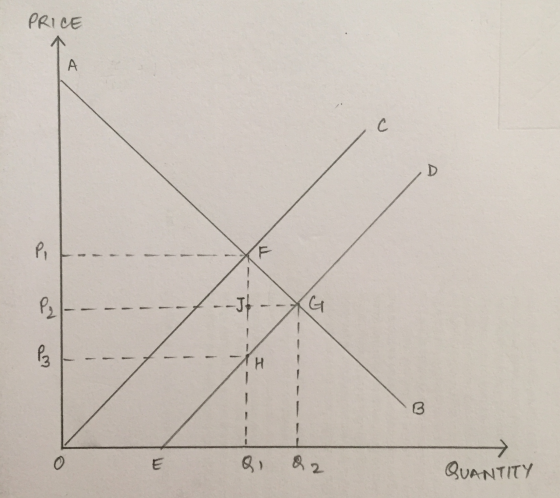
b.)
The new price is P2 (falls from P1 to P2) and the new quantity is Q2 (rises from Q1 to Q2)
c.)
Change in consumer surplus: P2P1FG (increases)
Change in producer surplus: P4KFP1 (increases)
Government expenditure: P4KGP2 (increases)
Deaweight loss: FKG
d.)






Now, after the subsidy, we get the supply curve as -






Therefore, price decreases by $2 and quantity increases by 20 units.
Change in consumer surplus: P2P1FG (increases)
Change in producer surplus: P4KFP1 (increases)
Government expenditure: P4KGP2 (increases)
Deaweight loss: FKG
In the above diagram, we get the value of P4 by putting Q=120 in the supply curve before subsidy is added -

Hence, we get -
Change in consumer surplus: 1/2 x (100+120) x 2 = 220
Change in producer surplus: 1/2 x (100+120) x 2 = 220
Government expenditure: 4 x 120 = 480
Deaweight loss: 480 - (220 + 220) = 40
Add Answer to:
A subsidy is a benefit given by the government to groups or
individuals, usually in the...
wanna check final answer I already did it Taxation Suppose now the government decides to intervene the market with...
 wanna check final answer I already did it
Taxation Suppose now the government decides to intervene the market with a tax on producers of $4, determine the price for the consumer, the g. price for the producer, and the quantity produced with the tax Draw a graph (Diagram 4) representing the market for Hallowcen costurmes with a tax on producers of $4. Accurately label and show the h. area for consumers (CS), producer surplus (PS), deadweight loss (DWL), and government...
wanna check final answer I already did it
Taxation Suppose now the government decides to intervene the market with a tax on producers of $4, determine the price for the consumer, the g. price for the producer, and the quantity produced with the tax Draw a graph (Diagram 4) representing the market for Hallowcen costurmes with a tax on producers of $4. Accurately label and show the h. area for consumers (CS), producer surplus (PS), deadweight loss (DWL), and government...
Text Exercise 5.4 Question Help- Suppose that the demand curve for wheat is Q-100-10p and that...
 Text Exercise 5.4 Question Help- Suppose that the demand curve for wheat is Q-100-10p and that the supply curve is Q 10p What are the effects of a subsidy (negative tax) of s2 per unit paid to producers on the equilbrium, govemment subsidy cost, consumer surplus (CS) producer surplus (PS), welfare (W), and deadweight loss (DWL? With the subsidy, the equilibrium price is $4 and the equilibrium quantity is 60 units (Enter your responses as whole numbers) The cost of...
Suppose that the demand curve for wheat is Qd= 400-10p Qs= 10p The government provides producers with a specific subsidy...
Suppose that the demand curve for wheat is Qd= 400-10p Qs= 10p The government provides producers with a specific subsidy of S=$11 per unit. How do the equilibrium price and quantity change? The equilibrium price by $_______ and the equilibrium quantity by $_______ units. (Enter numeric responses using real numbers rounded to two decimal places.) What effect does this tax (subsidy) have on consumer surplus, producer surplus, government revenue, welfare, and deadweight loss? Consumer surplus (increase or decrease) by $...
2. Welfare effects of a specific tax. The inverse demand and supply for a product is...
 2. Welfare effects of a specific tax. The inverse demand and supply for a product is given by p = 60 Q, and p Q,respectively. Find the consumer and produce surplus at equilibrium. Now assume a specific tax oft = 2 that is assessed on the sale of each unit sold. Find the changes in CS, PS, and tax revenue а. b. What is the incidence of the tax? с. Determined the Deadweight Loss (DWL) from the tax In this...
PART III - QUANTITAYIVE QUESTIONS Answer ALL the following questions. Show any work and calculation. No...
 PART III - QUANTITAYIVE QUESTIONS Answer ALL the following questions. Show any work and calculation. No marks will be allocated for answers without work. 1. Halloween costumes are becoming more popular as we are getting closer to Halloween. The domestic demand and supply for Halloween costumes in Canada are given by the following equations, where is the quantity of Halloween costumes and P is the price of Halloween costumes: P = 80 - (1/500) Q and P - 20 +...
The market demand and supply is described by the following equations: Q = 100 - P Q=2P - 20 1) Find the market equilibr...
 The market demand and supply is described by the following equations: Q = 100 - P Q=2P - 20 1) Find the market equilibrium 2) What is the CS, PS, and W in this market? 3) Assume that the government introduces a subsidy of 15$ per unit to the supply. What is the new equilibrium? 4) Find the change in CS, PS, and W. Is there Dead Weight Loss? if so, of how much?. 5) What does this tell you...
Suppose that the demand curve for wheat is Q=120 - 10p and the supply curve is...
Suppose that the demand curve for wheat is Q=120 - 10p and the supply curve is Q=10p The government imposes a price ceiling of p= $4 per unit per unit. a. How do the equilibrium price and quantity change? (round quantities to the nearest integer and round prices to the nearest penny) The equilibrium quantity without the price ceiling is 60 and the price without the price ceiling is $6. The equilibrium quantity with the price ceiling is 40. B)...
2. Suppose the market demand and supply functions of commodity X (it is a normal good)...
 2. Suppose the market demand and supply functions of commodity X (it is a normal good) are as below: Qp = 120,000 - 20,000 P Qs = 20,000 p ve y em . a) Calculate consumer surplus (CS), producer surplus (PS), and total surplus in part (a) of that question b) Calculate CS, PS, and total surplus in part (c) of that question. How do these values compare to those in part (a) above? Explain the change (that is, explain...
Suppose that the demand curve for wheat is Q=140 - 10p and the supply curve is...
 Suppose that the demand curve for wheat is Q=140 - 10p and the supply curve is Q = 10p. The government imposes a specific tax of = 1 per unit. a. How do the equilibrium price and quantity change? (Round quantities to the nearest integer and round prices to the nearest penny) The equilibrium quantity without the specific tax is 70 and the price without the specific tax is $ 7. The equilibrium quantity with the specific tax is 65...
8. Suppose that the demand curve for wheat is Q=120-10p and the supply curve is Q=...
 8. Suppose that the demand curve for wheat is Q=120-10p and the supply curve is Q= 10p. The government imposes a price ceiling of p S4 per unit. a. How do the equilibrium price and quantity change? (round quantities to the nearest integer and round prices to the nearest penny) 60 The equilibrium quantity without the price ceiling is ceiling is $ and the price without the price The equilibrium quantity with the price ceiling is b. What effect does...
 wanna check final answer I already did it
Taxation Suppose now the government decides to intervene the market with a tax on producers of $4, determine the price for the consumer, the g. price for the producer, and the quantity produced with the tax Draw a graph (Diagram 4) representing the market for Hallowcen costurmes with a tax on producers of $4. Accurately label and show the h. area for consumers (CS), producer surplus (PS), deadweight loss (DWL), and government...
wanna check final answer I already did it
Taxation Suppose now the government decides to intervene the market with a tax on producers of $4, determine the price for the consumer, the g. price for the producer, and the quantity produced with the tax Draw a graph (Diagram 4) representing the market for Hallowcen costurmes with a tax on producers of $4. Accurately label and show the h. area for consumers (CS), producer surplus (PS), deadweight loss (DWL), and government...
 Text Exercise 5.4 Question Help- Suppose that the demand curve for wheat is Q-100-10p and that the supply curve is Q 10p What are the effects of a subsidy (negative tax) of s2 per unit paid to producers on the equilbrium, govemment subsidy cost, consumer surplus (CS) producer surplus (PS), welfare (W), and deadweight loss (DWL? With the subsidy, the equilibrium price is $4 and the equilibrium quantity is 60 units (Enter your responses as whole numbers) The cost of...
 2. Welfare effects of a specific tax. The inverse demand and supply for a product is given by p = 60 Q, and p Q,respectively. Find the consumer and produce surplus at equilibrium. Now assume a specific tax oft = 2 that is assessed on the sale of each unit sold. Find the changes in CS, PS, and tax revenue а. b. What is the incidence of the tax? с. Determined the Deadweight Loss (DWL) from the tax In this...
 PART III - QUANTITAYIVE QUESTIONS Answer ALL the following questions. Show any work and calculation. No marks will be allocated for answers without work. 1. Halloween costumes are becoming more popular as we are getting closer to Halloween. The domestic demand and supply for Halloween costumes in Canada are given by the following equations, where is the quantity of Halloween costumes and P is the price of Halloween costumes: P = 80 - (1/500) Q and P - 20 +...
 The market demand and supply is described by the following equations: Q = 100 - P Q=2P - 20 1) Find the market equilibrium 2) What is the CS, PS, and W in this market? 3) Assume that the government introduces a subsidy of 15$ per unit to the supply. What is the new equilibrium? 4) Find the change in CS, PS, and W. Is there Dead Weight Loss? if so, of how much?. 5) What does this tell you...
 2. Suppose the market demand and supply functions of commodity X (it is a normal good) are as below: Qp = 120,000 - 20,000 P Qs = 20,000 p ve y em . a) Calculate consumer surplus (CS), producer surplus (PS), and total surplus in part (a) of that question b) Calculate CS, PS, and total surplus in part (c) of that question. How do these values compare to those in part (a) above? Explain the change (that is, explain...
 Suppose that the demand curve for wheat is Q=140 - 10p and the supply curve is Q = 10p. The government imposes a specific tax of = 1 per unit. a. How do the equilibrium price and quantity change? (Round quantities to the nearest integer and round prices to the nearest penny) The equilibrium quantity without the specific tax is 70 and the price without the specific tax is $ 7. The equilibrium quantity with the specific tax is 65...
 8. Suppose that the demand curve for wheat is Q=120-10p and the supply curve is Q= 10p. The government imposes a price ceiling of p S4 per unit. a. How do the equilibrium price and quantity change? (round quantities to the nearest integer and round prices to the nearest penny) 60 The equilibrium quantity without the price ceiling is ceiling is $ and the price without the price The equilibrium quantity with the price ceiling is b. What effect does...
Most questions answered within 3 hours.
-
Where is the error in this code sequence?
String s1 = "Hello";
String s2 = "ello";...
asked 11 months ago -
Financial data for Joel de Paris, Inc., for last year
follow:
Joel de Paris, Inc.
Balance...
asked 11 months ago -
Consider this reaction:
Al2(SO4)3 (aq)+ BaCl3
(aq) Al2Cl6 (aq)- +
3BaSO4(s) . What is the...
asked 11 months ago -
Suppose that Savneet is considering increasing her
recent random sample from 20 car rentals to 40...
asked 11 months ago -
Trucks arrive at an unloading terminal at an average rate of 120
per hour.
Trucks arrive...
asked 11 months ago -
Why are methanol and ethanol completely soluble in water while
octanol is not very little soluble....
asked 11 months ago -
A facilities manager at a university reads in a research report
that the mean amount of...
asked 11 months ago -
When the CuSO4 is rehydrated by adding water to the anhydrous
compound, is this an endothermic...
asked 11 months ago -
A ray of sunlight is passing from diamond into crown glass; the
angle of incidence is...
asked 11 months ago -
A block of mass 0.249 kg is placed on top of a light, vertical
spring of...
asked 11 months ago -
how do the kidneys compensate in the presences of acidosis
a) trigger hyperventilate
b) reserve acid...
asked 11 months ago -
Question 501 pts
The rental rate of capital to the firm increases. Which of the
following...
asked 11 months ago