
Homework Answers
GIven: 
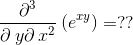
Solution:
![\frac{\partial ^3}{\partial \:y\partial \:x^2}\left(e^{xy}\right)=\frac{\partial ^2}{\partial \:x^2}[\frac{\partial }{\partial y}\left(e^{xy}\right)]\\ \Rightarrow \frac{\partial }{\partial y}\left(e^{xy}\right)=e^{xy}x\\ =\frac{\partial ^2}{\partial \:x^2}[e^{xy}x]\\](http://img.homeworklib.com/questions/2833c180-1160-11eb-9a6f-53d8d8920428.png?x-oss-process=image/resize,w_560)
Now
![\frac{\partial }{\partial \:x}[e^{xy}x] =\frac{\partial \:}{\partial \:x}\left(e^{xy}\right)x+\frac{\partial \:}{\partial \:x}\left(x\right)e^{xy}\\ =e^{xy}yx+1\cdot \:e^{xy}\\ =e^{xy}xy+e^{xy}](http://img.homeworklib.com/questions/288aec80-1160-11eb-b415-d39d480d1bde.png?x-oss-process=image/resize,w_560)
![\frac{\partial ^2}{\partial \:x^2}[e^{xy}x]=\frac{\partial }{\partial x}[e^{xy}xy+e^{xy}]\\ =\frac{\partial \:}{\partial \:x}\left(e^{xy}xy\right)+\frac{\partial \:}{\partial \:x}\left(e^{xy}\right)\\ =y\left(ye^{yx}x+e^{yx}\right)+e^{xy}y\\ =e^{xy}xy^2+2e^{xy}y](http://img.homeworklib.com/questions/28dfb8b0-1160-11eb-838a-0fd62b698361.png?x-oss-process=image/resize,w_560)
So

put (x,y)=(1,2)

Answer:
|
|

If you have any doubts reply in here,please rate the answer.Thank you.
Add Answer to:
Question 15 Find 331 - for f(x, y) = pay at (x, y) = (1,2). მცმე-2...
The joint pmf of X and Y is defined by f(x,y)=, x=1,2; y=1,2 (a) Find Cov(X,Y)....
 The joint pmf of X and Y is defined by f(x,y)=,
x=1,2; y=1,2
(a) Find Cov(X,Y).
(b)Find E(X|Y=1)
x + 2y 18
The joint pmf of X and Y is defined by f(x,y)=,
x=1,2; y=1,2
(a) Find Cov(X,Y).
(b)Find E(X|Y=1)
x + 2y 18
Let f(x,y)=x^2*y. Find the directional derivative of f at (1,2) in the direction of (3,4).
Let f(x,y)=x^2*y. Find the directional derivative of f at (1,2) in the direction of (3,4).
Question 8 (15 marks) Consider the function f: R2 R2 given by 1 (, y)(0,0) f(r,y) (a) Consider the surface z f(x, y). (...
 Question 8 (15 marks) Consider the function f: R2 R2 given by 1 (, y)(0,0) f(r,y) (a) Consider the surface z f(x, y). (i Determine the level curves for the surface when z on the same diagram in the r-y plane. 1 and 2, Sketch the level curves (i) Determine the cross-sectional curves of the surface in the r-z plane and in the y- plane. Sketch the two cross-sectional curves (iii) Sketch the surface. (b) For the point (r, y)...
Let F(x,y) = (2xy - +4,x? - X). If F is conservative, find f(1,2), where f...
 Let F(x,y) = (2xy - +4,x? - X). If F is conservative, find f(1,2), where f is the potential function for F with constant 0.
Question 1. (15 pts) Given f(x, y) = 3x 2 + y 3 . (a) Find...
 Question 1. (15 pts) Given f(x,
y) = 3x 2 + y 3 . (a) Find the gradient of f. (b) Find the
directional derivative of f at P0 = (3, 2) in the direction of u =
(5/13)i + (12/13)j.
Question 1. (15 pts) Given f(L,y) = 3x2 +y?. (a) Find the gradient of f. (b) Find the directional derivative off at P =(3,2) in the direction of u=(5/13)i + (12/13)j.
Question 1. (15 pts) Given f(x,
y) = 3x 2 + y 3 . (a) Find the gradient of f. (b) Find the
directional derivative of f at P0 = (3, 2) in the direction of u =
(5/13)i + (12/13)j.
Question 1. (15 pts) Given f(L,y) = 3x2 +y?. (a) Find the gradient of f. (b) Find the directional derivative off at P =(3,2) in the direction of u=(5/13)i + (12/13)j.
Question 23 Find the maximum of f(x, y) = 5x 3y subject to the constraint x?...
 Question 23 Find the maximum of f(x, y) = 5x 3y subject to the constraint x? + y =136. 80 54 68 72 None of the above or below 136
7.) Given f(x,1,2)=x²e (9²2) find: > SPIED A.) x (x, y, z) B.) fy (x,y,z) c.)...
 7.) Given f(x,1,2)=x²e (9²2) find: > SPIED A.) x (x, y, z) B.) fy (x,y,z) c.) fz (x,y,z) D.) Syy (x, y, z) 8.) At the Point P (1,2), find the slope of the function $(x,y) = 7x’y in the direction of ū = 43,47
Let the joint pdf of X and Y be defined by f(x,y)=\frac{x+y}{32} x=1,2, y=1,2,3,4 a) find...
Let the joint pdf of X and Y be defined by f(x,y)=\frac{x+y}{32} x=1,2, y=1,2,3,4 a) find fx(x), the marginal p.d.f of X b) find fy(y). the marginal p.d.f of p(x>y),p(y=2x) f) find P(x<= 3-Y) g) Are X and Y independent or dependent? Why or why not?
Chapter 15, Section 15.1, Question 020 Find diy F and curl F. F(x,y,z) = 4e" i...
 Chapter 15, Section 15.1, Question 020 Find diy F and curl F. F(x,y,z) = 4e" i - 7 cosy j + 10 sin’z k Enter the exact answers. Enter a value in each entry area, even if the coefficients are 0 or 1 for curl F. div F = ? Edit curl F = 2 Edit Di + ? Edit Dj + ( 2 Edit k By accessing this Question Assistance, you will learn while you eam points based on...
Question 20 The solution to the linear inequality − 10 x + 2 y > −...
Question 20 The solution to the linear inequality − 10 x + 2 y > − 4 will be the half-plane lying a) on and below the solid line − 10 x + 2 y = − 4. b) below the solid line − 10 x − 2 y = − 4. c) above the dashed line − 10 x + 2 y = − 4. d) on and above the solid line − 10 x + 2 y = − 4. e) below...
 The joint pmf of X and Y is defined by f(x,y)=,
x=1,2; y=1,2
(a) Find Cov(X,Y).
(b)Find E(X|Y=1)
x + 2y 18
The joint pmf of X and Y is defined by f(x,y)=,
x=1,2; y=1,2
(a) Find Cov(X,Y).
(b)Find E(X|Y=1)
x + 2y 18
 Question 8 (15 marks) Consider the function f: R2 R2 given by 1 (, y)(0,0) f(r,y) (a) Consider the surface z f(x, y). (i Determine the level curves for the surface when z on the same diagram in the r-y plane. 1 and 2, Sketch the level curves (i) Determine the cross-sectional curves of the surface in the r-z plane and in the y- plane. Sketch the two cross-sectional curves (iii) Sketch the surface. (b) For the point (r, y)...
 Let F(x,y) = (2xy - +4,x? - X). If F is conservative, find f(1,2), where f is the potential function for F with constant 0.
 Question 1. (15 pts) Given f(x,
y) = 3x 2 + y 3 . (a) Find the gradient of f. (b) Find the
directional derivative of f at P0 = (3, 2) in the direction of u =
(5/13)i + (12/13)j.
Question 1. (15 pts) Given f(L,y) = 3x2 +y?. (a) Find the gradient of f. (b) Find the directional derivative off at P =(3,2) in the direction of u=(5/13)i + (12/13)j.
Question 1. (15 pts) Given f(x,
y) = 3x 2 + y 3 . (a) Find the gradient of f. (b) Find the
directional derivative of f at P0 = (3, 2) in the direction of u =
(5/13)i + (12/13)j.
Question 1. (15 pts) Given f(L,y) = 3x2 +y?. (a) Find the gradient of f. (b) Find the directional derivative off at P =(3,2) in the direction of u=(5/13)i + (12/13)j.
 Question 23 Find the maximum of f(x, y) = 5x 3y subject to the constraint x? + y =136. 80 54 68 72 None of the above or below 136
 7.) Given f(x,1,2)=x²e (9²2) find: > SPIED A.) x (x, y, z) B.) fy (x,y,z) c.) fz (x,y,z) D.) Syy (x, y, z) 8.) At the Point P (1,2), find the slope of the function $(x,y) = 7x’y in the direction of ū = 43,47
 Chapter 15, Section 15.1, Question 020 Find diy F and curl F. F(x,y,z) = 4e" i - 7 cosy j + 10 sin’z k Enter the exact answers. Enter a value in each entry area, even if the coefficients are 0 or 1 for curl F. div F = ? Edit curl F = 2 Edit Di + ? Edit Dj + ( 2 Edit k By accessing this Question Assistance, you will learn while you eam points based on...
Most questions answered within 3 hours.
-
Where is the error in this code sequence?
String s1 = "Hello";
String s2 = "ello";...
asked 11 months ago -
Financial data for Joel de Paris, Inc., for last year
follow:
Joel de Paris, Inc.
Balance...
asked 11 months ago -
Consider this reaction:
Al2(SO4)3 (aq)+ BaCl3
(aq) Al2Cl6 (aq)- +
3BaSO4(s) . What is the...
asked 11 months ago -
Suppose that Savneet is considering increasing her
recent random sample from 20 car rentals to 40...
asked 11 months ago -
Trucks arrive at an unloading terminal at an average rate of 120
per hour.
Trucks arrive...
asked 11 months ago -
Why are methanol and ethanol completely soluble in water while
octanol is not very little soluble....
asked 11 months ago -
A facilities manager at a university reads in a research report
that the mean amount of...
asked 11 months ago -
When the CuSO4 is rehydrated by adding water to the anhydrous
compound, is this an endothermic...
asked 11 months ago -
A ray of sunlight is passing from diamond into crown glass; the
angle of incidence is...
asked 11 months ago -
A block of mass 0.249 kg is placed on top of a light, vertical
spring of...
asked 11 months ago -
how do the kidneys compensate in the presences of acidosis
a) trigger hyperventilate
b) reserve acid...
asked 11 months ago -
Question 501 pts
The rental rate of capital to the firm increases. Which of the
following...
asked 11 months ago