
Homework Answers
Add Answer to:
6.3 Exercises In Exercises 1-5 find the current in the RLC circuit, assuming that E(t) =...
PROBLEM 5. TUNING A CIRCUIT: PRACTICAL RESONANCE. Consider a forced RLC circuit with L-1 (H), R-1...
 PROBLEM 5. TUNING A CIRCUIT: PRACTICAL RESONANCE. Consider a forced RLC circuit with L-1 (H), R-10 (12) and C 丽0 (f). Suppose an alternating current supplies a electromotive force Et)100 coswt. The equation modeling the charge Q(t) on the capacitor is 650 Q"(t) 10Q650Q(t) 100 coswt. a. Is the damping over-, under- or critical? Find the form of the general solution. Identify the transient and steady-state parts of the solution. b. Find the amplitude C(w) of the steady-state piece (here...
1. Use Laplace Transforms to determine the function modeling the current in an RLC circuit with L 10 Henries, R 20 ohms...
 1. Use Laplace Transforms to determine the function modeling the current in an RLC circuit with L 10 Henries, R 20 ohms, C = 0.02 Farads, the initial charge is Q(0) = 0, the initial current is I(0) = 0, there is an electromotive force forcing the RLC circuit via the voltage function E(t) letting the current alternate naturally through the circuit. Use the fact the differential 10 sin (t), nd then, at t = 2T seconds, the battery is...
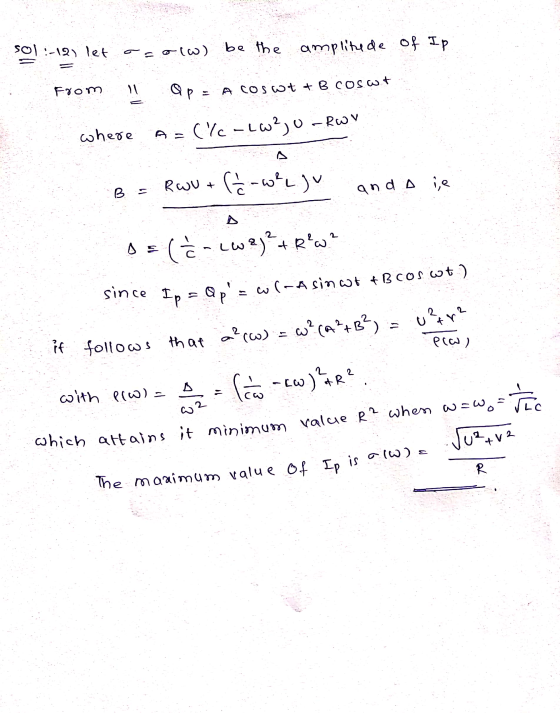
Show that if E(t) = U cos ωt+V sin ωt where U and V are constants then the steady state current is
Show that if E(t) = U cos ωt+V sin ωt where U and V are constants then the steady state current in the RLC is Ip = (ω 2RE(t) + (1/C − Lω2 )E0 (t))/ ∆ , where ∆ = (1/C − Lω2 ) 2 + R 2ω 2 .
Show that if E(t) = U cos ωt+V sin ωt where U and V are constants...
Show that if E(t) = U cos ωt+V sin ωt where U and V are constants then the steady state current in the RLC circuit shown below Ip = (ω2RE(t)+(1/C − Lω2)E′(t))/∆ ∆ = (1/C − Lω2)2 + R2ω2.
Solve the initial value problem honhomogeneous equation: LQ"+RQ+ Q = E. coswt initial Conditions: SQ (0)=Qe,...
 Solve the initial value problem honhomogeneous equation: LQ"+RQ+ Q = E. coswt initial Conditions: SQ (0)=Qe, Q (0) = Q! as follows: + First solve the associated homogeneous lequation LQ"+RQ'TEQ =0 by using the characteristic equation Irt art &r=0 to obtain three types of solutions 2 Next show how to find a particular solution Qp to the non homogeneous equation by showing Oplt) = t-Lw²coswt twR sin (wt) ( - Lw²) 4 w²R Eo Show in detail that you can...
b) A periodic voltage vs(t) is applied to a RLC circuit shown in Figure 1 (b)...
 b) A periodic voltage vs(t) is applied to a RLC circuit shown in Figure 1 (b) with R=10012, L=100mH and C=1pF. The first four nonzero terms in the Fourier series is given by the following: v:(t) = 10 +2 sin(10’t)-1sin(2x10't)+sin(3x10°r) v Find the first four nonzero terms in the Fourier series of the steady-state current iſt). (20 marks) R M v.(t) Tv.(t) Figure 2(b): Circuit for Question 2
+0/1 points | Previous Answers WWCMDiffEQLinAlg1 2.7.003b My Notes For the following LRC circuit ...
 +0/1 points | Previous Answers WWCMDiffEQLinAlg1 2.7.003b My Notes For the following LRC circuit with periodic electric source v(t), find the steady-periodic current in the form isp(t)-10 sin(wt-d), where 10 > 0 and 0 δ < 2π. (Round numerical values to two decimal places.) R = 20, L = 10, C = 0.01, v(t) = 900 cos(5) | isp(t): 54.48 sin(5t-.54) Additional Materials eBook
+0/1 points | Previous Answers WWCMDiffEQLinAlg1 2.7.003b My Notes For the following LRC circuit with periodic...
+0/1 points | Previous Answers WWCMDiffEQLinAlg1 2.7.003b My Notes For the following LRC circuit with periodic electric source v(t), find the steady-periodic current in the form isp(t)-10 sin(wt-d), where 10 > 0 and 0 δ < 2π. (Round numerical values to two decimal places.) R = 20, L = 10, C = 0.01, v(t) = 900 cos(5) | isp(t): 54.48 sin(5t-.54) Additional Materials eBook
+0/1 points | Previous Answers WWCMDiffEQLinAlg1 2.7.003b My Notes For the following LRC circuit with periodic...
2. This problem is about an RLC circuit, which involves a resistor (of resistance R ohms),...
 2. This problem is about an RLC circuit, which involves a resistor (of resistance R ohms), an inductor (of L henries), and a capacitor (of C farads). There is also a voltage source (such as a battery) providing E(t) volts at time t. 0 Switch When the switch is closed there is a current of I(t) amperes. With the help of Kirchhoff's laws one can derive an ODE for I = I(t): LI" + RI' + + I = E'(t)...
In a series resistance-capacitance DC circuit, the instantaneous charge Q on the capacitor as a... In...
In a series resistance-capacitance DC circuit, the instantaneous charge Q on the capacitor as a... In a series resistance-capacitance DC circuit, the instantaneous charge Q on the capacitor as a function of time (where t=0 is the moment the circuit is energized by closing a switch) is given by the equation Q(t)=CV(1-e-t/(RC), where C, V, and R are constants. Further, the instantaneous charging current Ic is the rate of change of charge on the capacitor, or Ic=dQ/dt a. Find the...
A sinusoidal voltage v(t) = (40 V) sin(100t) is applied to a series RLC circuit with...
 A sinusoidal voltage v(t) = (40 V) sin(100t) is applied to a series RLC circuit with L = 160 mH, C = 99 mu/F. and R = 68 ohm. What is the impedance of the circuit? What is the current amplitude? Determine the numerical values for I_m, and omega, and phi in the equation i(t) = I_m sin(omegst minus phi).
 PROBLEM 5. TUNING A CIRCUIT: PRACTICAL RESONANCE. Consider a forced RLC circuit with L-1 (H), R-10 (12) and C 丽0 (f). Suppose an alternating current supplies a electromotive force Et)100 coswt. The equation modeling the charge Q(t) on the capacitor is 650 Q"(t) 10Q650Q(t) 100 coswt. a. Is the damping over-, under- or critical? Find the form of the general solution. Identify the transient and steady-state parts of the solution. b. Find the amplitude C(w) of the steady-state piece (here...
 1. Use Laplace Transforms to determine the function modeling the current in an RLC circuit with L 10 Henries, R 20 ohms, C = 0.02 Farads, the initial charge is Q(0) = 0, the initial current is I(0) = 0, there is an electromotive force forcing the RLC circuit via the voltage function E(t) letting the current alternate naturally through the circuit. Use the fact the differential 10 sin (t), nd then, at t = 2T seconds, the battery is...
 Solve the initial value problem honhomogeneous equation: LQ"+RQ+ Q = E. coswt initial Conditions: SQ (0)=Qe, Q (0) = Q! as follows: + First solve the associated homogeneous lequation LQ"+RQ'TEQ =0 by using the characteristic equation Irt art &r=0 to obtain three types of solutions 2 Next show how to find a particular solution Qp to the non homogeneous equation by showing Oplt) = t-Lw²coswt twR sin (wt) ( - Lw²) 4 w²R Eo Show in detail that you can...
 b) A periodic voltage vs(t) is applied to a RLC circuit shown in Figure 1 (b) with R=10012, L=100mH and C=1pF. The first four nonzero terms in the Fourier series is given by the following: v:(t) = 10 +2 sin(10’t)-1sin(2x10't)+sin(3x10°r) v Find the first four nonzero terms in the Fourier series of the steady-state current iſt). (20 marks) R M v.(t) Tv.(t) Figure 2(b): Circuit for Question 2
 +0/1 points | Previous Answers WWCMDiffEQLinAlg1 2.7.003b My Notes For the following LRC circuit with periodic electric source v(t), find the steady-periodic current in the form isp(t)-10 sin(wt-d), where 10 > 0 and 0 δ < 2π. (Round numerical values to two decimal places.) R = 20, L = 10, C = 0.01, v(t) = 900 cos(5) | isp(t): 54.48 sin(5t-.54) Additional Materials eBook
+0/1 points | Previous Answers WWCMDiffEQLinAlg1 2.7.003b My Notes For the following LRC circuit with periodic...
+0/1 points | Previous Answers WWCMDiffEQLinAlg1 2.7.003b My Notes For the following LRC circuit with periodic electric source v(t), find the steady-periodic current in the form isp(t)-10 sin(wt-d), where 10 > 0 and 0 δ < 2π. (Round numerical values to two decimal places.) R = 20, L = 10, C = 0.01, v(t) = 900 cos(5) | isp(t): 54.48 sin(5t-.54) Additional Materials eBook
+0/1 points | Previous Answers WWCMDiffEQLinAlg1 2.7.003b My Notes For the following LRC circuit with periodic...
 2. This problem is about an RLC circuit, which involves a resistor (of resistance R ohms), an inductor (of L henries), and a capacitor (of C farads). There is also a voltage source (such as a battery) providing E(t) volts at time t. 0 Switch When the switch is closed there is a current of I(t) amperes. With the help of Kirchhoff's laws one can derive an ODE for I = I(t): LI" + RI' + + I = E'(t)...
 A sinusoidal voltage v(t) = (40 V) sin(100t) is applied to a series RLC circuit with L = 160 mH, C = 99 mu/F. and R = 68 ohm. What is the impedance of the circuit? What is the current amplitude? Determine the numerical values for I_m, and omega, and phi in the equation i(t) = I_m sin(omegst minus phi).
Most questions answered within 3 hours.
-
Where is the error in this code sequence?
String s1 = "Hello";
String s2 = "ello";...
asked 11 months ago -
Financial data for Joel de Paris, Inc., for last year
follow:
Joel de Paris, Inc.
Balance...
asked 11 months ago -
Consider this reaction:
Al2(SO4)3 (aq)+ BaCl3
(aq) Al2Cl6 (aq)- +
3BaSO4(s) . What is the...
asked 11 months ago -
Suppose that Savneet is considering increasing her
recent random sample from 20 car rentals to 40...
asked 11 months ago -
Trucks arrive at an unloading terminal at an average rate of 120
per hour.
Trucks arrive...
asked 11 months ago -
Why are methanol and ethanol completely soluble in water while
octanol is not very little soluble....
asked 11 months ago -
A facilities manager at a university reads in a research report
that the mean amount of...
asked 11 months ago -
When the CuSO4 is rehydrated by adding water to the anhydrous
compound, is this an endothermic...
asked 11 months ago -
A ray of sunlight is passing from diamond into crown glass; the
angle of incidence is...
asked 11 months ago -
A block of mass 0.249 kg is placed on top of a light, vertical
spring of...
asked 11 months ago -
how do the kidneys compensate in the presences of acidosis
a) trigger hyperventilate
b) reserve acid...
asked 11 months ago -
Question 501 pts
The rental rate of capital to the firm increases. Which of the
following...
asked 11 months ago