
Homework Answers

Add Answer to:
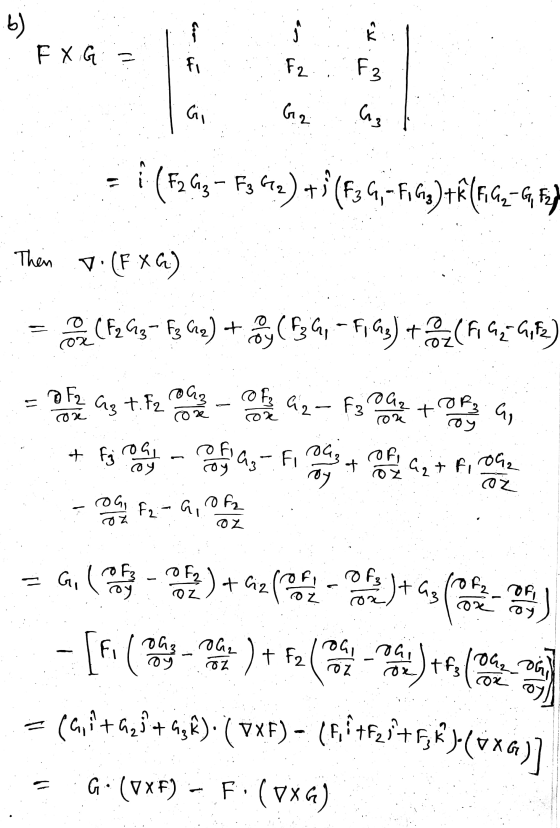
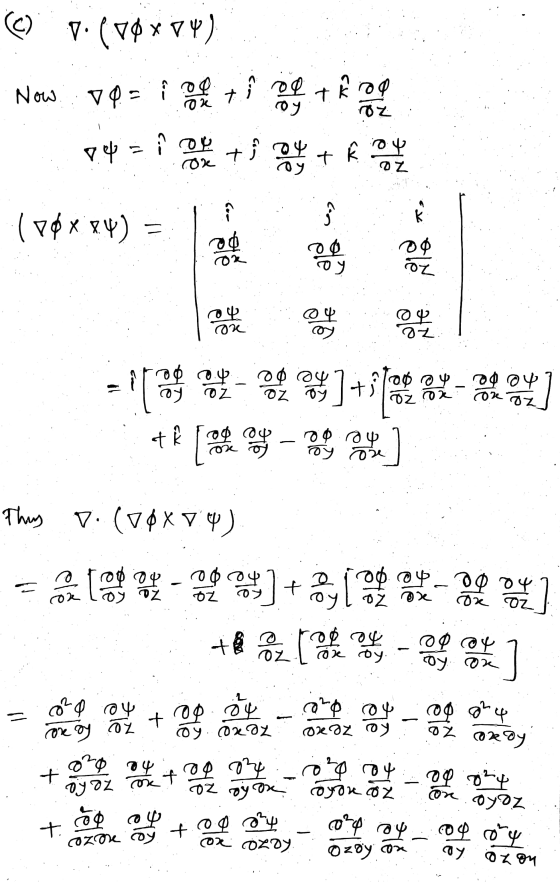
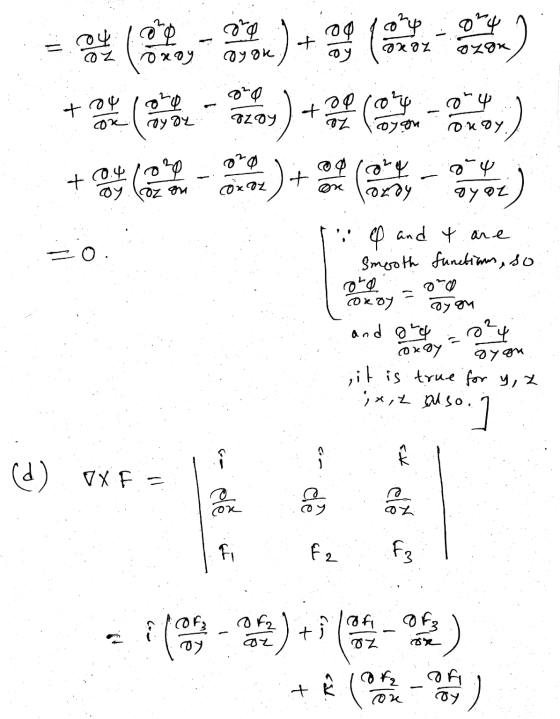
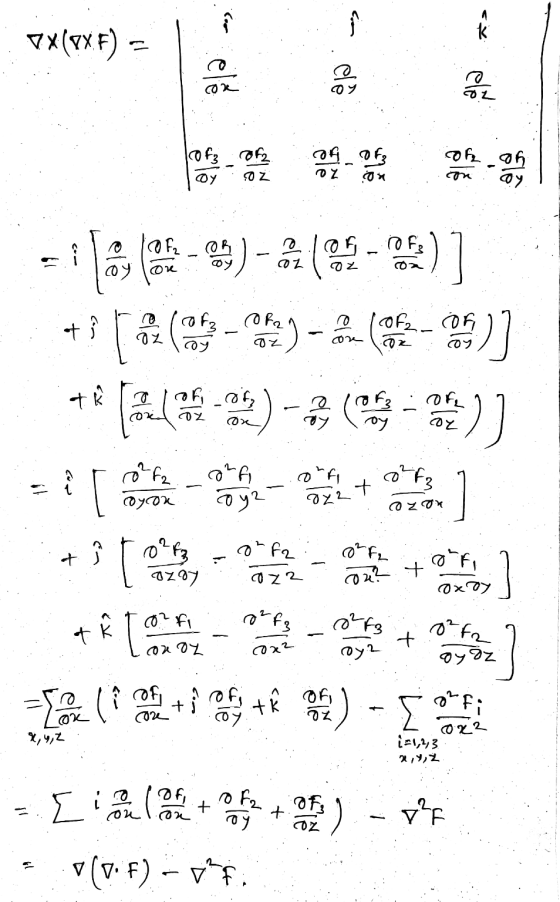
Problem 9 Prove the following identities where o and ø are scalar fields, and F and...
3. Let f(x, y, ). g(y,z) and h(x,y,z) be C2 scalar functions. Prove the following identity: (a) B...
 Please solve all parts in this problem neatly
3. Let f(x, y, ). g(y,z) and h(x,y,z) be C2 scalar functions. Prove the following identity: (a) By direct calculation (without using the vector identities) ( b) Using the vector identities. Clearly state which identities you have used .
3. Let f(x, y, ). g(y,z) and h(x,y,z) be C2 scalar functions. Prove the following identity: (a) By direct calculation (without using the vector identities) ( b) Using the vector identities. Clearly state...
Please solve all parts in this problem neatly
3. Let f(x, y, ). g(y,z) and h(x,y,z) be C2 scalar functions. Prove the following identity: (a) By direct calculation (without using the vector identities) ( b) Using the vector identities. Clearly state which identities you have used .
3. Let f(x, y, ). g(y,z) and h(x,y,z) be C2 scalar functions. Prove the following identity: (a) By direct calculation (without using the vector identities) ( b) Using the vector identities. Clearly state...
1. (1.5 points) Sketch the following vector fields: (B) B(x,y)=(z-y,2). (C) Vf where f(x,y) = xy
 1. (1.5 points) Sketch the following vector fields: (B) B(x,y)=(z-y,2). (C) Vf where f(x,y) = xy
1. (1.5 points) Sketch the following vector fields: (B) B(x,y)=(z-y,2). (C) Vf where f(x,y) = xy
1. (1.5 points) Sketch the following vector fields: (B) B(x,y)=(z-y,2). (C) Vf where f(x,y) = xy
Problem 4. (15 points each) Let F(x, y, z) = (0, x, y) G(x, y, z)...
 Problem 4. (15 points each) Let F(x, y, z) = (0, x, y) G(x, y, z) = (2x, z, y) + (x, y, z) = (3y, 2x, z). (a) For each field, either find a scalar potential function or prove that none exists. (b) For each field, either find a vector potential function or prove that none exists. (c) Let F(t) = (2, 2t, t2). For which of these vector fields is ñ a flow line? Justify your answer.
First find f+g, f-g, fg and Then determine the domain for each function. f(x) = 4x...
 First find f+g, f-g, fg and Then determine the domain for each function. f(x) = 4x + 1, g(x) = x - 9 (f+g)(x) = (Simplify your answer.) What is the domain off+g? O [0,00) 0 (-00,00) (4-9)(x) = (Simplify your answer.) What is the domain off-g? O O o [0,00) (-00,00) ( 10 ) Click to select your answer(s). First find f+g, f-g, fg and - Then determine the domain for each function. f(x) = 4x + 1, g(x)=x-9...
9. Using Generalized Curvilinear Coördinates, if the scalar S and the vector Ä are both functions...
 9. Using Generalized Curvilinear Coördinates, if the scalar S and the vector Ä are both functions of position, prove the following relations: (a) 7 (SA)=s(8. A)+A.IS; (b) (x(SA)=s(0xĂ)+()xA; (c) Ex(s)=0; (a) 8x(0xA)=(. A)-VA. Most of these identities are independent of the specific coördinate system that one employs; however, care must be taken with the operator VA, since in Cartesian Coördinates, it is defined as G?A=i(v?4)+1(v24,)+R(v?4.), but in the Cartesian case, the unit vectors are independent of the coordinate variables, which...
Let F, =M, i+Nyj+Pk and F2 =Mzi + N2j+Pyk be differentiable vector fields and let a...
 Let F, =M, i+Nyj+Pk and F2 =Mzi + N2j+Pyk be differentiable vector fields and let a and b be arbitrary real constants. Verify the following identities. a. V. (aF7 +bF2)=aV.Fy+bV.F2 b. Vx(aF, +bF2) =aVxF, +bVxF2 c. V. (F, ⓇF_)=F2.VxF,-F7.VxFz a. Start by expressing af, +bF, in terms of My, Ng, P1, M2, Ny, and P2- V.(aF, + bFy)=v-[i+Di+(k] a a Use the definition of the divergence of a vector field, denoted div For V.F, to expand the right side of...
how did we get the following equation (1.9) from maxwells equations at e at where p is the density of free charges and j is the density of currents at a point where the electric and magnetic fie...
 how
did we get the following equation (1.9) from maxwells
equations
at e at where p is the density of free charges and j is the density of currents at a point where the electric and magnetic fields are evaluated. The parameters and are constants that determine the property of the vacuum and are called the electric permittivity and magnetic permeability respectively The parameter c-1/olo and its numerical value is equal to the speed of light in vacuum,c 3 x...
how
did we get the following equation (1.9) from maxwells
equations
at e at where p is the density of free charges and j is the density of currents at a point where the electric and magnetic fields are evaluated. The parameters and are constants that determine the property of the vacuum and are called the electric permittivity and magnetic permeability respectively The parameter c-1/olo and its numerical value is equal to the speed of light in vacuum,c 3 x...
Problem 9. Let ABCD be a parallelogram. Let E be a point on AD. Let F...
 Problem 9. Let ABCD be a parallelogram. Let E be a point on AD. Let F = BEN AC and G = BE CD. Prove BF = V FG* FE
4. (a) Prove the following Green's identity for functions f.g E Co(2) where2C R'" where the notat...
 Prove the following Green's identity for function.....
4. (a) Prove the following Green's identity for functions f.g E Co(2) where2C R'" where the notation : ▽ Vf n, where n is the outward pointing unit normal vector. You may use the divergence theorem, as well as the identity (b) Let G(x.xo) denote the Green's function for the Laplacian on Ω with Dirichlet boundary con- ditions, that is, 4,G(x, xo) = δ(x-xo), for x 62 (x,x;)= 0 for x Eon By...
Prove the following Green's identity for function.....
4. (a) Prove the following Green's identity for functions f.g E Co(2) where2C R'" where the notation : ▽ Vf n, where n is the outward pointing unit normal vector. You may use the divergence theorem, as well as the identity (b) Let G(x.xo) denote the Green's function for the Laplacian on Ω with Dirichlet boundary con- ditions, that is, 4,G(x, xo) = δ(x-xo), for x 62 (x,x;)= 0 for x Eon By...
Extra Credit Prove that the V fo at each point Po (xo. yo, zo) on the surface f(x(t),y(t),z(r)) =...
 Extra Credit Prove that the V fo at each point Po (xo. yo, zo) on the surface f(x(t),y(t),z(r)) = K for some constant K is orthogonal to the tangent vector T() of each curve C described by the vector function on the surface passing through Po (xo,yo, zo). Hint, remember that the tangent vector T(o) R'(), so prove that Vfo R'O) 0
Extra Credit Prove that the V fo at each point Po (xo. yo, zo) on the surface f(x(t),y(t),z(r))...
Extra Credit Prove that the V fo at each point Po (xo. yo, zo) on the surface f(x(t),y(t),z(r)) = K for some constant K is orthogonal to the tangent vector T() of each curve C described by the vector function on the surface passing through Po (xo,yo, zo). Hint, remember that the tangent vector T(o) R'(), so prove that Vfo R'O) 0
Extra Credit Prove that the V fo at each point Po (xo. yo, zo) on the surface f(x(t),y(t),z(r))...
 Please solve all parts in this problem neatly
3. Let f(x, y, ). g(y,z) and h(x,y,z) be C2 scalar functions. Prove the following identity: (a) By direct calculation (without using the vector identities) ( b) Using the vector identities. Clearly state which identities you have used .
3. Let f(x, y, ). g(y,z) and h(x,y,z) be C2 scalar functions. Prove the following identity: (a) By direct calculation (without using the vector identities) ( b) Using the vector identities. Clearly state...
Please solve all parts in this problem neatly
3. Let f(x, y, ). g(y,z) and h(x,y,z) be C2 scalar functions. Prove the following identity: (a) By direct calculation (without using the vector identities) ( b) Using the vector identities. Clearly state which identities you have used .
3. Let f(x, y, ). g(y,z) and h(x,y,z) be C2 scalar functions. Prove the following identity: (a) By direct calculation (without using the vector identities) ( b) Using the vector identities. Clearly state...
 1. (1.5 points) Sketch the following vector fields: (B) B(x,y)=(z-y,2). (C) Vf where f(x,y) = xy
1. (1.5 points) Sketch the following vector fields: (B) B(x,y)=(z-y,2). (C) Vf where f(x,y) = xy
1. (1.5 points) Sketch the following vector fields: (B) B(x,y)=(z-y,2). (C) Vf where f(x,y) = xy
 Problem 4. (15 points each) Let F(x, y, z) = (0, x, y) G(x, y, z) = (2x, z, y) + (x, y, z) = (3y, 2x, z). (a) For each field, either find a scalar potential function or prove that none exists. (b) For each field, either find a vector potential function or prove that none exists. (c) Let F(t) = (2, 2t, t2). For which of these vector fields is ñ a flow line? Justify your answer.
 First find f+g, f-g, fg and Then determine the domain for each function. f(x) = 4x + 1, g(x) = x - 9 (f+g)(x) = (Simplify your answer.) What is the domain off+g? O [0,00) 0 (-00,00) (4-9)(x) = (Simplify your answer.) What is the domain off-g? O O o [0,00) (-00,00) ( 10 ) Click to select your answer(s). First find f+g, f-g, fg and - Then determine the domain for each function. f(x) = 4x + 1, g(x)=x-9...
 9. Using Generalized Curvilinear Coördinates, if the scalar S and the vector Ä are both functions of position, prove the following relations: (a) 7 (SA)=s(8. A)+A.IS; (b) (x(SA)=s(0xĂ)+()xA; (c) Ex(s)=0; (a) 8x(0xA)=(. A)-VA. Most of these identities are independent of the specific coördinate system that one employs; however, care must be taken with the operator VA, since in Cartesian Coördinates, it is defined as G?A=i(v?4)+1(v24,)+R(v?4.), but in the Cartesian case, the unit vectors are independent of the coordinate variables, which...
 Let F, =M, i+Nyj+Pk and F2 =Mzi + N2j+Pyk be differentiable vector fields and let a and b be arbitrary real constants. Verify the following identities. a. V. (aF7 +bF2)=aV.Fy+bV.F2 b. Vx(aF, +bF2) =aVxF, +bVxF2 c. V. (F, ⓇF_)=F2.VxF,-F7.VxFz a. Start by expressing af, +bF, in terms of My, Ng, P1, M2, Ny, and P2- V.(aF, + bFy)=v-[i+Di+(k] a a Use the definition of the divergence of a vector field, denoted div For V.F, to expand the right side of...
 how
did we get the following equation (1.9) from maxwells
equations
at e at where p is the density of free charges and j is the density of currents at a point where the electric and magnetic fields are evaluated. The parameters and are constants that determine the property of the vacuum and are called the electric permittivity and magnetic permeability respectively The parameter c-1/olo and its numerical value is equal to the speed of light in vacuum,c 3 x...
how
did we get the following equation (1.9) from maxwells
equations
at e at where p is the density of free charges and j is the density of currents at a point where the electric and magnetic fields are evaluated. The parameters and are constants that determine the property of the vacuum and are called the electric permittivity and magnetic permeability respectively The parameter c-1/olo and its numerical value is equal to the speed of light in vacuum,c 3 x...
 Problem 9. Let ABCD be a parallelogram. Let E be a point on AD. Let F = BEN AC and G = BE CD. Prove BF = V FG* FE
 Prove the following Green's identity for function.....
4. (a) Prove the following Green's identity for functions f.g E Co(2) where2C R'" where the notation : ▽ Vf n, where n is the outward pointing unit normal vector. You may use the divergence theorem, as well as the identity (b) Let G(x.xo) denote the Green's function for the Laplacian on Ω with Dirichlet boundary con- ditions, that is, 4,G(x, xo) = δ(x-xo), for x 62 (x,x;)= 0 for x Eon By...
Prove the following Green's identity for function.....
4. (a) Prove the following Green's identity for functions f.g E Co(2) where2C R'" where the notation : ▽ Vf n, where n is the outward pointing unit normal vector. You may use the divergence theorem, as well as the identity (b) Let G(x.xo) denote the Green's function for the Laplacian on Ω with Dirichlet boundary con- ditions, that is, 4,G(x, xo) = δ(x-xo), for x 62 (x,x;)= 0 for x Eon By...
 Extra Credit Prove that the V fo at each point Po (xo. yo, zo) on the surface f(x(t),y(t),z(r)) = K for some constant K is orthogonal to the tangent vector T() of each curve C described by the vector function on the surface passing through Po (xo,yo, zo). Hint, remember that the tangent vector T(o) R'(), so prove that Vfo R'O) 0
Extra Credit Prove that the V fo at each point Po (xo. yo, zo) on the surface f(x(t),y(t),z(r))...
Extra Credit Prove that the V fo at each point Po (xo. yo, zo) on the surface f(x(t),y(t),z(r)) = K for some constant K is orthogonal to the tangent vector T() of each curve C described by the vector function on the surface passing through Po (xo,yo, zo). Hint, remember that the tangent vector T(o) R'(), so prove that Vfo R'O) 0
Extra Credit Prove that the V fo at each point Po (xo. yo, zo) on the surface f(x(t),y(t),z(r))...
Most questions answered within 3 hours.
-
Where is the error in this code sequence?
String s1 = "Hello";
String s2 = "ello";...
asked 10 months ago -
Financial data for Joel de Paris, Inc., for last year
follow:
Joel de Paris, Inc.
Balance...
asked 10 months ago -
Consider this reaction:
Al2(SO4)3 (aq)+ BaCl3
(aq) Al2Cl6 (aq)- +
3BaSO4(s) . What is the...
asked 10 months ago -
Suppose that Savneet is considering increasing her
recent random sample from 20 car rentals to 40...
asked 10 months ago -
Trucks arrive at an unloading terminal at an average rate of 120
per hour.
Trucks arrive...
asked 10 months ago -
Why are methanol and ethanol completely soluble in water while
octanol is not very little soluble....
asked 10 months ago -
A facilities manager at a university reads in a research report
that the mean amount of...
asked 10 months ago -
When the CuSO4 is rehydrated by adding water to the anhydrous
compound, is this an endothermic...
asked 10 months ago -
A ray of sunlight is passing from diamond into crown glass; the
angle of incidence is...
asked 10 months ago -
A block of mass 0.249 kg is placed on top of a light, vertical
spring of...
asked 10 months ago -
how do the kidneys compensate in the presences of acidosis
a) trigger hyperventilate
b) reserve acid...
asked 10 months ago -
Question 501 pts
The rental rate of capital to the firm increases. Which of the
following...
asked 10 months ago