
Homework Answers
Add Answer to:
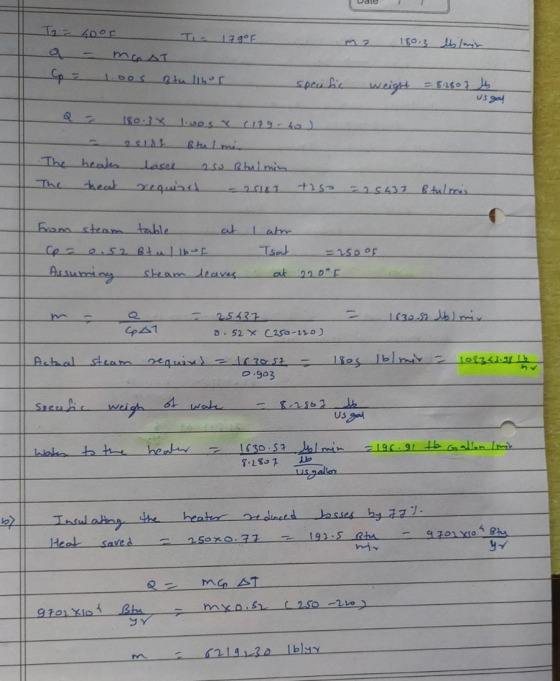
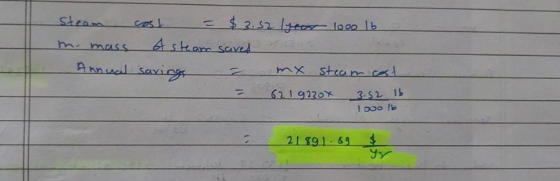
7.2. (PS) A process needs 180.3 lb/min of hot water at 179°F. The water enters the...
A pump is used to circulate hot water in a home heating system. Water enters the...
A pump is used to circulate hot water in a home heating system. Water enters the well-insulated pump operating at steady state at a rate of 0.42 gal/min. The inlet pressure and temperature are 14.7 lbf/in.2, and 180°F, respectively; at the exit the pressure is 90 lbf/in.2 The pump requires 1/15 hp of power input. Water can be modeled as an incompressible substance with constant density of 60.58 lb/ft3 and constant specific heat of 1 Btu/lb · °R. Neglecting kinetic...
A pump is used to circulate hot water in a home heating system. Water enters the...
 A pump is used to circulate hot water in a home heating system.
Water enters the well-insulated pump operating at steady state at a
rate of 0.42 gal/min. The inlet pressure and temperature are 14.7
lbf/in2, and 180F,
respectively; at the exit the pressure is 60 lbf/in2.
The pump requires 1/35 hp of power input. Water can be modeled as
an incompressible substance with constant density of 60.58
lb/ft3 and constant specific heat of 1 Btu/lb
R.
Neglecting kinetic and...
A pump is used to circulate hot water in a home heating system.
Water enters the well-insulated pump operating at steady state at a
rate of 0.42 gal/min. The inlet pressure and temperature are 14.7
lbf/in2, and 180F,
respectively; at the exit the pressure is 60 lbf/in2.
The pump requires 1/35 hp of power input. Water can be modeled as
an incompressible substance with constant density of 60.58
lb/ft3 and constant specific heat of 1 Btu/lb
R.
Neglecting kinetic and...
Problem 4.049 A pump is used to circulate hot water in a home heating system. Water...
 Problem 4.049 A pump is used to circulate hot water in a home heating system. Water enters the well-insulated pump operating at steady state at a rate of 0.42 gal/min. The inlet pressure and temperature are 14.7 lbf/in., and 180°F, respectively; at the exit the pressure is 90 lbf/in. The pump requires 1/35 hp of power input. Water can be modeled as an incompressible substance with constant density of 60.58 lb/ft and constant specific heat of 1 Btu/lb OR Neglecting...
4. Liquid water at 100°F and 200 gal/min volumetric flow rate enters a cooling tower operating...
 4. Liquid water at 100°F and 200 gal/min volumetric flow rate enters a cooling tower operating at steady state. Atmospheric air enters with a dry-bulb temperature of 80°F and a wet-bulb temperature of 60°F. Moist air exits the cooling tower at 90° and 90% relative humidity. Makeup water is provided at 80°F. Calculate the mass flow rates of the dry air and makeup water, each in lb/min, versus return water temperature at 80, 90, and 100°F. Ignore kinetic and potential...
Problem 1: This is textbook problem 4.51 (page 224) Steam at 1800 lbf/in2 and 1100 °F...
Problem 1: This is textbook problem 4.51 (page 224) Steam at 1800 lbf/in2 and 1100 °F enters a turbine operating at steady state. As shown in the Figure, 20% of the entering mass flow is extracted at 600 lbf/in2 and 500 °F. The rest of the steam exits as a saturated vapor at 1 lbf/in2 . The turbine develops a power output of 6.8×10⁶ Btu/h. Heat transfer from the turbine to the surroundings occurs at a rate of 5×10⁴ Btu/h....
When boiling water, a hot plate takes an average of 7 minutes (min) and 16 seconds...
 When boiling water, a hot plate takes an average of 7 minutes (min) and 16 seconds [s] to boil 150 milliliters [ml] of water. Assume the temperature in the lab is 78 degrees Fahrenheit (°F). The hot plate is rated to provide 379 watts [W]. If we wish to boil 150 milliliters (ml) of acetone using this same hot plate, how long do we expect the process to take? Acetone has a boiling point of 56 degrees Celsius [°C]. [Hint:...
a. Calculate the dry air and water vapor mass flow rates (lb/min) if the volume flow...
 a. Calculate the dry air and water vapor mass flow rates (lb/min) if the volume flow rate is 1,000 cfm, the humidity ratio is 0.025 lbv/lba, and the dry air density is 0.072 Iba/ft3. b. Assume the above air enters an evaporator coil at 90°F where it is cooled in a constant humidity ratio process until reaching the 100 % RH curve ( the temperature at that point is the dew point. The air then keeps dropping in temperature, following...
Two large parallel plates with surface conditions approximating those of a blackbody are maintained at 800°C...
 Two large parallel plates with surface conditions approximating those of a blackbody are maintained at 800°C and 100°C, respectively. Determine the rate of heal transfer by radiation between the plates in Wim and the radiative heat transfer coefficient in W/m K ) 12 Write down the one-dimensional sent heal conduction equation for a plane wall with constant thermal conductivity and heat generation in its simplest form, and indicate what each variable represents 13 Write down the one-dimensional transient heat conduction...
 A pump is used to circulate hot water in a home heating system.
Water enters the well-insulated pump operating at steady state at a
rate of 0.42 gal/min. The inlet pressure and temperature are 14.7
lbf/in2, and 180F,
respectively; at the exit the pressure is 60 lbf/in2.
The pump requires 1/35 hp of power input. Water can be modeled as
an incompressible substance with constant density of 60.58
lb/ft3 and constant specific heat of 1 Btu/lb
R.
Neglecting kinetic and...
A pump is used to circulate hot water in a home heating system.
Water enters the well-insulated pump operating at steady state at a
rate of 0.42 gal/min. The inlet pressure and temperature are 14.7
lbf/in2, and 180F,
respectively; at the exit the pressure is 60 lbf/in2.
The pump requires 1/35 hp of power input. Water can be modeled as
an incompressible substance with constant density of 60.58
lb/ft3 and constant specific heat of 1 Btu/lb
R.
Neglecting kinetic and...
 Problem 4.049 A pump is used to circulate hot water in a home heating system. Water enters the well-insulated pump operating at steady state at a rate of 0.42 gal/min. The inlet pressure and temperature are 14.7 lbf/in., and 180°F, respectively; at the exit the pressure is 90 lbf/in. The pump requires 1/35 hp of power input. Water can be modeled as an incompressible substance with constant density of 60.58 lb/ft and constant specific heat of 1 Btu/lb OR Neglecting...
 4. Liquid water at 100°F and 200 gal/min volumetric flow rate enters a cooling tower operating at steady state. Atmospheric air enters with a dry-bulb temperature of 80°F and a wet-bulb temperature of 60°F. Moist air exits the cooling tower at 90° and 90% relative humidity. Makeup water is provided at 80°F. Calculate the mass flow rates of the dry air and makeup water, each in lb/min, versus return water temperature at 80, 90, and 100°F. Ignore kinetic and potential...
 When boiling water, a hot plate takes an average of 7 minutes (min) and 16 seconds [s] to boil 150 milliliters [ml] of water. Assume the temperature in the lab is 78 degrees Fahrenheit (°F). The hot plate is rated to provide 379 watts [W]. If we wish to boil 150 milliliters (ml) of acetone using this same hot plate, how long do we expect the process to take? Acetone has a boiling point of 56 degrees Celsius [°C]. [Hint:...
 a. Calculate the dry air and water vapor mass flow rates (lb/min) if the volume flow rate is 1,000 cfm, the humidity ratio is 0.025 lbv/lba, and the dry air density is 0.072 Iba/ft3. b. Assume the above air enters an evaporator coil at 90°F where it is cooled in a constant humidity ratio process until reaching the 100 % RH curve ( the temperature at that point is the dew point. The air then keeps dropping in temperature, following...
 Two large parallel plates with surface conditions approximating those of a blackbody are maintained at 800°C and 100°C, respectively. Determine the rate of heal transfer by radiation between the plates in Wim and the radiative heat transfer coefficient in W/m K ) 12 Write down the one-dimensional sent heal conduction equation for a plane wall with constant thermal conductivity and heat generation in its simplest form, and indicate what each variable represents 13 Write down the one-dimensional transient heat conduction...
Most questions answered within 3 hours.
-
Where is the error in this code sequence?
String s1 = "Hello";
String s2 = "ello";...
asked 11 months ago -
Financial data for Joel de Paris, Inc., for last year
follow:
Joel de Paris, Inc.
Balance...
asked 11 months ago -
Consider this reaction:
Al2(SO4)3 (aq)+ BaCl3
(aq) Al2Cl6 (aq)- +
3BaSO4(s) . What is the...
asked 11 months ago -
Suppose that Savneet is considering increasing her
recent random sample from 20 car rentals to 40...
asked 11 months ago -
Trucks arrive at an unloading terminal at an average rate of 120
per hour.
Trucks arrive...
asked 11 months ago -
Why are methanol and ethanol completely soluble in water while
octanol is not very little soluble....
asked 11 months ago -
A facilities manager at a university reads in a research report
that the mean amount of...
asked 11 months ago -
When the CuSO4 is rehydrated by adding water to the anhydrous
compound, is this an endothermic...
asked 11 months ago -
A ray of sunlight is passing from diamond into crown glass; the
angle of incidence is...
asked 11 months ago -
A block of mass 0.249 kg is placed on top of a light, vertical
spring of...
asked 11 months ago -
how do the kidneys compensate in the presences of acidosis
a) trigger hyperventilate
b) reserve acid...
asked 11 months ago -
Question 501 pts
The rental rate of capital to the firm increases. Which of the
following...
asked 11 months ago