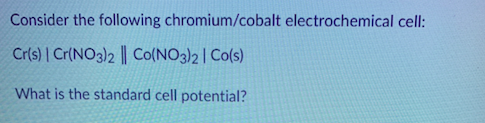
Choices:
a) -1.19 V
b) -0.91 V
c) -0.63 V
d) 0.63 V
e) 0.91 V
Homework Answers
Request Answer!
We need at least 10 more requests to produce the answer.
0 / 10 have requested this problem solution
The more requests, the faster the answer.
A voltaic cell consists of two half-cells. One half-cell contains a chromium electrode immersed in 1.00...
A voltaic cell consists of two half-cells. One half-cell contains a chromium electrode immersed in 1.00 M Cr(NO3)3 solution. The second half-cell contains a cobalt electrode immersed in 1.00 M Co(NO3)2 solution. Cobalt plates out on the cobalt electrode as the voltaic cell runs. The beginning voltage of the cell is +0.467 V at 25°C. The standard electrode potential (standard reduction potential) of chromium at 25°C is −0.744 V. (a) Write a balanced half-reaction equation for the reaction occurring at...
C)/-1.78 V )-0.89 V Given that the is the standard E) None of these. 24,Forthe reaction...
 C)/-1.78 V )-0.89 V Given that the is the standard E) None of these. 24,Forthe reaction N产(aq) + 2Fe2+(aq) → Ni(s) A) 0.80 V 2Fe3 (aq), the standard cell potential cell is oneduo -0.30 v B 0.30 V 9.チ A) +2.81 V +0.52 V D-1.02 V. D) -0.80 V E) 0.43 V 29. Which one E) -2.81 V. spontaneous 25. Consider an electrochemical cell based on the C? following cell diagram:
Consider a galvanic electrochemical cell constructed using Cr/Cr3* and Zn/Zn2+ at 25 °C. The following half-reactions...
 Consider a galvanic electrochemical cell constructed using Cr/Cr3* and Zn/Zn2+ at 25 °C. The following half-reactions are provided for each metal: Cr3+ (aq) + 3 e → Cr(s) Eºred = -0.744 V Zna*(aq) + 2 e Zn(s) Eºred = -0.763 V What is the standard cell potential for this cell?
86. What is the formula for lead (IV) sulfide? B) PbS A) PbS C) Pb S...
 86. What is the formula for lead (IV) sulfide? B) PbS A) PbS C) Pb S D) Pb,S E) Pb,S 87. What is the name of H3PO4? A) hydrochloric acid C) sulfuric acid D) phosphoric acid E) none of these B) nitric acid 88. What is the name of Co,O,? A) dicobalt trioxide cobalt (II) oxide D) cobalt (III) oxide B) cobalt trioxide C) E) dicobalt (I) trioxide 89. What is the name of H2SO4 A) hydrosulfuric acid C) sulfuric...
Given: C+++ (aq) +3e" = Cr(s);E°=-0.74V Ag+ (aq) +e Ag(s); E° = 0.80 V What is...
 Given: C+++ (aq) +3e" = Cr(s);E°=-0.74V Ag+ (aq) +e Ag(s); E° = 0.80 V What is the cell potential at 25°C for the following cell? Cr(s) | Cr3+(0.010 M) || Ag+(0.00025 M) | Ag(s) a) 1.71 V b) 1.51 V O c) 0.95 V d) 2.09 V e) 1.37 V
Consider a galvanic electrochemical cell constructed using Cr/Cr³⁺ and Zn/Zn²⁺ at 25 °C. The following half-reactions...
Consider a galvanic electrochemical cell constructed using Cr/Cr³⁺ and Zn/Zn²⁺ at 25 °C. The following half-reactions are provided for each metal: Cr³⁺(aq) + 3 e⁻ → Cr(s) E°red = -0.744 V Zn²⁺(aq) + 2 e⁻ → Zn(s) E°red = -0.763 V which half reaction takes place at the anode which is the standar cell potential write the balance equation for the overall reaction in acidic sol What is the cell potential for this cell at 25 °C when [Zn²⁺] =...
Given the following half-cell potentials, i. Zn2+ + 2 e– → Zn (E° = –0.76 V)...
Given the following half-cell potentials, i. Zn2+ + 2 e– → Zn (E° = –0.76 V) ii. Cr3+ + 3 e– → Cr (E° = –0.74 V) determine the cell potential whose overall redox reaction under standard conditions is 3 Zn(s) + 2 Cr3+(aq) → 3 Zn2+(aq) + 2 Cr(s): * A. –0.80 V B. –0.02 V C. +0.02 V D. +0.80 V
Using the standard electrode potentials Co2+(aq) + 2e → Co(s) E° = -0.28 V Fe2+(aq) +...
 Using the standard electrode potentials Co2+(aq) + 2e → Co(s) E° = -0.28 V Fe2+(aq) + 2e → Fe(s) E° = -0.44 V choose the correct statement. Cobalt protects iron against corrosion by forming an insulating layer of oxide. Cobalt will protect iron against corrosion by cathodic protection. Cobalt is easier to oxidize than iron. Cobalt will be used as a sacrificial anode to protect iron against corrosion. Cobalt will serve as the cathode in an electrochemical cell when in...
Page 3 An electrochemical is prepared from a chromium metal electrode in contact solution of 0.500 M chromium (III)...
 Page 3 An electrochemical is prepared from a chromium metal electrode in contact solution of 0.500 M chromium (III) nitrate and a standard hydrogen half-cell elect The two half cells are connected by a porous disk or a KCl salt bridge. Standard Reduction Potentials at 298 K Cr+ (aq) + 3e ----> Cr(s) Cr+ (aq) + e ----> Cr2+ (aq) E° = -0.740 V E° = -0.440 V a) Write the reaction for the cell and calculate the standard free...
how is cell potential become 1.51 - 1.19?? for question b. it was originally 1.51 /...
 how is cell potential become 1.51 - 1.19?? for
question b.
it was originally 1.51 / 1.19 both positive.
then reversed second reaction (anode)
shouldn't it be 1.51 - (-1.19) so 2.7..?
8.3 Standard Reduction Po Also, since the two half-reactions invo anust be multiplied by integers as foilows lve different numhers of electrons 3(Mg--> Mg2+ + 2e-) %" (cathode)--1.66 V 2.37 V 2A13+ (aq) + 3Mg(s)-→ 2Al(s) + 3Mgat (aq) go (anode) l(cathode) (anode -1.66 V + 2.37 V...
how is cell potential become 1.51 - 1.19?? for
question b.
it was originally 1.51 / 1.19 both positive.
then reversed second reaction (anode)
shouldn't it be 1.51 - (-1.19) so 2.7..?
8.3 Standard Reduction Po Also, since the two half-reactions invo anust be multiplied by integers as foilows lve different numhers of electrons 3(Mg--> Mg2+ + 2e-) %" (cathode)--1.66 V 2.37 V 2A13+ (aq) + 3Mg(s)-→ 2Al(s) + 3Mgat (aq) go (anode) l(cathode) (anode -1.66 V + 2.37 V...
 C)/-1.78 V )-0.89 V Given that the is the standard E) None of these. 24,Forthe reaction N产(aq) + 2Fe2+(aq) → Ni(s) A) 0.80 V 2Fe3 (aq), the standard cell potential cell is oneduo -0.30 v B 0.30 V 9.チ A) +2.81 V +0.52 V D-1.02 V. D) -0.80 V E) 0.43 V 29. Which one E) -2.81 V. spontaneous 25. Consider an electrochemical cell based on the C? following cell diagram:
 Consider a galvanic electrochemical cell constructed using Cr/Cr3* and Zn/Zn2+ at 25 °C. The following half-reactions are provided for each metal: Cr3+ (aq) + 3 e → Cr(s) Eºred = -0.744 V Zna*(aq) + 2 e Zn(s) Eºred = -0.763 V What is the standard cell potential for this cell?
 86. What is the formula for lead (IV) sulfide? B) PbS A) PbS C) Pb S D) Pb,S E) Pb,S 87. What is the name of H3PO4? A) hydrochloric acid C) sulfuric acid D) phosphoric acid E) none of these B) nitric acid 88. What is the name of Co,O,? A) dicobalt trioxide cobalt (II) oxide D) cobalt (III) oxide B) cobalt trioxide C) E) dicobalt (I) trioxide 89. What is the name of H2SO4 A) hydrosulfuric acid C) sulfuric...
 Given: C+++ (aq) +3e" = Cr(s);E°=-0.74V Ag+ (aq) +e Ag(s); E° = 0.80 V What is the cell potential at 25°C for the following cell? Cr(s) | Cr3+(0.010 M) || Ag+(0.00025 M) | Ag(s) a) 1.71 V b) 1.51 V O c) 0.95 V d) 2.09 V e) 1.37 V
 Using the standard electrode potentials Co2+(aq) + 2e → Co(s) E° = -0.28 V Fe2+(aq) + 2e → Fe(s) E° = -0.44 V choose the correct statement. Cobalt protects iron against corrosion by forming an insulating layer of oxide. Cobalt will protect iron against corrosion by cathodic protection. Cobalt is easier to oxidize than iron. Cobalt will be used as a sacrificial anode to protect iron against corrosion. Cobalt will serve as the cathode in an electrochemical cell when in...
 Page 3 An electrochemical is prepared from a chromium metal electrode in contact solution of 0.500 M chromium (III) nitrate and a standard hydrogen half-cell elect The two half cells are connected by a porous disk or a KCl salt bridge. Standard Reduction Potentials at 298 K Cr+ (aq) + 3e ----> Cr(s) Cr+ (aq) + e ----> Cr2+ (aq) E° = -0.740 V E° = -0.440 V a) Write the reaction for the cell and calculate the standard free...
 how is cell potential become 1.51 - 1.19?? for
question b.
it was originally 1.51 / 1.19 both positive.
then reversed second reaction (anode)
shouldn't it be 1.51 - (-1.19) so 2.7..?
8.3 Standard Reduction Po Also, since the two half-reactions invo anust be multiplied by integers as foilows lve different numhers of electrons 3(Mg--> Mg2+ + 2e-) %" (cathode)--1.66 V 2.37 V 2A13+ (aq) + 3Mg(s)-→ 2Al(s) + 3Mgat (aq) go (anode) l(cathode) (anode -1.66 V + 2.37 V...
how is cell potential become 1.51 - 1.19?? for
question b.
it was originally 1.51 / 1.19 both positive.
then reversed second reaction (anode)
shouldn't it be 1.51 - (-1.19) so 2.7..?
8.3 Standard Reduction Po Also, since the two half-reactions invo anust be multiplied by integers as foilows lve different numhers of electrons 3(Mg--> Mg2+ + 2e-) %" (cathode)--1.66 V 2.37 V 2A13+ (aq) + 3Mg(s)-→ 2Al(s) + 3Mgat (aq) go (anode) l(cathode) (anode -1.66 V + 2.37 V...
Most questions answered within 3 hours.
-
Where is the error in this code sequence?
String s1 = "Hello";
String s2 = "ello";...
asked 11 months ago -
Financial data for Joel de Paris, Inc., for last year
follow:
Joel de Paris, Inc.
Balance...
asked 11 months ago -
Consider this reaction:
Al2(SO4)3 (aq)+ BaCl3
(aq) Al2Cl6 (aq)- +
3BaSO4(s) . What is the...
asked 11 months ago -
Suppose that Savneet is considering increasing her
recent random sample from 20 car rentals to 40...
asked 11 months ago -
Trucks arrive at an unloading terminal at an average rate of 120
per hour.
Trucks arrive...
asked 11 months ago -
Why are methanol and ethanol completely soluble in water while
octanol is not very little soluble....
asked 11 months ago -
A facilities manager at a university reads in a research report
that the mean amount of...
asked 11 months ago -
When the CuSO4 is rehydrated by adding water to the anhydrous
compound, is this an endothermic...
asked 11 months ago -
A ray of sunlight is passing from diamond into crown glass; the
angle of incidence is...
asked 11 months ago -
A block of mass 0.249 kg is placed on top of a light, vertical
spring of...
asked 11 months ago -
how do the kidneys compensate in the presences of acidosis
a) trigger hyperventilate
b) reserve acid...
asked 11 months ago -
Question 501 pts
The rental rate of capital to the firm increases. Which of the
following...
asked 11 months ago