
Homework Answers
In some countries, frequency=50hz, whereas in some countries
f=60hz. By taking standard frequency , this problem can be
solved.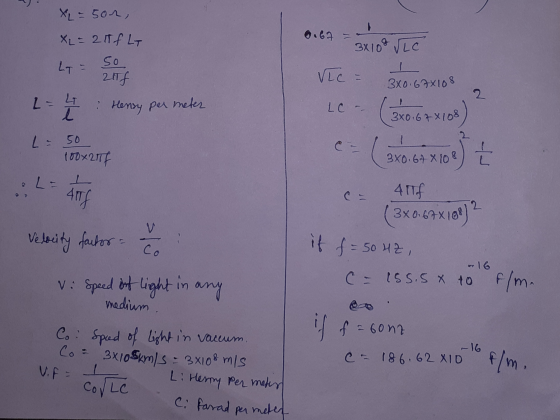
Add Answer to:
2. A 50 ohm transmission line has length = 100 metres. The velocity factor of the...
3. Could a AM335X GPIO pin drive a 50 Ohm transmission line that has a 50...
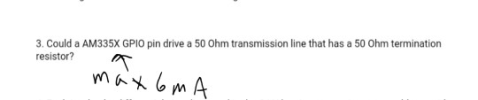 3. Could a AM335X GPIO pin drive a 50 Ohm transmission line that has a 50 Ohm termination resistor? maxbm A
Please answer all parts. Thank you! (25 points) A half wavelength long 50 Ohm transmission line is terminated with a load of 100 Ohm. The voltage across the load is 16V 2. Determine standing wave rat...
 Please answer all parts. Thank you!
(25 points) A half wavelength long 50 Ohm transmission line is terminated with a load of 100 Ohm. The voltage across the load is 16V 2. Determine standing wave ratio on the transmission line. Determine the incident voltage and reflected voltage at the load. Determine the incident current and reflected current a quarter wavelength away from the load. Determine the wave impedance a quarter wavelength away from the load. Design a matching network to...
Please answer all parts. Thank you!
(25 points) A half wavelength long 50 Ohm transmission line is terminated with a load of 100 Ohm. The voltage across the load is 16V 2. Determine standing wave ratio on the transmission line. Determine the incident voltage and reflected voltage at the load. Determine the incident current and reflected current a quarter wavelength away from the load. Determine the wave impedance a quarter wavelength away from the load. Design a matching network to...
A section of transmission line of 50 ohm characteristic impedance and 3x10^8 m/s propagation velocity carries...
A section of transmission line of 50 ohm characteristic impedance and 3x10^8 m/s propagation velocity carries simultaneously 300 MHz and 150 MHz signals. The line is terminated in a parallel connection of two sections of the same line, both sections terminated in 50 ohm resistance designated A and B. A 50 cm long open-circuited section is connected 50 cm from the connection to the driving line across the line terminated in resistance A. A 50 cm long short-circuited section (of...
2. Lumped versus distributed circuits (15%) (a) A transmission line of length 1 connects a load...
 2. Lumped versus distributed circuits (15%) (a) A transmission line of length 1 connects a load to a sinusoidal voltage source with an oscillation frequency of f. Assuming that the velocity of wave propagation in the line is c (that is, the speed of light in vacuum), for which of the following sit- uations can we model the transmission line as a wire (that is, use a lumped-element model) and where do we need a distributed model? (i) f =...
Question: A three-phase, 60-Hz, completely transposed transmission line has a length of 100-km and has a...
Question: A three-phase, 60-Hz, completely transposed transmission line has a length of 100-km and has a series impedance per phase of (0.25+j0.85) ohms/mile and shunt admittance of 5.0*10^-5 Siemens/mile. The transmission line delivers 150 MW at 0.85 lagging power factor to a load connnected to its receiving end. The line-to-line voltage at the receiving end is 138-kV. Note: The Medium Length Line method should be used since it is used for distances between 50 miles to 150 miles. Determine the...
A distortionless transmission line with a characteristic impedance of ?0 = 75Ω has an attenuation constant...
A distortionless transmission line with a characteristic impedance of ?0 = 75Ω has an attenuation constant of ? = 10−3 Np/m. The line has a capacitance per unit length of C′ = 60 pF/m. (a) Find the per unit length resistance R′, inductance L′, and conductance G′ of the transmission line. (b) Find the phase velocity ?? for this line.
A 3-phase, 50 Hz, long 300 Km transmission line delivers 60 MVA at 124 kV and...
 A 3-phase, 50 Hz, long 300 Km transmission line delivers 60 MVA at 124 kV and 0-8 p.f. lagging. The total resistance 25.3 ohm and total reactance is 66.5 ohm and the admittance due to capacitance is 0.442*10-3 mho. Determine: (i) (ii) (iii) A,B, C and D constants of long T.L Sending end voltage, current and power factor Transmission efficiency, Voltage regulation
PROBLEM: A 230-kV, 50 Hz, three-phase transmission line is 120 km long. The line has a per phase ...
 PROBLEM: A 230-kV, 50 Hz, three-phase transmission line is 120 km long. The line has a per phase series impedance of z-0.05 +j0.45 Ω per km, and a per phase shunt admittance of y 3.4x10⁻⁶ Siemens per km. The line delivers (at the receiving end) 200 MVA, 0.8 lagging power factor at 220 kV. Now consider two cases: A- Assume that shunt parameters of the transmission line are ignored (i.e. even if this is a medium length transmission line, under...
Given a 50 Ω lossless transmission line, find the length of the line so the input...
Given a 50 Ω lossless transmission line, find the length of the line so the input impedance at 3 GHz appears as a capacitor equal to 10 pF. Wave velocity on the line is 0.8c. (only one solution is necessary).
A 3-phase, 50 Hz overhead transmission line has the following constants
A 3-phase, 50 Hz overhead transmission line has the following constants : Resistance/phase = 9·6 Ω Inductance/phase = 0·097 mH Capacitance/phase = 0·765 μF If the line is supplying a balanced load of 24,000 kVA 0·8 p.f. lagging at 66 kV, calculate : (i) sending end current (ii) line value of sending end voltage (iii) sending end power factor (iv) percentage regulation (v) transmission efficiency
 3. Could a AM335X GPIO pin drive a 50 Ohm transmission line that has a 50 Ohm termination resistor? maxbm A
 Please answer all parts. Thank you!
(25 points) A half wavelength long 50 Ohm transmission line is terminated with a load of 100 Ohm. The voltage across the load is 16V 2. Determine standing wave ratio on the transmission line. Determine the incident voltage and reflected voltage at the load. Determine the incident current and reflected current a quarter wavelength away from the load. Determine the wave impedance a quarter wavelength away from the load. Design a matching network to...
Please answer all parts. Thank you!
(25 points) A half wavelength long 50 Ohm transmission line is terminated with a load of 100 Ohm. The voltage across the load is 16V 2. Determine standing wave ratio on the transmission line. Determine the incident voltage and reflected voltage at the load. Determine the incident current and reflected current a quarter wavelength away from the load. Determine the wave impedance a quarter wavelength away from the load. Design a matching network to...
 2. Lumped versus distributed circuits (15%) (a) A transmission line of length 1 connects a load to a sinusoidal voltage source with an oscillation frequency of f. Assuming that the velocity of wave propagation in the line is c (that is, the speed of light in vacuum), for which of the following sit- uations can we model the transmission line as a wire (that is, use a lumped-element model) and where do we need a distributed model? (i) f =...
 A 3-phase, 50 Hz, long 300 Km transmission line delivers 60 MVA at 124 kV and 0-8 p.f. lagging. The total resistance 25.3 ohm and total reactance is 66.5 ohm and the admittance due to capacitance is 0.442*10-3 mho. Determine: (i) (ii) (iii) A,B, C and D constants of long T.L Sending end voltage, current and power factor Transmission efficiency, Voltage regulation
 PROBLEM: A 230-kV, 50 Hz, three-phase transmission line is 120 km long. The line has a per phase series impedance of z-0.05 +j0.45 Ω per km, and a per phase shunt admittance of y 3.4x10⁻⁶ Siemens per km. The line delivers (at the receiving end) 200 MVA, 0.8 lagging power factor at 220 kV. Now consider two cases: A- Assume that shunt parameters of the transmission line are ignored (i.e. even if this is a medium length transmission line, under...
Most questions answered within 3 hours.
-
Where is the error in this code sequence?
String s1 = "Hello";
String s2 = "ello";...
asked 10 months ago -
Financial data for Joel de Paris, Inc., for last year
follow:
Joel de Paris, Inc.
Balance...
asked 10 months ago -
Consider this reaction:
Al2(SO4)3 (aq)+ BaCl3
(aq) Al2Cl6 (aq)- +
3BaSO4(s) . What is the...
asked 10 months ago -
Suppose that Savneet is considering increasing her
recent random sample from 20 car rentals to 40...
asked 10 months ago -
Trucks arrive at an unloading terminal at an average rate of 120
per hour.
Trucks arrive...
asked 10 months ago -
Why are methanol and ethanol completely soluble in water while
octanol is not very little soluble....
asked 10 months ago -
A facilities manager at a university reads in a research report
that the mean amount of...
asked 10 months ago -
When the CuSO4 is rehydrated by adding water to the anhydrous
compound, is this an endothermic...
asked 10 months ago -
A ray of sunlight is passing from diamond into crown glass; the
angle of incidence is...
asked 10 months ago -
A block of mass 0.249 kg is placed on top of a light, vertical
spring of...
asked 10 months ago -
how do the kidneys compensate in the presences of acidosis
a) trigger hyperventilate
b) reserve acid...
asked 10 months ago -
Question 501 pts
The rental rate of capital to the firm increases. Which of the
following...
asked 10 months ago