
Homework Answers
Request Answer!
We need at least 10 more requests to produce the answer.
0 / 10 have requested this problem solution
The more requests, the faster the answer.
Add Answer to:
please provide a full explanation on how you got the answers and
please answer all of...
please help asap in all sections!! Question 5 Methyl 4-methylpentanoate is one of 120 volatile compournds...
 please help asap in all sections!!
Question 5 Methyl 4-methylpentanoate is one of 120 volatile compournds identified in a study of metabolites from Streptomyces bacteria (Actinomycetologica 2009, 23, 27-33) Mathy 4-methylpentanoate The synthesis of Methyl 4-methylpentanoate using 2-methylbutane involves several steps. Part-1 of the reaction scheme (2-methylbutane to 3-methyl-1-butene) is illustrated below. Identity the reagent involved in each step and arange them accordingly Br A by NaOH; Os and H20; HBr/ROOR; NaOEt/EtOH NaOH; O and HyO; NaDE/EROH; HBr/RDOR Br: NaOE/EOH;...
please help asap in all sections!!
Question 5 Methyl 4-methylpentanoate is one of 120 volatile compournds identified in a study of metabolites from Streptomyces bacteria (Actinomycetologica 2009, 23, 27-33) Mathy 4-methylpentanoate The synthesis of Methyl 4-methylpentanoate using 2-methylbutane involves several steps. Part-1 of the reaction scheme (2-methylbutane to 3-methyl-1-butene) is illustrated below. Identity the reagent involved in each step and arange them accordingly Br A by NaOH; Os and H20; HBr/ROOR; NaOEt/EtOH NaOH; O and HyO; NaDE/EROH; HBr/RDOR Br: NaOE/EOH;...
Short Answer Section (43 pts) – showing work helps! Substitution vs. Elimination (12 pts). Predict all...
 Short Answer Section (43 pts) – showing work helps! Substitution
vs. Elimination (12 pts). Predict all major product(s) of each of
the following reactions and indicate the predominant mechanistic
pathways (Sn1, Sn2, E1, E2). Remember to consider rearrangements.
Mechanism #1 (10 pts). Draw a stepwise mechanism to account for the
following transformation. Br mechanism(s)? NaOH Cl mechanism(s)?
NaOEt OTs for this reaction, circle the major product mechanism(s)?
O K Cl for this reaction, circle the major product mechanism(s)?
NaOCH3 H2O...
Short Answer Section (43 pts) – showing work helps! Substitution
vs. Elimination (12 pts). Predict all major product(s) of each of
the following reactions and indicate the predominant mechanistic
pathways (Sn1, Sn2, E1, E2). Remember to consider rearrangements.
Mechanism #1 (10 pts). Draw a stepwise mechanism to account for the
following transformation. Br mechanism(s)? NaOH Cl mechanism(s)?
NaOEt OTs for this reaction, circle the major product mechanism(s)?
O K Cl for this reaction, circle the major product mechanism(s)?
NaOCH3 H2O...
Please provide a full answer for all the parts using Organic Chemistry 2. An explanation would...
 Please provide a full answer for all the parts using Organic
Chemistry 2. An explanation would be a plus.
(10 points) Draw the major product of the following reactions. If the reaction does not 2. occur, write no reaction. 1. NaOH/heat н* b.) а.) 2 ОН 2. Hзо", rt ОН H3C-NH2 с.) d.) ОН ОН DCC e.) HS ОН
Please provide a full answer for all the parts using Organic
Chemistry 2. An explanation would be a plus.
(10 points) Draw the major product of the following reactions. If the reaction does not 2. occur, write no reaction. 1. NaOH/heat н* b.) а.) 2 ОН 2. Hзо", rt ОН H3C-NH2 с.) d.) ОН ОН DCC e.) HS ОН
Draw a detailed mechanism for the following transformation 1. Br. Br HBr HO 2. What are the major product (s) formed in...
 Draw a detailed mechanism for the following transformation 1. Br. Br HBr HO 2. What are the major product (s) formed in the following substitution reaction? Draw as Fisher projections CH;CH2ОH CH-CHз Нас— вr CH2CH2CH3 Draw the mechanism for the following reaction. 3. HO Br Draw the major organic product(s) produced in the following reaction as Fischer projection. 4. CHз ОСHЗ Н NaN3 Н. -CH3 Н- Br DMSO CH3 Draw the mechanism for the following reaction to demonstrate how the...
Please and all two questions and explain how you got to your answer. I'm really lost...
 Please and all two questions
and explain how you got to your answer. I'm really lost and I have
an exam in 7 days! A step by step would be appreciated.
6. (10 points) Provide products for the reactions shown below. Draw all possible stereoisomers and indicate if the products are achiral, chiral, racemic or meso. Вrz Hао 1) ВНз-THF 2) H,О, NaOH 7. (10 points) Draw a detailed mechanism using curved arrow notation for the reaction shown below. H2SO4...
Please and all two questions
and explain how you got to your answer. I'm really lost and I have
an exam in 7 days! A step by step would be appreciated.
6. (10 points) Provide products for the reactions shown below. Draw all possible stereoisomers and indicate if the products are achiral, chiral, racemic or meso. Вrz Hао 1) ВНз-THF 2) H,О, NaOH 7. (10 points) Draw a detailed mechanism using curved arrow notation for the reaction shown below. H2SO4...
I need the mechanism please. IV. Provide a complete stepwise mechanism for the following reaction sequence,...
 I need the mechanism please.
IV. Provide a complete stepwise mechanism for the following reaction sequence, including initiation and termination steps for any radical reactions (i.e. write a continuous reaction mechanism with the product of step 1 being used in step 2.... Draw the product of each step in the indicated boxes. 1) Br2, hv 2) KO Bu/BuOH 3) HBr, ROOR Br step 1 product step 2 product
I need the mechanism please.
IV. Provide a complete stepwise mechanism for the following reaction sequence, including initiation and termination steps for any radical reactions (i.e. write a continuous reaction mechanism with the product of step 1 being used in step 2.... Draw the product of each step in the indicated boxes. 1) Br2, hv 2) KO Bu/BuOH 3) HBr, ROOR Br step 1 product step 2 product
Write the word or phare that best completes each statement or answers the questions 17) Draw...
 Write the word or phare that best completes each statement or
answers the questions
17) Draw the major product of the following reaction: CH2 CH3 oH2 CH3 OH HCI CH3 CI 18) What is the product of the following reaction? 1. Cl. H20 19) Draw the product of the following reaction 0 он PCC or CH3 CH3 CH(CH) CH(CH3)2 20) Draw the product of the following reaction: 03 (CH3)2S 21) Draw the major product of the following reaction: HBr (excess)...
Write the word or phare that best completes each statement or
answers the questions
17) Draw the major product of the following reaction: CH2 CH3 oH2 CH3 OH HCI CH3 CI 18) What is the product of the following reaction? 1. Cl. H20 19) Draw the product of the following reaction 0 он PCC or CH3 CH3 CH(CH) CH(CH3)2 20) Draw the product of the following reaction: 03 (CH3)2S 21) Draw the major product of the following reaction: HBr (excess)...
Write these answers On the Answer Sheet along the question, 19. Draw the expected major product/predict...
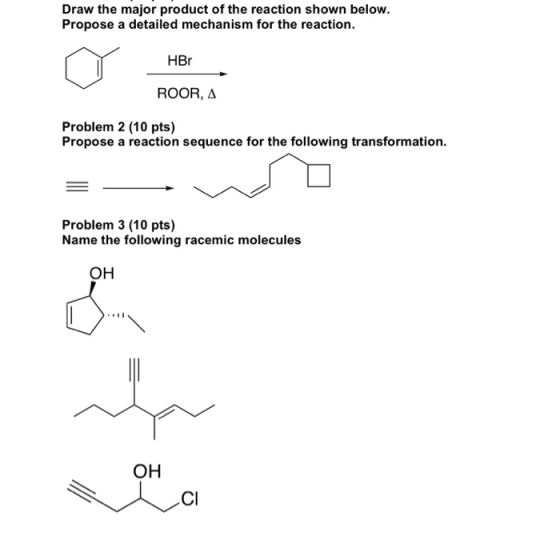
 Write these answers On the Answer Sheet along the question, 19. Draw the expected major product/predict the reagent for the reaction (2.5 pts. for each '?') 30 pts. HBr ROOR 1-BuOK/BuOH + enantiomer 1. 1 eq HCI 2. 1 eq HBO 1. NaNH2 3. NaNH2 HCECH - Br Br 1) Hg(OA), HOCH CH CH3 2) NaBH 2
With explanation please -- thanks! 9. (30 pts) Predict whether the following conditions would mainly proceed...
 With explanation please --
thanks!
9. (30 pts) Predict whether the following conditions would mainly proceed via an SN2, SN1, E2, or E1 mechanism (write your answer into box on left). Draw the major product (including enatiomer wher appropriate) in each reaction and show stereochemistry (where appropriate). SN2, SN1 E1, or E2 conc.H2SO4 heat SN2, S1 E1, or E2 H2O SN2, SN1 E1, or E2 NaOEt EtOH, heat SN2, SN1 E1, or E2 v O-CF3 H. KOtBu D. H tBuOH...
With explanation please --
thanks!
9. (30 pts) Predict whether the following conditions would mainly proceed via an SN2, SN1, E2, or E1 mechanism (write your answer into box on left). Draw the major product (including enatiomer wher appropriate) in each reaction and show stereochemistry (where appropriate). SN2, SN1 E1, or E2 conc.H2SO4 heat SN2, S1 E1, or E2 H2O SN2, SN1 E1, or E2 NaOEt EtOH, heat SN2, SN1 E1, or E2 v O-CF3 H. KOtBu D. H tBuOH...
(1) Mechanism. Draw the mechanism explaining the following transformation of the reactant into the observed major...
 (1) Mechanism. Draw the mechanism explaining the following transformation of the reactant into the observed major product over this two-step reaction. Identify the structure of the mystery intermediate at the completion of Step 1 that must be accessed to make the final product after Step 2. Make sure to use appropriate arrow-pushing notation to depict the movement of electrons and bond breaking and formation. Show proper geometry, bond lengths, angles, etc. in each reactant, intermediate, and product. (16 pts) NaOEt...
 please help asap in all sections!!
Question 5 Methyl 4-methylpentanoate is one of 120 volatile compournds identified in a study of metabolites from Streptomyces bacteria (Actinomycetologica 2009, 23, 27-33) Mathy 4-methylpentanoate The synthesis of Methyl 4-methylpentanoate using 2-methylbutane involves several steps. Part-1 of the reaction scheme (2-methylbutane to 3-methyl-1-butene) is illustrated below. Identity the reagent involved in each step and arange them accordingly Br A by NaOH; Os and H20; HBr/ROOR; NaOEt/EtOH NaOH; O and HyO; NaDE/EROH; HBr/RDOR Br: NaOE/EOH;...
please help asap in all sections!!
Question 5 Methyl 4-methylpentanoate is one of 120 volatile compournds identified in a study of metabolites from Streptomyces bacteria (Actinomycetologica 2009, 23, 27-33) Mathy 4-methylpentanoate The synthesis of Methyl 4-methylpentanoate using 2-methylbutane involves several steps. Part-1 of the reaction scheme (2-methylbutane to 3-methyl-1-butene) is illustrated below. Identity the reagent involved in each step and arange them accordingly Br A by NaOH; Os and H20; HBr/ROOR; NaOEt/EtOH NaOH; O and HyO; NaDE/EROH; HBr/RDOR Br: NaOE/EOH;...
 Short Answer Section (43 pts) – showing work helps! Substitution
vs. Elimination (12 pts). Predict all major product(s) of each of
the following reactions and indicate the predominant mechanistic
pathways (Sn1, Sn2, E1, E2). Remember to consider rearrangements.
Mechanism #1 (10 pts). Draw a stepwise mechanism to account for the
following transformation. Br mechanism(s)? NaOH Cl mechanism(s)?
NaOEt OTs for this reaction, circle the major product mechanism(s)?
O K Cl for this reaction, circle the major product mechanism(s)?
NaOCH3 H2O...
Short Answer Section (43 pts) – showing work helps! Substitution
vs. Elimination (12 pts). Predict all major product(s) of each of
the following reactions and indicate the predominant mechanistic
pathways (Sn1, Sn2, E1, E2). Remember to consider rearrangements.
Mechanism #1 (10 pts). Draw a stepwise mechanism to account for the
following transformation. Br mechanism(s)? NaOH Cl mechanism(s)?
NaOEt OTs for this reaction, circle the major product mechanism(s)?
O K Cl for this reaction, circle the major product mechanism(s)?
NaOCH3 H2O...
 Please provide a full answer for all the parts using Organic
Chemistry 2. An explanation would be a plus.
(10 points) Draw the major product of the following reactions. If the reaction does not 2. occur, write no reaction. 1. NaOH/heat н* b.) а.) 2 ОН 2. Hзо", rt ОН H3C-NH2 с.) d.) ОН ОН DCC e.) HS ОН
Please provide a full answer for all the parts using Organic
Chemistry 2. An explanation would be a plus.
(10 points) Draw the major product of the following reactions. If the reaction does not 2. occur, write no reaction. 1. NaOH/heat н* b.) а.) 2 ОН 2. Hзо", rt ОН H3C-NH2 с.) d.) ОН ОН DCC e.) HS ОН
 Draw a detailed mechanism for the following transformation 1. Br. Br HBr HO 2. What are the major product (s) formed in the following substitution reaction? Draw as Fisher projections CH;CH2ОH CH-CHз Нас— вr CH2CH2CH3 Draw the mechanism for the following reaction. 3. HO Br Draw the major organic product(s) produced in the following reaction as Fischer projection. 4. CHз ОСHЗ Н NaN3 Н. -CH3 Н- Br DMSO CH3 Draw the mechanism for the following reaction to demonstrate how the...
 Please and all two questions
and explain how you got to your answer. I'm really lost and I have
an exam in 7 days! A step by step would be appreciated.
6. (10 points) Provide products for the reactions shown below. Draw all possible stereoisomers and indicate if the products are achiral, chiral, racemic or meso. Вrz Hао 1) ВНз-THF 2) H,О, NaOH 7. (10 points) Draw a detailed mechanism using curved arrow notation for the reaction shown below. H2SO4...
Please and all two questions
and explain how you got to your answer. I'm really lost and I have
an exam in 7 days! A step by step would be appreciated.
6. (10 points) Provide products for the reactions shown below. Draw all possible stereoisomers and indicate if the products are achiral, chiral, racemic or meso. Вrz Hао 1) ВНз-THF 2) H,О, NaOH 7. (10 points) Draw a detailed mechanism using curved arrow notation for the reaction shown below. H2SO4...
 I need the mechanism please.
IV. Provide a complete stepwise mechanism for the following reaction sequence, including initiation and termination steps for any radical reactions (i.e. write a continuous reaction mechanism with the product of step 1 being used in step 2.... Draw the product of each step in the indicated boxes. 1) Br2, hv 2) KO Bu/BuOH 3) HBr, ROOR Br step 1 product step 2 product
I need the mechanism please.
IV. Provide a complete stepwise mechanism for the following reaction sequence, including initiation and termination steps for any radical reactions (i.e. write a continuous reaction mechanism with the product of step 1 being used in step 2.... Draw the product of each step in the indicated boxes. 1) Br2, hv 2) KO Bu/BuOH 3) HBr, ROOR Br step 1 product step 2 product
 Write the word or phare that best completes each statement or
answers the questions
17) Draw the major product of the following reaction: CH2 CH3 oH2 CH3 OH HCI CH3 CI 18) What is the product of the following reaction? 1. Cl. H20 19) Draw the product of the following reaction 0 он PCC or CH3 CH3 CH(CH) CH(CH3)2 20) Draw the product of the following reaction: 03 (CH3)2S 21) Draw the major product of the following reaction: HBr (excess)...
Write the word or phare that best completes each statement or
answers the questions
17) Draw the major product of the following reaction: CH2 CH3 oH2 CH3 OH HCI CH3 CI 18) What is the product of the following reaction? 1. Cl. H20 19) Draw the product of the following reaction 0 он PCC or CH3 CH3 CH(CH) CH(CH3)2 20) Draw the product of the following reaction: 03 (CH3)2S 21) Draw the major product of the following reaction: HBr (excess)...
 Write these answers On the Answer Sheet along the question, 19. Draw the expected major product/predict the reagent for the reaction (2.5 pts. for each '?') 30 pts. HBr ROOR 1-BuOK/BuOH + enantiomer 1. 1 eq HCI 2. 1 eq HBO 1. NaNH2 3. NaNH2 HCECH - Br Br 1) Hg(OA), HOCH CH CH3 2) NaBH 2
 With explanation please --
thanks!
9. (30 pts) Predict whether the following conditions would mainly proceed via an SN2, SN1, E2, or E1 mechanism (write your answer into box on left). Draw the major product (including enatiomer wher appropriate) in each reaction and show stereochemistry (where appropriate). SN2, SN1 E1, or E2 conc.H2SO4 heat SN2, S1 E1, or E2 H2O SN2, SN1 E1, or E2 NaOEt EtOH, heat SN2, SN1 E1, or E2 v O-CF3 H. KOtBu D. H tBuOH...
With explanation please --
thanks!
9. (30 pts) Predict whether the following conditions would mainly proceed via an SN2, SN1, E2, or E1 mechanism (write your answer into box on left). Draw the major product (including enatiomer wher appropriate) in each reaction and show stereochemistry (where appropriate). SN2, SN1 E1, or E2 conc.H2SO4 heat SN2, S1 E1, or E2 H2O SN2, SN1 E1, or E2 NaOEt EtOH, heat SN2, SN1 E1, or E2 v O-CF3 H. KOtBu D. H tBuOH...
 (1) Mechanism. Draw the mechanism explaining the following transformation of the reactant into the observed major product over this two-step reaction. Identify the structure of the mystery intermediate at the completion of Step 1 that must be accessed to make the final product after Step 2. Make sure to use appropriate arrow-pushing notation to depict the movement of electrons and bond breaking and formation. Show proper geometry, bond lengths, angles, etc. in each reactant, intermediate, and product. (16 pts) NaOEt...
Most questions answered within 3 hours.
-
Where is the error in this code sequence?
String s1 = "Hello";
String s2 = "ello";...
asked 10 months ago -
Financial data for Joel de Paris, Inc., for last year
follow:
Joel de Paris, Inc.
Balance...
asked 10 months ago -
Consider this reaction:
Al2(SO4)3 (aq)+ BaCl3
(aq) Al2Cl6 (aq)- +
3BaSO4(s) . What is the...
asked 10 months ago -
Suppose that Savneet is considering increasing her
recent random sample from 20 car rentals to 40...
asked 10 months ago -
Trucks arrive at an unloading terminal at an average rate of 120
per hour.
Trucks arrive...
asked 10 months ago -
Why are methanol and ethanol completely soluble in water while
octanol is not very little soluble....
asked 10 months ago -
A facilities manager at a university reads in a research report
that the mean amount of...
asked 10 months ago -
When the CuSO4 is rehydrated by adding water to the anhydrous
compound, is this an endothermic...
asked 10 months ago -
A ray of sunlight is passing from diamond into crown glass; the
angle of incidence is...
asked 10 months ago -
A block of mass 0.249 kg is placed on top of a light, vertical
spring of...
asked 10 months ago -
how do the kidneys compensate in the presences of acidosis
a) trigger hyperventilate
b) reserve acid...
asked 10 months ago -
Question 501 pts
The rental rate of capital to the firm increases. Which of the
following...
asked 10 months ago