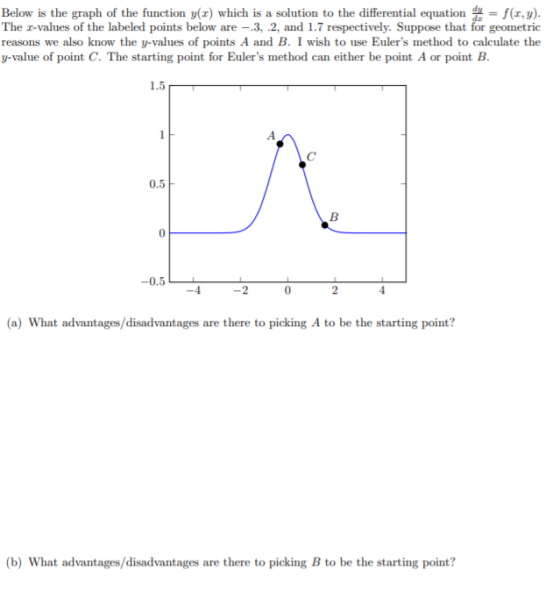
Below is the graph of the function y(x) which is a solution to the differential equation dy dx = f(x, y).
please help me, thanks so much
Homework Answers
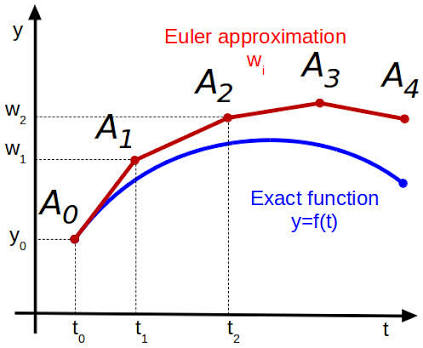
In Euler's method, if we observe graphically, what we are doing basically is extending the lines from one reference point to another by taking the initial point as obtained after the extension of previous line and the slope same as the slope of the tangent at that point.
For better understanding, see that diagram:-
A) Now, if we take A as the starting point, we
can see that we have the advantage that distance
between A and B is less i.e. 0.5 units so we could take much less
step size, it saves our time too as tedious calculations got
reduced and we achieve better approximation.
Disadvantage is that there is a maxima between the
two points. Usually for Euler's method, path with only either
increasing path or decreasing path is preferred to maintain least
distance between the Euler's approximation line and the actual
curve so that accuracy can be improved.
B) Now, if we take B as the starting point, the
advantage we have is that the curve is having only
a decreasing path, there is no maxima or minima in between So
accuracy will be better
Disadvantage is that the distance between B and C
is much more than that of A and C i.e.1.5 units so that would be
lead to a larger step size and lead to large errors as error in
approximation is directly proportional to the square of the step
size or if we took smaller step size, then it would become too
lengthy and time- consuming.
General advantages and disadvantages of Euler's methods are as
follows:-
Advantages:
1. Euler’s Method is simple and direct
2. Can be used for nonlinear IVPs
Disadvantages:
1. It is less accurate and numerically unstable.
2. Approximation error is proportional to the step size h. Hence,
good approximation is obtained with a very small h. This requires a
large number of time discretization leading to a larger computation
time.
3. Usually applicable to explicit differential equations
Add Answer to:
Below is the graph of the function y(x) which is a solution to
the differential equation...
1. Let y = f(x) be the solution to the differential equation = y - x....
 1. Let y = f(x) be the solution to the differential equation = y - x. The point (5,1) is on the graph of the solution to this differential equation. What is the approximation for f() if Euler's Method is used, starting at x = 5 with a step size of 0.5?
(1) Solve the differential equation y 2xy, y(1)= 1 analytically. Plot the solution curve for the interval x 1 to 2 (see...
 (1) Solve the differential equation y 2xy, y(1)= 1 analytically. Plot the solution curve for the interval x 1 to 2 (see both MS word and Excel templates). 3 pts (2) On the same graph, plot the solution curve for the differential equation using Euler's method. 5pts (3) On the same graph, plot the solution curve for the differential equation using improved Euler's method. 5pts (4) On the same graph, plot the solution curve for the differential equation using Runge-Kutta...
Consider the differential equation dy/dx = (y-1)/x.
 Consider the differential equation dy/dx = (y-1)/x. (a) On the axes provided, sketch a slope field for the given differential equation at the nine points indicated. (b) Let y = f (x) be the particular solution to the given differential equation with the initial condition f (3) = 2. Write an equation for the line tangent to the graph of y= f (x) at x = 3. Use the equation to approximate the value of f (3.3). (c) Find the particular solution y...
Problem Thre: 125 points) Consider the following initial value problem: dy-2y+ t The y(0) -1 ea dt ical solution of the differential equation is: y(O)(2-2t+3e-2+1)y fr exoc the differential equat...
 Problem Thre: 125 points) Consider the following initial value problem: dy-2y+ t The y(0) -1 ea dt ical solution of the differential equation is: y(O)(2-2t+3e-2+1)y fr exoc the differential equation numerically over the interval 0 s i s 2.0 and a step size h At 0.5.A Apply the following Runge-Kutta methods for each of the step. (show your calculations) i. [0.0 0.5: Euler method ii. [0.5 1.0]: Heun method. ii. [1.0 1.5): Midpoint method. iv. [1.5 2.0): 4h RK method...
Question l: Solve the differential equation--=yr-lly for y(0.5) and y(1), where y(0)=1 (a) Analytically (b) Using...
 Question l: Solve the differential equation--=yr-lly for y(0.5) and y(1), where y(0)=1 (a) Analytically (b) Using Ralston method with h 0.5. (This part is for practice only, no need for dy dx submission) (c) Using Heun's method with h 0.5. Perform 2 corrector iterations per step. (d) Using 4th-order RK method with h = 0.5 (e) Using Non-Self Starting Heun's method with h 0.5 (f) Using Adams 2-step method with h 0.5 (This part is for practice only, no need...
Question 1 Solve the differential equation i -yx2-1.ly for v(0.5) and y(), where y(0) -1 (a) Anal...
 Question 1 Solve the differential equation i -yx2-1.ly for v(0.5) and y(), where y(0) -1 (a) Analytically. (b) Using Ralston method with h 0.5. (This part is for practice only, no need for dy dx submission) (c) Using Heun's method with h 0.5. Perform 2 corrector iterations per step. (d) Using 4h-order RK method with h0.5 (e) Using Non-Self Starting Heun's method with h 0.5 () Using Adams 2-step method with h 0.5 (This part is for practice only, no...
Determine if the given function y- f(x) is a solution of the accompanying differential equation D...
 Determine if the given function y- f(x) is a solution of the accompanying differential equation Differential equation: 9xy' + 9y-cos x Initial condition: y()0 Solution candidate: y- x O a. No b. Yes
Determine if the given function y- f(x) is a solution of the accompanying differential equation Differential equation: 9xy' + 9y-cos x Initial condition: y()0 Solution candidate: y- x O a. No b. Yes
Determine if the given function y- f(x) is a solution of the accompanying differential equation Differential equation: 9xy' + 9y-cos x Initial condition: y()0 Solution candidate: y- x O a. No b. Yes
(1 point) We know that y(x) 72 is a solution to the differential equation Dy -...
 (1 point) We know that y(x) 72 is a solution to the differential equation Dy - Dy - 98y = 0 for 2 € (-00,00). Use the method of reduction of order to find the second solution to Dy - Dy - 98y = 0 for x € (-0,00) (a) After you reduce the second order equation by making the substitution w = ' you get a first order equation of the form f(x,x) = Note: Make sure you use...
dy 3. (5 points): Consider the autonomous differential equation dt is given below. Draw the phase...
 dy 3. (5 points): Consider the autonomous differential equation dt is given below. Draw the phase line and classify the equilibria. f(y) where the graph of f(y) Y 1 -0.5 0.5 1 y
please answer b. and c. Problem 1. Consider the differential equation given by (a) On the...
 please answer b. and c.
Problem 1. Consider the differential equation given by (a) On the axes provided below, sketch a slope field for the given differential equation at the nine points indicated. locales de mor t e wold qolution to the given differential equation with the initial condition (b) Let y = f(x) be the particular solution to the given differential equation with the initial condition f(0) = 3. Use Euler's method starting at x = 0, with a...
please answer b. and c.
Problem 1. Consider the differential equation given by (a) On the axes provided below, sketch a slope field for the given differential equation at the nine points indicated. locales de mor t e wold qolution to the given differential equation with the initial condition (b) Let y = f(x) be the particular solution to the given differential equation with the initial condition f(0) = 3. Use Euler's method starting at x = 0, with a...
 1. Let y = f(x) be the solution to the differential equation = y - x. The point (5,1) is on the graph of the solution to this differential equation. What is the approximation for f() if Euler's Method is used, starting at x = 5 with a step size of 0.5?
 (1) Solve the differential equation y 2xy, y(1)= 1 analytically. Plot the solution curve for the interval x 1 to 2 (see both MS word and Excel templates). 3 pts (2) On the same graph, plot the solution curve for the differential equation using Euler's method. 5pts (3) On the same graph, plot the solution curve for the differential equation using improved Euler's method. 5pts (4) On the same graph, plot the solution curve for the differential equation using Runge-Kutta...
 Problem Thre: 125 points) Consider the following initial value problem: dy-2y+ t The y(0) -1 ea dt ical solution of the differential equation is: y(O)(2-2t+3e-2+1)y fr exoc the differential equation numerically over the interval 0 s i s 2.0 and a step size h At 0.5.A Apply the following Runge-Kutta methods for each of the step. (show your calculations) i. [0.0 0.5: Euler method ii. [0.5 1.0]: Heun method. ii. [1.0 1.5): Midpoint method. iv. [1.5 2.0): 4h RK method...
 Question l: Solve the differential equation--=yr-lly for y(0.5) and y(1), where y(0)=1 (a) Analytically (b) Using Ralston method with h 0.5. (This part is for practice only, no need for dy dx submission) (c) Using Heun's method with h 0.5. Perform 2 corrector iterations per step. (d) Using 4th-order RK method with h = 0.5 (e) Using Non-Self Starting Heun's method with h 0.5 (f) Using Adams 2-step method with h 0.5 (This part is for practice only, no need...
 Question 1 Solve the differential equation i -yx2-1.ly for v(0.5) and y(), where y(0) -1 (a) Analytically. (b) Using Ralston method with h 0.5. (This part is for practice only, no need for dy dx submission) (c) Using Heun's method with h 0.5. Perform 2 corrector iterations per step. (d) Using 4h-order RK method with h0.5 (e) Using Non-Self Starting Heun's method with h 0.5 () Using Adams 2-step method with h 0.5 (This part is for practice only, no...
 Determine if the given function y- f(x) is a solution of the accompanying differential equation Differential equation: 9xy' + 9y-cos x Initial condition: y()0 Solution candidate: y- x O a. No b. Yes
Determine if the given function y- f(x) is a solution of the accompanying differential equation Differential equation: 9xy' + 9y-cos x Initial condition: y()0 Solution candidate: y- x O a. No b. Yes
Determine if the given function y- f(x) is a solution of the accompanying differential equation Differential equation: 9xy' + 9y-cos x Initial condition: y()0 Solution candidate: y- x O a. No b. Yes
 (1 point) We know that y(x) 72 is a solution to the differential equation Dy - Dy - 98y = 0 for 2 € (-00,00). Use the method of reduction of order to find the second solution to Dy - Dy - 98y = 0 for x € (-0,00) (a) After you reduce the second order equation by making the substitution w = ' you get a first order equation of the form f(x,x) = Note: Make sure you use...
 dy 3. (5 points): Consider the autonomous differential equation dt is given below. Draw the phase line and classify the equilibria. f(y) where the graph of f(y) Y 1 -0.5 0.5 1 y
 please answer b. and c.
Problem 1. Consider the differential equation given by (a) On the axes provided below, sketch a slope field for the given differential equation at the nine points indicated. locales de mor t e wold qolution to the given differential equation with the initial condition (b) Let y = f(x) be the particular solution to the given differential equation with the initial condition f(0) = 3. Use Euler's method starting at x = 0, with a...
please answer b. and c.
Problem 1. Consider the differential equation given by (a) On the axes provided below, sketch a slope field for the given differential equation at the nine points indicated. locales de mor t e wold qolution to the given differential equation with the initial condition (b) Let y = f(x) be the particular solution to the given differential equation with the initial condition f(0) = 3. Use Euler's method starting at x = 0, with a...
Most questions answered within 3 hours.
-
Where is the error in this code sequence?
String s1 = "Hello";
String s2 = "ello";...
asked 10 months ago -
Financial data for Joel de Paris, Inc., for last year
follow:
Joel de Paris, Inc.
Balance...
asked 10 months ago -
Consider this reaction:
Al2(SO4)3 (aq)+ BaCl3
(aq) Al2Cl6 (aq)- +
3BaSO4(s) . What is the...
asked 10 months ago -
Suppose that Savneet is considering increasing her
recent random sample from 20 car rentals to 40...
asked 10 months ago -
Trucks arrive at an unloading terminal at an average rate of 120
per hour.
Trucks arrive...
asked 10 months ago -
Why are methanol and ethanol completely soluble in water while
octanol is not very little soluble....
asked 10 months ago -
A facilities manager at a university reads in a research report
that the mean amount of...
asked 10 months ago -
When the CuSO4 is rehydrated by adding water to the anhydrous
compound, is this an endothermic...
asked 10 months ago -
A ray of sunlight is passing from diamond into crown glass; the
angle of incidence is...
asked 10 months ago -
A block of mass 0.249 kg is placed on top of a light, vertical
spring of...
asked 10 months ago -
how do the kidneys compensate in the presences of acidosis
a) trigger hyperventilate
b) reserve acid...
asked 10 months ago -
Question 501 pts
The rental rate of capital to the firm increases. Which of the
following...
asked 10 months ago