
Homework Answers
Add Answer to:
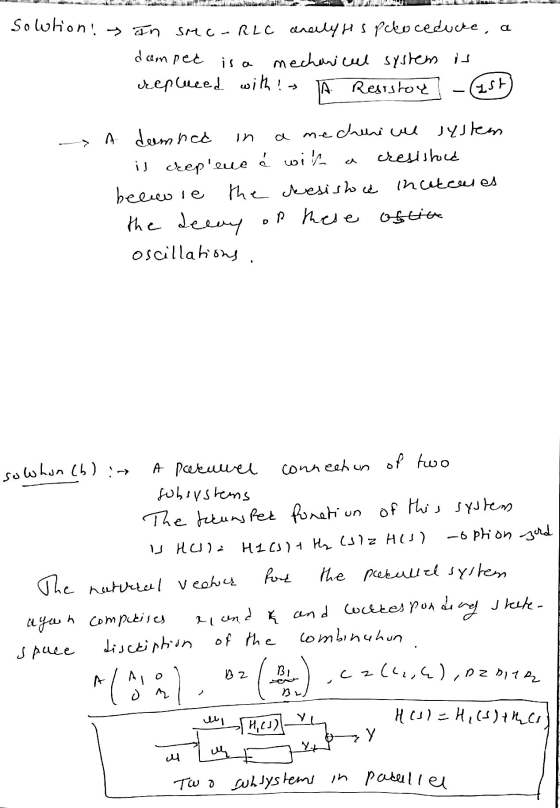
D Question 23 1 pts In SMD-RLC analysis procedure, a damper in a mechanical system is...
I need help with #10. Please show work. Question 10 7.25 pts An RLC circuit consists...
 I need help with #10. Please show work.
Question 10 7.25 pts An RLC circuit consists of an inductor of 9 milli-henries, a resistor of 4 Ohms, and a 2 micro-farad capacitor connected in series to an AC voltage source with a maximum voltage of 386 volts. What is the average power of the circuit at 7 kilohertz in watts? 7.25 pts D Question 11
I need help with #10. Please show work.
Question 10 7.25 pts An RLC circuit consists of an inductor of 9 milli-henries, a resistor of 4 Ohms, and a 2 micro-farad capacitor connected in series to an AC voltage source with a maximum voltage of 386 volts. What is the average power of the circuit at 7 kilohertz in watts? 7.25 pts D Question 11
Question 16 1 pts A 50-2 resistor, a 0.1-H inductor, and a 10-uF capacitor are connected...
 Question 16 1 pts A 50-2 resistor, a 0.1-H inductor, and a 10-uF capacitor are connected in series to a 60-Hz source. The rms current in the circuit is 3 A. Find the rms voltage across the resistor, the inductor, and the capacitor. O 60 V, 80 V,796 V (all rms) O 150 V, 113V,562 V (allrms) O 150 V, 113 V, 796 V (all rms) O 0.06 V, 80 V,562 V (all rms) 1 pts Question 17 In an...
Question 5 0/1 pts Calculate the phase angle (in radians) for a circuit with a maximum...
 Question 5 0/1 pts Calculate the phase angle (in radians) for a circuit with a maximum voltage of 12 V and w=200 Hz. The voltage source is connected in series with a 20e-6 F capacitor, a 20-mH inductor, and a 50- resistor. 0.0180 radians -1.37 radians 0.134 radians 0.0300 radians
Question 5 20 pts Н w R1 L1 C1 A parallel RLC circuit is shown with...
 Question 5 20 pts Н w R1 L1 C1 A parallel RLC circuit is shown with a DC current source I1 = IDc feeding the parallel combination. The circuit is shown with the source II being turned ON at time to Assume the capacitor C1 and inductor L1 are initially unchanged. Denote the currents IR, IL, Io as the currents through RI, L1 and C1 respectively. 7/28/20, 5:12 am https://useonline.southalabama.edu/courses/41 a) Employ KCL to obtain the integro-differential equation for the...
Question 5 20 pts Н w R1 L1 C1 A parallel RLC circuit is shown with...
 Question 5 20 pts Н w R1 L1 C1 A parallel RLC circuit is shown with a DC current source I1 = IDc feeding the parallel combination. The circuit is shown with the source II being turned ON at time to Assume the capacitor C1 and inductor L1 are initially unchanged. Denote the currents IR, IL, Io as the currents through RI, L1 and C1 respectively. 7/28/20, 5:12 am https://useonline.southalabama.edu/courses/41 a) Employ KCL to obtain the integro-differential equation for the...
3. (35 pts) Consider a standard RLC circuit with a resistor R, inductor L and capacitor C all in ...
 3. (35 pts) Consider a standard RLC circuit with a resistor R, inductor L and capacitor C all in series driven by a voltage source v(t). The voltage source gives pulses of 5 volts that last 1 msec every 10 msec, i.e. a square wave with period 10. We are interested in the output y(t) which is the current flowing through the circuit at time t. (a) Find a general expression for the frequency response H(jw) of this system (b)...
Question 1 1 pts When an RLC series circuit is in resonance, its impedance is: O...
 Question 1 1 pts When an RLC series circuit is in resonance, its impedance is: O equal to its resistance. O at maximum. O negative. O zero. Question 2 1 pts Consider an AC series circuit containing a coil, capacitor and resistance. Tripling the frequency will change the inductive reactance by what factor? O 1 3 O 1/3 O 1.73 Question 3 1 pts The power factor in an AC series circuit is equal to which of the following ratios?...
1) (40 pts total) Solving and order ODE using Laplace Transforms: Consider a series RLC circuit...
 1) (40 pts total) Solving and order ODE using Laplace Transforms: Consider a series RLC circuit with resistor R, inductor L, and a capacitor C in series. The same current i(t) flows through R, L, and C. The voltage source v(t) is removed at t=0, but current continues to flow through the circuit for some time. We wish to find the natural response of this series RLC circuit, and find an equation for i(t). Using KVL and differentiating the equation...
3. (40 pts total) Eigenvalues of Systems of Equations Application: Series RLC Circuit, Natural, or Transient...
 3. (40 pts total) Eigenvalues of Systems of Equations Application: Series RLC Circuit, Natural, or Transient Response (Remember EE280, maybe not) M SR v(t) Consider a series RLC circuit, with a resistor R, inductor L, and capacitor C in series. The same current i(t) flows through R, L, and C. The switch S1 is initially closed and S2 is initially open allowing the circuit to fully charge. At t=0 the switch S1 opens and S2 closes as shown above. Solving...
Question 5 1 pts An ac generator supplies a peak (not rms) voltage of 150 V...
 Question 5 1 pts An ac generator supplies a peak (not rms) voltage of 150 V at 60.0 Hz. The generator is connected in series with a 35-mH inductor, a 45-uF capacitor and an 85-0 resistor. Reference: Ref 23-3 Which one of the following statements concerning this circuit is true? The phase angle for this circuit is positive. The circuit is more capacitive than inductive. The voltage and current are exactly out of phase. The voltage and current are in...
 I need help with #10. Please show work.
Question 10 7.25 pts An RLC circuit consists of an inductor of 9 milli-henries, a resistor of 4 Ohms, and a 2 micro-farad capacitor connected in series to an AC voltage source with a maximum voltage of 386 volts. What is the average power of the circuit at 7 kilohertz in watts? 7.25 pts D Question 11
I need help with #10. Please show work.
Question 10 7.25 pts An RLC circuit consists of an inductor of 9 milli-henries, a resistor of 4 Ohms, and a 2 micro-farad capacitor connected in series to an AC voltage source with a maximum voltage of 386 volts. What is the average power of the circuit at 7 kilohertz in watts? 7.25 pts D Question 11
 Question 16 1 pts A 50-2 resistor, a 0.1-H inductor, and a 10-uF capacitor are connected in series to a 60-Hz source. The rms current in the circuit is 3 A. Find the rms voltage across the resistor, the inductor, and the capacitor. O 60 V, 80 V,796 V (all rms) O 150 V, 113V,562 V (allrms) O 150 V, 113 V, 796 V (all rms) O 0.06 V, 80 V,562 V (all rms) 1 pts Question 17 In an...
 Question 5 0/1 pts Calculate the phase angle (in radians) for a circuit with a maximum voltage of 12 V and w=200 Hz. The voltage source is connected in series with a 20e-6 F capacitor, a 20-mH inductor, and a 50- resistor. 0.0180 radians -1.37 radians 0.134 radians 0.0300 radians
 Question 5 20 pts Н w R1 L1 C1 A parallel RLC circuit is shown with a DC current source I1 = IDc feeding the parallel combination. The circuit is shown with the source II being turned ON at time to Assume the capacitor C1 and inductor L1 are initially unchanged. Denote the currents IR, IL, Io as the currents through RI, L1 and C1 respectively. 7/28/20, 5:12 am https://useonline.southalabama.edu/courses/41 a) Employ KCL to obtain the integro-differential equation for the...
 Question 5 20 pts Н w R1 L1 C1 A parallel RLC circuit is shown with a DC current source I1 = IDc feeding the parallel combination. The circuit is shown with the source II being turned ON at time to Assume the capacitor C1 and inductor L1 are initially unchanged. Denote the currents IR, IL, Io as the currents through RI, L1 and C1 respectively. 7/28/20, 5:12 am https://useonline.southalabama.edu/courses/41 a) Employ KCL to obtain the integro-differential equation for the...
 3. (35 pts) Consider a standard RLC circuit with a resistor R, inductor L and capacitor C all in series driven by a voltage source v(t). The voltage source gives pulses of 5 volts that last 1 msec every 10 msec, i.e. a square wave with period 10. We are interested in the output y(t) which is the current flowing through the circuit at time t. (a) Find a general expression for the frequency response H(jw) of this system (b)...
 Question 1 1 pts When an RLC series circuit is in resonance, its impedance is: O equal to its resistance. O at maximum. O negative. O zero. Question 2 1 pts Consider an AC series circuit containing a coil, capacitor and resistance. Tripling the frequency will change the inductive reactance by what factor? O 1 3 O 1/3 O 1.73 Question 3 1 pts The power factor in an AC series circuit is equal to which of the following ratios?...
 1) (40 pts total) Solving and order ODE using Laplace Transforms: Consider a series RLC circuit with resistor R, inductor L, and a capacitor C in series. The same current i(t) flows through R, L, and C. The voltage source v(t) is removed at t=0, but current continues to flow through the circuit for some time. We wish to find the natural response of this series RLC circuit, and find an equation for i(t). Using KVL and differentiating the equation...
 3. (40 pts total) Eigenvalues of Systems of Equations Application: Series RLC Circuit, Natural, or Transient Response (Remember EE280, maybe not) M SR v(t) Consider a series RLC circuit, with a resistor R, inductor L, and capacitor C in series. The same current i(t) flows through R, L, and C. The switch S1 is initially closed and S2 is initially open allowing the circuit to fully charge. At t=0 the switch S1 opens and S2 closes as shown above. Solving...
 Question 5 1 pts An ac generator supplies a peak (not rms) voltage of 150 V at 60.0 Hz. The generator is connected in series with a 35-mH inductor, a 45-uF capacitor and an 85-0 resistor. Reference: Ref 23-3 Which one of the following statements concerning this circuit is true? The phase angle for this circuit is positive. The circuit is more capacitive than inductive. The voltage and current are exactly out of phase. The voltage and current are in...
Most questions answered within 3 hours.
-
Where is the error in this code sequence?
String s1 = "Hello";
String s2 = "ello";...
asked 10 months ago -
Financial data for Joel de Paris, Inc., for last year
follow:
Joel de Paris, Inc.
Balance...
asked 10 months ago -
Consider this reaction:
Al2(SO4)3 (aq)+ BaCl3
(aq) Al2Cl6 (aq)- +
3BaSO4(s) . What is the...
asked 10 months ago -
Suppose that Savneet is considering increasing her
recent random sample from 20 car rentals to 40...
asked 10 months ago -
Trucks arrive at an unloading terminal at an average rate of 120
per hour.
Trucks arrive...
asked 10 months ago -
Why are methanol and ethanol completely soluble in water while
octanol is not very little soluble....
asked 10 months ago -
A facilities manager at a university reads in a research report
that the mean amount of...
asked 10 months ago -
When the CuSO4 is rehydrated by adding water to the anhydrous
compound, is this an endothermic...
asked 10 months ago -
A ray of sunlight is passing from diamond into crown glass; the
angle of incidence is...
asked 10 months ago -
A block of mass 0.249 kg is placed on top of a light, vertical
spring of...
asked 10 months ago -
how do the kidneys compensate in the presences of acidosis
a) trigger hyperventilate
b) reserve acid...
asked 10 months ago -
Question 501 pts
The rental rate of capital to the firm increases. Which of the
following...
asked 10 months ago