


Homework Answers
Request Answer!
We need at least 10 more requests to produce the answer.
0 / 10 have requested this problem solution
The more requests, the faster the answer.
Add Answer to:
The following mechanism was proposed for the formation of COCl 2 from CO and Cl 2....
Which of the following changes, at equilibrium, would increase the yield of SiCl 4(g)? si (s)...
 Which of the following changes, at equilibrium, would increase the yield of SiCl 4(g)? si (s) + 2 c 2 (g) = SiCl 4(g) AH > 0 1) increase the pressure 2) add helium gas By add a catalyst 4) increase the temperature 5) increase the amount of Si 6) remove some Sici 4 7) decrease the pressure 8) decrease the temperatuer O 1, 4, and 5 O 2,3,7, and 8 O 2, 4, and 7 0 2,4,5, and 8...
A three-step mechanism has been suggested for the formation of carbonyl chloride: Step 1: Cl2 ===> 2 Cl (fast equlibrium) Step 2: Cl + CO ===> COCl (fast equilibrium) Step 3: COCl + Cl2 ===> COCl2 + Cl (slow) What is the molecularit
1. A three-step mechanism has been suggested for the formation of carbonyl chloride: Step 1: Cl2 ===> 2 Cl (fast equlibrium) Step 2: Cl + CO ===> COCl (fast equilibrium) Step 3: COCl + Cl2 ===> COCl2 + Cl (slow) What is the molecularity of the rate-determining step? unimolecular bimolecular termolelcular none of these 2. The elementary reaction representing the formation of ozone, O2(g) + O(g) + M(g) ===> O3(g) + M*(g) is an example of a _________ reaction. unimolecular...
Calculate the concentration of COCl 2 at equilibrium if the equilibrium concentrations of CO and Cl...
Calculate the concentration of COCl 2 at equilibrium if the equilibrium concentrations of CO and Cl 2 are both 3.6 × 10 –5 M and K c = 4.56 × 10 9. CO(g) + Cl2(g) ⇌ COCl2(g) a. 1.3 × 10¹⁴ M b. 5.9 M c. 0.17 M d. 1.7 × 10⁻⁵ M e. 0.98 M
QUESTION 2 What ae the concentrations of HSO 3" and SO 3 2-in a 5.45 M...
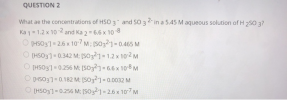 QUESTION 2 What ae the concentrations of HSO 3" and SO 3 2-in a 5.45 M aqueous solution of H 250 3? Ka 1 = 1.2 x 10⁻² and Ka 2 = 6.6 x 10⁻⁸ [HS03'1 = 2.6 x 10⁻⁷M; [S032-) = 0.465 M. [H503"] = 0.342 M; [SO32-) = 1.2 x 10⁻² M. [HSO3'] = 0.256 M; [SO32-) = 6.6 x 10⁻⁸ M [HSO3'] = 0.182 M; [S032-) = 0.0032 M [HSO3'] = 0.256 M; [S032-) = 2.6 x...
3.(12pts) The reaction Cl(aq) + HS(a) determined DRL S)+(aq) +2 Cl(aq) has the experimentally rate k[Cl2][H2S]...
 3.(12pts) The reaction Cl(aq) + HS(a) determined DRL S)+(aq) +2 Cl(aq) has the experimentally rate k[Cl2][H2S] Which of the following mechanisms is(are) consistent with the experimental results. Mech I Mech 11, Mech III Cl2 +H2S >H CI CI+HS (slow) CI+ + HS. …>H+ + Cl. + S H2S = HS. + H+ HSCl2 2CI +S+H (fast) (fast equil) (slow) H2S HS+H (fast equil) (fast equil) (slow) 4. (10 pts) Write the equilibrium constant Ke expression for the following 4 KO:(s)...
For the following half reactions and the partially complete image for an electrochemical cell: Indicate the...
 For the following half reactions and the partially complete image for an electrochemical cell: Indicate the direction of electron flow and then complete the cell diagram. bar Cl₂'g) . 4 . e Ci(m) Pt(s) Cl2(g) CI-(aq) Ni2+(aq) Ni(s) Ered/v 1.358 C12(g) + 2e → 201(aq) Ni2+ lag) + 2 → Ni(s) -0.257 electrochemical cell: am. -Ibar Claig) . > > SI cí (im) Eredly 1.358 ) -0.257
please note step 2, the right side if the equation is supposed to read: CO +...
 please note step 2, the right side if the equation is supposed
to read:
CO + Cl + M Step 2
CO(g) + Cl2(g) = COCl2(g) Given the mechanism below, answer the following questions. Cl2 + M 2CI+ M Cl + COM COCI + M COCI + Cl2 COCl2 + c Step 1 Step 2 Step 3 a. There are two intermediates in this mechanism. Identify them. b. In terms of the product molecule write an expression for the rate...
please note step 2, the right side if the equation is supposed
to read:
CO + Cl + M Step 2
CO(g) + Cl2(g) = COCl2(g) Given the mechanism below, answer the following questions. Cl2 + M 2CI+ M Cl + COM COCI + M COCI + Cl2 COCl2 + c Step 1 Step 2 Step 3 a. There are two intermediates in this mechanism. Identify them. b. In terms of the product molecule write an expression for the rate...
The equilibrium constant, K, for the following reaction is 2.36x10⁻² at 618 K. COCI,(E)=CO(g) +C1, An...
 The equilibrium constant, K, for the following reaction is 2.36x10⁻² at 618 K. COCI,(E)=CO(g) +C1, An equilibrium mixture of the three gases in a 10.4 L container at 618 K contains 0.361 M COCI, 9.23x10⁻²M CO and 9.23 102 M CI. What will be the concentrations of the three gases once equilibrium has been reestablished, if the volume of the container is increased to 17.8 L? [COCI,] = [CO] = [CI] -
A compare? rate Coastant at 1.000 x 10k, and 2. The reaction CO(g) + Cl2 →...
 A compare? rate Coastant at 1.000 x 10k, and 2. The reaction CO(g) + Cl2 → COCl2(g) Has the reaction mechanism Cl + CO=COCI fast Cl2 + COCl → COC12 + Cl slow a. List the intermediates in the reaction mechanism. b. The order of the overall reaction is 5/2. Determine the rate law for the reaction. (Many steps are required)
1. The rate of formation of carbon tetrachloride from chloroform, CHCl3(g) + Cl2(g) => CCl4(g) +...
1. The rate of formation of carbon tetrachloride from chloroform, CHCl3(g) + Cl2(g) => CCl4(g) + HCl(g) is first order in CHCl3 and half order in Cl2. Which step of the proposed mechanism must be slow in order to agree with this rate law? 1. Cl2(g) => 2 Cl(g) 2. Cl(g) + CHCl3(g) => HCl(g) + CCl3(g) 3. CCl3(g) + Cl(g) => CCl4(g) 1. 1 2. 2 3. 3 2. The proposed mechanism for a reaction is Cl2 =>...
 Which of the following changes, at equilibrium, would increase the yield of SiCl 4(g)? si (s) + 2 c 2 (g) = SiCl 4(g) AH > 0 1) increase the pressure 2) add helium gas By add a catalyst 4) increase the temperature 5) increase the amount of Si 6) remove some Sici 4 7) decrease the pressure 8) decrease the temperatuer O 1, 4, and 5 O 2,3,7, and 8 O 2, 4, and 7 0 2,4,5, and 8...
 QUESTION 2 What ae the concentrations of HSO 3" and SO 3 2-in a 5.45 M aqueous solution of H 250 3? Ka 1 = 1.2 x 10⁻² and Ka 2 = 6.6 x 10⁻⁸ [HS03'1 = 2.6 x 10⁻⁷M; [S032-) = 0.465 M. [H503"] = 0.342 M; [SO32-) = 1.2 x 10⁻² M. [HSO3'] = 0.256 M; [SO32-) = 6.6 x 10⁻⁸ M [HSO3'] = 0.182 M; [S032-) = 0.0032 M [HSO3'] = 0.256 M; [S032-) = 2.6 x...
 3.(12pts) The reaction Cl(aq) + HS(a) determined DRL S)+(aq) +2 Cl(aq) has the experimentally rate k[Cl2][H2S] Which of the following mechanisms is(are) consistent with the experimental results. Mech I Mech 11, Mech III Cl2 +H2S >H CI CI+HS (slow) CI+ + HS. …>H+ + Cl. + S H2S = HS. + H+ HSCl2 2CI +S+H (fast) (fast equil) (slow) H2S HS+H (fast equil) (fast equil) (slow) 4. (10 pts) Write the equilibrium constant Ke expression for the following 4 KO:(s)...
 For the following half reactions and the partially complete image for an electrochemical cell: Indicate the direction of electron flow and then complete the cell diagram. bar Cl₂'g) . 4 . e Ci(m) Pt(s) Cl2(g) CI-(aq) Ni2+(aq) Ni(s) Ered/v 1.358 C12(g) + 2e → 201(aq) Ni2+ lag) + 2 → Ni(s) -0.257 electrochemical cell: am. -Ibar Claig) . > > SI cí (im) Eredly 1.358 ) -0.257
 please note step 2, the right side if the equation is supposed
to read:
CO + Cl + M Step 2
CO(g) + Cl2(g) = COCl2(g) Given the mechanism below, answer the following questions. Cl2 + M 2CI+ M Cl + COM COCI + M COCI + Cl2 COCl2 + c Step 1 Step 2 Step 3 a. There are two intermediates in this mechanism. Identify them. b. In terms of the product molecule write an expression for the rate...
please note step 2, the right side if the equation is supposed
to read:
CO + Cl + M Step 2
CO(g) + Cl2(g) = COCl2(g) Given the mechanism below, answer the following questions. Cl2 + M 2CI+ M Cl + COM COCI + M COCI + Cl2 COCl2 + c Step 1 Step 2 Step 3 a. There are two intermediates in this mechanism. Identify them. b. In terms of the product molecule write an expression for the rate...
 The equilibrium constant, K, for the following reaction is 2.36x10⁻² at 618 K. COCI,(E)=CO(g) +C1, An equilibrium mixture of the three gases in a 10.4 L container at 618 K contains 0.361 M COCI, 9.23x10⁻²M CO and 9.23 102 M CI. What will be the concentrations of the three gases once equilibrium has been reestablished, if the volume of the container is increased to 17.8 L? [COCI,] = [CO] = [CI] -
 A compare? rate Coastant at 1.000 x 10k, and 2. The reaction CO(g) + Cl2 → COCl2(g) Has the reaction mechanism Cl + CO=COCI fast Cl2 + COCl → COC12 + Cl slow a. List the intermediates in the reaction mechanism. b. The order of the overall reaction is 5/2. Determine the rate law for the reaction. (Many steps are required)
Most questions answered within 3 hours.
-
Where is the error in this code sequence?
String s1 = "Hello";
String s2 = "ello";...
asked 11 months ago -
Financial data for Joel de Paris, Inc., for last year
follow:
Joel de Paris, Inc.
Balance...
asked 11 months ago -
Consider this reaction:
Al2(SO4)3 (aq)+ BaCl3
(aq) Al2Cl6 (aq)- +
3BaSO4(s) . What is the...
asked 11 months ago -
Suppose that Savneet is considering increasing her
recent random sample from 20 car rentals to 40...
asked 11 months ago -
Trucks arrive at an unloading terminal at an average rate of 120
per hour.
Trucks arrive...
asked 11 months ago -
Why are methanol and ethanol completely soluble in water while
octanol is not very little soluble....
asked 11 months ago -
A facilities manager at a university reads in a research report
that the mean amount of...
asked 11 months ago -
When the CuSO4 is rehydrated by adding water to the anhydrous
compound, is this an endothermic...
asked 11 months ago -
A ray of sunlight is passing from diamond into crown glass; the
angle of incidence is...
asked 11 months ago -
A block of mass 0.249 kg is placed on top of a light, vertical
spring of...
asked 11 months ago -
how do the kidneys compensate in the presences of acidosis
a) trigger hyperventilate
b) reserve acid...
asked 11 months ago -
Question 501 pts
The rental rate of capital to the firm increases. Which of the
following...
asked 11 months ago