

Homework Answers
1) given data:
mass of block (m) = 2 kg
final velocity of block (V') = 10 m/s
distance travelled (d) = 20 m
coefficient of kinetic friction ( )
= 0.2
)
= 0.2
let the initial velocity of block be V
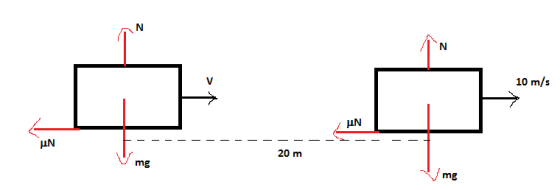
friction force =
N
=
*mg
= 0.2*2*9.81
= 3.924 N
from netwon's second law
f = m*a
a = f/m
= 3.924/2
= 1.962 m/s2
now from equation of motion
V'2 = V2 - 2*a*d
102 + 2*1.962*20 = V2
V = 13.359 m/s
thus correct option is c
2)
- hydrodynamic bearings are challenging to design for an average machinery designer. thus this statement is true.
- bearings are selected rather than being designed.so this statement is false
- bushing, journal bearing and rolling element bearing are all types of bearing thus this statement is also correct.
- both radial and axial loaded rolling element bearing are type of bearing and uses rolling element. thus this statement is also true.
thus correct option is b
Add Answer to:
Question 2
A 2-kg block slides along a rough horizontal surface and slows to 10 m/s...
A 2-kg block slides along a rough horizontal surface and slows to 10 m/s after traveling...
 A 2-kg block slides along a rough horizontal surface and slows to 10 m/s after traveling 20 m. it the kinetic coeficient of friction between the Book SA ace is 0.2, the initial speed (m/s) of the block was most nearly 13.4 20.0 10.0 10.4
3 m Mx = 0.2 Given: The 15-kg block slides along a rough surface with the...
 3 m Mx = 0.2 Given: The 15-kg block slides along a rough surface with the friction coefficient given. Find: a) Draw the free-body and kinetic diagrams of the block. 8 m/s b) Find the tension in the cable. Show your work. N
A 2.0-kg block slides along a rough horizontal surface. A force(P=6.0N) is applied to the block...
A 2.0-kg block slides along a rough horizontal surface. A force(P=6.0N) is applied to the block at a 30degree angle. What is the horizontal acceleration of the block? ASSUME NO FRICTIONAL FORCE
A block is pulled along a rough horizontal surface by force of magnitude 100 Newtons, at...
 A block is pulled along a rough horizontal surface by force of
magnitude 100 Newtons, at an angle of 30 degrees as shown. The
block has a mass M=20.0 kg, and the coefficient of kinetic friction
between the block and the surface is 0.50.
a)The horizontal component of the tension, T, is
b)The normal force exerted upward by the floor on the block has
a magnitude of
c)If the block moves 10.0 m to the right, the work done by...
A block is pulled along a rough horizontal surface by force of
magnitude 100 Newtons, at an angle of 30 degrees as shown. The
block has a mass M=20.0 kg, and the coefficient of kinetic friction
between the block and the surface is 0.50.
a)The horizontal component of the tension, T, is
b)The normal force exerted upward by the floor on the block has
a magnitude of
c)If the block moves 10.0 m to the right, the work done by...
DYNAMICS-15 A block with a spring attached to one end slides along a rough surface with an initia...
 DYNAMICS-15 A block with a spring attached to one end slides along a rough surface with an initial velocity of 7 m/s. After it slides 4 m, it impacts a wall for 0.1 s, and then slides 10 m in the opposite direction before coming to a stop. If the block's deceleration is assumed constant and the contraction of the spring is negligible, what is the average acceleration of the block during impact with the wall? spring block +X (A)...
A2.2 kg block of wood is sliding at a speed of 4.0 m/s along a smooth,...
 A2.2 kg block of wood is sliding at a speed of 4.0 m/s along a smooth, flasf frictionless surface of a frozen lake. It then hits a rough patch and the friction slows it down by providing an acceleration of 0.5 m/s2. After 3 seconds of traveling along this surface, how far will our object have slid along the rough surface?
(S points) A o.5 kg block slides along a horizontal frictionless surface at 2.0 m/s. It...
 (S points) A o.5 kg block slides along a horizontal frictionless surface at 2.0 m/s. It is brought to rest by compressing a ve 16. sed long spring of spring constant 800 N/m. How far does the spring get compressed (in cm)? 17. (5 points) A block is released from rest at point P. h2 50 m high, and slides along the frictionless track shown. What is its speed at pointō匹=40 m high? h1 h2 ground level
A 3.0 kg block slides along a horizontal frictionless surface with a speed of 9.8 m/s....
A 3.0 kg block slides along a horizontal frictionless surface with a speed of 9.8 m/s. The block makes a smooth transition to a frictionless ramp inclined at an angle of 35.0
A block of mass m = 78 kg slides along a horizontal surface
 A block of mass m = 78 kg slides along a horizontal surface. The coefficient of friction between the block and the surface is μk = 0.29. The block has an initial speed of v0 = 29 m/s in the positive x-direction as shown. a. Write an expression for the x-component of the frictional force the block experiences, Ff, in terms of the given variables and variables available in the palette. b. What is the magnitude of the frictional force in N? c....
A block of mass m = 63 kg slides along a horizontal surface.
 A block of mass m = 63 kg slides along a horizontal surface. The coefficient of friction between the block and the surface is μk= 0.41. The block has an initial speed of v0 = 16 m/s in the positive x-direction as shown. Part (a) Write an expression for the x-component of the frictional force the block experiences, Ff in terms of the given variables and variables available in the palette.Part (b) What is the magnitude of the frictional force in...
 A 2-kg block slides along a rough horizontal surface and slows to 10 m/s after traveling 20 m. it the kinetic coeficient of friction between the Book SA ace is 0.2, the initial speed (m/s) of the block was most nearly 13.4 20.0 10.0 10.4
 3 m Mx = 0.2 Given: The 15-kg block slides along a rough surface with the friction coefficient given. Find: a) Draw the free-body and kinetic diagrams of the block. 8 m/s b) Find the tension in the cable. Show your work. N
 A block is pulled along a rough horizontal surface by force of
magnitude 100 Newtons, at an angle of 30 degrees as shown. The
block has a mass M=20.0 kg, and the coefficient of kinetic friction
between the block and the surface is 0.50.
a)The horizontal component of the tension, T, is
b)The normal force exerted upward by the floor on the block has
a magnitude of
c)If the block moves 10.0 m to the right, the work done by...
A block is pulled along a rough horizontal surface by force of
magnitude 100 Newtons, at an angle of 30 degrees as shown. The
block has a mass M=20.0 kg, and the coefficient of kinetic friction
between the block and the surface is 0.50.
a)The horizontal component of the tension, T, is
b)The normal force exerted upward by the floor on the block has
a magnitude of
c)If the block moves 10.0 m to the right, the work done by...
 DYNAMICS-15 A block with a spring attached to one end slides along a rough surface with an initial velocity of 7 m/s. After it slides 4 m, it impacts a wall for 0.1 s, and then slides 10 m in the opposite direction before coming to a stop. If the block's deceleration is assumed constant and the contraction of the spring is negligible, what is the average acceleration of the block during impact with the wall? spring block +X (A)...
 A2.2 kg block of wood is sliding at a speed of 4.0 m/s along a smooth, flasf frictionless surface of a frozen lake. It then hits a rough patch and the friction slows it down by providing an acceleration of 0.5 m/s2. After 3 seconds of traveling along this surface, how far will our object have slid along the rough surface?
 (S points) A o.5 kg block slides along a horizontal frictionless surface at 2.0 m/s. It is brought to rest by compressing a ve 16. sed long spring of spring constant 800 N/m. How far does the spring get compressed (in cm)? 17. (5 points) A block is released from rest at point P. h2 50 m high, and slides along the frictionless track shown. What is its speed at pointō匹=40 m high? h1 h2 ground level
Most questions answered within 3 hours.
-
Where is the error in this code sequence?
String s1 = "Hello";
String s2 = "ello";...
asked 10 months ago -
Financial data for Joel de Paris, Inc., for last year
follow:
Joel de Paris, Inc.
Balance...
asked 10 months ago -
Consider this reaction:
Al2(SO4)3 (aq)+ BaCl3
(aq) Al2Cl6 (aq)- +
3BaSO4(s) . What is the...
asked 10 months ago -
Suppose that Savneet is considering increasing her
recent random sample from 20 car rentals to 40...
asked 10 months ago -
Trucks arrive at an unloading terminal at an average rate of 120
per hour.
Trucks arrive...
asked 10 months ago -
Why are methanol and ethanol completely soluble in water while
octanol is not very little soluble....
asked 10 months ago -
A facilities manager at a university reads in a research report
that the mean amount of...
asked 10 months ago -
When the CuSO4 is rehydrated by adding water to the anhydrous
compound, is this an endothermic...
asked 10 months ago -
A ray of sunlight is passing from diamond into crown glass; the
angle of incidence is...
asked 10 months ago -
A block of mass 0.249 kg is placed on top of a light, vertical
spring of...
asked 10 months ago -
how do the kidneys compensate in the presences of acidosis
a) trigger hyperventilate
b) reserve acid...
asked 10 months ago -
Question 501 pts
The rental rate of capital to the firm increases. Which of the
following...
asked 10 months ago