
Homework Answers
SOLUTION-
EQDFA is the decidability problem to check whether two DFAs accept the same language or not and so it can be represented as {<A,B> | A,B are DFA, and L(A) = L(B)}.
Let us consider A, B be two DFAs and start by constructing the Symmetric difference of A and B (let's call it C).
so,
So, we can say thet C is DFA ,as DFA is closed under union, intersection and complement
Construction of C can be finished in polynomial time as all of union, intersection and Complement of a DFA can be constructed in polynomial time.
Verifying L(A) = L(B) is same as verifying L(C) = . The
below TM decides whether a language is empty or not in polynomial
time as follows:
Consider a Turing Machine T = On input <C> where C is a DFA.
- Mark the start state of C
- Mark all states that have a transition coming into it from a state that is already marked
- Repeat step 2 until no new state is marked
- If no final state of A is marked, accept; otherwise, reject
Therefore we get to decide EQDFA in polynomial time. Therefore EQDFA is in P.
IF YOU HAVE ANY DOUBT PLEASE COMMENT DOWN BELOW I
WILL SOLVE IT FOR YOU:)
----------------PLEASE RATE THE ANSWER-----------THANK
YOU!!!!!!!!----------
4. Show that for a prime p E Z, p = a2 + 2b2 for some...
 4. Show that for a prime p E Z, p = a2 + 2b2 for some a,b E Z if and only if = 1. (You can use properties of Z[V-2 discussed in class.)
4. Show that for a prime p E Z, p = a2 + 2b2 for some a,b E Z if and only if = 1. (You can use properties of Z[V-2 discussed in class.)
4. Show that for a prime p E Z, p = a2 + 2b2 for some a,b E Z if and only if = 1. (You can use properties of Z[V-2 discussed in class.)
4. Let M-(E, F) be a matroid and let E'-{e e E : {e) e F}. Show that dim(P)-el (where E' is the s...
 please explain the steps you take
4. Let M-(E, F) be a matroid and let E'-{e e E : {e) e F}. Show that dim(P)-el (where E' is the set of incidence vectors of independent sets and P conv(X) like in class) and show that the description for Q (as defined in class) has the required number of linear independent equations.
4. Let M-(E, F) be a matroid and let E'-{e e E : {e) e F}. Show that dim(P)-el...
please explain the steps you take
4. Let M-(E, F) be a matroid and let E'-{e e E : {e) e F}. Show that dim(P)-el (where E' is the set of incidence vectors of independent sets and P conv(X) like in class) and show that the description for Q (as defined in class) has the required number of linear independent equations.
4. Let M-(E, F) be a matroid and let E'-{e e E : {e) e F}. Show that dim(P)-el...
[15] 4. Let E and F be events of sample space S. Let P(E) = 0.3,...
 [15] 4. Let E and F be events of sample space S. Let P(E) = 0.3, P(F) = 0.6 and the P(EUF) = 0.7. a) Fill in all probabilities in the Venn diagram shown. S b) Find P(EnF). c) Find P(ENF). d) Find the P(E|F). e) Are E and F independent events? Justify your answer.
If the matrix A - |--2 15 ]] i e., A= PDP " with P degalizable,...
 If the matrix A - |--2 15 ]] i e., A= PDP " with P degalizable, invertible and D = 16 d. do=d, diagonal, which choice for P? 4. A is not chagonalizable of the folosing is a 2 2 -1 3. P=[4] 4.P=[:] 5.P=[14]
2. Show that p-1 E(+1) = 2a +(*)(4+1) k=0 l=0 Hint: Fix an 0 <I<p –...
 2. Show that p-1 E(+1) = 2a +(*)(4+1) k=0 l=0 Hint: Fix an 0 <I<p – 1, Ask youself how many k satisfy k2 = 1 mod p.
show works , thank you P UULIU1 10 15 . 4. (dpt) Use logarithmic differentiation to...
 show works , thank you
P UULIU1 10 15 . 4. (dpt) Use logarithmic differentiation to find if y=(2 + cos r)"/2.
show works , thank you
P UULIU1 10 15 . 4. (dpt) Use logarithmic differentiation to find if y=(2 + cos r)"/2.
show all the work 2. Let E, F be events with probabilities P(E) = 2, P(F)...
 show all the work
2. Let E, F be events with probabilities P(E) = 2, P(F) = 3, PENF) = .1. Compute the probability that at most one of E, F occurs. A. .4 B..5 C..1 D..9
show all the work
2. Let E, F be events with probabilities P(E) = 2, P(F) = 3, PENF) = .1. Compute the probability that at most one of E, F occurs. A. .4 B..5 C..1 D..9
10. Prove that P(E UFUG)P(E) P(F) + 2P(EFG). 11. If P(E)9 and P(F).8, show that P(EF...
 10. Prove that P(E UFUG)P(E) P(F) + 2P(EFG). 11. If P(E)9 and P(F).8, show that P(EF .7 In general, prove Bonferroni's inequality, namely, P(EF) 2 P(E) + P(F)-1 13. Prove that P(EF*)= P(E)-P(EF).
Let E and F be events for which P(E) = .5, P(F)= .4, and P(E F)...
Let E and F be events for which P(E) = .5, P(F)= .4, and P(E F) = .2 a) are E and F mutually exclusive or independent? (justify mathematically) b) Find P(E F) c) Find P(F') d) Find P(F l E) e) Find P(E' F) We were unable to transcribe this imageWe were unable to transcribe this imageWe were unable to transcribe this imageWe were unable to transcribe this image
-id e Show that: a cos p 2 b. Sin e 2i
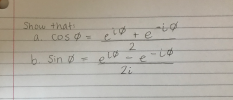 -id e Show that: a cos p 2 b. Sin e 2i
 4. Show that for a prime p E Z, p = a2 + 2b2 for some a,b E Z if and only if = 1. (You can use properties of Z[V-2 discussed in class.)
4. Show that for a prime p E Z, p = a2 + 2b2 for some a,b E Z if and only if = 1. (You can use properties of Z[V-2 discussed in class.)
4. Show that for a prime p E Z, p = a2 + 2b2 for some a,b E Z if and only if = 1. (You can use properties of Z[V-2 discussed in class.)
 please explain the steps you take
4. Let M-(E, F) be a matroid and let E'-{e e E : {e) e F}. Show that dim(P)-el (where E' is the set of incidence vectors of independent sets and P conv(X) like in class) and show that the description for Q (as defined in class) has the required number of linear independent equations.
4. Let M-(E, F) be a matroid and let E'-{e e E : {e) e F}. Show that dim(P)-el...
please explain the steps you take
4. Let M-(E, F) be a matroid and let E'-{e e E : {e) e F}. Show that dim(P)-el (where E' is the set of incidence vectors of independent sets and P conv(X) like in class) and show that the description for Q (as defined in class) has the required number of linear independent equations.
4. Let M-(E, F) be a matroid and let E'-{e e E : {e) e F}. Show that dim(P)-el...
 [15] 4. Let E and F be events of sample space S. Let P(E) = 0.3, P(F) = 0.6 and the P(EUF) = 0.7. a) Fill in all probabilities in the Venn diagram shown. S b) Find P(EnF). c) Find P(ENF). d) Find the P(E|F). e) Are E and F independent events? Justify your answer.
 If the matrix A - |--2 15 ]] i e., A= PDP " with P degalizable, invertible and D = 16 d. do=d, diagonal, which choice for P? 4. A is not chagonalizable of the folosing is a 2 2 -1 3. P=[4] 4.P=[:] 5.P=[14]
 2. Show that p-1 E(+1) = 2a +(*)(4+1) k=0 l=0 Hint: Fix an 0 <I<p – 1, Ask youself how many k satisfy k2 = 1 mod p.
 show works , thank you
P UULIU1 10 15 . 4. (dpt) Use logarithmic differentiation to find if y=(2 + cos r)"/2.
show works , thank you
P UULIU1 10 15 . 4. (dpt) Use logarithmic differentiation to find if y=(2 + cos r)"/2.
 show all the work
2. Let E, F be events with probabilities P(E) = 2, P(F) = 3, PENF) = .1. Compute the probability that at most one of E, F occurs. A. .4 B..5 C..1 D..9
show all the work
2. Let E, F be events with probabilities P(E) = 2, P(F) = 3, PENF) = .1. Compute the probability that at most one of E, F occurs. A. .4 B..5 C..1 D..9
 10. Prove that P(E UFUG)P(E) P(F) + 2P(EFG). 11. If P(E)9 and P(F).8, show that P(EF .7 In general, prove Bonferroni's inequality, namely, P(EF) 2 P(E) + P(F)-1 13. Prove that P(EF*)= P(E)-P(EF).
 -id e Show that: a cos p 2 b. Sin e 2i
Most questions answered within 3 hours.
-
Where is the error in this code sequence?
String s1 = "Hello";
String s2 = "ello";...
asked 11 months ago -
Financial data for Joel de Paris, Inc., for last year
follow:
Joel de Paris, Inc.
Balance...
asked 11 months ago -
Consider this reaction:
Al2(SO4)3 (aq)+ BaCl3
(aq) Al2Cl6 (aq)- +
3BaSO4(s) . What is the...
asked 11 months ago -
Suppose that Savneet is considering increasing her
recent random sample from 20 car rentals to 40...
asked 11 months ago -
Trucks arrive at an unloading terminal at an average rate of 120
per hour.
Trucks arrive...
asked 11 months ago -
Why are methanol and ethanol completely soluble in water while
octanol is not very little soluble....
asked 11 months ago -
A facilities manager at a university reads in a research report
that the mean amount of...
asked 11 months ago -
When the CuSO4 is rehydrated by adding water to the anhydrous
compound, is this an endothermic...
asked 11 months ago -
A ray of sunlight is passing from diamond into crown glass; the
angle of incidence is...
asked 11 months ago -
A block of mass 0.249 kg is placed on top of a light, vertical
spring of...
asked 11 months ago -
how do the kidneys compensate in the presences of acidosis
a) trigger hyperventilate
b) reserve acid...
asked 11 months ago -
Question 501 pts
The rental rate of capital to the firm increases. Which of the
following...
asked 11 months ago