
Homework Answers
1. H2 receptor antagonist reduce the effects of acid in your stomach. ... Proton pump inhibitors (PPIs) reduce your body's production of acid. They work well for heartburn that isn't resolved byantacids or H2 blockers. It may take a little longer for a PPI to help your symptoms, but relief will last longer.
Both medications work by blocking and decreasing the production ofstomach acid, but PPIs are considered stronger and faster in reducing stomach acids. However, H2 receptor blockers specifically decrease the acid released in the evening, which is a common contributor to peptic ulcers
PPI are used for ulcers and GERD but H2 receptor antagonist are used for Mild heartburn
PPI retention time is 3 days while H2 receptor antagonist is 12 hrs
PPI inhibits the pump H2 receptor antagonist blocks H2 receptor
2. Nurse will teach that home remedies are effective only upto a certain time.But if symptoms are increasing and getting no relief from home remedies you should consult a physician because their can be any problem which cannot be treated by own. Certain medical interventions are required for treatment. She will also advice taking OTC medications without physician advise can leads to serious problems In future because of side effects.So always take medications by physician advise not by own will.And use those home remedies which are advised by the certified doctor in the past not to follow remedies by own.Nurse will also tell her that some ppi coming now a days are cost effective.
3. I will try to understand Mrs by my full efforts. I will say her I think their may be a problem of gastritis or GERD or may a initial stage ofpeptic ulcer disease that's why she is not getting relief from heartburn and indigestion. If H pylori gastritis is their she must need some antibiotics.
I tell her that PPi has longer duration of action, more complete inhibition of acid Secreation that maintains gastric PH above 4. I will tell her so many pros of ppi over H2 receptor antagonist.
Add Answer to:
Ms. Mckelvey has been taking over-the-counter (OTC) famotidine for her indigestion for 2 weeks without significant...
ant'd Case Study Ms. McKelvey has been taking over-the-counter (OTC) famotidine for her indigestion for 2...
 ant'd Case Study Ms. McKelvey has been taking over-the-counter (OTC) famotidine for her indigestion for 2 weeks without significant relief. She decided to contact her healthcare provider because the symptoms continued to occur, particularly her heartburn symptoms. Now, however, the healthcare provider has added a proton pump inhibitor. When the healthcare provider leaves the room, Ms. McKelvey tells the nurse she is unhappy about this, because she has prided herself on keeping her "medical costs” down by using only home...
2. Ms. George is a 32-year-old computer programmer eorge is a 32 year-old computer programmer. Over...
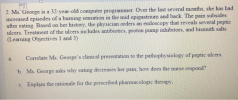 2. Ms. George is a 32-year-old computer programmer eorge is a 32 year-old computer programmer. Over the last several months, she has had th ased episodes of a burning sensation in the mid epigastrium and back. The pain subsides after eating. Based on her history, the physician orders an endoscopy that reveals several peptic ulcers. Treatment of the ulcers includes antibiotics, proton pump inhibitors, and bismuth salts. Learning Objectives 1 and 3) incre Correlate Ms. George's clinical presentation to the...
Ms. X., aged 55 years, has been complaining of severe fatigue and “indigestion.” Her son is...
Ms. X., aged 55 years, has been complaining of severe fatigue and “indigestion.” Her son is quite concerned and decides to take her to the emergency department. On arrival she appears very anxious, and her facial skin is cool and clammy; her blood pressure is 90/60, and the pulse is around 90, weak, and irregular. She is given oxygen, an intravenous line is opened, and leads for ECG are attached. Blood is taken for determination of serum enzymes and electrolytes....
J.V., a 56-year-old delivery truck driver, has been taken to the emergency department (ED) because he...
J.V., a 56-year-old delivery truck driver, has been taken to the emergency department (ED) because he was experiencing chest pain. It started just after he had a quick lunch at a food truck. He told the paramedic that he often has chest pain but that it goes away when he "takes a swig of antacid," but this time the pain did not stop. On arrival he was given another dose of antacid and sublingual nitroglycerin, and the chest pain stopped....
1. Oral acetaminophen has been ordered for a young child who has a fever. A liquid...
 1. Oral acetaminophen has been ordered for a young child who has a fever. A liquid form has been obtained by the nurse to increase the chance of problem free administration. Prior to administration, the nurse is going through the rights of medication administration. When confirming the right dose, what term is the most appropriate? a. "160 mg" b. "one teaspoon" c. "one third of a tablespoon d. "SmL 2. A pregnant woman asks why she needs to take a...
 ant'd Case Study Ms. McKelvey has been taking over-the-counter (OTC) famotidine for her indigestion for 2 weeks without significant relief. She decided to contact her healthcare provider because the symptoms continued to occur, particularly her heartburn symptoms. Now, however, the healthcare provider has added a proton pump inhibitor. When the healthcare provider leaves the room, Ms. McKelvey tells the nurse she is unhappy about this, because she has prided herself on keeping her "medical costs” down by using only home...
 2. Ms. George is a 32-year-old computer programmer eorge is a 32 year-old computer programmer. Over the last several months, she has had th ased episodes of a burning sensation in the mid epigastrium and back. The pain subsides after eating. Based on her history, the physician orders an endoscopy that reveals several peptic ulcers. Treatment of the ulcers includes antibiotics, proton pump inhibitors, and bismuth salts. Learning Objectives 1 and 3) incre Correlate Ms. George's clinical presentation to the...
 1. Oral acetaminophen has been ordered for a young child who has a fever. A liquid form has been obtained by the nurse to increase the chance of problem free administration. Prior to administration, the nurse is going through the rights of medication administration. When confirming the right dose, what term is the most appropriate? a. "160 mg" b. "one teaspoon" c. "one third of a tablespoon d. "SmL 2. A pregnant woman asks why she needs to take a...
Most questions answered within 3 hours.
-
Where is the error in this code sequence?
String s1 = "Hello";
String s2 = "ello";...
asked 10 months ago -
Financial data for Joel de Paris, Inc., for last year
follow:
Joel de Paris, Inc.
Balance...
asked 10 months ago -
Consider this reaction:
Al2(SO4)3 (aq)+ BaCl3
(aq) Al2Cl6 (aq)- +
3BaSO4(s) . What is the...
asked 10 months ago -
Suppose that Savneet is considering increasing her
recent random sample from 20 car rentals to 40...
asked 10 months ago -
Trucks arrive at an unloading terminal at an average rate of 120
per hour.
Trucks arrive...
asked 10 months ago -
Why are methanol and ethanol completely soluble in water while
octanol is not very little soluble....
asked 10 months ago -
A facilities manager at a university reads in a research report
that the mean amount of...
asked 10 months ago -
When the CuSO4 is rehydrated by adding water to the anhydrous
compound, is this an endothermic...
asked 10 months ago -
A ray of sunlight is passing from diamond into crown glass; the
angle of incidence is...
asked 10 months ago -
A block of mass 0.249 kg is placed on top of a light, vertical
spring of...
asked 10 months ago -
how do the kidneys compensate in the presences of acidosis
a) trigger hyperventilate
b) reserve acid...
asked 10 months ago -
Question 501 pts
The rental rate of capital to the firm increases. Which of the
following...
asked 10 months ago