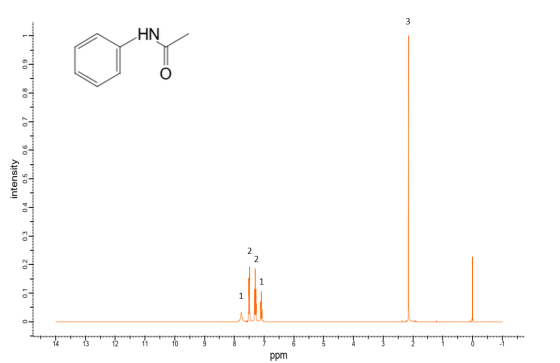
How to do a summary on this compound:
1)mention how many signals there are in the NMR and what this means.
2) Find the location of the signals and describe what they mean.(ex peak 1.3 could indicate a possible CH>CH2>CH3)
3)Talk about the integrals and the possible number of hydrogen's there could be based on the other integrals.
4)Discuss the signal splitting and how many neighbors each proton has.
Homework Answers
Request Answer!
We need at least 10 more requests to produce the answer.
0 / 10 have requested this problem solution
The more requests, the faster the answer.
Add Answer to:
How to do a summary on this compound:
1)mention how many signals there are in the...
7. Which compound below best fits the following spectral data? 8. How many signals would you...
 7. Which compound below best fits the following
spectral data?
8. How many signals would you expect to see in the
broadband decoupled C^13 spectra of the following compounds?
9. If a proton gave an NMR signal at 3.2 ppm on a MHz
NMR, what would the chemical shift be of this proton (in ppm) if
the sample was run in 400 MHz NMR?
7. Which compound below best fits the following spectral data? (6 points) H-1 NMR 0.9 ppm...
7. Which compound below best fits the following
spectral data?
8. How many signals would you expect to see in the
broadband decoupled C^13 spectra of the following compounds?
9. If a proton gave an NMR signal at 3.2 ppm on a MHz
NMR, what would the chemical shift be of this proton (in ppm) if
the sample was run in 400 MHz NMR?
7. Which compound below best fits the following spectral data? (6 points) H-1 NMR 0.9 ppm...
PART 1 - For the following compounds A. Predict how many signals would be detected in...
 PART 1 - For the following compounds A. Predict how many signals would be detected in the expected 'H NMR spectrum. B. Label proton groups and determine their multiplicity. c. Predict the chemical shifts of each signal in the expected 'H NMR spectrum of the following compounds from the correlation chart in the last page. <Example> Number of signals O Proton groups Multiplicity Triplet B Multiplet (sextet) c Triplet D Singlet Chemical Shirt (ppm) 0.8-1.0 1.2 - 1.5 3.2 4.0...
How many proton (1H) NMR signals does the acrylic compound display?
 How many proton (1H) NMR signals does the acrylic compound display?a. CH3(CH2)3CH3
7. Which compound below be H-1 NMR 0.9 ppm (quartet fits the following spectral data? (6...
 7. Which compound below be H-1 NMR 0.9 ppm (quartet fits the following spectral data? (6 points) 1.2 ppm (sextet 2 hydrogens), 2.1 ppm (triplet, hydrogens), 4.3 ppm (singlet 3 hydrogens) C-13 NMR 5 signals 25 ppr ppm (CH2); 61 ppm: (CH3) 198 Ppm (C). IR strong peak 1735 cm Ignals 25 ppm (CH): 35 ppm (CH2), 46 ppm (CH2); 61 ppm: em Mass Spee parent M+ = 102 Mass Spec paren ou 0 H2 CH3 HjC Holo H3C- CC...
Determine the structure of the chemical compound from the proton NMR spectrum 1.9 1.8 1.50 1.7...
 Determine the structure of the chemical compound from the
proton NMR spectrum
1.9 1.8 1.50 1.7 1.45 1.483 1.6 1.40 (2.473 11,467 -1.461 11.446 1.5 1.435 1.424 1.420 1.4 ppm 21.407 1.3 1.396 21-1.388 1.372 1.359 142.346 1.324 -1.308 -1.303 1.202 1.2 1.1 1.0 -0.951 -0.928 -0.904 0.9 0.8 0.7 Co Higo 0.6 0.5 ppm
Determine the structure of the chemical compound from the
proton NMR spectrum
1.9 1.8 1.50 1.7 1.45 1.483 1.6 1.40 (2.473 11,467 -1.461 11.446 1.5 1.435 1.424 1.420 1.4 ppm 21.407 1.3 1.396 21-1.388 1.372 1.359 142.346 1.324 -1.308 -1.303 1.202 1.2 1.1 1.0 -0.951 -0.928 -0.904 0.9 0.8 0.7 Co Higo 0.6 0.5 ppm
8. The structure and proton NMR spectrum of a molecule are shown below. The molecule has...
 8. The structure and proton NMR spectrum of a molecule are shown below. The molecule has letters by each location that has one or more protons. The chemical shifts of the signals in the spectrum are listed at right with Roman numerals. On your answer page write the Roman numeral of the chemical shift of each family on the line by that family's letta B. - A. sicer Fam., Chemical shift (ppm) 4.2 II 3.5 III 2.75 IV V 1.15...
Indicate how many 'H NMR signals (individual resonances, not counting splitting) are expected for the compound....
 Indicate how many 'H NMR signals (individual resonances, not counting splitting) are expected for the compound. Br—CH20 -CH3 Br How many 'H NMR signals are expected? signals
Indicate how many^1 H NMR signals (individual resonances, not counting splitting) are expected for the compound...
 Indicate how many^1 H NMR signals (individual resonances, not counting splitting) are expected for the compound below.
1. How many distinct signals are expected in the proton-decoupled 13C NMR spectrum of 4-methyl-2-pentanol A....
1. How many distinct signals are expected in the proton-decoupled 13C NMR spectrum of 4-methyl-2-pentanol A. 3 B.4 C. 5 D. 6 2) what splitting pattern is observed in the proton NMR spectrum for the indicated BOLDED hydrogens CH3OCH2CH2CH2OCH3 a. Singlet B. doublet C. Triplet D. quartet
How many signals are present in the H NMR spectrum of the following molecule? What splitting...
 How many signals are present in the H NMR spectrum of the following molecule? What splitting pattern is observed for each signal? Part 1: Number of signal(s): -4 Part 2 out of 2 OH Hb Ha:1peak(s) peak(s) peak(s) peak(s) Hd:
 7. Which compound below best fits the following
spectral data?
8. How many signals would you expect to see in the
broadband decoupled C^13 spectra of the following compounds?
9. If a proton gave an NMR signal at 3.2 ppm on a MHz
NMR, what would the chemical shift be of this proton (in ppm) if
the sample was run in 400 MHz NMR?
7. Which compound below best fits the following spectral data? (6 points) H-1 NMR 0.9 ppm...
7. Which compound below best fits the following
spectral data?
8. How many signals would you expect to see in the
broadband decoupled C^13 spectra of the following compounds?
9. If a proton gave an NMR signal at 3.2 ppm on a MHz
NMR, what would the chemical shift be of this proton (in ppm) if
the sample was run in 400 MHz NMR?
7. Which compound below best fits the following spectral data? (6 points) H-1 NMR 0.9 ppm...
 PART 1 - For the following compounds A. Predict how many signals would be detected in the expected 'H NMR spectrum. B. Label proton groups and determine their multiplicity. c. Predict the chemical shifts of each signal in the expected 'H NMR spectrum of the following compounds from the correlation chart in the last page. <Example> Number of signals O Proton groups Multiplicity Triplet B Multiplet (sextet) c Triplet D Singlet Chemical Shirt (ppm) 0.8-1.0 1.2 - 1.5 3.2 4.0...
 How many proton (1H) NMR signals does the acrylic compound display?a. CH3(CH2)3CH3
 7. Which compound below be H-1 NMR 0.9 ppm (quartet fits the following spectral data? (6 points) 1.2 ppm (sextet 2 hydrogens), 2.1 ppm (triplet, hydrogens), 4.3 ppm (singlet 3 hydrogens) C-13 NMR 5 signals 25 ppr ppm (CH2); 61 ppm: (CH3) 198 Ppm (C). IR strong peak 1735 cm Ignals 25 ppm (CH): 35 ppm (CH2), 46 ppm (CH2); 61 ppm: em Mass Spee parent M+ = 102 Mass Spec paren ou 0 H2 CH3 HjC Holo H3C- CC...
 Determine the structure of the chemical compound from the
proton NMR spectrum
1.9 1.8 1.50 1.7 1.45 1.483 1.6 1.40 (2.473 11,467 -1.461 11.446 1.5 1.435 1.424 1.420 1.4 ppm 21.407 1.3 1.396 21-1.388 1.372 1.359 142.346 1.324 -1.308 -1.303 1.202 1.2 1.1 1.0 -0.951 -0.928 -0.904 0.9 0.8 0.7 Co Higo 0.6 0.5 ppm
Determine the structure of the chemical compound from the
proton NMR spectrum
1.9 1.8 1.50 1.7 1.45 1.483 1.6 1.40 (2.473 11,467 -1.461 11.446 1.5 1.435 1.424 1.420 1.4 ppm 21.407 1.3 1.396 21-1.388 1.372 1.359 142.346 1.324 -1.308 -1.303 1.202 1.2 1.1 1.0 -0.951 -0.928 -0.904 0.9 0.8 0.7 Co Higo 0.6 0.5 ppm
 8. The structure and proton NMR spectrum of a molecule are shown below. The molecule has letters by each location that has one or more protons. The chemical shifts of the signals in the spectrum are listed at right with Roman numerals. On your answer page write the Roman numeral of the chemical shift of each family on the line by that family's letta B. - A. sicer Fam., Chemical shift (ppm) 4.2 II 3.5 III 2.75 IV V 1.15...
 Indicate how many 'H NMR signals (individual resonances, not counting splitting) are expected for the compound. Br—CH20 -CH3 Br How many 'H NMR signals are expected? signals
 Indicate how many^1 H NMR signals (individual resonances, not counting splitting) are expected for the compound below.
 How many signals are present in the H NMR spectrum of the following molecule? What splitting pattern is observed for each signal? Part 1: Number of signal(s): -4 Part 2 out of 2 OH Hb Ha:1peak(s) peak(s) peak(s) peak(s) Hd:
Most questions answered within 3 hours.
-
Where is the error in this code sequence?
String s1 = "Hello";
String s2 = "ello";...
asked 10 months ago -
Financial data for Joel de Paris, Inc., for last year
follow:
Joel de Paris, Inc.
Balance...
asked 10 months ago -
Consider this reaction:
Al2(SO4)3 (aq)+ BaCl3
(aq) Al2Cl6 (aq)- +
3BaSO4(s) . What is the...
asked 10 months ago -
Suppose that Savneet is considering increasing her
recent random sample from 20 car rentals to 40...
asked 10 months ago -
Trucks arrive at an unloading terminal at an average rate of 120
per hour.
Trucks arrive...
asked 10 months ago -
Why are methanol and ethanol completely soluble in water while
octanol is not very little soluble....
asked 10 months ago -
A facilities manager at a university reads in a research report
that the mean amount of...
asked 10 months ago -
When the CuSO4 is rehydrated by adding water to the anhydrous
compound, is this an endothermic...
asked 10 months ago -
A ray of sunlight is passing from diamond into crown glass; the
angle of incidence is...
asked 10 months ago -
A block of mass 0.249 kg is placed on top of a light, vertical
spring of...
asked 10 months ago -
how do the kidneys compensate in the presences of acidosis
a) trigger hyperventilate
b) reserve acid...
asked 10 months ago -
Question 501 pts
The rental rate of capital to the firm increases. Which of the
following...
asked 10 months ago