
Homework Answers
Add Answer to:
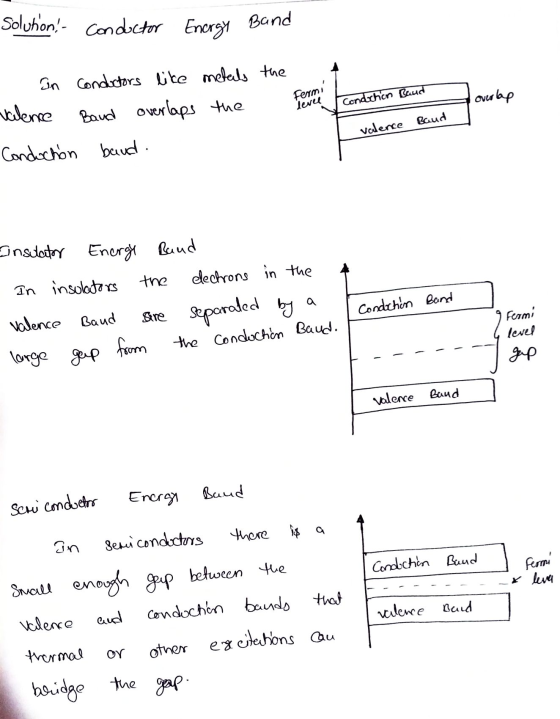
(iii) Use sketches to show how the energy band structure of conductors, semiconductors and insulators will...
(a) The band theory of solids can be used to qualitatively explain the difference in electrical...
 (a) The band theory of solids can be used to qualitatively explain the difference in electrical conductivity between metals, semiconductors and insulators. Assume a pure solid with no impurities added and answer the following questions. ) What do the energy bands represent in a solid. (ii) What is the relationship between these bands in the solid and the quantum levels of electrons in an individual atom? (iii) Use sketches to show how the energy band structure of conductors, semiconductors and...
(a) The band theory of solids can be used to qualitatively explain the difference in electrical...
 (a) The band theory of solids can be used to qualitatively explain the difference in electrical conductivity between metals, semiconductors and insulators. Assume a pure solid with no impurities added and answer the following questions. (1) What do the energy bands represent in a solid. (ii) What is the relationship between these bands in the solid and the quantum levels of electrons in an individual atom? (ii) Use sketches to show how the energy band structure of conductors, semiconductors and...
4. [5%) What are the general expected band gaps Egap for conductors, semiconductors and insulators.
 4. [5%) What are the general expected band gaps Egap for conductors, semiconductors and insulators.
1. Explain the difference among insulators, semiconductors, and conductors taking energy band gap consideration! How current pass through PN junction? Problem-1: Calculate current (I) passed thro...
 1. Explain the difference among insulators, semiconductors, and conductors taking energy band gap consideration! How current pass through PN junction? Problem-1: Calculate current (I) passed through a PN junction with a saturation value of 0.1 A, applying voltage of +5V at 300 K?
1. Explain the difference among insulators, semiconductors, and conductors taking energy band gap consideration! How current pass through PN junction? Problem-1: Calculate current (I) passed through a PN junction with a saturation value of 0.1 A, applying...
1. Explain the difference among insulators, semiconductors, and conductors taking energy band gap consideration! How current pass through PN junction? Problem-1: Calculate current (I) passed through a PN junction with a saturation value of 0.1 A, applying voltage of +5V at 300 K?
1. Explain the difference among insulators, semiconductors, and conductors taking energy band gap consideration! How current pass through PN junction? Problem-1: Calculate current (I) passed through a PN junction with a saturation value of 0.1 A, applying...
Please describe in your own words how electricity works and how conductors, insulators and semiconductors play...
Please describe in your own words how electricity works and how conductors, insulators and semiconductors play their role in the deliverance of electricity.
Q6. [20 Marks] (a) Write short notes on electrical insulators, conductors, and semiconductors (3mrk) (b) Write...
 Q6. [20 Marks] (a) Write short notes on electrical insulators, conductors, and semiconductors (3mrk) (b) Write notes on intrinsic and extrinsic semiconductors (3mrk) (c) Define the terms valence band, conduction band and forbidden gap (3mrk) (d) Describe in brief, the Band theory of formation of energy bands in solids (4mrk) (e) (i) Explain what is meant by Density of States (DOS) (1mrk) The density of states function for electrons in a metal is given by: Z(E)dE = 13.6x1027 E2 DE...
(iv) Write down an expression for the electrical conductivity of a material and define all the...
 (iv) Write down an expression for the electrical conductivity of a material and define all the variables in your equation. (2) (v) Now use your equation from (iv) and the sketches of band structure from (iii) to explain the differences in electrical conductivity between metals, semiconductors and insulators. (4)
Utilizing band theory, explain how p-type and n-type semiconductors are made, and show how they work...
Utilizing band theory, explain how p-type and n-type semiconductors are made, and show how they work in a diode.
Utilizing band theory, explain how p-type and n-type semiconductors are made, and show how they work...
Utilizing band theory, explain how p-type and n-type semiconductors are made, and show how they work in a diode
Long Answer (no math) Describe the band structure of a metal, semiconductor, and insulator. How do...
Long Answer (no math) Describe the band structure of a metal, semiconductor, and insulator. How do they differ (band gap, energy, conductivity)? What are the "bands" and how are they formed? What makes these extended structures different from discrete molecules? Lastly, describe a nano semiconductor's band structure, comparing it's band structure to a bulk semiconductor's band structure?
 (a) The band theory of solids can be used to qualitatively explain the difference in electrical conductivity between metals, semiconductors and insulators. Assume a pure solid with no impurities added and answer the following questions. ) What do the energy bands represent in a solid. (ii) What is the relationship between these bands in the solid and the quantum levels of electrons in an individual atom? (iii) Use sketches to show how the energy band structure of conductors, semiconductors and...
 (a) The band theory of solids can be used to qualitatively explain the difference in electrical conductivity between metals, semiconductors and insulators. Assume a pure solid with no impurities added and answer the following questions. (1) What do the energy bands represent in a solid. (ii) What is the relationship between these bands in the solid and the quantum levels of electrons in an individual atom? (ii) Use sketches to show how the energy band structure of conductors, semiconductors and...
 4. [5%) What are the general expected band gaps Egap for conductors, semiconductors and insulators.
 1. Explain the difference among insulators, semiconductors, and conductors taking energy band gap consideration! How current pass through PN junction? Problem-1: Calculate current (I) passed through a PN junction with a saturation value of 0.1 A, applying voltage of +5V at 300 K?
1. Explain the difference among insulators, semiconductors, and conductors taking energy band gap consideration! How current pass through PN junction? Problem-1: Calculate current (I) passed through a PN junction with a saturation value of 0.1 A, applying...
1. Explain the difference among insulators, semiconductors, and conductors taking energy band gap consideration! How current pass through PN junction? Problem-1: Calculate current (I) passed through a PN junction with a saturation value of 0.1 A, applying voltage of +5V at 300 K?
1. Explain the difference among insulators, semiconductors, and conductors taking energy band gap consideration! How current pass through PN junction? Problem-1: Calculate current (I) passed through a PN junction with a saturation value of 0.1 A, applying...
 Q6. [20 Marks] (a) Write short notes on electrical insulators, conductors, and semiconductors (3mrk) (b) Write notes on intrinsic and extrinsic semiconductors (3mrk) (c) Define the terms valence band, conduction band and forbidden gap (3mrk) (d) Describe in brief, the Band theory of formation of energy bands in solids (4mrk) (e) (i) Explain what is meant by Density of States (DOS) (1mrk) The density of states function for electrons in a metal is given by: Z(E)dE = 13.6x1027 E2 DE...
 (iv) Write down an expression for the electrical conductivity of a material and define all the variables in your equation. (2) (v) Now use your equation from (iv) and the sketches of band structure from (iii) to explain the differences in electrical conductivity between metals, semiconductors and insulators. (4)
Most questions answered within 3 hours.
-
Where is the error in this code sequence?
String s1 = "Hello";
String s2 = "ello";...
asked 11 months ago -
Financial data for Joel de Paris, Inc., for last year
follow:
Joel de Paris, Inc.
Balance...
asked 11 months ago -
Consider this reaction:
Al2(SO4)3 (aq)+ BaCl3
(aq) Al2Cl6 (aq)- +
3BaSO4(s) . What is the...
asked 11 months ago -
Suppose that Savneet is considering increasing her
recent random sample from 20 car rentals to 40...
asked 11 months ago -
Trucks arrive at an unloading terminal at an average rate of 120
per hour.
Trucks arrive...
asked 11 months ago -
Why are methanol and ethanol completely soluble in water while
octanol is not very little soluble....
asked 11 months ago -
A facilities manager at a university reads in a research report
that the mean amount of...
asked 11 months ago -
When the CuSO4 is rehydrated by adding water to the anhydrous
compound, is this an endothermic...
asked 11 months ago -
A ray of sunlight is passing from diamond into crown glass; the
angle of incidence is...
asked 11 months ago -
A block of mass 0.249 kg is placed on top of a light, vertical
spring of...
asked 11 months ago -
how do the kidneys compensate in the presences of acidosis
a) trigger hyperventilate
b) reserve acid...
asked 11 months ago -
Question 501 pts
The rental rate of capital to the firm increases. Which of the
following...
asked 11 months ago