
Homework Answers
300
the above is answer
because beyond this point marginal cost is higher than the marginal revenue. For example at 400 units, the marginal revenue is 10000 while marginal cost is 15000
Add Answer to:
Quantity of Eyeglasses 100 200 Total Revenue $10,000 $20,000 $30,000 $40,000 $50,000 Total Cost $5,000 $12,500...
Question 1 (1 point) Quantity of Eyeglasses 100 200 300 400 500 Total Revenue $10,000 $20,000...
 Question 1 (1 point) Quantity of Eyeglasses 100 200 300 400 500 Total Revenue $10,000 $20,000 $30,000 $40,000 $50,000 Total Cost $8,000 $12,000 $25,000 $39,000 $60,000 The chart above shows the total revenue and total cost for producing different quantities of eyeglasses for a certain eyeglass manufacturer. Assume the market for eyeglasses is perfectly competitive. Also assume the manufacturer can only produce at the quantities given in the table. How many eyeglasses does the manufacturer produce? 500 200 400 300
Marginal Cost Average Variable Cost Average Total Cost Quantity of Exercise Machines 1 2 3 4...
 Marginal Cost Average Variable Cost Average Total Cost Quantity of Exercise Machines 1 2 3 4 5 6 7 8 9 10 $200 $400 $600 $800 $1,000 $1,200 $1,400 $1,600 $1,800 $2,000 $200 $300 $400 $500 $600 $700 $800 $900 $1000 $1100 $1200 $800 $733.33 $750 $800 $866.67 $942.86 $1025 $1111.11 $1200 The above table shows the costs of a small manufacturer producing different quantities of exercise machines. If the exercise machine market is perfectly competitive and exercise machines cost...
Marginal Cost Quantity of Exercise Machines Average Variable Cost Average Total Cost 1 2 3 4...
 Marginal Cost Quantity of Exercise Machines Average Variable Cost Average Total Cost 1 2 3 4 5 6 7 8 9 10 $200 $400 $600 $800 $1,000 $1,200 $1,400 $1,600 $1,800 $2,000 $200 $300 $400 $500 $600 $700 $800 $900 $1000 $1100 $1200 $800 $733.33 $750 $800 $866.67 $942.86 $1025 $1111.11 $1200 The above table shows the costs of a small manufacturer producing different quantities of exercise machines. If the exercise machine market is perfectly competitive and exercise machines cost...
Chapter 14 1. Chart. Market for portable, flat-sc reen TVs. Quantity Total Cost Marginal Cost Price...
Chapter 14 1. Chart. Market for portable, flat-sc reen TVs. Quantity Total Cost Marginal Cost Price Total Revenue Marginal Revenue 0 $500 ---- $350 ---- 1 $550 $350 2 $600 $350 3 $800 $350 4 $1000 $350 5 $1250 $350 Give the total fixed cost? Fill in the Marginal Cost for the entire chart. How can you determine total revenue? Fill in TR for the chart. Fill in marginal revenue for the chart. At what quantity will the manufacturer produce...
Variable Cost (dollars) $0 Quantity O 100 200 300 400 500 600 Total Cost (dollars) $1,000 1,360 1,560 1,960 2,760 4,000...
 Variable Cost (dollars) $0 Quantity O 100 200 300 400 500 600 Total Cost (dollars) $1,000 1,360 1,560 1,960 2,760 4,000 5,800 360 560 960 1,760 3.000 4.800 Table 10.1 shows the short-run cost data of a perfectly competitive firm that produces plastic camera cases. Assume that output can only be increased in batches of 100 units. Refer to Table 10.1. If the market price of each camera case is $8, what is the profit- maximizing quantity?
Case B $ 20,000 Case A $ 10,000 90,000 100,000 70,000 Case C $ 15,000 30,000...
 Case B $ 20,000 Case A $ 10,000 90,000 100,000 70,000 Case C $ 15,000 30,000 85,000 95,000 100,000 Beginning inventory, raw material Ending inventory, raw material Purchases of raw material Direct material Direct labor Manufacturing overhead Total manufacturing costs Beginning inventory, work in process Ending inventory, work in process Cost of goods manufactured Beginning inventory, finished goods Cost of goods available for sale Ending inventory, finished goods Cost of goods sold 125,000 160,000 340,000 250,000 520,000 35,000 345,000 20,000...
Question 31 2.5 pts 31. A firm in a perfectly competitive industry has total revenue of...
 Question 31 2.5 pts 31. A firm in a perfectly competitive industry has total revenue of $200,000 per year when producing 1,000 units of output per year. In this case its average revenue is $200 and its marginal revenue is __ zero. also $200 less than $200. O greater than $200 Question 32 2.5 pts 32. In a perfectly competitive industry, the market price of the product is $12.Firm A is producing the output at which average total cost equals...
Quest Exhibit 10-2 A monopolistic competitive firm Price, costs, and revenue (dollars) 10 100 200 300...
 Quest Exhibit 10-2 A monopolistic competitive firm Price, costs, and revenue (dollars) 10 100 200 300 400 500 Quantity of output (units per week) Comparing the monopolistically competitive firm in Exhibit 10-2 to the long-run profit-maximizing outcome for a perfectly comp form with a price of $15 per unit and a quantity of 600, a. the profit earned by the monopolistically competitive firm is higher than that of the perfectly competitive firm the marginal revenue of the monopolistically competitive firm...
Assume a laptop manufacturer is currently producing 1000 laptops at an average total cost of of...
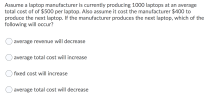 Assume a laptop manufacturer is currently producing 1000 laptops at an average total cost of of $500 per laptop. Also assume it cost the manufacturer $400 to produce the next laptop. If the manufacturer produces the next laptop, which of the following will occur? average revenue will decrease average total cost will increase fixed cost will increase average total cost will decrease
Microeconomic question perfectly competitive firm is The following figure shows the marginal cost, average total cost,...
 Microeconomic question
perfectly competitive firm is The following figure shows the marginal cost, average total cost, demand, marginal revenue curves for a firm in monopolistic competition. Assume that the cost curves of a perfectly competitive firm are identical to the cost curves of this monopolistically competitive firm shown here. The average revenue for the perfectly competitive firm is $6. of AA л Figure 10.1 Marginal Cost Average Total Cost Dollars per unit mm Demand 10 Marginal Revenue 20 30 40...
Microeconomic question
perfectly competitive firm is The following figure shows the marginal cost, average total cost, demand, marginal revenue curves for a firm in monopolistic competition. Assume that the cost curves of a perfectly competitive firm are identical to the cost curves of this monopolistically competitive firm shown here. The average revenue for the perfectly competitive firm is $6. of AA л Figure 10.1 Marginal Cost Average Total Cost Dollars per unit mm Demand 10 Marginal Revenue 20 30 40...
 Question 1 (1 point) Quantity of Eyeglasses 100 200 300 400 500 Total Revenue $10,000 $20,000 $30,000 $40,000 $50,000 Total Cost $8,000 $12,000 $25,000 $39,000 $60,000 The chart above shows the total revenue and total cost for producing different quantities of eyeglasses for a certain eyeglass manufacturer. Assume the market for eyeglasses is perfectly competitive. Also assume the manufacturer can only produce at the quantities given in the table. How many eyeglasses does the manufacturer produce? 500 200 400 300
 Marginal Cost Average Variable Cost Average Total Cost Quantity of Exercise Machines 1 2 3 4 5 6 7 8 9 10 $200 $400 $600 $800 $1,000 $1,200 $1,400 $1,600 $1,800 $2,000 $200 $300 $400 $500 $600 $700 $800 $900 $1000 $1100 $1200 $800 $733.33 $750 $800 $866.67 $942.86 $1025 $1111.11 $1200 The above table shows the costs of a small manufacturer producing different quantities of exercise machines. If the exercise machine market is perfectly competitive and exercise machines cost...
 Marginal Cost Quantity of Exercise Machines Average Variable Cost Average Total Cost 1 2 3 4 5 6 7 8 9 10 $200 $400 $600 $800 $1,000 $1,200 $1,400 $1,600 $1,800 $2,000 $200 $300 $400 $500 $600 $700 $800 $900 $1000 $1100 $1200 $800 $733.33 $750 $800 $866.67 $942.86 $1025 $1111.11 $1200 The above table shows the costs of a small manufacturer producing different quantities of exercise machines. If the exercise machine market is perfectly competitive and exercise machines cost...
 Variable Cost (dollars) $0 Quantity O 100 200 300 400 500 600 Total Cost (dollars) $1,000 1,360 1,560 1,960 2,760 4,000 5,800 360 560 960 1,760 3.000 4.800 Table 10.1 shows the short-run cost data of a perfectly competitive firm that produces plastic camera cases. Assume that output can only be increased in batches of 100 units. Refer to Table 10.1. If the market price of each camera case is $8, what is the profit- maximizing quantity?
 Case B $ 20,000 Case A $ 10,000 90,000 100,000 70,000 Case C $ 15,000 30,000 85,000 95,000 100,000 Beginning inventory, raw material Ending inventory, raw material Purchases of raw material Direct material Direct labor Manufacturing overhead Total manufacturing costs Beginning inventory, work in process Ending inventory, work in process Cost of goods manufactured Beginning inventory, finished goods Cost of goods available for sale Ending inventory, finished goods Cost of goods sold 125,000 160,000 340,000 250,000 520,000 35,000 345,000 20,000...
 Question 31 2.5 pts 31. A firm in a perfectly competitive industry has total revenue of $200,000 per year when producing 1,000 units of output per year. In this case its average revenue is $200 and its marginal revenue is __ zero. also $200 less than $200. O greater than $200 Question 32 2.5 pts 32. In a perfectly competitive industry, the market price of the product is $12.Firm A is producing the output at which average total cost equals...
 Quest Exhibit 10-2 A monopolistic competitive firm Price, costs, and revenue (dollars) 10 100 200 300 400 500 Quantity of output (units per week) Comparing the monopolistically competitive firm in Exhibit 10-2 to the long-run profit-maximizing outcome for a perfectly comp form with a price of $15 per unit and a quantity of 600, a. the profit earned by the monopolistically competitive firm is higher than that of the perfectly competitive firm the marginal revenue of the monopolistically competitive firm...
 Assume a laptop manufacturer is currently producing 1000 laptops at an average total cost of of $500 per laptop. Also assume it cost the manufacturer $400 to produce the next laptop. If the manufacturer produces the next laptop, which of the following will occur? average revenue will decrease average total cost will increase fixed cost will increase average total cost will decrease
 Microeconomic question
perfectly competitive firm is The following figure shows the marginal cost, average total cost, demand, marginal revenue curves for a firm in monopolistic competition. Assume that the cost curves of a perfectly competitive firm are identical to the cost curves of this monopolistically competitive firm shown here. The average revenue for the perfectly competitive firm is $6. of AA л Figure 10.1 Marginal Cost Average Total Cost Dollars per unit mm Demand 10 Marginal Revenue 20 30 40...
Microeconomic question
perfectly competitive firm is The following figure shows the marginal cost, average total cost, demand, marginal revenue curves for a firm in monopolistic competition. Assume that the cost curves of a perfectly competitive firm are identical to the cost curves of this monopolistically competitive firm shown here. The average revenue for the perfectly competitive firm is $6. of AA л Figure 10.1 Marginal Cost Average Total Cost Dollars per unit mm Demand 10 Marginal Revenue 20 30 40...
Most questions answered within 3 hours.
-
Where is the error in this code sequence?
String s1 = "Hello";
String s2 = "ello";...
asked 11 months ago -
Financial data for Joel de Paris, Inc., for last year
follow:
Joel de Paris, Inc.
Balance...
asked 11 months ago -
Consider this reaction:
Al2(SO4)3 (aq)+ BaCl3
(aq) Al2Cl6 (aq)- +
3BaSO4(s) . What is the...
asked 11 months ago -
Suppose that Savneet is considering increasing her
recent random sample from 20 car rentals to 40...
asked 11 months ago -
Trucks arrive at an unloading terminal at an average rate of 120
per hour.
Trucks arrive...
asked 11 months ago -
Why are methanol and ethanol completely soluble in water while
octanol is not very little soluble....
asked 11 months ago -
A facilities manager at a university reads in a research report
that the mean amount of...
asked 11 months ago -
When the CuSO4 is rehydrated by adding water to the anhydrous
compound, is this an endothermic...
asked 11 months ago -
A ray of sunlight is passing from diamond into crown glass; the
angle of incidence is...
asked 11 months ago -
A block of mass 0.249 kg is placed on top of a light, vertical
spring of...
asked 11 months ago -
how do the kidneys compensate in the presences of acidosis
a) trigger hyperventilate
b) reserve acid...
asked 11 months ago -
Question 501 pts
The rental rate of capital to the firm increases. Which of the
following...
asked 11 months ago