This is lab information using copper plates and an electric field. The M is the mass...
This is lab information using copper plates and an electric field. The M is the mass of the copper. The I is the amps that ran through after an hour.
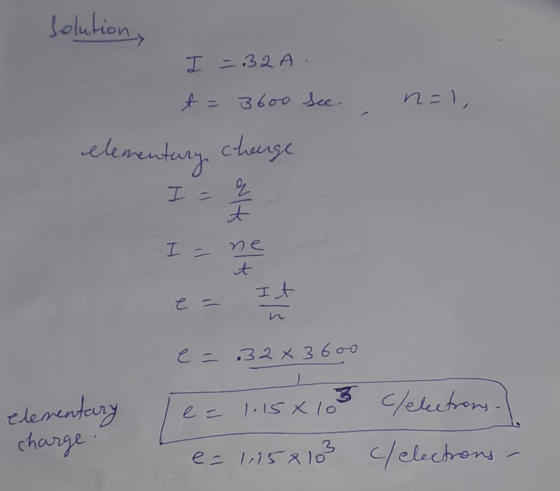
MInitial (g): 19.5273 g
MFinal (g): 19.1607 g
Mass Difference (g): .3666
I (A): .32
t (s): 3600 s (1 hour)
Find the elementary charge e (C/electrons)
Homework Answers
Add Answer to:
This is lab information using copper plates and an electric
field. The M is the mass...
The Elementary Electric Charge Data: Minitial (g): 19.527g Mfinal (g): 19.161g AM(g): 0.366g I(A): 0.320A t(s):...
 The Elementary Electric Charge Data: Minitial (g): 19.527g Mfinal (g): 19.161g AM(g): 0.366g I(A): 0.320A t(s): 3,600s Results: e (C/electron): %error, by comparison with 1.602 x 10⁻¹⁹ C:
3.1 Pre-lab In the lab on electric potential and electric field lines, you noted that charged...
 3.1 Pre-lab In the lab on electric potential and electric field lines, you noted that charged par- ticles produce electric fields and these electric fields, in turn, act on charged par- ticles. However, you then proceeded to produce an electric field geometry using conductors held at a particular electric potential. What happened to the electric charges? Electric charge and electric potential are closely related to each other. Putting charge on a conductor raises its electric potential. It is usually much...
Consider the mass spectrometer shown schematically in the figure below. The electric field between the plates...
Consider the mass spectrometer shown schematically in the figure below. The electric field between the plates of the velocity selector is 940 V/m, and the magnetic fields in both the velocity selector and the deflection chamber have magnitudes of 0.920 T. Calculate the radius r of the path for a singly charged ion with mass m = 2.30 ✕ 10−26 kg. ..... mm A singly charged positive ion has a mass of 2.60 ✕ 10−26 kg. After being accelerated through...
1. An electron (q = -1.6x10⁻¹⁹ C, m=9.11x10⁻³¹ kg) is placed in an electric field of...
1. An electron (q = -1.6x10⁻¹⁹ C, m=9.11x10⁻³¹ kg) is placed in an electric field of magnitude 3.52x10⁴N/C which points in the positive z direction. Calculate the magnitude and direction of the acceleration of the electron. 2. An electron is initially moving in the +z direction, with a speed v=2.54x10⁵ m/s at z=0. In the region between z=+1.50 cm and z=+2.50 cm, there is a uniform electric field of magnitude 4.10x10⁴ N/C in the +x direction. Outside that region (z...
c. The potential difference of O d. The electric field between the plates is halved. e....
 c. The potential difference of O d. The electric field between the plates is halved. e. The charge on the plates does not change. A particle with a mass of 5 mg and a charge of 5 mC enters a uniform magnetic field with initial kinetic energy Tand follows a circular path. After making seven complete revolutions (cycles), the particle's kinetic energy equals: Select one: O a. T. O b. 71. c.T/49. d. 49T. c. 7/7. A 20-cm long solonoid...
A small object with mass m, charge q, and initial speed v0 5.00x10³ m/s is projected into a uniform electric field between two parallel metal plates of length 26.0 cm (Figure 1)
 A small object with mass m, charge q, and initial speed v0 5.00x10³ m/s is projected into a uniform electric field between two parallel metal plates of length 26.0 cm (Figure 1). The electric field between the plates is directed downward and has magnitude E 800 N/C. Assume that the field is zero outside the region between the plates. The separation between the plates is large enough for the object to pass between the plates without hitting the lower plate....
Finding the charge to mass (e/m) ratio of the electron Often in physics, we look for ways to find fundamental physical...
 Finding the charge to mass (e/m) ratio of the electron Often in physics, we look for ways to find fundamental physical constants. From the set-up demonstrated in class, we are able to find a monumental combination of two physical constants-the charge of an electron (e) and the mass of an electron (m). Since the charge of an electron (e) is well known through other experiments, we will use the ratio of charge to mass to find the mass of an...
Finding the charge to mass (e/m) ratio of the electron Often in physics, we look for ways to find fundamental physical...
 Finding the charge to mass (e/m) ratio of the electron Often in physics, we look for ways to find fundamental physical constants. From the set-up demonstrated in class, we are able to find a monumental combination of two physical constants-the charge of an electron (e) and the mass of an electron (m). Since the charge of an electron (e) is well known through other experiments, we will use the ratio of charge to mass to find the mass of an...
The ion gun of a mass spectrometer uses the electric field between charged metal plates to...
The ion gun of a mass spectrometer uses the electric field between charged metal plates to accelerate H+ ions (charge +e, mass 1.67 × 10⁻²⁷ kg) from rest at the first plate to a velocity of 1.00 × 10⁶ m s−1 at the second plate. If the higher potential plate is at +400 V find the potential of the other plate?
An electric field of 8.50 times 10^5 V/m is desired between two parallel plates, each with...
 An electric field of 8.50 times 10^5 V/m is desired between two parallel plates, each with an area of 35.0 cm^2 separated by 3.00 mm of air. What charge must be on each plate? How does the energy stored on a parallel plate capacitor change if: The potential difference applied between the plates is doubled? The charge on each plate is doubled? The separation between the plates is doubled, as the capacitor remains connected to the same battery? The separation...
 The Elementary Electric Charge Data: Minitial (g): 19.527g Mfinal (g): 19.161g AM(g): 0.366g I(A): 0.320A t(s): 3,600s Results: e (C/electron): %error, by comparison with 1.602 x 10⁻¹⁹ C:
 3.1 Pre-lab In the lab on electric potential and electric field lines, you noted that charged par- ticles produce electric fields and these electric fields, in turn, act on charged par- ticles. However, you then proceeded to produce an electric field geometry using conductors held at a particular electric potential. What happened to the electric charges? Electric charge and electric potential are closely related to each other. Putting charge on a conductor raises its electric potential. It is usually much...
 c. The potential difference of O d. The electric field between the plates is halved. e. The charge on the plates does not change. A particle with a mass of 5 mg and a charge of 5 mC enters a uniform magnetic field with initial kinetic energy Tand follows a circular path. After making seven complete revolutions (cycles), the particle's kinetic energy equals: Select one: O a. T. O b. 71. c.T/49. d. 49T. c. 7/7. A 20-cm long solonoid...
 Finding the charge to mass (e/m) ratio of the electron Often in physics, we look for ways to find fundamental physical constants. From the set-up demonstrated in class, we are able to find a monumental combination of two physical constants-the charge of an electron (e) and the mass of an electron (m). Since the charge of an electron (e) is well known through other experiments, we will use the ratio of charge to mass to find the mass of an...
 Finding the charge to mass (e/m) ratio of the electron Often in physics, we look for ways to find fundamental physical constants. From the set-up demonstrated in class, we are able to find a monumental combination of two physical constants-the charge of an electron (e) and the mass of an electron (m). Since the charge of an electron (e) is well known through other experiments, we will use the ratio of charge to mass to find the mass of an...
 An electric field of 8.50 times 10^5 V/m is desired between two parallel plates, each with an area of 35.0 cm^2 separated by 3.00 mm of air. What charge must be on each plate? How does the energy stored on a parallel plate capacitor change if: The potential difference applied between the plates is doubled? The charge on each plate is doubled? The separation between the plates is doubled, as the capacitor remains connected to the same battery? The separation...
Most questions answered within 3 hours.
-
Where is the error in this code sequence?
String s1 = "Hello";
String s2 = "ello";...
asked 10 months ago -
Financial data for Joel de Paris, Inc., for last year
follow:
Joel de Paris, Inc.
Balance...
asked 10 months ago -
Consider this reaction:
Al2(SO4)3 (aq)+ BaCl3
(aq) Al2Cl6 (aq)- +
3BaSO4(s) . What is the...
asked 10 months ago -
Suppose that Savneet is considering increasing her
recent random sample from 20 car rentals to 40...
asked 10 months ago -
Trucks arrive at an unloading terminal at an average rate of 120
per hour.
Trucks arrive...
asked 10 months ago -
Why are methanol and ethanol completely soluble in water while
octanol is not very little soluble....
asked 10 months ago -
A facilities manager at a university reads in a research report
that the mean amount of...
asked 10 months ago -
When the CuSO4 is rehydrated by adding water to the anhydrous
compound, is this an endothermic...
asked 10 months ago -
A ray of sunlight is passing from diamond into crown glass; the
angle of incidence is...
asked 10 months ago -
A block of mass 0.249 kg is placed on top of a light, vertical
spring of...
asked 10 months ago -
how do the kidneys compensate in the presences of acidosis
a) trigger hyperventilate
b) reserve acid...
asked 10 months ago -
Question 501 pts
The rental rate of capital to the firm increases. Which of the
following...
asked 10 months ago