
Homework Answers
- All are correct except option 3. Because any semiconductor depend on band gap. More the band gap more energy required to move the electron from Valence band to conduction band. More electrical current can flow.
Add Answer to:
(b) In an intrinsic semiconductor: There are absolutely no impurities the electrical conductivity is only determined...
(a) As the bond strength in a material increases we normally find that: the electrical conductivity...
 (a) As the bond strength in a material increases we normally find that: the electrical conductivity decreases the electrical conductivity increases the melting point decreases the melting point increases The material becomes more metallic in character (b) In an intrinsic semiconductor: There are absolutely no impurities The electrical conductivity is only determined by thermal excitations The electrical conductivity is independent of the bandgap. There are equal numbers of free electrons and holes (Both electrons and holes will contribute significantly to...
(c) In an extrinsic semiconductor: There are equal numbers of free electrons and holes There are...
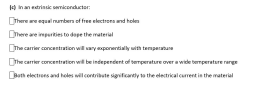 (c) In an extrinsic semiconductor: There are equal numbers of free electrons and holes There are impurities to dope the material The carrier concentration will vary exponentially with temperature The carrier concentration will be independent of temperature over a wide temperature range Both electrons and holes will contribute significantly to the electrical current in the material
On increasing the temperature, the increase in conductivity of intrinsic semiconductor is due to (A) Decrease...
 On increasing the temperature, the increase in conductivity of intrinsic semiconductor is due to (A) Decrease in band gap between valence band and conduction band (B) Increase in electrons in conduction band (C) Increase in negative charged electrons than positive holes in valence band (D) Increase in electrons in valence band
Here are the equations to use: Use Eq. (2) below to calculate the intrinsic number density...
 Here are the equations to use:
Use Eq. (2) below to calculate the intrinsic number density of conduction electrons in Si at a temperature of 405 K. You may use the values of effective mass mp 1.04mo. 09m1 where m is the mass of a free electron and the band gap energy value E- 1.12 ev, The conductivity of a semiconductor material can be expressed by where q is the elementary charge, n the number density of conduction electrons, μη...
Here are the equations to use:
Use Eq. (2) below to calculate the intrinsic number density of conduction electrons in Si at a temperature of 405 K. You may use the values of effective mass mp 1.04mo. 09m1 where m is the mass of a free electron and the band gap energy value E- 1.12 ev, The conductivity of a semiconductor material can be expressed by where q is the elementary charge, n the number density of conduction electrons, μη...
Please clearly answer the following question showing all work, each step, and the reasoning thereof. 16.1-7...
 Please clearly answer the following question showing all work,
each step, and the reasoning thereof.
16.1-7 Fermi Level of an Intrinsic Semiconductor. Given the expressions (16.1-12) and (161 13) for the thermal equilibrium carrier concentrations in the conduction and valence bands: (a) Determine an expression for the Fermi level E of an intrinsic semiconductor and show that it falls exactly in the middle of the bandgap only when the effective mass of the electrons me is precisely equal to the...
Please clearly answer the following question showing all work,
each step, and the reasoning thereof.
16.1-7 Fermi Level of an Intrinsic Semiconductor. Given the expressions (16.1-12) and (161 13) for the thermal equilibrium carrier concentrations in the conduction and valence bands: (a) Determine an expression for the Fermi level E of an intrinsic semiconductor and show that it falls exactly in the middle of the bandgap only when the effective mass of the electrons me is precisely equal to the...
(a) An intrinsic semiconductor has mobile holes or electrons at room temperature - Tor F? Select...
 (a) An intrinsic semiconductor has mobile holes or electrons at room temperature - Tor F? Select one: O True O False O Choose not to answer (b) The number of mobile electrons and mobile holes are equal in an n-type silicon - Tor F? Select one: O True O False O Choose not to answer (c) Unlike a BT, performance of a MOSFET is not affected by ambient temperature due to its "field-effect - Tor F? Select one: O True...
Taking pure silicon (Si) as an example, explain what is meant by the terms electron-hole generation...
 Taking pure silicon (Si) as an example, explain what is meant by the terms electron-hole generation and recombination, how they affect the electrical conductivity, and define what is meant by the "intrinsic carrier density", n. [5 marks] Q3. a) b) With the aid of both lattice and energy band diagrams, explain how n-type doping of Si is achieved and state two types of suitable dopant atoms. [7 marks] c) An n-type region on a Si wafer has a donor concentration...
ECET 212 ELECTRICAL POWER &MOTORS QUESTIONS 1. Transformer regulation can be determined with the formula a....
 ECET 212 ELECTRICAL POWER &MOTORS QUESTIONS 1. Transformer regulation can be determined with the formula a. (EPRI-ESEc) / EPRI x100% b. (ENL- EFL)/ EFL x100% c. (IPRI-ESEC) / IPRI×100% d. (INL-IFL) / INL X 100% 2. What is the transformer regulation if the no-load and full-load voltages are 100 V and 95 v respectively? a. 105% b. 10.5% C. 95% d. 5.3% 3. The secondary voltage can rise above its rated value when the load is a. resistive b. capacitive...
14) Which of the following is NOT a typical electrical component? A) Resistor B) Capacitor C)...
 14) Which of the following is NOT a typical electrical component? A) Resistor B) Capacitor C) Megatron Inductor E) Transformer D) 23) Convert 6.8 x 10⁻⁵ W to the closest standard metric prefix. A) 68 °W B) 0.68 uW C) 680 uW D) 6.8 uw 24) Convert 3.95 x 10⁻⁴ A to the closest standard metric prefix. A) 3.95 mA 39.5 mA 0.395 mA D 395 mA Convert the following: 25) 2 x 10⁻³ Amp = A) 2 microamps 2...
CHEM-C 105 Principles of Chemistry I Summer Semester Practice Midterm Exam. 7? questions Note that questions are...
 CHEM-C 105 Principles of Chemistry I Summer Semester Practice Midterm Exam. 7? questions Note that questions are graded by answer only and work doesn't count HOW do You Aind 1. In which of the following are the masses given in the correct order? A. eg < mg <g< kg the Correct order 2 B. eg < g < kg < mg C. kg <g<eg < mg D. mg< eg<g< kg 2. For each of the diagrams above, determine how accurate...
 (a) As the bond strength in a material increases we normally find that: the electrical conductivity decreases the electrical conductivity increases the melting point decreases the melting point increases The material becomes more metallic in character (b) In an intrinsic semiconductor: There are absolutely no impurities The electrical conductivity is only determined by thermal excitations The electrical conductivity is independent of the bandgap. There are equal numbers of free electrons and holes (Both electrons and holes will contribute significantly to...
 (c) In an extrinsic semiconductor: There are equal numbers of free electrons and holes There are impurities to dope the material The carrier concentration will vary exponentially with temperature The carrier concentration will be independent of temperature over a wide temperature range Both electrons and holes will contribute significantly to the electrical current in the material
 On increasing the temperature, the increase in conductivity of intrinsic semiconductor is due to (A) Decrease in band gap between valence band and conduction band (B) Increase in electrons in conduction band (C) Increase in negative charged electrons than positive holes in valence band (D) Increase in electrons in valence band
 Here are the equations to use:
Use Eq. (2) below to calculate the intrinsic number density of conduction electrons in Si at a temperature of 405 K. You may use the values of effective mass mp 1.04mo. 09m1 where m is the mass of a free electron and the band gap energy value E- 1.12 ev, The conductivity of a semiconductor material can be expressed by where q is the elementary charge, n the number density of conduction electrons, μη...
Here are the equations to use:
Use Eq. (2) below to calculate the intrinsic number density of conduction electrons in Si at a temperature of 405 K. You may use the values of effective mass mp 1.04mo. 09m1 where m is the mass of a free electron and the band gap energy value E- 1.12 ev, The conductivity of a semiconductor material can be expressed by where q is the elementary charge, n the number density of conduction electrons, μη...
 Please clearly answer the following question showing all work,
each step, and the reasoning thereof.
16.1-7 Fermi Level of an Intrinsic Semiconductor. Given the expressions (16.1-12) and (161 13) for the thermal equilibrium carrier concentrations in the conduction and valence bands: (a) Determine an expression for the Fermi level E of an intrinsic semiconductor and show that it falls exactly in the middle of the bandgap only when the effective mass of the electrons me is precisely equal to the...
Please clearly answer the following question showing all work,
each step, and the reasoning thereof.
16.1-7 Fermi Level of an Intrinsic Semiconductor. Given the expressions (16.1-12) and (161 13) for the thermal equilibrium carrier concentrations in the conduction and valence bands: (a) Determine an expression for the Fermi level E of an intrinsic semiconductor and show that it falls exactly in the middle of the bandgap only when the effective mass of the electrons me is precisely equal to the...
 (a) An intrinsic semiconductor has mobile holes or electrons at room temperature - Tor F? Select one: O True O False O Choose not to answer (b) The number of mobile electrons and mobile holes are equal in an n-type silicon - Tor F? Select one: O True O False O Choose not to answer (c) Unlike a BT, performance of a MOSFET is not affected by ambient temperature due to its "field-effect - Tor F? Select one: O True...
 Taking pure silicon (Si) as an example, explain what is meant by the terms electron-hole generation and recombination, how they affect the electrical conductivity, and define what is meant by the "intrinsic carrier density", n. [5 marks] Q3. a) b) With the aid of both lattice and energy band diagrams, explain how n-type doping of Si is achieved and state two types of suitable dopant atoms. [7 marks] c) An n-type region on a Si wafer has a donor concentration...
 ECET 212 ELECTRICAL POWER &MOTORS QUESTIONS 1. Transformer regulation can be determined with the formula a. (EPRI-ESEc) / EPRI x100% b. (ENL- EFL)/ EFL x100% c. (IPRI-ESEC) / IPRI×100% d. (INL-IFL) / INL X 100% 2. What is the transformer regulation if the no-load and full-load voltages are 100 V and 95 v respectively? a. 105% b. 10.5% C. 95% d. 5.3% 3. The secondary voltage can rise above its rated value when the load is a. resistive b. capacitive...
 14) Which of the following is NOT a typical electrical component? A) Resistor B) Capacitor C) Megatron Inductor E) Transformer D) 23) Convert 6.8 x 10⁻⁵ W to the closest standard metric prefix. A) 68 °W B) 0.68 uW C) 680 uW D) 6.8 uw 24) Convert 3.95 x 10⁻⁴ A to the closest standard metric prefix. A) 3.95 mA 39.5 mA 0.395 mA D 395 mA Convert the following: 25) 2 x 10⁻³ Amp = A) 2 microamps 2...
 CHEM-C 105 Principles of Chemistry I Summer Semester Practice Midterm Exam. 7? questions Note that questions are graded by answer only and work doesn't count HOW do You Aind 1. In which of the following are the masses given in the correct order? A. eg < mg <g< kg the Correct order 2 B. eg < g < kg < mg C. kg <g<eg < mg D. mg< eg<g< kg 2. For each of the diagrams above, determine how accurate...
Most questions answered within 3 hours.
-
Where is the error in this code sequence?
String s1 = "Hello";
String s2 = "ello";...
asked 10 months ago -
Financial data for Joel de Paris, Inc., for last year
follow:
Joel de Paris, Inc.
Balance...
asked 10 months ago -
Consider this reaction:
Al2(SO4)3 (aq)+ BaCl3
(aq) Al2Cl6 (aq)- +
3BaSO4(s) . What is the...
asked 10 months ago -
Suppose that Savneet is considering increasing her
recent random sample from 20 car rentals to 40...
asked 10 months ago -
Trucks arrive at an unloading terminal at an average rate of 120
per hour.
Trucks arrive...
asked 10 months ago -
Why are methanol and ethanol completely soluble in water while
octanol is not very little soluble....
asked 10 months ago -
A facilities manager at a university reads in a research report
that the mean amount of...
asked 10 months ago -
When the CuSO4 is rehydrated by adding water to the anhydrous
compound, is this an endothermic...
asked 10 months ago -
A ray of sunlight is passing from diamond into crown glass; the
angle of incidence is...
asked 10 months ago -
A block of mass 0.249 kg is placed on top of a light, vertical
spring of...
asked 10 months ago -
how do the kidneys compensate in the presences of acidosis
a) trigger hyperventilate
b) reserve acid...
asked 10 months ago -
Question 501 pts
The rental rate of capital to the firm increases. Which of the
following...
asked 10 months ago