
Homework Answers
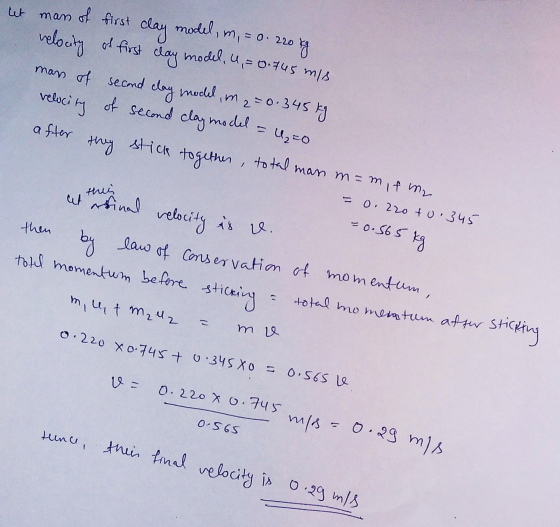
Summary-This is the basic problem from Laws of Motion based on Law of Conservation of Momentum. I have provided the step by step solution.
Add Answer to:
Suppose a clay model of a koala bear has a mass of 0.220 kg and slides...
Suppose a clay model of a koala bear has a mass of 0.240 kg and slides...
Suppose a clay model of a koala bear has a mass of 0.240 kg and slides on ice at a speed of 0.725 m/s. It runs into another clay model, which is initially motionless and has a mass of 0.330 kg. Both being soft clay, they naturally stick together. What is their final velocity (in m/s)? (Enter the magnitude.)
*1. A clay ball has a mass of 2 kg and a velocity of 10 m/s....
 *1. A clay ball has a mass of 2 kg and a velocity of 10 m/s. a) How much momentum does it have? b) The 2 kg ball strikes another ball, which is stationary, head on. The second ball has a mass of 3 kg. The two balls stick together. How much momentum will the combination have after the collision? c) What velocity will the combined masses have after the collision?
A softball of mass 0.220 kg that is moving with a speed of 6.5 m/s (in...
A softball of mass 0.220 kg that is moving with a speed of 6.5 m/s (in the positive direction) collides head-on and elastically with another ball initially at rest. Afterward it is found that the incoming ball has bounced backward with a speed of 4.3 m/s. (a) Calculate the velocity of the target ball after the collision. m/s (b) Calculate the mass of the target ball. kg
A lump of clay of mass m1 and velocity v1 catches up with and bumps into...
A lump of clay of mass m1 and velocity v1 catches up with and bumps into a slower lump of clay of mass m2 and velocity v2 heading in the same direction. They share common velocity after they stick together. a. Derive an equation for this common velocity. b. Calculate the final velocity of the stuck-together lumps when a lump of mas 2.2 kg moving at 3.2m/s catches up with and sticks to a 2.7 kg lump moving at 1.2...
A baseball and a ball of clay are approaching each other. The mass of the baseball...
A baseball and a ball of clay are approaching each other. The mass of the baseball is 145 g and it is moving due west 5.00 m/s at 180°. The ball of clay is 290 g and it is moving northwest at 135° at 4.00 m/s. What is the magnitude of their combined velocity after they collide and stick together?
A disk of mass m, = 70.0 g and radius r , = 4.50 cm slides...
 A disk of mass m, = 70.0 g and radius r , = 4.50 cm slides on a frictionless sheet of ice with velocity v, where v = 12.00 m/s, as shown in a top-down view in figure (a) below. The edge of this disk just grazes the edge of a second disk in a glancing blow. The second disk has a mass m2 = 140 g, a radius r2 = 6.00 cm, and is initially at rest. As the...
please show steps thanks:) VID TU.O.P.04. My Notes Adid slides toward a motionless stick on a frictionless surface f...
 please show steps thanks:)
VID TU.O.P.04. My Notes Adid slides toward a motionless stick on a frictionless surface figure below). The disk strikes and adheres to the stick and they rotate together, pivoting around the nail Angular momentumn is conserved for this inelastic collision because the surface is frictionless and the unbalanced external force at the nail exerts no torque. Before Alter Nail (pivot) Consider a situation where the disk has a mass of 51.5 g and an initial velocity...
please show steps thanks:)
VID TU.O.P.04. My Notes Adid slides toward a motionless stick on a frictionless surface figure below). The disk strikes and adheres to the stick and they rotate together, pivoting around the nail Angular momentumn is conserved for this inelastic collision because the surface is frictionless and the unbalanced external force at the nail exerts no torque. Before Alter Nail (pivot) Consider a situation where the disk has a mass of 51.5 g and an initial velocity...
A 200 g meter stick has a 50.0 g lump of clay stuck on it at...
A 200 g meter stick has a 50.0 g lump of clay stuck on it at the 10.0 cm mark. It is initially at rest on a level, frictionaless surface, lying along the y-axis with its 50.0 cm mark at the origin. A second 50.0 g lump of clay, initially moving at 1.20 m/s i, collides with the meter stick and sticks to it at the 90.0 cm mark. 1. What is the initial momentum of the system of the...
An object (A) of mass m A = 29.0 kg is moving in a direction that...
An object (A) of mass m A = 29.0 kg is moving in a direction that makes angle of 40° north of east with a speed v A = 5.10 m/s, while object (B) of mass m B = 17.5 kg is moving due north with a speed v B = 7.85 m/s. The two objects collide and stick together in a completely inelastic collision. Find the magnitude of the final velocity of the two-object system after the collision. An...
09. A box of mass 1 Kg slides with initial velocity 6 m/s on a frictionless...
 09. A box of mass 1 Kg slides with initial velocity 6 m/s on a frictionless surface and collides inelastically with an identical rest box. The boxes stick together and move after the collision. What is the change of kinetic energy? A)-9 B) 18)3 D) -15]
 *1. A clay ball has a mass of 2 kg and a velocity of 10 m/s. a) How much momentum does it have? b) The 2 kg ball strikes another ball, which is stationary, head on. The second ball has a mass of 3 kg. The two balls stick together. How much momentum will the combination have after the collision? c) What velocity will the combined masses have after the collision?
 A disk of mass m, = 70.0 g and radius r , = 4.50 cm slides on a frictionless sheet of ice with velocity v, where v = 12.00 m/s, as shown in a top-down view in figure (a) below. The edge of this disk just grazes the edge of a second disk in a glancing blow. The second disk has a mass m2 = 140 g, a radius r2 = 6.00 cm, and is initially at rest. As the...
 please show steps thanks:)
VID TU.O.P.04. My Notes Adid slides toward a motionless stick on a frictionless surface figure below). The disk strikes and adheres to the stick and they rotate together, pivoting around the nail Angular momentumn is conserved for this inelastic collision because the surface is frictionless and the unbalanced external force at the nail exerts no torque. Before Alter Nail (pivot) Consider a situation where the disk has a mass of 51.5 g and an initial velocity...
please show steps thanks:)
VID TU.O.P.04. My Notes Adid slides toward a motionless stick on a frictionless surface figure below). The disk strikes and adheres to the stick and they rotate together, pivoting around the nail Angular momentumn is conserved for this inelastic collision because the surface is frictionless and the unbalanced external force at the nail exerts no torque. Before Alter Nail (pivot) Consider a situation where the disk has a mass of 51.5 g and an initial velocity...
 09. A box of mass 1 Kg slides with initial velocity 6 m/s on a frictionless surface and collides inelastically with an identical rest box. The boxes stick together and move after the collision. What is the change of kinetic energy? A)-9 B) 18)3 D) -15]
Most questions answered within 3 hours.
-
Where is the error in this code sequence?
String s1 = "Hello";
String s2 = "ello";...
asked 10 months ago -
Financial data for Joel de Paris, Inc., for last year
follow:
Joel de Paris, Inc.
Balance...
asked 10 months ago -
Consider this reaction:
Al2(SO4)3 (aq)+ BaCl3
(aq) Al2Cl6 (aq)- +
3BaSO4(s) . What is the...
asked 10 months ago -
Suppose that Savneet is considering increasing her
recent random sample from 20 car rentals to 40...
asked 10 months ago -
Trucks arrive at an unloading terminal at an average rate of 120
per hour.
Trucks arrive...
asked 10 months ago -
Why are methanol and ethanol completely soluble in water while
octanol is not very little soluble....
asked 10 months ago -
A facilities manager at a university reads in a research report
that the mean amount of...
asked 10 months ago -
When the CuSO4 is rehydrated by adding water to the anhydrous
compound, is this an endothermic...
asked 10 months ago -
A ray of sunlight is passing from diamond into crown glass; the
angle of incidence is...
asked 10 months ago -
A block of mass 0.249 kg is placed on top of a light, vertical
spring of...
asked 10 months ago -
how do the kidneys compensate in the presences of acidosis
a) trigger hyperventilate
b) reserve acid...
asked 10 months ago -
Question 501 pts
The rental rate of capital to the firm increases. Which of the
following...
asked 10 months ago