1a) A charged particle with a charge-to-mass ratio of |q|/m = 5.7 × 10⁸ C/kg travels...
1a) A charged particle with a charge-to-mass ratio of |q|/m = 5.7 × 10⁸ C/kg travels on a circular path that is perpendicular to a magnetic field whose magnitude is 0.55 T. How much time does it take for the particle to complete one revolution?
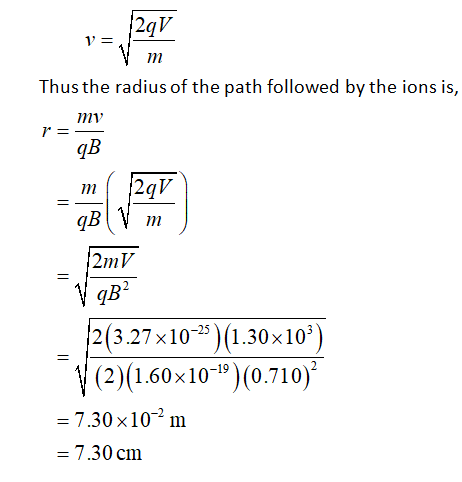
1b) Suppose that an ion source in a mass spectrometer produces doubly ionized gold ions (Au2+), each with a mass of 3.27 × 10⁻²⁵ kg. The ions are accelerated from rest through a potential difference of 1.30 kV. Then, a 0.710-T magnetic field causes the ions to follow a circular path. Determine the radius of the path.
thank you!
Homework Answers

Add Answer to:
1a) A charged particle with a charge-to-mass ratio of
|q|/m = 5.7 × 10⁸ C/kg travels...
Suppose that an ion source in a mass spectrometer produces doubly ionized gold ions (Au2+), each...
Suppose that an ion source in a mass spectrometer produces doubly ionized gold ions (Au2+), each with a mass of 3.27 × 10⁻²⁵ kg. The ions are accelerated from rest through a potential difference of 2.20 kV. Then, a 0.530-T magnetic field causes the ions to follow a circular path. Determine the radius of the path.
Suppose that an ion source in a mass spectrometer produces doubly ionized gold ions (Au2+), each...
Suppose that an ion source in a mass spectrometer produces doubly ionized gold ions (Au2+), each with a mass of 3.27 × 10⁻²⁵ kg. The ions are accelerated from rest through a potential difference of 2.70 kV. Then, a 0.570-T magnetic field causes the ions to follow a circular path. Determine the radius of the path.
Suppose that an ion source in a mass spectrometer produces doubly ionized gold ions (Au^2+), each...
 Suppose that an ion source in a mass spectrometer produces doubly ionized gold ions (Au^2+), each with a mass of 3.27 times 10^-25 kg. The ions are accelerated from rest through a potential difference of 2.20 kV. Then, a 0.710-T magnetic field causes the ions to follow a circular path. Determine the radius of the path.
This is what I did. r = (m*v) / (qB) To find v, v= sqrt( 2*q*V/m)...
 This is what I did.
r = (m*v) / (qB)
To find v, v= sqrt( 2*q*V/m) = 37013.9
and I put this number and the given numbers to find 'r', but I
got it wrong. What did I do wrong?
I. Suppose that an ion source in a mass spectrometer produces doubly ionized gold ions (Au2+), each with a mass of 3.27 × 10⁻²⁵ kg The ions are accelerated from rest through a potential difference of 1.40 kV. Then, a...
This is what I did.
r = (m*v) / (qB)
To find v, v= sqrt( 2*q*V/m) = 37013.9
and I put this number and the given numbers to find 'r', but I
got it wrong. What did I do wrong?
I. Suppose that an ion source in a mass spectrometer produces doubly ionized gold ions (Au2+), each with a mass of 3.27 × 10⁻²⁵ kg The ions are accelerated from rest through a potential difference of 1.40 kV. Then, a...
Suppose that an ion source in a mass spectrometer produces doubly ionized gold ions (Au^2+), each...
Suppose that an ion source in a mass spectrometer produces doubly ionized gold ions (Au^2+), each with a mass of 3.27*10^(-25) kg. The ions are accelerated from rest through a potential difference of 1.10 kV. Then, a 0.490 T magnetic field causes the ions to follow a circular path. Determine the radius of the path.
A charged particle with a charge-to-mass ratio of |q|/m = 5.7x 10⁸ C/kg travels on a...
A charged particle with a charge-to-mass ratio of |q|/m = 5.7x 10⁸ C/kg travels on a circular path that isperpendicular to a magnetic field whose magnitude is 0.76 T. How much time does it take for the particle to complete onerevolution? t = ?
1. Suppose that an ion source in a mass spectrometer produces doubly ionized gold ions -25...
 1. Suppose that an ion source in a mass spectrometer produces doubly ionized gold ions -25 potential difference of 1.30 kV. Then, a 0.440 T magnetic field causes the ions to follow a circular path. Determine the radius of the path.
A charged partide with a charge-to-mass ratio of Igl/m -5.7 x 10 c/kg travels on a...
 A charged partide with a charge-to-mass ratio of Igl/m -5.7 x 10 c/kg travels on a dircular path that is perpendicular to a magnetic field whose magnitude is 0.65 T. How much time does it take for the particle to complete one revolution? Additional Materials Section 21.4 Submit Answer Save Pro A positively charged particle of mass 5.00 x 10 kg is traveling due east with a speed of 35 m/s and enters a o 43-T uniform magnetic field. The...
20. A charged particle has a charge of q+2e and a mass of 4.00 u, where...
 20. A charged particle has a charge of q+2e and a mass of 4.00 u, where u is the atomic mass unit, with 1u 1.661x10⁻²⁷ kg. Suppose the charged particle travels in a circular path of radius 4.50 cm in a uniform magnetic field with B1.20 T. Which of the following is TRUE? A) The particle's speed is 1.30x10⁵ m/s B) The period of revolution is 0.409 us. C) The particle's kinetic energy is 0.140 MeV. D) The particle has...
A. An α-particle has a charge of +2e and a mass of 6.64 × 10⁻²⁷ kg....
 A. An α-particle has a charge of +2e and a mass of 6.64
× 10-27 kg. It is accelerated from rest through a
potential difference that has a value of 1.67 × 10⁶ V
and then enters a uniform magnetic field whose magnitude is 2.49 T.
The α-particle moves perpendicular to the magnetic field at all
times. What is (a) the speed of the α-particle,
(b) the magnitude of the magnetic force on it, and
(c) the radius of its...
A. An α-particle has a charge of +2e and a mass of 6.64
× 10-27 kg. It is accelerated from rest through a
potential difference that has a value of 1.67 × 10⁶ V
and then enters a uniform magnetic field whose magnitude is 2.49 T.
The α-particle moves perpendicular to the magnetic field at all
times. What is (a) the speed of the α-particle,
(b) the magnitude of the magnetic force on it, and
(c) the radius of its...
 Suppose that an ion source in a mass spectrometer produces doubly ionized gold ions (Au^2+), each with a mass of 3.27 times 10^-25 kg. The ions are accelerated from rest through a potential difference of 2.20 kV. Then, a 0.710-T magnetic field causes the ions to follow a circular path. Determine the radius of the path.
 This is what I did.
r = (m*v) / (qB)
To find v, v= sqrt( 2*q*V/m) = 37013.9
and I put this number and the given numbers to find 'r', but I
got it wrong. What did I do wrong?
I. Suppose that an ion source in a mass spectrometer produces doubly ionized gold ions (Au2+), each with a mass of 3.27 × 10⁻²⁵ kg The ions are accelerated from rest through a potential difference of 1.40 kV. Then, a...
This is what I did.
r = (m*v) / (qB)
To find v, v= sqrt( 2*q*V/m) = 37013.9
and I put this number and the given numbers to find 'r', but I
got it wrong. What did I do wrong?
I. Suppose that an ion source in a mass spectrometer produces doubly ionized gold ions (Au2+), each with a mass of 3.27 × 10⁻²⁵ kg The ions are accelerated from rest through a potential difference of 1.40 kV. Then, a...
 1. Suppose that an ion source in a mass spectrometer produces doubly ionized gold ions -25 potential difference of 1.30 kV. Then, a 0.440 T magnetic field causes the ions to follow a circular path. Determine the radius of the path.
 A charged partide with a charge-to-mass ratio of Igl/m -5.7 x 10 c/kg travels on a dircular path that is perpendicular to a magnetic field whose magnitude is 0.65 T. How much time does it take for the particle to complete one revolution? Additional Materials Section 21.4 Submit Answer Save Pro A positively charged particle of mass 5.00 x 10 kg is traveling due east with a speed of 35 m/s and enters a o 43-T uniform magnetic field. The...
 20. A charged particle has a charge of q+2e and a mass of 4.00 u, where u is the atomic mass unit, with 1u 1.661x10⁻²⁷ kg. Suppose the charged particle travels in a circular path of radius 4.50 cm in a uniform magnetic field with B1.20 T. Which of the following is TRUE? A) The particle's speed is 1.30x10⁵ m/s B) The period of revolution is 0.409 us. C) The particle's kinetic energy is 0.140 MeV. D) The particle has...
 A. An α-particle has a charge of +2e and a mass of 6.64
× 10-27 kg. It is accelerated from rest through a
potential difference that has a value of 1.67 × 10⁶ V
and then enters a uniform magnetic field whose magnitude is 2.49 T.
The α-particle moves perpendicular to the magnetic field at all
times. What is (a) the speed of the α-particle,
(b) the magnitude of the magnetic force on it, and
(c) the radius of its...
A. An α-particle has a charge of +2e and a mass of 6.64
× 10-27 kg. It is accelerated from rest through a
potential difference that has a value of 1.67 × 10⁶ V
and then enters a uniform magnetic field whose magnitude is 2.49 T.
The α-particle moves perpendicular to the magnetic field at all
times. What is (a) the speed of the α-particle,
(b) the magnitude of the magnetic force on it, and
(c) the radius of its...
Most questions answered within 3 hours.
-
Where is the error in this code sequence?
String s1 = "Hello";
String s2 = "ello";...
asked 10 months ago -
Financial data for Joel de Paris, Inc., for last year
follow:
Joel de Paris, Inc.
Balance...
asked 10 months ago -
Consider this reaction:
Al2(SO4)3 (aq)+ BaCl3
(aq) Al2Cl6 (aq)- +
3BaSO4(s) . What is the...
asked 10 months ago -
Suppose that Savneet is considering increasing her
recent random sample from 20 car rentals to 40...
asked 10 months ago -
Trucks arrive at an unloading terminal at an average rate of 120
per hour.
Trucks arrive...
asked 10 months ago -
Why are methanol and ethanol completely soluble in water while
octanol is not very little soluble....
asked 10 months ago -
A facilities manager at a university reads in a research report
that the mean amount of...
asked 10 months ago -
When the CuSO4 is rehydrated by adding water to the anhydrous
compound, is this an endothermic...
asked 10 months ago -
A ray of sunlight is passing from diamond into crown glass; the
angle of incidence is...
asked 10 months ago -
A block of mass 0.249 kg is placed on top of a light, vertical
spring of...
asked 10 months ago -
how do the kidneys compensate in the presences of acidosis
a) trigger hyperventilate
b) reserve acid...
asked 10 months ago -
Question 501 pts
The rental rate of capital to the firm increases. Which of the
following...
asked 10 months ago