
Homework Answers
This is a problem of Electric Circuits whose solution has been provided below.
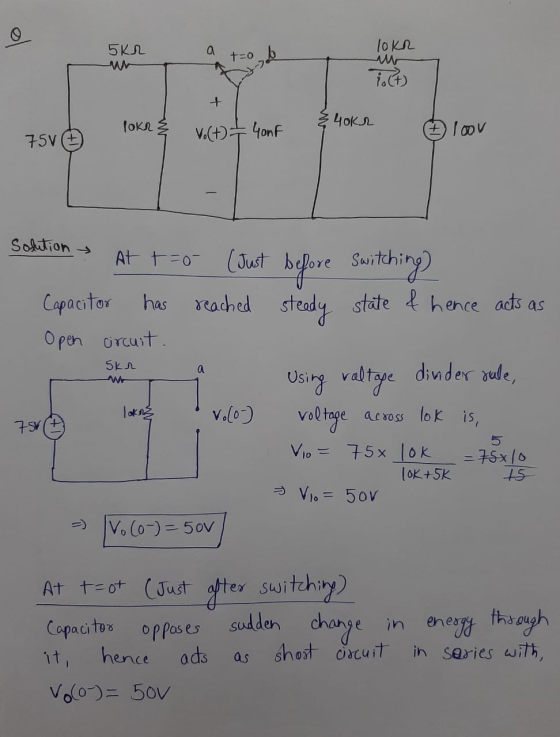
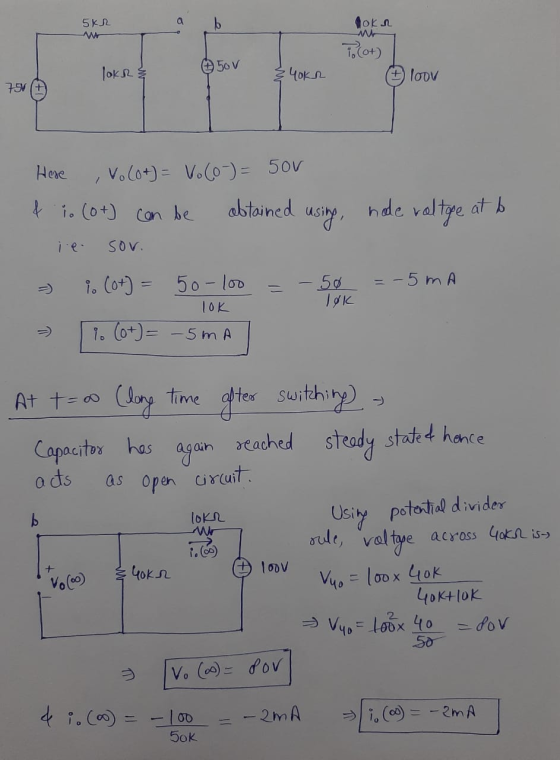
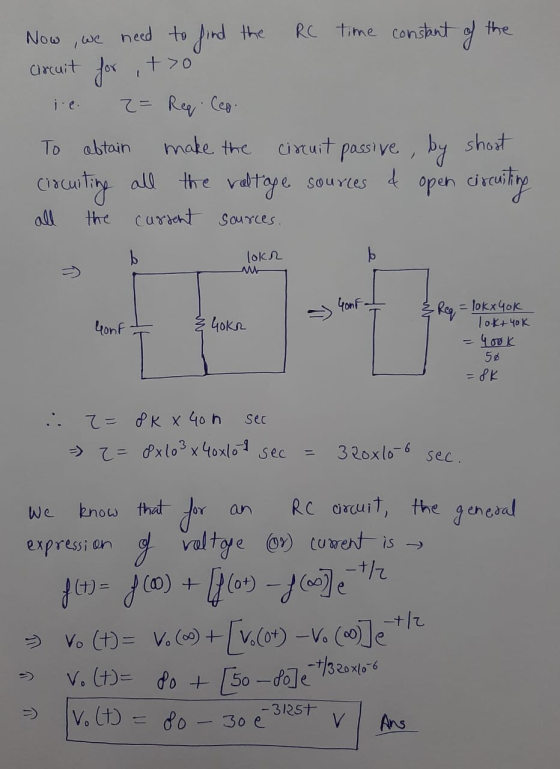
![-t/ Similarly, 1.(+) = 1.c.) + [5.664) [io (ot) – 1. (x)] => 1.(+) = -2 +[-5-(-2)] e - 31257 MA => 9.00 - 2-3e-3125+ mA An](http://img.homeworklib.com/questions/63dcbec0-04b9-11eb-a1aa-fdf7e7e4efcc.png?x-oss-process=image/resize,w_560)
1. Find v(t) fort> 0 in the circuit in below: t=0 222 w 622 w +...
 1. Find v(t) fort> 0 in the circuit in below: t=0 222 w 622 w + 10V 2 F +1 50 V Assume the switch has been open for a long time and is closed at t=0.
Solve for I.(t) fort >0 as the switch moves from 20 V voltage source to 150...
 Solve for I.(t) fort >0 as the switch moves from 20 V voltage source to 150 mA current source for t>0. t=0 R=2000 IL R2 Vs1 20V 10uF 100 L (1/4.1) H 150 mA
Solve for Vc(t) for t> 0 as the switch (SW1) becomes open for t>0. t=0 R2=5k0...
 Solve for Vc(t) for t> 0 as the switch (SW1) becomes open for t>0. t=0 R2=5k0 SW1 + Vs1 18V R2 4kΩ Vc R3 с 10uF 2kΩ 132 2mA
Problem 4 = 20A Find i(t) and v(t) for t > 0 in the circuit below...
 Problem 4 = 20A Find i(t) and v(t) for t > 0 in the circuit below if i(0) 2 H 202 5Ω v(t) 1Ω Problem 5 If the switch in circuit below has been open for a long time and is closed at t = 0, find vo(t) a. Suppose that the switch has been closed for a long time and is opened at t = 0. Find vo(t). b. t = 0 2Ω WW 3 F 4Ω 18 V
Solve for Iz(t) in the circuit shown for t>O as the switch is closed for t>0....
 Solve for Iz(t) in the circuit shown for t>O as the switch is closed for t>0. t=0 R3=2000 Rz=2000 Ix V. 24V R; 2009 R2 1000 30 mH
Solve for Vc(t) for t> 0 as the switch (SW1) becomes opened and the switch (SW2)...
 Solve for Vc(t) for t> 0 as the switch (SW1) becomes opened and the switch (SW2) becomes closed for t>O. t=0 20 mH t=0 R2=160 SW1 SW2 Vs + 80V R, 240 VC с (1/600) F R3 8Ω (4).4 1.5 A
8. The swi itch in the circuit below has been in position 1 for a long...
 8. The swi itch in the circuit below has been in position 1 for a long time. At t-0, the switch moves to position 2. Find the a. initial condition for t<0. b. the finial condition Vo(t) for t>0. 40kQ 40V 1 60k? -75V
pls answer! my last attempt :) Use the step-by-step method to find io(t) for t> 0...
 pls answer! my last attempt :)
Use the step-by-step method to find io(t) for t> 0 in the circuit in the figure below. 36 V 4 k2 4 k2 24 ko X . 341 500uF t = 0 34 22 i.lt) Please round all numbers to 3 significant digits. Click here to enter or edit your answer jo(t) = mA Use the step-by-step method to find io(t) for t > 0 in the circuit in the figure below. 200 uF...
pls answer! my last attempt :)
Use the step-by-step method to find io(t) for t> 0 in the circuit in the figure below. 36 V 4 k2 4 k2 24 ko X . 341 500uF t = 0 34 22 i.lt) Please round all numbers to 3 significant digits. Click here to enter or edit your answer jo(t) = mA Use the step-by-step method to find io(t) for t > 0 in the circuit in the figure below. 200 uF...
please circle final answer thank you! Question 34 Solve the problem. At time t > 0,...
 please circle final answer thank
you!
Question 34 Solve the problem. At time t > 0, the velocity of a body moving along the s-axis is v= 12.5t+ 4. When is the body's velocity increasing? ot>4 ot< 2.5 ot<4 ot > 2.5
please circle final answer thank
you!
Question 34 Solve the problem. At time t > 0, the velocity of a body moving along the s-axis is v= 12.5t+ 4. When is the body's velocity increasing? ot>4 ot< 2.5 ot<4 ot > 2.5
The switch in the figure given below moves from position 1 to position 2 at t...
 The switch in the figure given below moves from position 1 to position 2 at t = 0. Find v(t), for all t> 0. Assume: V1 = 18 V. t=0 + 2 + V 10 mF ע 0.25 H The value of v(t) = (Click to select) |t)] u(t) V.
 1. Find v(t) fort> 0 in the circuit in below: t=0 222 w 622 w + 10V 2 F +1 50 V Assume the switch has been open for a long time and is closed at t=0.
 Solve for I.(t) fort >0 as the switch moves from 20 V voltage source to 150 mA current source for t>0. t=0 R=2000 IL R2 Vs1 20V 10uF 100 L (1/4.1) H 150 mA
 Solve for Vc(t) for t> 0 as the switch (SW1) becomes open for t>0. t=0 R2=5k0 SW1 + Vs1 18V R2 4kΩ Vc R3 с 10uF 2kΩ 132 2mA
 Problem 4 = 20A Find i(t) and v(t) for t > 0 in the circuit below if i(0) 2 H 202 5Ω v(t) 1Ω Problem 5 If the switch in circuit below has been open for a long time and is closed at t = 0, find vo(t) a. Suppose that the switch has been closed for a long time and is opened at t = 0. Find vo(t). b. t = 0 2Ω WW 3 F 4Ω 18 V
 Solve for Iz(t) in the circuit shown for t>O as the switch is closed for t>0. t=0 R3=2000 Rz=2000 Ix V. 24V R; 2009 R2 1000 30 mH
 Solve for Vc(t) for t> 0 as the switch (SW1) becomes opened and the switch (SW2) becomes closed for t>O. t=0 20 mH t=0 R2=160 SW1 SW2 Vs + 80V R, 240 VC с (1/600) F R3 8Ω (4).4 1.5 A
 8. The swi itch in the circuit below has been in position 1 for a long time. At t-0, the switch moves to position 2. Find the a. initial condition for t<0. b. the finial condition Vo(t) for t>0. 40kQ 40V 1 60k? -75V
 pls answer! my last attempt :)
Use the step-by-step method to find io(t) for t> 0 in the circuit in the figure below. 36 V 4 k2 4 k2 24 ko X . 341 500uF t = 0 34 22 i.lt) Please round all numbers to 3 significant digits. Click here to enter or edit your answer jo(t) = mA Use the step-by-step method to find io(t) for t > 0 in the circuit in the figure below. 200 uF...
pls answer! my last attempt :)
Use the step-by-step method to find io(t) for t> 0 in the circuit in the figure below. 36 V 4 k2 4 k2 24 ko X . 341 500uF t = 0 34 22 i.lt) Please round all numbers to 3 significant digits. Click here to enter or edit your answer jo(t) = mA Use the step-by-step method to find io(t) for t > 0 in the circuit in the figure below. 200 uF...
 please circle final answer thank
you!
Question 34 Solve the problem. At time t > 0, the velocity of a body moving along the s-axis is v= 12.5t+ 4. When is the body's velocity increasing? ot>4 ot< 2.5 ot<4 ot > 2.5
please circle final answer thank
you!
Question 34 Solve the problem. At time t > 0, the velocity of a body moving along the s-axis is v= 12.5t+ 4. When is the body's velocity increasing? ot>4 ot< 2.5 ot<4 ot > 2.5
 The switch in the figure given below moves from position 1 to position 2 at t = 0. Find v(t), for all t> 0. Assume: V1 = 18 V. t=0 + 2 + V 10 mF ע 0.25 H The value of v(t) = (Click to select) |t)] u(t) V.
Most questions answered within 3 hours.
-
Where is the error in this code sequence?
String s1 = "Hello";
String s2 = "ello";...
asked 11 months ago -
Financial data for Joel de Paris, Inc., for last year
follow:
Joel de Paris, Inc.
Balance...
asked 11 months ago -
Consider this reaction:
Al2(SO4)3 (aq)+ BaCl3
(aq) Al2Cl6 (aq)- +
3BaSO4(s) . What is the...
asked 11 months ago -
Suppose that Savneet is considering increasing her
recent random sample from 20 car rentals to 40...
asked 11 months ago -
Trucks arrive at an unloading terminal at an average rate of 120
per hour.
Trucks arrive...
asked 11 months ago -
Why are methanol and ethanol completely soluble in water while
octanol is not very little soluble....
asked 11 months ago -
A facilities manager at a university reads in a research report
that the mean amount of...
asked 11 months ago -
When the CuSO4 is rehydrated by adding water to the anhydrous
compound, is this an endothermic...
asked 11 months ago -
A ray of sunlight is passing from diamond into crown glass; the
angle of incidence is...
asked 11 months ago -
A block of mass 0.249 kg is placed on top of a light, vertical
spring of...
asked 11 months ago -
how do the kidneys compensate in the presences of acidosis
a) trigger hyperventilate
b) reserve acid...
asked 11 months ago -
Question 501 pts
The rental rate of capital to the firm increases. Which of the
following...
asked 11 months ago