
Homework Answers
Add Answer to:
Let f: R2 + R be defined by f(x, y) = xyle=(22+y?). Evaluate Sr2 f, if...
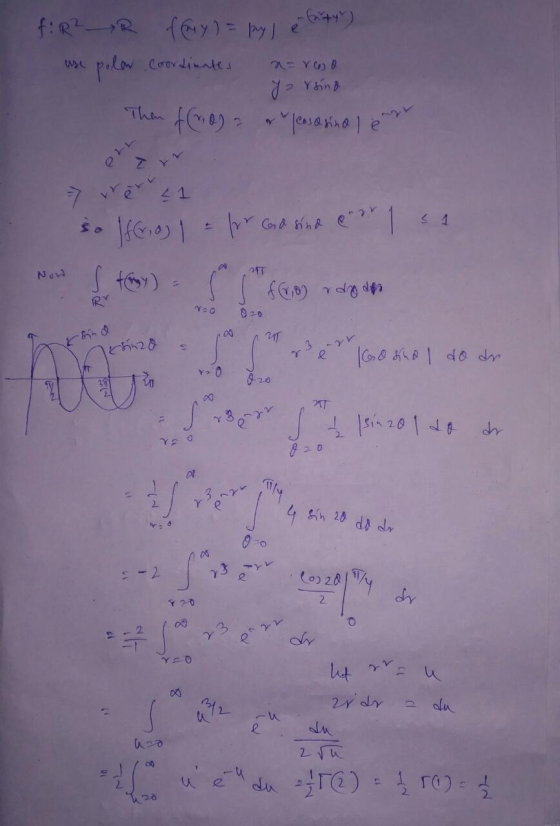
Let f : R2 + R be defined by f(x,y) = |xy|e-(z?+y?). Evaluate SR2 f, if...
 Let f : R2 + R be defined by f(x,y) = |xy|e-(z?+y?). Evaluate SR2 f, if it exists
5. Let f : R2 + R be defined by f(x,y) = xyle=(x2+zº). Evaluate Sr2 f,...
 5. Let f : R2 + R be defined by f(x,y) = xyle=(x2+zº). Evaluate Sr2 f, if it exists (8 points).
Let f: R2 + R be defined by f(x, y) = xyle=(22+v?). Evaluate Sg2 f, if...
 Let f: R2 + R be defined by f(x, y) = xyle=(22+v?). Evaluate Sg2 f, if it exists
Let f:R2→R be defined by f(x,y) =|xy|e−(x2+y2). Evaluate ∫R2f, if it exists Let f : R2...
 Let f:R2→R be defined by f(x,y) =|xy|e−(x2+y2). Evaluate
∫R2f, if it exists
Let f : R2 + R be defined by f(L,y) = [tyle=(3++y?). Evaluate Sir2 f, if it exists
Let f:R2→R be defined by f(x,y) =|xy|e−(x2+y2). Evaluate
∫R2f, if it exists
Let f : R2 + R be defined by f(L,y) = [tyle=(3++y?). Evaluate Sir2 f, if it exists
Let f : R2 + R be defined by f(L,y) = |kyle=(2²+y?). Evaluate /ik2 f, if...
 Let f : R2 + R be defined by f(L,y) = |kyle=(2²+y?). Evaluate /ik2 f, if it exists
(b) Let F: R2 + Rº be a vector field on R2 defined as F(x, y)...
 (b) Let F: R2 + Rº be a vector field on R2 defined as F(x, y) = (3y, 22 – y). Suppose further that ^ C R2 is a curve in R2 consisting of the parabola y = 22 - 1 for 1 € (-1,0) and the straight line y = 1 – 1 for 1 € [0,1]. (i) Sketch the curvey in R2 [2] (ii) By considering the curve y piecewise, compute the vector field integral: [5] F(x). F(x)...
1. Consider the unit circle: (x,y) : x2 y2 = 1. T. Let f R2 ->R...
 1. Consider the unit circle: (x,y) : x2 y2 = 1. T. Let f R2 ->R be defined by f(x,y) = x2-y, and let F : R2 -> R be defined by F(x, y) Compute the integral of f and F around the unit circle. For the integral of F, proceed in the standard (anticlockwise) direction
5. Let f: R2 + R2 be defined by [a2 + 2xy] f(x,y) = | 14,9)...
 5. Let f: R2 + R2 be defined by [a2 + 2xy] f(x,y) = | 14,9) | xy2 ] (a) Explain why f we are guaranteed to have an inverse defined on an open neigh- borhood of [31]? = f(1, 1), but not at [1 0]? = f(1,0). (b) Give the derivative of the inverse function at (3,1): DF-1(3,1). e a la IV
1(a) Let f : R2 → R b constant M > 0 such that livf(x,y)|| (0.0)-0. Assume that there exists a e continuously differentiable, with Mv/r2 + уг, for all (z. y) E R2 If(x,y)| 〈 M(x2 + y2)· for all (...
 1(a) Let f : R2 → R b constant M > 0 such that livf(x,y)|| (0.0)-0. Assume that there exists a e continuously differentiable, with Mv/r2 + уг, for all (z. y) E R2 If(x,y)| 〈 M(x2 + y2)· for all (a·y) E R2 Prove that:
1(a) Let f : R2 → R b constant M > 0 such that livf(x,y)|| (0.0)-0. Assume that there exists a e continuously differentiable, with Mv/r2 + уг, for all (z. y) E R2...
1(a) Let f : R2 → R b constant M > 0 such that livf(x,y)|| (0.0)-0. Assume that there exists a e continuously differentiable, with Mv/r2 + уг, for all (z. y) E R2 If(x,y)| 〈 M(x2 + y2)· for all (a·y) E R2 Prove that:
1(a) Let f : R2 → R b constant M > 0 such that livf(x,y)|| (0.0)-0. Assume that there exists a e continuously differentiable, with Mv/r2 + уг, for all (z. y) E R2...
Problem 2 (Eigenvalues and Eigenvectors). (a) If R2-R2 be defined by f(x,y) = (y,z), then find al...
 please answer both a and b
Problem 2 (Eigenvalues and Eigenvectors). (a) If R2-R2 be defined by f(x,y) = (y,z), then find all the eigenvalues and eigenvectors of f Hint: Use the matrix representation. (b) Let U be a vector subspace (U o, V) of a finite dimensional vector space V. Show that there exists a linear transformation V V such that U is not an invariant subspace of f. Hence, or otherwise, show that: a vector subspace U-o or...
please answer both a and b
Problem 2 (Eigenvalues and Eigenvectors). (a) If R2-R2 be defined by f(x,y) = (y,z), then find all the eigenvalues and eigenvectors of f Hint: Use the matrix representation. (b) Let U be a vector subspace (U o, V) of a finite dimensional vector space V. Show that there exists a linear transformation V V such that U is not an invariant subspace of f. Hence, or otherwise, show that: a vector subspace U-o or...
 Let f : R2 + R be defined by f(x,y) = |xy|e-(z?+y?). Evaluate SR2 f, if it exists
 5. Let f : R2 + R be defined by f(x,y) = xyle=(x2+zº). Evaluate Sr2 f, if it exists (8 points).
 Let f: R2 + R be defined by f(x, y) = xyle=(22+v?). Evaluate Sg2 f, if it exists
 Let f:R2→R be defined by f(x,y) =|xy|e−(x2+y2). Evaluate
∫R2f, if it exists
Let f : R2 + R be defined by f(L,y) = [tyle=(3++y?). Evaluate Sir2 f, if it exists
Let f:R2→R be defined by f(x,y) =|xy|e−(x2+y2). Evaluate
∫R2f, if it exists
Let f : R2 + R be defined by f(L,y) = [tyle=(3++y?). Evaluate Sir2 f, if it exists
 Let f : R2 + R be defined by f(L,y) = |kyle=(2²+y?). Evaluate /ik2 f, if it exists
 (b) Let F: R2 + Rº be a vector field on R2 defined as F(x, y) = (3y, 22 – y). Suppose further that ^ C R2 is a curve in R2 consisting of the parabola y = 22 - 1 for 1 € (-1,0) and the straight line y = 1 – 1 for 1 € [0,1]. (i) Sketch the curvey in R2 [2] (ii) By considering the curve y piecewise, compute the vector field integral: [5] F(x). F(x)...
 1. Consider the unit circle: (x,y) : x2 y2 = 1. T. Let f R2 ->R be defined by f(x,y) = x2-y, and let F : R2 -> R be defined by F(x, y) Compute the integral of f and F around the unit circle. For the integral of F, proceed in the standard (anticlockwise) direction
 5. Let f: R2 + R2 be defined by [a2 + 2xy] f(x,y) = | 14,9) | xy2 ] (a) Explain why f we are guaranteed to have an inverse defined on an open neigh- borhood of [31]? = f(1, 1), but not at [1 0]? = f(1,0). (b) Give the derivative of the inverse function at (3,1): DF-1(3,1). e a la IV
 1(a) Let f : R2 → R b constant M > 0 such that livf(x,y)|| (0.0)-0. Assume that there exists a e continuously differentiable, with Mv/r2 + уг, for all (z. y) E R2 If(x,y)| 〈 M(x2 + y2)· for all (a·y) E R2 Prove that:
1(a) Let f : R2 → R b constant M > 0 such that livf(x,y)|| (0.0)-0. Assume that there exists a e continuously differentiable, with Mv/r2 + уг, for all (z. y) E R2...
1(a) Let f : R2 → R b constant M > 0 such that livf(x,y)|| (0.0)-0. Assume that there exists a e continuously differentiable, with Mv/r2 + уг, for all (z. y) E R2 If(x,y)| 〈 M(x2 + y2)· for all (a·y) E R2 Prove that:
1(a) Let f : R2 → R b constant M > 0 such that livf(x,y)|| (0.0)-0. Assume that there exists a e continuously differentiable, with Mv/r2 + уг, for all (z. y) E R2...
 please answer both a and b
Problem 2 (Eigenvalues and Eigenvectors). (a) If R2-R2 be defined by f(x,y) = (y,z), then find all the eigenvalues and eigenvectors of f Hint: Use the matrix representation. (b) Let U be a vector subspace (U o, V) of a finite dimensional vector space V. Show that there exists a linear transformation V V such that U is not an invariant subspace of f. Hence, or otherwise, show that: a vector subspace U-o or...
please answer both a and b
Problem 2 (Eigenvalues and Eigenvectors). (a) If R2-R2 be defined by f(x,y) = (y,z), then find all the eigenvalues and eigenvectors of f Hint: Use the matrix representation. (b) Let U be a vector subspace (U o, V) of a finite dimensional vector space V. Show that there exists a linear transformation V V such that U is not an invariant subspace of f. Hence, or otherwise, show that: a vector subspace U-o or...
Most questions answered within 3 hours.
-
Where is the error in this code sequence?
String s1 = "Hello";
String s2 = "ello";...
asked 10 months ago -
Financial data for Joel de Paris, Inc., for last year
follow:
Joel de Paris, Inc.
Balance...
asked 10 months ago -
Consider this reaction:
Al2(SO4)3 (aq)+ BaCl3
(aq) Al2Cl6 (aq)- +
3BaSO4(s) . What is the...
asked 10 months ago -
Suppose that Savneet is considering increasing her
recent random sample from 20 car rentals to 40...
asked 10 months ago -
Trucks arrive at an unloading terminal at an average rate of 120
per hour.
Trucks arrive...
asked 10 months ago -
Why are methanol and ethanol completely soluble in water while
octanol is not very little soluble....
asked 10 months ago -
A facilities manager at a university reads in a research report
that the mean amount of...
asked 10 months ago -
When the CuSO4 is rehydrated by adding water to the anhydrous
compound, is this an endothermic...
asked 10 months ago -
A ray of sunlight is passing from diamond into crown glass; the
angle of incidence is...
asked 10 months ago -
A block of mass 0.249 kg is placed on top of a light, vertical
spring of...
asked 10 months ago -
how do the kidneys compensate in the presences of acidosis
a) trigger hyperventilate
b) reserve acid...
asked 10 months ago -
Question 501 pts
The rental rate of capital to the firm increases. Which of the
following...
asked 10 months ago