


Homework Answers
Request Answer!
We need at least 10 more requests to produce the answer.
0 / 10 have requested this problem solution
The more requests, the faster the answer.
Add Answer to:
Which of the following will change the value of the equlibrium constant, K. for a given...
At a given temperature, the equilibrium constant for a certain reaction is 1 X 10¹⁴. Does...
 At a given temperature, the equilibrium constant for a certain reaction is 1 X 10¹⁴. Does this equilibrium favor products or reactants? Why? Select the single best answer. A very high value for the equilbrium constant favors product formation. O O Significant concentrations of both products and reactants are present at equilibrium. A very high value for the equilbrium constant favors reactant formation. A very low value for the equilibrium constant favors reactant formation. A very low value for the...
3 attempts left Check my work At a given temperature, the equilibrium constant for a certain reaction is 1 x 1026....
 3 attempts left Check my work At a given temperature, the equilibrium constant for a certain reaction is 1 x 1026. Does this equilibrium favor products or reactants? Why? Select the single best answer. A large value for the equilibrium constant favors reactant formation. A small value for the equilbrium constant favors product formation. Significant concentrations of both products and reactants are present at equilibrium. A large value for the equilibrium constant favors product formation. A small value for the...
D Question 2 1 pts Which statement(s) concerning the reaction is/are true? 2A) A2(g) +B2(g) K-29x...
 D Question 2 1 pts Which statement(s) concerning the reaction is/are true? 2A) A2(g) +B2(g) K-29x 10-85 There are fewer moles of reactants than products at equilibrium, because the equilibrium constant is small. There are more moles of reactants than products at equilibrium, because the equilibrium constant is large. There are near equal amounts of reactants and products at equilibrium because the equilibrium constant is close to 1 There are more moles of reactants than products at equilibrium, because the...
Question 2 1 pts Which statement(s) concerning the reaction is/are true? 2ABig) Alg) + Bale) K-2.9...
 Question 2 1 pts Which statement(s) concerning the reaction is/are true? 2ABig) Alg) + Bale) K-2.9 x 10-85 There are fewer moles of reactants than products at equilibrium, because the equilibrium constant is small There are more moles of reactants than products at equilibrium, because the equilibrium constant is large. There are near equal amounts of reactants and products at equilibrium because the equilibrium constant is close to 1 There are more moles of reactants than products at equilibrium, because...
Q1: The value of K, the equilibrium constant, is affected by which of the following (more...
 Q1: The value of K, the equilibrium constant, is affected by which of the following (more than one answer could be acceptable)? reactant initial concentrations a) b) c) d) product initial concentrations the system temperature the nature of the reactants and products Explain your answer.
it is relatively easy to change the temperature of a substance tha Indicate the answer choice...
 it is relatively easy to change the temperature of a substance
tha
Indicate the answer choice that best completes the statement or anwers the qucation 1. Which one of the following statements is INCORRECT? Energy is neither created nor destroyed in chemical reactions b. Kinctic energy is the energy that results from an object's position. transfer heat from the system into the surroundings d. Increasing the thermal energy of a gas increases the motion of e. Energy is the capacity...
it is relatively easy to change the temperature of a substance
tha
Indicate the answer choice that best completes the statement or anwers the qucation 1. Which one of the following statements is INCORRECT? Energy is neither created nor destroyed in chemical reactions b. Kinctic energy is the energy that results from an object's position. transfer heat from the system into the surroundings d. Increasing the thermal energy of a gas increases the motion of e. Energy is the capacity...
Calculate the equilibrium constant K and the standard free energy change ΔrG˚ at room temperature for...
Calculate the equilibrium constant K and the standard free energy change ΔrG˚ at room temperature for the following reaction, HF(aq) H+(aq) + F- (aq) At equilibrium, you measured the following concentrations of reactants and products: [HF]eq = 0.092 M, [H+] eq = 0.008M, [F- ] eq = 0.008 M Think about it: According to your calculation of ΔrG˚, is this reaction reactant favored or product favored? Do you come to the same conclusion when you look at the equilibrium...
A Which one of the following will change the value of an equilibrium constant? a) Varying the initial concentrations of...
 A Which one of the following will change the value of an equilibrium constant? a) Varying the initial concentrations of reactants b) Varying the initial concentration of products c) Changing the volume of the reaction vessel d) Changing temperature e All of the above 5) The equililbrium constant for the gas phase reaction N2(g)+3H2(g) 2NH,(g) is Keg 4.34 x 10 at 300°C. At equilibrium a) products predominate b) only products are present reactants predominate d) only reactants are present roughly...
Which one of the following statements is true? O A catalyst alters the equilibrium constant of...
 Which one of the following statements is true? O A catalyst alters the equilibrium constant of a reaction and is neither a product nor a reactant in the overall equation. In order for a reaction to occur, product and reactant molecules must collide with each other. The transition state is a short-lived, high energy state, intermediate between products and reactants. In reactions that are first order in one reactant and first order in another, the slow step always involves a...
Which of the following statements is true? [A] Catalysts are an effective means of changing the...
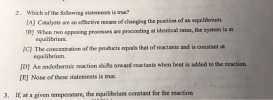 Which of the following statements is true? [A] Catalysts are an effective means of changing the position of an equilibrium. B1 When two opposing processes are proceeding at identical rates, the system is at 2. equilibrium. IC] The concentration of the products equals that of reactants and is constant at equilibrium [D] An endothermic reaction shifts toward reactants when heat is added to the reaction. [E None of these statements is true. 3. If, at a given temperature, the equilibrium...
 At a given temperature, the equilibrium constant for a certain reaction is 1 X 10¹⁴. Does this equilibrium favor products or reactants? Why? Select the single best answer. A very high value for the equilbrium constant favors product formation. O O Significant concentrations of both products and reactants are present at equilibrium. A very high value for the equilbrium constant favors reactant formation. A very low value for the equilibrium constant favors reactant formation. A very low value for the...
 3 attempts left Check my work At a given temperature, the equilibrium constant for a certain reaction is 1 x 1026. Does this equilibrium favor products or reactants? Why? Select the single best answer. A large value for the equilibrium constant favors reactant formation. A small value for the equilbrium constant favors product formation. Significant concentrations of both products and reactants are present at equilibrium. A large value for the equilibrium constant favors product formation. A small value for the...
 D Question 2 1 pts Which statement(s) concerning the reaction is/are true? 2A) A2(g) +B2(g) K-29x 10-85 There are fewer moles of reactants than products at equilibrium, because the equilibrium constant is small. There are more moles of reactants than products at equilibrium, because the equilibrium constant is large. There are near equal amounts of reactants and products at equilibrium because the equilibrium constant is close to 1 There are more moles of reactants than products at equilibrium, because the...
 Question 2 1 pts Which statement(s) concerning the reaction is/are true? 2ABig) Alg) + Bale) K-2.9 x 10-85 There are fewer moles of reactants than products at equilibrium, because the equilibrium constant is small There are more moles of reactants than products at equilibrium, because the equilibrium constant is large. There are near equal amounts of reactants and products at equilibrium because the equilibrium constant is close to 1 There are more moles of reactants than products at equilibrium, because...
 Q1: The value of K, the equilibrium constant, is affected by which of the following (more than one answer could be acceptable)? reactant initial concentrations a) b) c) d) product initial concentrations the system temperature the nature of the reactants and products Explain your answer.
 it is relatively easy to change the temperature of a substance
tha
Indicate the answer choice that best completes the statement or anwers the qucation 1. Which one of the following statements is INCORRECT? Energy is neither created nor destroyed in chemical reactions b. Kinctic energy is the energy that results from an object's position. transfer heat from the system into the surroundings d. Increasing the thermal energy of a gas increases the motion of e. Energy is the capacity...
it is relatively easy to change the temperature of a substance
tha
Indicate the answer choice that best completes the statement or anwers the qucation 1. Which one of the following statements is INCORRECT? Energy is neither created nor destroyed in chemical reactions b. Kinctic energy is the energy that results from an object's position. transfer heat from the system into the surroundings d. Increasing the thermal energy of a gas increases the motion of e. Energy is the capacity...
 A Which one of the following will change the value of an equilibrium constant? a) Varying the initial concentrations of reactants b) Varying the initial concentration of products c) Changing the volume of the reaction vessel d) Changing temperature e All of the above 5) The equililbrium constant for the gas phase reaction N2(g)+3H2(g) 2NH,(g) is Keg 4.34 x 10 at 300°C. At equilibrium a) products predominate b) only products are present reactants predominate d) only reactants are present roughly...
 Which one of the following statements is true? O A catalyst alters the equilibrium constant of a reaction and is neither a product nor a reactant in the overall equation. In order for a reaction to occur, product and reactant molecules must collide with each other. The transition state is a short-lived, high energy state, intermediate between products and reactants. In reactions that are first order in one reactant and first order in another, the slow step always involves a...
 Which of the following statements is true? [A] Catalysts are an effective means of changing the position of an equilibrium. B1 When two opposing processes are proceeding at identical rates, the system is at 2. equilibrium. IC] The concentration of the products equals that of reactants and is constant at equilibrium [D] An endothermic reaction shifts toward reactants when heat is added to the reaction. [E None of these statements is true. 3. If, at a given temperature, the equilibrium...
Most questions answered within 3 hours.
-
Where is the error in this code sequence?
String s1 = "Hello";
String s2 = "ello";...
asked 11 months ago -
Financial data for Joel de Paris, Inc., for last year
follow:
Joel de Paris, Inc.
Balance...
asked 11 months ago -
Consider this reaction:
Al2(SO4)3 (aq)+ BaCl3
(aq) Al2Cl6 (aq)- +
3BaSO4(s) . What is the...
asked 11 months ago -
Suppose that Savneet is considering increasing her
recent random sample from 20 car rentals to 40...
asked 11 months ago -
Trucks arrive at an unloading terminal at an average rate of 120
per hour.
Trucks arrive...
asked 11 months ago -
Why are methanol and ethanol completely soluble in water while
octanol is not very little soluble....
asked 11 months ago -
A facilities manager at a university reads in a research report
that the mean amount of...
asked 11 months ago -
When the CuSO4 is rehydrated by adding water to the anhydrous
compound, is this an endothermic...
asked 11 months ago -
A ray of sunlight is passing from diamond into crown glass; the
angle of incidence is...
asked 11 months ago -
A block of mass 0.249 kg is placed on top of a light, vertical
spring of...
asked 11 months ago -
how do the kidneys compensate in the presences of acidosis
a) trigger hyperventilate
b) reserve acid...
asked 11 months ago -
Question 501 pts
The rental rate of capital to the firm increases. Which of the
following...
asked 11 months ago