
Homework Answers
Request Answer!
We need at least 10 more requests to produce the answer.
0 / 10 have requested this problem solution
The more requests, the faster the answer.
Add Answer to:
Consider the titration curves of four different acids titrated with a strong base 12.0 10.0 8.0...
The graph below shows the titration curves for two monoprotic acids. A Review Constants Complete the...
 The graph below shows the titration curves for two monoprotic acids. A Review Constants Complete the sentences describing the plot. Match the words in the left column to the appropriate blanks in the sentences on the right. 14 12 Reset Help 10 Acid B 8 The curve of the strong acid is PH 6 10.0 А 4 Curve A The approximate pH at the equivalence point of the titration for Curve A is B 2 12.0 0 0 7.0 10...
The following plot shows the pH curves for the titrations of various acids by 0.10 M NaOH (all of...
 29. a,b,c
The following plot shows the pH curves for the titrations of various acids by 0.10 M NaOH (all of the acids were 50.0-mL samples of 0.10 M concentration). 12.0 10.0 8.0 6.0 4.0 2.0 0 10 20 30 40 50 60 Vol 0.10 M NaOH added (mL) a. Which pH curve corresponds to the weakest acid? b. Which pH curve corresponds to the strongest acid? Which point on the pH curve would you examine to see if this...
29. a,b,c
The following plot shows the pH curves for the titrations of various acids by 0.10 M NaOH (all of the acids were 50.0-mL samples of 0.10 M concentration). 12.0 10.0 8.0 6.0 4.0 2.0 0 10 20 30 40 50 60 Vol 0.10 M NaOH added (mL) a. Which pH curve corresponds to the weakest acid? b. Which pH curve corresponds to the strongest acid? Which point on the pH curve would you examine to see if this...
14.0 2.0 10.0 equivalence point pH=7.0 8.0 6.0 4.0 2.0 0.0 0.0 20.0 40.0 6o.0 80.0...
 14.0 2.0 10.0 equivalence point pH=7.0 8.0 6.0 4.0 2.0 0.0 0.0 20.0 40.0 6o.0 80.0 Volume of NaOH added (ml) Figure 16.15. A strong acid-base titration curve. 50.0 mL of 0.100 M titrated with 0.100 M of NaOH
Question: In the figure below, titration curves for strong acid with strong base and weak acid...
 Question: In the figure below, titration curves for strong acid
with strong base and weak acid with strong base are shown. Compare
the shapes of these curves early in the titration for three
different cases: titration of a strong acid, titration of a weak
acid with a lower pKa, and titration of a weak acid with a higher
pKa. Discuss with the class why the titration curve for weak acids
increase more rapidly early in the titration than do stronger...
Question: In the figure below, titration curves for strong acid
with strong base and weak acid with strong base are shown. Compare
the shapes of these curves early in the titration for three
different cases: titration of a strong acid, titration of a weak
acid with a lower pKa, and titration of a weak acid with a higher
pKa. Discuss with the class why the titration curve for weak acids
increase more rapidly early in the titration than do stronger...
This graph contains the titration curve of which of these amino acids: leucine, histidine, or lysine?...
 This graph contains the titration curve of which of these amino
acids: leucine, histidine, or lysine? Explain.
14.0r 12.0 10.0 8.0 6.0 4.0 2.0 a 60 Volume of base added
This graph contains the titration curve of which of these amino
acids: leucine, histidine, or lysine? Explain.
14.0r 12.0 10.0 8.0 6.0 4.0 2.0 a 60 Volume of base added
An unknown acid is titrated with a strong base (NaOH) to produce the above titration curve....
 An unknown acid is titrated with a strong base (NaOH) to produce
the above titration curve. Key points on this graph reveal
important information about the substance and the solution created
with it.
What volume of NaOH is needed to reach the equivalence point
(the point where you added equal moles of NaOH to the
acid)? Select one of the following : ["10 mL", "5
mL", "20 mL", "30 mL", "40 mL", "25 mL", "15 mL", "35 mL"]
...
An unknown acid is titrated with a strong base (NaOH) to produce
the above titration curve. Key points on this graph reveal
important information about the substance and the solution created
with it.
What volume of NaOH is needed to reach the equivalence point
(the point where you added equal moles of NaOH to the
acid)? Select one of the following : ["10 mL", "5
mL", "20 mL", "30 mL", "40 mL", "25 mL", "15 mL", "35 mL"]
...
Strong acid-titrated with strong base. Suppose the titration was reversed in question 2. If you titrated...
 Strong acid-titrated with strong base. Suppose the titration was reversed in question 2. If you titrated 30.0 mL of 0.1 M HCl with 0.1 M NaOH, indicate the approximate pH (a) at the start of the titration and (b) at the equivalence point. (c) What is the total volume of solution at the equivalence point? Add this curve to your sketch in question 2. 3. la. 1.0; b. 7.0; c. 60 mL]
Question 4 10 pts 4. Consider the titration curves (labeled a and b) for two weak...
 Question 4 10 pts 4. Consider the titration curves (labeled a and b) for two weak acids, both titrated with 0.100 M NaOH: (0) Which acid solution is more concentrated? (ii) Which acid has the larger K? Hd pH TTTTTT TTTTTTT 0 20 40 60 80 100 Volume of base added (mL) 0 () 20 40 60 80 100 Volume of base added (mL) HTML Editore BIVA-A- IE111xx, 3. DO VIVO 12pt MacBook Pro
Looking at the following graph, determine the pKb of the compound 14.0 12.0 10.0- 8.0 6.0...
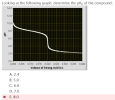 Looking at the following graph, determine the pKb of the compound 14.0 12.0 10.0- 8.0 6.0 4.0 2.0 0.0 0.000 0.005 0.010 0.015 0.020 0.025 0.030 0.035 0.040 Volume of Strong Acid in L A. 2.4 B. 5.0 C. 6.0 D. 7.0 x E. 8.0
24A) 40mL of 0.2 M formic acid is titrated with a strong base (NaOH= 0.5 M). Determine the pH before any base has been...
 24A) 40mL of 0.2 M formic acid is titrated with a strong base
(NaOH= 0.5 M). Determine the pH before any base has been added.
Please show steps and please explain why the answer is what it
is.
24B) The 40mL 0.2 M formic acid is titrated with a 6.0mL of
strong base. Here NaOH can be treated as a conjugate base and
formic acid is the acid.
please show steps and explain!
Us (24-25, Acid/base, aqueous equilibrium) 24A) (4...
24A) 40mL of 0.2 M formic acid is titrated with a strong base
(NaOH= 0.5 M). Determine the pH before any base has been added.
Please show steps and please explain why the answer is what it
is.
24B) The 40mL 0.2 M formic acid is titrated with a 6.0mL of
strong base. Here NaOH can be treated as a conjugate base and
formic acid is the acid.
please show steps and explain!
Us (24-25, Acid/base, aqueous equilibrium) 24A) (4...
 The graph below shows the titration curves for two monoprotic acids. A Review Constants Complete the sentences describing the plot. Match the words in the left column to the appropriate blanks in the sentences on the right. 14 12 Reset Help 10 Acid B 8 The curve of the strong acid is PH 6 10.0 А 4 Curve A The approximate pH at the equivalence point of the titration for Curve A is B 2 12.0 0 0 7.0 10...
 29. a,b,c
The following plot shows the pH curves for the titrations of various acids by 0.10 M NaOH (all of the acids were 50.0-mL samples of 0.10 M concentration). 12.0 10.0 8.0 6.0 4.0 2.0 0 10 20 30 40 50 60 Vol 0.10 M NaOH added (mL) a. Which pH curve corresponds to the weakest acid? b. Which pH curve corresponds to the strongest acid? Which point on the pH curve would you examine to see if this...
29. a,b,c
The following plot shows the pH curves for the titrations of various acids by 0.10 M NaOH (all of the acids were 50.0-mL samples of 0.10 M concentration). 12.0 10.0 8.0 6.0 4.0 2.0 0 10 20 30 40 50 60 Vol 0.10 M NaOH added (mL) a. Which pH curve corresponds to the weakest acid? b. Which pH curve corresponds to the strongest acid? Which point on the pH curve would you examine to see if this...
 14.0 2.0 10.0 equivalence point pH=7.0 8.0 6.0 4.0 2.0 0.0 0.0 20.0 40.0 6o.0 80.0 Volume of NaOH added (ml) Figure 16.15. A strong acid-base titration curve. 50.0 mL of 0.100 M titrated with 0.100 M of NaOH
 Question: In the figure below, titration curves for strong acid
with strong base and weak acid with strong base are shown. Compare
the shapes of these curves early in the titration for three
different cases: titration of a strong acid, titration of a weak
acid with a lower pKa, and titration of a weak acid with a higher
pKa. Discuss with the class why the titration curve for weak acids
increase more rapidly early in the titration than do stronger...
Question: In the figure below, titration curves for strong acid
with strong base and weak acid with strong base are shown. Compare
the shapes of these curves early in the titration for three
different cases: titration of a strong acid, titration of a weak
acid with a lower pKa, and titration of a weak acid with a higher
pKa. Discuss with the class why the titration curve for weak acids
increase more rapidly early in the titration than do stronger...
 This graph contains the titration curve of which of these amino
acids: leucine, histidine, or lysine? Explain.
14.0r 12.0 10.0 8.0 6.0 4.0 2.0 a 60 Volume of base added
This graph contains the titration curve of which of these amino
acids: leucine, histidine, or lysine? Explain.
14.0r 12.0 10.0 8.0 6.0 4.0 2.0 a 60 Volume of base added
 An unknown acid is titrated with a strong base (NaOH) to produce
the above titration curve. Key points on this graph reveal
important information about the substance and the solution created
with it.
What volume of NaOH is needed to reach the equivalence point
(the point where you added equal moles of NaOH to the
acid)? Select one of the following : ["10 mL", "5
mL", "20 mL", "30 mL", "40 mL", "25 mL", "15 mL", "35 mL"]
...
An unknown acid is titrated with a strong base (NaOH) to produce
the above titration curve. Key points on this graph reveal
important information about the substance and the solution created
with it.
What volume of NaOH is needed to reach the equivalence point
(the point where you added equal moles of NaOH to the
acid)? Select one of the following : ["10 mL", "5
mL", "20 mL", "30 mL", "40 mL", "25 mL", "15 mL", "35 mL"]
...
 Strong acid-titrated with strong base. Suppose the titration was reversed in question 2. If you titrated 30.0 mL of 0.1 M HCl with 0.1 M NaOH, indicate the approximate pH (a) at the start of the titration and (b) at the equivalence point. (c) What is the total volume of solution at the equivalence point? Add this curve to your sketch in question 2. 3. la. 1.0; b. 7.0; c. 60 mL]
 Question 4 10 pts 4. Consider the titration curves (labeled a and b) for two weak acids, both titrated with 0.100 M NaOH: (0) Which acid solution is more concentrated? (ii) Which acid has the larger K? Hd pH TTTTTT TTTTTTT 0 20 40 60 80 100 Volume of base added (mL) 0 () 20 40 60 80 100 Volume of base added (mL) HTML Editore BIVA-A- IE111xx, 3. DO VIVO 12pt MacBook Pro
 Looking at the following graph, determine the pKb of the compound 14.0 12.0 10.0- 8.0 6.0 4.0 2.0 0.0 0.000 0.005 0.010 0.015 0.020 0.025 0.030 0.035 0.040 Volume of Strong Acid in L A. 2.4 B. 5.0 C. 6.0 D. 7.0 x E. 8.0
 24A) 40mL of 0.2 M formic acid is titrated with a strong base
(NaOH= 0.5 M). Determine the pH before any base has been added.
Please show steps and please explain why the answer is what it
is.
24B) The 40mL 0.2 M formic acid is titrated with a 6.0mL of
strong base. Here NaOH can be treated as a conjugate base and
formic acid is the acid.
please show steps and explain!
Us (24-25, Acid/base, aqueous equilibrium) 24A) (4...
24A) 40mL of 0.2 M formic acid is titrated with a strong base
(NaOH= 0.5 M). Determine the pH before any base has been added.
Please show steps and please explain why the answer is what it
is.
24B) The 40mL 0.2 M formic acid is titrated with a 6.0mL of
strong base. Here NaOH can be treated as a conjugate base and
formic acid is the acid.
please show steps and explain!
Us (24-25, Acid/base, aqueous equilibrium) 24A) (4...
Most questions answered within 3 hours.
-
Where is the error in this code sequence?
String s1 = "Hello";
String s2 = "ello";...
asked 10 months ago -
Financial data for Joel de Paris, Inc., for last year
follow:
Joel de Paris, Inc.
Balance...
asked 10 months ago -
Consider this reaction:
Al2(SO4)3 (aq)+ BaCl3
(aq) Al2Cl6 (aq)- +
3BaSO4(s) . What is the...
asked 10 months ago -
Suppose that Savneet is considering increasing her
recent random sample from 20 car rentals to 40...
asked 10 months ago -
Trucks arrive at an unloading terminal at an average rate of 120
per hour.
Trucks arrive...
asked 10 months ago -
Why are methanol and ethanol completely soluble in water while
octanol is not very little soluble....
asked 10 months ago -
A facilities manager at a university reads in a research report
that the mean amount of...
asked 10 months ago -
When the CuSO4 is rehydrated by adding water to the anhydrous
compound, is this an endothermic...
asked 10 months ago -
A ray of sunlight is passing from diamond into crown glass; the
angle of incidence is...
asked 10 months ago -
A block of mass 0.249 kg is placed on top of a light, vertical
spring of...
asked 10 months ago -
how do the kidneys compensate in the presences of acidosis
a) trigger hyperventilate
b) reserve acid...
asked 10 months ago -
Question 501 pts
The rental rate of capital to the firm increases. Which of the
following...
asked 10 months ago