Differential Equations The mass m and Hooke’s constant k for a mass-and-spring system are given below....
Differential Equations
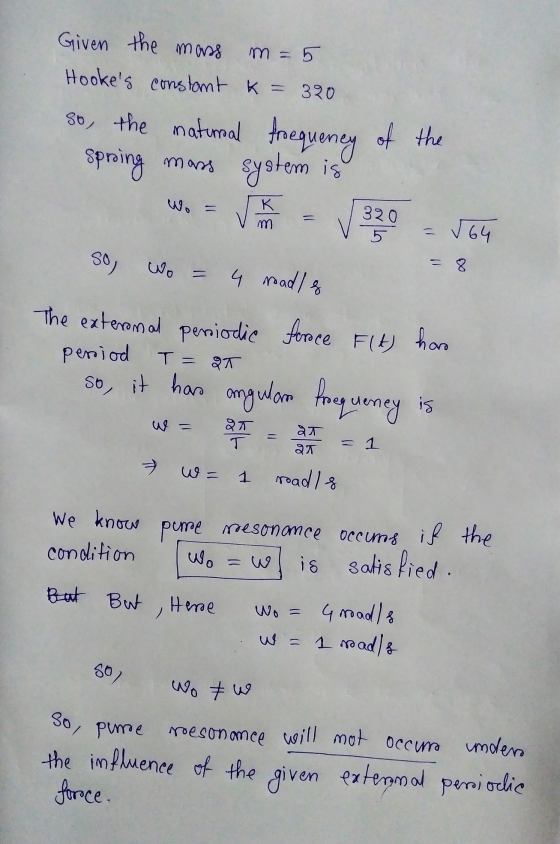
The mass m and Hooke’s constant k for a mass-and-spring system are given below. Determine whether or not pure resonance will occur under the influence of the given external periodic force
?(?). ? = 5, ? = 320; ?(?) is the odd function of period 2? with ?(?) = 3 for 0 < ? < pi
Homework Answers
Add Answer to:
Differential Equations
The mass m and Hooke’s constant k for a mass-and-spring system
are given below....
Consider a damped forced mass-spring system with m = 1, γ = 2, and k =...
Consider a damped forced mass-spring system with m = 1, γ = 2, and k = 26 under the influence of an external force F(t) = 82 cos(ωt). We can prove that the amplitude of this motion is given by R(ω) = p F0 m2 (ω0 2 − ω2 ) 2 + γ 2ω2 = 82 √ ω4 − 48ω2 + 76 For what value of ω will the maximum amplitude occur? When resonance will occur and how would you...
A system made up of a mass (m), attached to a spring of stiffness k [N/m]...
 A system made up of a mass (m), attached to a spring of stiffness k [N/m] will oscillate to a specific amplitude (A) which will depend on an external force (F) and initial conditions. If all the variables involved are given in Table 1, formulate the necessary Pi groups to describe this behavior. Make sure you write the Pi groups using the parameters involved Variable Units A m m kg Parameter Amplitude Mass Spring constant External Force Frequency k N/m...
A system made up of a mass (m) attached to a spring (k) will oscillate to...
 A system made up of a mass (m) attached to a spring
(k) will oscillate to a specific amplitude (a) depending on an
external force (f) and initial conditions. If all the variables
involved are given in the table, formulate the necessary Pi groups
to describe this behavior.
Parameter Variable Units Amplitude A m MAS kg Spring A constant N/m External Force F N Frequency rads
A system made up of a mass (m) attached to a spring
(k) will oscillate to a specific amplitude (a) depending on an
external force (f) and initial conditions. If all the variables
involved are given in the table, formulate the necessary Pi groups
to describe this behavior.
Parameter Variable Units Amplitude A m MAS kg Spring A constant N/m External Force F N Frequency rads
A system made up of a mass (m), attached to a spring of stiffness k [N/m]...
 A system made up of a mass (m), attached to a spring of stiffness k [N/m] will oscillate to a specific amplitude (A) which will depend on an external force (F) and initial conditions. If all the variables involved are given in Table 1, formulate the necessary Pi groups to describe this behavior. Make sure you write the Pi groups using the parameters involved Parameter Variable Variable Units Amplitude A т Mass m kg Spring k N/m constant External F...
1. A 1 kg mass is attached to a spring of spring constant k = 4kg/82, The spring-mass system is a...
 Differntial Equations Forced Spring Motion
1. A 1 kg mass is attached to a spring of spring constant k = 4kg/82, The spring-mass system is attached to a machine that supplies an external driving force of f(t) = 4 cos(wt). The systern is started from equilibrium i.e. 2(0) = 0 and z'(0) = 0. There is no damping. (a) Find the position x(t) of the mass as a function of time (b) write your answer in the form r(t)-1 sin(6t)...
Differntial Equations Forced Spring Motion
1. A 1 kg mass is attached to a spring of spring constant k = 4kg/82, The spring-mass system is attached to a machine that supplies an external driving force of f(t) = 4 cos(wt). The systern is started from equilibrium i.e. 2(0) = 0 and z'(0) = 0. There is no damping. (a) Find the position x(t) of the mass as a function of time (b) write your answer in the form r(t)-1 sin(6t)...
System A consists of a mass m attached to a spring with a force constant k;...
System A consists of a mass m attached to a spring with a force constant k; system B has a mass 2m attached to a spring with a force constant k; system C has a mass 3m attached to a spring with a force constant 6k; and system D has a mass m attached to a spring with a force constant 4k. Rank these systems in order of decreasing period of oscillation. Rank from largest to smallest. To rank items...
13. A damped mass-spring system with mass m, spring constant k, and damping constant b is...
 13. A damped mass-spring system with mass m, spring constant k, and damping constant b is driven by an external force with frequency w and amplitude Fo. 2662 where, wo is the (a) Show that the maximum oscillation amplitude occurs when w = natural frequency of the system. where, wd is the (b) Show that the maximum oscillation amplitude at that frequency is A = frequency of the undriven, damped system.
A mass m is attached to both a spring (with given spring constant k) and a...
 A mass m is attached to both a spring (with given spring constant k) and a dashpot (with given damping constant c). The mass is set in motion with initial position X, and initial velocity vo Find the position function x(t) and determine whether the motion is overdamped, critically damped, or underdamped. If it is underdamped, write the position function in the form x(t) =C, e-pt cos (0,t-a). Also, find the undamped position function u(t) = Cocos (0,0+ - )...
A block of mass m = 2.0 kg is attached to a Hooke’s-law spring with force...
A block of mass m = 2.0 kg is attached to a Hooke’s-law spring with force constant k = 8 . 0 N / m and is on a frictionless horizontal surface, as shown in the figure below. The block is released from rest at position x i . As the block passes through the equilibrium point at x = 0, it moves with a speed of 8.0 m/s. What is the value, in m, of the initial position, x...
For Hooke’s Law, F = kx, the spring constant, k, describes the force required to deform...
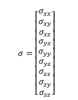 For Hooke’s Law, F = kx, the spring constant, k, describes the
force required to deform a spring. For a three-dimensional object,
we can generalize Hooke’s Law to describe the stress required to
strain a material: where stress can be written as a [9x1] tensor,
strain can also be written as a [9x1] tensor, and E is an
“elasticity” tensor, which is analogous to our spring constant. How
many elements, n, in the elasticity tensor are required to satisfy
the...
For Hooke’s Law, F = kx, the spring constant, k, describes the
force required to deform a spring. For a three-dimensional object,
we can generalize Hooke’s Law to describe the stress required to
strain a material: where stress can be written as a [9x1] tensor,
strain can also be written as a [9x1] tensor, and E is an
“elasticity” tensor, which is analogous to our spring constant. How
many elements, n, in the elasticity tensor are required to satisfy
the...
 A system made up of a mass (m), attached to a spring of stiffness k [N/m] will oscillate to a specific amplitude (A) which will depend on an external force (F) and initial conditions. If all the variables involved are given in Table 1, formulate the necessary Pi groups to describe this behavior. Make sure you write the Pi groups using the parameters involved Variable Units A m m kg Parameter Amplitude Mass Spring constant External Force Frequency k N/m...
 A system made up of a mass (m) attached to a spring
(k) will oscillate to a specific amplitude (a) depending on an
external force (f) and initial conditions. If all the variables
involved are given in the table, formulate the necessary Pi groups
to describe this behavior.
Parameter Variable Units Amplitude A m MAS kg Spring A constant N/m External Force F N Frequency rads
A system made up of a mass (m) attached to a spring
(k) will oscillate to a specific amplitude (a) depending on an
external force (f) and initial conditions. If all the variables
involved are given in the table, formulate the necessary Pi groups
to describe this behavior.
Parameter Variable Units Amplitude A m MAS kg Spring A constant N/m External Force F N Frequency rads
 A system made up of a mass (m), attached to a spring of stiffness k [N/m] will oscillate to a specific amplitude (A) which will depend on an external force (F) and initial conditions. If all the variables involved are given in Table 1, formulate the necessary Pi groups to describe this behavior. Make sure you write the Pi groups using the parameters involved Parameter Variable Variable Units Amplitude A т Mass m kg Spring k N/m constant External F...
 Differntial Equations Forced Spring Motion
1. A 1 kg mass is attached to a spring of spring constant k = 4kg/82, The spring-mass system is attached to a machine that supplies an external driving force of f(t) = 4 cos(wt). The systern is started from equilibrium i.e. 2(0) = 0 and z'(0) = 0. There is no damping. (a) Find the position x(t) of the mass as a function of time (b) write your answer in the form r(t)-1 sin(6t)...
Differntial Equations Forced Spring Motion
1. A 1 kg mass is attached to a spring of spring constant k = 4kg/82, The spring-mass system is attached to a machine that supplies an external driving force of f(t) = 4 cos(wt). The systern is started from equilibrium i.e. 2(0) = 0 and z'(0) = 0. There is no damping. (a) Find the position x(t) of the mass as a function of time (b) write your answer in the form r(t)-1 sin(6t)...
 13. A damped mass-spring system with mass m, spring constant k, and damping constant b is driven by an external force with frequency w and amplitude Fo. 2662 where, wo is the (a) Show that the maximum oscillation amplitude occurs when w = natural frequency of the system. where, wd is the (b) Show that the maximum oscillation amplitude at that frequency is A = frequency of the undriven, damped system.
 A mass m is attached to both a spring (with given spring constant k) and a dashpot (with given damping constant c). The mass is set in motion with initial position X, and initial velocity vo Find the position function x(t) and determine whether the motion is overdamped, critically damped, or underdamped. If it is underdamped, write the position function in the form x(t) =C, e-pt cos (0,t-a). Also, find the undamped position function u(t) = Cocos (0,0+ - )...
 For Hooke’s Law, F = kx, the spring constant, k, describes the
force required to deform a spring. For a three-dimensional object,
we can generalize Hooke’s Law to describe the stress required to
strain a material: where stress can be written as a [9x1] tensor,
strain can also be written as a [9x1] tensor, and E is an
“elasticity” tensor, which is analogous to our spring constant. How
many elements, n, in the elasticity tensor are required to satisfy
the...
For Hooke’s Law, F = kx, the spring constant, k, describes the
force required to deform a spring. For a three-dimensional object,
we can generalize Hooke’s Law to describe the stress required to
strain a material: where stress can be written as a [9x1] tensor,
strain can also be written as a [9x1] tensor, and E is an
“elasticity” tensor, which is analogous to our spring constant. How
many elements, n, in the elasticity tensor are required to satisfy
the...
Most questions answered within 3 hours.
-
Where is the error in this code sequence?
String s1 = "Hello";
String s2 = "ello";...
asked 10 months ago -
Financial data for Joel de Paris, Inc., for last year
follow:
Joel de Paris, Inc.
Balance...
asked 10 months ago -
Consider this reaction:
Al2(SO4)3 (aq)+ BaCl3
(aq) Al2Cl6 (aq)- +
3BaSO4(s) . What is the...
asked 10 months ago -
Suppose that Savneet is considering increasing her
recent random sample from 20 car rentals to 40...
asked 10 months ago -
Trucks arrive at an unloading terminal at an average rate of 120
per hour.
Trucks arrive...
asked 10 months ago -
Why are methanol and ethanol completely soluble in water while
octanol is not very little soluble....
asked 10 months ago -
A facilities manager at a university reads in a research report
that the mean amount of...
asked 10 months ago -
When the CuSO4 is rehydrated by adding water to the anhydrous
compound, is this an endothermic...
asked 10 months ago -
A ray of sunlight is passing from diamond into crown glass; the
angle of incidence is...
asked 10 months ago -
A block of mass 0.249 kg is placed on top of a light, vertical
spring of...
asked 10 months ago -
how do the kidneys compensate in the presences of acidosis
a) trigger hyperventilate
b) reserve acid...
asked 10 months ago -
Question 501 pts
The rental rate of capital to the firm increases. Which of the
following...
asked 10 months ago