A scuba diver exhales 3.32 L of air while swimming at a depth of 20.0 m...
Homework Answers
we can solve this problem by using Boyles law
at constant temperature, volume of gas is inversely proportional to
its pressure.
as the pressure drops from 2.95 atm to 1.00 atm , then volume of
air raises
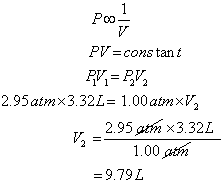
hence volume of air = 9.79 L
Add Answer to:
A scuba diver exhales 3.32 L of air while swimming at a depth of 20.0 m...
read the description please
a scuba diver exhales 4.95 L of air while swimming at a depth of 51.90 m where the sum of atmospheric pressure and water pressure is 6.02 atm. By the time this exhaled air rises to the surface, where the pressure is 1.00 atm, what is its volume
mere entry question is worth point / You have 6 of 6 attempts remaining/ There is...
 mere entry question is worth point / You have 6 of 6 attempts remaining/ There is a 5x attempt penalty 14 Question (1 point) See page 275 1st attempt See Periodic Table See Hint A scuba diver exhales 1.95 L of air while swimming at a depth of 59.70 m where the sum of atmospheric pressure and water pressure is 6.77 atm. By the time this exhaled air rises to the surface, where the pressure is 1.00 atm, what is...
A scuba diver creates a spherical bubble with a radius of 2.0 cm at a depth...
A scuba diver creates a spherical bubble with a radius of 2.0 cm at a depth of 30.0 m where the total pressure (including atmospheric pressure) is 4.00 atm. What is the radius of the bubble when it reaches the surface of the water? (Assume atmospheric pressure to be 1.00 atm and the temperature to be 298 K.)
A scuba diver creates a spherical bubble with a radius of 3.5 cm at a depth...
A scuba diver creates a spherical bubble with a radius of 3.5 cm at a depth of 30.0 m where the total pressure (including atmospheric pressure) is 4.00 atm. What is the radius of the bubble when it reaches the surface of the water? (Assume atmospheric pressure to be 1.00 atm and the temperature to be 298 K.) Express your answer using two significant figures.
A scuba diver takes a 2.3 L balloon from the surface, where the pressure is 1.0...
A scuba diver takes a 2.3 L balloon from the surface, where the pressure is 1.0 atm and the temperature is 35 ∘C, to a depth of 30 m , where the pressure is 4.0 atm and the temperature is 17 ∘C. What is the volume of the balloon at this depth?
A scuba diver ascends too quickly and develops the bends. A nitrogen bubble has formed in...
 A scuba diver ascends too quickly and develops the bends. A nitrogen bubble has formed in the patient's elbow. At a depth of 58 ft, where the pressure is 2.76 atm, the bubble had a volume of 0.023 mL. Assuming a constant temperature and number of moles of nitrogen in the bubble, what volume did the bubble increase to at the surface, where the pressure is 1.00 atm? bubble volume at surface: The scuba diver is placed into a hyperbaric...
Question 4 of 11 > A scuba diver ascends too quickly and develops the bends. A nitrogen bubble has formed in the...
 Question 4 of 11 > A scuba diver ascends too quickly and develops the bends. A nitrogen bubble has formed in the patient's elbow. At a depth of 53 ft, where the pressure is 2.60 atm, the bubble had a volume of 0.022 mL. Assuming a constant temperature and number of moles of nitrogen in the bubble, what volume did the bubble increase to at the surface, where the pressure is 1.00 atm? bubble volume at surface: ml The scuba...
Exercise 5.85 Part A A scuba diver creates a spherical bubble with a radius of 2.5...
 Exercise 5.85 Part A A scuba diver creates a spherical bubble with a radius of 2.5 cm at a depth of 30.0 m where the total pressure (including atmospheric pressure) is 4.00 atm What is the radius of the bubble when it reaches the surface of the water? (Assume atmospheric pressure to be 1.00 atm and the temperature to be 298 K.) Express your answer using two significant figures. r= cm Submit My Answers Give Up Provide Feedback Continue
A scuba diver at a depth of 34.0 m below the surface of the sea off...
 A scuba diver at a depth of 34.0 m below the surface of the sea off the shores of Panama City, where the temperature is 5.0°C, releases an air bubble with volume 15.0 cm3. The bubble rises to the surface where the temperature is 19.0°C. What is the volume of the bubble immediately before it breaks the surface? The specific gravity for seawater is 1.025. Submit Answer Tries 0/5
Part A If the diver were to ascend to the surface (where the pressure is 1.0...
 Part A If the diver were to ascend to the surface (where the pressure is 1.0 atm) while holding her breath, to what volume would the air in her lungs expand? (Assume constant temperature.) Express your answer using two significant figures. VAED V2 L Submit Request Answer Exercise 11.36 3 of 15 Review I Constants I Periodic Table A scuba diver with a lung capacity of 5.5 L inhales a lungful of air at a depth of 43 m and...
 mere entry question is worth point / You have 6 of 6 attempts remaining/ There is a 5x attempt penalty 14 Question (1 point) See page 275 1st attempt See Periodic Table See Hint A scuba diver exhales 1.95 L of air while swimming at a depth of 59.70 m where the sum of atmospheric pressure and water pressure is 6.77 atm. By the time this exhaled air rises to the surface, where the pressure is 1.00 atm, what is...
 A scuba diver ascends too quickly and develops the bends. A nitrogen bubble has formed in the patient's elbow. At a depth of 58 ft, where the pressure is 2.76 atm, the bubble had a volume of 0.023 mL. Assuming a constant temperature and number of moles of nitrogen in the bubble, what volume did the bubble increase to at the surface, where the pressure is 1.00 atm? bubble volume at surface: The scuba diver is placed into a hyperbaric...
 Question 4 of 11 > A scuba diver ascends too quickly and develops the bends. A nitrogen bubble has formed in the patient's elbow. At a depth of 53 ft, where the pressure is 2.60 atm, the bubble had a volume of 0.022 mL. Assuming a constant temperature and number of moles of nitrogen in the bubble, what volume did the bubble increase to at the surface, where the pressure is 1.00 atm? bubble volume at surface: ml The scuba...
 Exercise 5.85 Part A A scuba diver creates a spherical bubble with a radius of 2.5 cm at a depth of 30.0 m where the total pressure (including atmospheric pressure) is 4.00 atm What is the radius of the bubble when it reaches the surface of the water? (Assume atmospheric pressure to be 1.00 atm and the temperature to be 298 K.) Express your answer using two significant figures. r= cm Submit My Answers Give Up Provide Feedback Continue
 A scuba diver at a depth of 34.0 m below the surface of the sea off the shores of Panama City, where the temperature is 5.0°C, releases an air bubble with volume 15.0 cm3. The bubble rises to the surface where the temperature is 19.0°C. What is the volume of the bubble immediately before it breaks the surface? The specific gravity for seawater is 1.025. Submit Answer Tries 0/5
 Part A If the diver were to ascend to the surface (where the pressure is 1.0 atm) while holding her breath, to what volume would the air in her lungs expand? (Assume constant temperature.) Express your answer using two significant figures. VAED V2 L Submit Request Answer Exercise 11.36 3 of 15 Review I Constants I Periodic Table A scuba diver with a lung capacity of 5.5 L inhales a lungful of air at a depth of 43 m and...
Most questions answered within 3 hours.
-
Where is the error in this code sequence?
String s1 = "Hello";
String s2 = "ello";...
asked 11 months ago -
Financial data for Joel de Paris, Inc., for last year
follow:
Joel de Paris, Inc.
Balance...
asked 11 months ago -
Consider this reaction:
Al2(SO4)3 (aq)+ BaCl3
(aq) Al2Cl6 (aq)- +
3BaSO4(s) . What is the...
asked 11 months ago -
Suppose that Savneet is considering increasing her
recent random sample from 20 car rentals to 40...
asked 11 months ago -
Trucks arrive at an unloading terminal at an average rate of 120
per hour.
Trucks arrive...
asked 11 months ago -
Why are methanol and ethanol completely soluble in water while
octanol is not very little soluble....
asked 11 months ago -
A facilities manager at a university reads in a research report
that the mean amount of...
asked 11 months ago -
When the CuSO4 is rehydrated by adding water to the anhydrous
compound, is this an endothermic...
asked 11 months ago -
A ray of sunlight is passing from diamond into crown glass; the
angle of incidence is...
asked 11 months ago -
A block of mass 0.249 kg is placed on top of a light, vertical
spring of...
asked 11 months ago -
how do the kidneys compensate in the presences of acidosis
a) trigger hyperventilate
b) reserve acid...
asked 11 months ago -
Question 501 pts
The rental rate of capital to the firm increases. Which of the
following...
asked 11 months ago