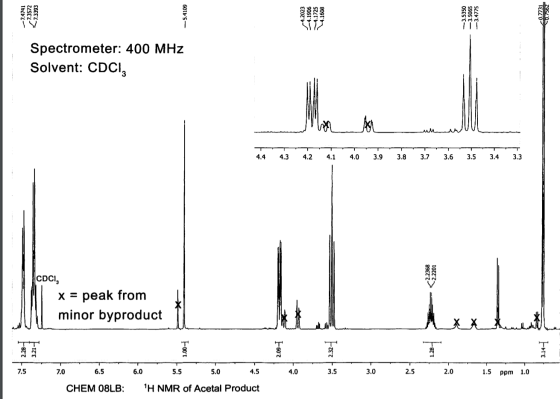
The 1H NMR spectrum has peaks (marked with "x") for a minor byproduct - what might that be?
Homework Answers
Request Answer!
We need at least 10 more requests to produce the answer.
0 / 10 have requested this problem solution
The more requests, the faster the answer.
Add Answer to:
The 1H NMR spectrum has peaks (marked with "x") for a minor
byproduct - what might...
Identify the peak in the 1H NMR spectrum corresponding to the CH3 group, explain what coupling...
 Identify the peak in the 1H NMR spectrum corresponding to the
CH3 group, explain what coupling pattern it has and why it has that
pattern.
7.4741 7.3572 7.3393 -5.4109 4.2023 4.1906 -4.1725 4.1608 -3.5350 -3.5065 -3.4775 Spectrometer: 400 MHZ Solvent: CDCI T 4.4 4.3 4.2 4.1 4.0 3.9 3.8 3.7 3.6 3.5 3.4 3.3 <3.2368 CDCI, x = peak from minor byproduct do 1.00-1 F-602 3.1444 Feer to 7.5 7.0 6.5 6.0 5.5 5.0 4.5 4.0 3.5 3.0 2.5 2.0...
Identify the peak in the 1H NMR spectrum corresponding to the
CH3 group, explain what coupling pattern it has and why it has that
pattern.
7.4741 7.3572 7.3393 -5.4109 4.2023 4.1906 -4.1725 4.1608 -3.5350 -3.5065 -3.4775 Spectrometer: 400 MHZ Solvent: CDCI T 4.4 4.3 4.2 4.1 4.0 3.9 3.8 3.7 3.6 3.5 3.4 3.3 <3.2368 CDCI, x = peak from minor byproduct do 1.00-1 F-602 3.1444 Feer to 7.5 7.0 6.5 6.0 5.5 5.0 4.5 4.0 3.5 3.0 2.5 2.0...
identify the peak in the 1H NMR spectrum corresponding to the CH3 group, explain what coupling...
 identify the peak in the 1H NMR spectrum corresponding to the
CH3 group, explain what coupling pattern it has and why it has that
pattern.
7.4741 7.3572 7.3393 -5.4109 4.2023 4.1906 -4.1725 4.1608 -3.5350 -3.5065 -3.4775 Spectrometer: 400 MHZ Solvent: CDCI T 4.4 4.3 4.2 4.1 4.0 3.9 3.8 3.7 3.6 3.5 3.4 3.3 <3.2368 CDCI, x = peak from minor byproduct do 1.00-1 F-602 3.1444 Feer to 7.5 7.0 6.5 6.0 5.5 5.0 4.5 4.0 3.5 3.0 2.5 2.0...
identify the peak in the 1H NMR spectrum corresponding to the
CH3 group, explain what coupling pattern it has and why it has that
pattern.
7.4741 7.3572 7.3393 -5.4109 4.2023 4.1906 -4.1725 4.1608 -3.5350 -3.5065 -3.4775 Spectrometer: 400 MHZ Solvent: CDCI T 4.4 4.3 4.2 4.1 4.0 3.9 3.8 3.7 3.6 3.5 3.4 3.3 <3.2368 CDCI, x = peak from minor byproduct do 1.00-1 F-602 3.1444 Feer to 7.5 7.0 6.5 6.0 5.5 5.0 4.5 4.0 3.5 3.0 2.5 2.0...
The data for 30 samples of 8 measurements each were collected from a process at Hawkeye...
The data for 30 samples of 8 measurements each were collected from a process at Hawkeye Plastics. They’ve asked you to create an x ̅-chart and an s-chart for the process and to interpret the results for them. a) What values will be used for the centerline, upper control limit, and lower control limit of each chart? (You only need to make a table of the values to answer this question and others like it in this assignment.) b) Create...
fill out the table below using the H-NMR there may be more or less noteable peaks....
 fill out the table below using the H-NMR
there may be more or less noteable peaks.
the two most important are Bis-allylic protons and OCH3
Methoxylic protons
Below depicts the H-NMR products: Characterization of the Chemical shift of the peak (location) Integration value peak 4.4 4.3 4.2 4.1 4.0 3.9 3.8 3.7 3.6 3.5 3.4 3.3 3.2 3.1 3.0 2.9 2.8 Proton oza 20.90 619 : parts per Million : Proton
fill out the table below using the H-NMR
there may be more or less noteable peaks.
the two most important are Bis-allylic protons and OCH3
Methoxylic protons
Below depicts the H-NMR products: Characterization of the Chemical shift of the peak (location) Integration value peak 4.4 4.3 4.2 4.1 4.0 3.9 3.8 3.7 3.6 3.5 3.4 3.3 3.2 3.1 3.0 2.9 2.8 Proton oza 20.90 619 : parts per Million : Proton
A compound A, C7H12O3, contains two functional groups. One of the functional groups is a derivative...
 A compound A, C7H12O3, contains two functional groups. One of the functional groups is a derivative of carboxylic acid. The 1H NMR spectrum of the compound is given below. Deduce the structure of the compound A. Write your structure on the spectrum and using arrows assign all the peaks in the spectrum to various protons in the molecule. (5 Pts, NO PARTIAL CREDITS) 4.3 4.2 4.1 4.0 3.9 3.8 3.7 3.6 3.5 3.4 3.3 3.2 3.1 3.0 2.9 2.8 2.7...
(a) From the spectral data ( H, C NMR, IR, MS) you were given, identify the...
 (a) From the spectral data ( H, C NMR, IR, MS) you were given,
identify the structure of your product. Explain why you chose your
particular product based on the spectroscopic data.
(b) Fully assign the 1H NMR spectrum of your product (i.e.
determine which peaks in the 1H NMR correspond to which hydrogens
in the product). You will not receive full marks for determination
of the unknown unless you assign the 1H NMR spectrum
completely.
(c) Now work backwards...
(a) From the spectral data ( H, C NMR, IR, MS) you were given,
identify the structure of your product. Explain why you chose your
particular product based on the spectroscopic data.
(b) Fully assign the 1H NMR spectrum of your product (i.e.
determine which peaks in the 1H NMR correspond to which hydrogens
in the product). You will not receive full marks for determination
of the unknown unless you assign the 1H NMR spectrum
completely.
(c) Now work backwards...
Predict the structure of the following compounds: Formula: C4H8O (All scale is in ppm) (NMR Solvent:...
 Predict the structure of the following compounds:
Formula: C4H8O (All scale is in ppm) (NMR
Solvent: CDCl3)
Calculate the element of unsaturation of the compound.
1H NMR
44 1.o 6.6 5.8 4.0 3. 2.0 Zoom peaks au UUUUUUUUUUUUUUUUUU UUUUUUUUUUUUUUUUUUUUUUUUUUUUUUUUUUUUUUU 6.6 6.5 6.4 6.3 6.2 6.1 6.0 AM LLLLLLLLLLLLL 4.3 4.2 LUUUUUUUUUU 3.7 4.1 4.0 3.9 3.8
Predict the structure of the following compounds:
Formula: C4H8O (All scale is in ppm) (NMR
Solvent: CDCl3)
Calculate the element of unsaturation of the compound.
1H NMR
44 1.o 6.6 5.8 4.0 3. 2.0 Zoom peaks au UUUUUUUUUUUUUUUUUU UUUUUUUUUUUUUUUUUUUUUUUUUUUUUUUUUUUUUUU 6.6 6.5 6.4 6.3 6.2 6.1 6.0 AM LLLLLLLLLLLLL 4.3 4.2 LUUUUUUUUUU 3.7 4.1 4.0 3.9 3.8
the following 1H NMR shows data from a sample of the reaction of styrene oxide and...
 the following 1H NMR shows data from a sample of the
reaction of styrene oxide and HBr.
use the information from the data to indicate the extent to which
the reaction progressed by pointing out the presence or absence of
specific signals.
this is the styrene oxide data before reaction
ოოოოოოოოოო 22 2.79 2.82 12.81 2.80 2.80 mmmmmmm gal- BRUKER Current Data Parastra JUMB Deb-2015-CH25 2013 PZ - Memutation Parameters 11.34 PULPROG SOLVENT cocia FIORES 641025 0.195625 5.1110078 78.000 sec...
the following 1H NMR shows data from a sample of the
reaction of styrene oxide and HBr.
use the information from the data to indicate the extent to which
the reaction progressed by pointing out the presence or absence of
specific signals.
this is the styrene oxide data before reaction
ოოოოოოოოოო 22 2.79 2.82 12.81 2.80 2.80 mmmmmmm gal- BRUKER Current Data Parastra JUMB Deb-2015-CH25 2013 PZ - Memutation Parameters 11.34 PULPROG SOLVENT cocia FIORES 641025 0.195625 5.1110078 78.000 sec...
What fraction of the measurements are less than 5.1? What fraction of the measurements are larger...
 What fraction of the measurements are less than 5.1?
What fraction of the measurements are larger than 3.6?
truct a relative frequency histogram for these 50 measurements 6.2 4.13.8 3.0 3.4 2.9 2.1 4.1 1.7 4.8 3.7. 3.6 5.5 2.1 2.75.1 1.0 3.8 5.7 3.7 2.7 3.8 4.8 2.4 3.8 3.3 4.2 2.46.0 3.0 4.6 2.8 3.2 4.8 2.5 3.8 4.7 4.0 4.6 3.9 3.4 4.3 4.5 5.1 3.6 4.0 4.2 1.6 4.8 5.7
What fraction of the measurements are less than 5.1?
What fraction of the measurements are larger than 3.6?
truct a relative frequency histogram for these 50 measurements 6.2 4.13.8 3.0 3.4 2.9 2.1 4.1 1.7 4.8 3.7. 3.6 5.5 2.1 2.75.1 1.0 3.8 5.7 3.7 2.7 3.8 4.8 2.4 3.8 3.3 4.2 2.46.0 3.0 4.6 2.8 3.2 4.8 2.5 3.8 4.7 4.0 4.6 3.9 3.4 4.3 4.5 5.1 3.6 4.0 4.2 1.6 4.8 5.7
How would you analyze the peaks for a 1H NMR of Bromovanillyl Alcohol and an IR...
 How would you analyze the peaks for a 1H NMR of
Bromovanillyl Alcohol and an IR spectra of Bromovanillyl
Alcohol?
IR Peaks
NMR Peaks
%Transmittance 3446.63 3121.86 8 3004.87 2925.69 2877.64 8 1611.72" 1588.93 1499.44 1420.46 1398.31 1371.05 05 1277.51 1200.01 1179.94 1143.10 8 1047.61 1010.21 948.66 852.87 836.91 823.94 780.44 719.71 H NMR (400 mHz, CDCls) Br 6.86 s) 92 7.09 5.90 4.60 1.64 CDCls H20 12.5 12.0 11.5 11.0 10.5 10.0 9.5 9.0 8.5 8.0 7.5 7.0 6.5...
How would you analyze the peaks for a 1H NMR of
Bromovanillyl Alcohol and an IR spectra of Bromovanillyl
Alcohol?
IR Peaks
NMR Peaks
%Transmittance 3446.63 3121.86 8 3004.87 2925.69 2877.64 8 1611.72" 1588.93 1499.44 1420.46 1398.31 1371.05 05 1277.51 1200.01 1179.94 1143.10 8 1047.61 1010.21 948.66 852.87 836.91 823.94 780.44 719.71 H NMR (400 mHz, CDCls) Br 6.86 s) 92 7.09 5.90 4.60 1.64 CDCls H20 12.5 12.0 11.5 11.0 10.5 10.0 9.5 9.0 8.5 8.0 7.5 7.0 6.5...
 Identify the peak in the 1H NMR spectrum corresponding to the
CH3 group, explain what coupling pattern it has and why it has that
pattern.
7.4741 7.3572 7.3393 -5.4109 4.2023 4.1906 -4.1725 4.1608 -3.5350 -3.5065 -3.4775 Spectrometer: 400 MHZ Solvent: CDCI T 4.4 4.3 4.2 4.1 4.0 3.9 3.8 3.7 3.6 3.5 3.4 3.3 <3.2368 CDCI, x = peak from minor byproduct do 1.00-1 F-602 3.1444 Feer to 7.5 7.0 6.5 6.0 5.5 5.0 4.5 4.0 3.5 3.0 2.5 2.0...
Identify the peak in the 1H NMR spectrum corresponding to the
CH3 group, explain what coupling pattern it has and why it has that
pattern.
7.4741 7.3572 7.3393 -5.4109 4.2023 4.1906 -4.1725 4.1608 -3.5350 -3.5065 -3.4775 Spectrometer: 400 MHZ Solvent: CDCI T 4.4 4.3 4.2 4.1 4.0 3.9 3.8 3.7 3.6 3.5 3.4 3.3 <3.2368 CDCI, x = peak from minor byproduct do 1.00-1 F-602 3.1444 Feer to 7.5 7.0 6.5 6.0 5.5 5.0 4.5 4.0 3.5 3.0 2.5 2.0...
 identify the peak in the 1H NMR spectrum corresponding to the
CH3 group, explain what coupling pattern it has and why it has that
pattern.
7.4741 7.3572 7.3393 -5.4109 4.2023 4.1906 -4.1725 4.1608 -3.5350 -3.5065 -3.4775 Spectrometer: 400 MHZ Solvent: CDCI T 4.4 4.3 4.2 4.1 4.0 3.9 3.8 3.7 3.6 3.5 3.4 3.3 <3.2368 CDCI, x = peak from minor byproduct do 1.00-1 F-602 3.1444 Feer to 7.5 7.0 6.5 6.0 5.5 5.0 4.5 4.0 3.5 3.0 2.5 2.0...
identify the peak in the 1H NMR spectrum corresponding to the
CH3 group, explain what coupling pattern it has and why it has that
pattern.
7.4741 7.3572 7.3393 -5.4109 4.2023 4.1906 -4.1725 4.1608 -3.5350 -3.5065 -3.4775 Spectrometer: 400 MHZ Solvent: CDCI T 4.4 4.3 4.2 4.1 4.0 3.9 3.8 3.7 3.6 3.5 3.4 3.3 <3.2368 CDCI, x = peak from minor byproduct do 1.00-1 F-602 3.1444 Feer to 7.5 7.0 6.5 6.0 5.5 5.0 4.5 4.0 3.5 3.0 2.5 2.0...
 fill out the table below using the H-NMR
there may be more or less noteable peaks.
the two most important are Bis-allylic protons and OCH3
Methoxylic protons
Below depicts the H-NMR products: Characterization of the Chemical shift of the peak (location) Integration value peak 4.4 4.3 4.2 4.1 4.0 3.9 3.8 3.7 3.6 3.5 3.4 3.3 3.2 3.1 3.0 2.9 2.8 Proton oza 20.90 619 : parts per Million : Proton
fill out the table below using the H-NMR
there may be more or less noteable peaks.
the two most important are Bis-allylic protons and OCH3
Methoxylic protons
Below depicts the H-NMR products: Characterization of the Chemical shift of the peak (location) Integration value peak 4.4 4.3 4.2 4.1 4.0 3.9 3.8 3.7 3.6 3.5 3.4 3.3 3.2 3.1 3.0 2.9 2.8 Proton oza 20.90 619 : parts per Million : Proton
 A compound A, C7H12O3, contains two functional groups. One of the functional groups is a derivative of carboxylic acid. The 1H NMR spectrum of the compound is given below. Deduce the structure of the compound A. Write your structure on the spectrum and using arrows assign all the peaks in the spectrum to various protons in the molecule. (5 Pts, NO PARTIAL CREDITS) 4.3 4.2 4.1 4.0 3.9 3.8 3.7 3.6 3.5 3.4 3.3 3.2 3.1 3.0 2.9 2.8 2.7...
 (a) From the spectral data ( H, C NMR, IR, MS) you were given,
identify the structure of your product. Explain why you chose your
particular product based on the spectroscopic data.
(b) Fully assign the 1H NMR spectrum of your product (i.e.
determine which peaks in the 1H NMR correspond to which hydrogens
in the product). You will not receive full marks for determination
of the unknown unless you assign the 1H NMR spectrum
completely.
(c) Now work backwards...
(a) From the spectral data ( H, C NMR, IR, MS) you were given,
identify the structure of your product. Explain why you chose your
particular product based on the spectroscopic data.
(b) Fully assign the 1H NMR spectrum of your product (i.e.
determine which peaks in the 1H NMR correspond to which hydrogens
in the product). You will not receive full marks for determination
of the unknown unless you assign the 1H NMR spectrum
completely.
(c) Now work backwards...
 Predict the structure of the following compounds:
Formula: C4H8O (All scale is in ppm) (NMR
Solvent: CDCl3)
Calculate the element of unsaturation of the compound.
1H NMR
44 1.o 6.6 5.8 4.0 3. 2.0 Zoom peaks au UUUUUUUUUUUUUUUUUU UUUUUUUUUUUUUUUUUUUUUUUUUUUUUUUUUUUUUUU 6.6 6.5 6.4 6.3 6.2 6.1 6.0 AM LLLLLLLLLLLLL 4.3 4.2 LUUUUUUUUUU 3.7 4.1 4.0 3.9 3.8
Predict the structure of the following compounds:
Formula: C4H8O (All scale is in ppm) (NMR
Solvent: CDCl3)
Calculate the element of unsaturation of the compound.
1H NMR
44 1.o 6.6 5.8 4.0 3. 2.0 Zoom peaks au UUUUUUUUUUUUUUUUUU UUUUUUUUUUUUUUUUUUUUUUUUUUUUUUUUUUUUUUU 6.6 6.5 6.4 6.3 6.2 6.1 6.0 AM LLLLLLLLLLLLL 4.3 4.2 LUUUUUUUUUU 3.7 4.1 4.0 3.9 3.8
 the following 1H NMR shows data from a sample of the
reaction of styrene oxide and HBr.
use the information from the data to indicate the extent to which
the reaction progressed by pointing out the presence or absence of
specific signals.
this is the styrene oxide data before reaction
ოოოოოოოოოო 22 2.79 2.82 12.81 2.80 2.80 mmmmmmm gal- BRUKER Current Data Parastra JUMB Deb-2015-CH25 2013 PZ - Memutation Parameters 11.34 PULPROG SOLVENT cocia FIORES 641025 0.195625 5.1110078 78.000 sec...
the following 1H NMR shows data from a sample of the
reaction of styrene oxide and HBr.
use the information from the data to indicate the extent to which
the reaction progressed by pointing out the presence or absence of
specific signals.
this is the styrene oxide data before reaction
ოოოოოოოოოო 22 2.79 2.82 12.81 2.80 2.80 mmmmmmm gal- BRUKER Current Data Parastra JUMB Deb-2015-CH25 2013 PZ - Memutation Parameters 11.34 PULPROG SOLVENT cocia FIORES 641025 0.195625 5.1110078 78.000 sec...
 What fraction of the measurements are less than 5.1?
What fraction of the measurements are larger than 3.6?
truct a relative frequency histogram for these 50 measurements 6.2 4.13.8 3.0 3.4 2.9 2.1 4.1 1.7 4.8 3.7. 3.6 5.5 2.1 2.75.1 1.0 3.8 5.7 3.7 2.7 3.8 4.8 2.4 3.8 3.3 4.2 2.46.0 3.0 4.6 2.8 3.2 4.8 2.5 3.8 4.7 4.0 4.6 3.9 3.4 4.3 4.5 5.1 3.6 4.0 4.2 1.6 4.8 5.7
What fraction of the measurements are less than 5.1?
What fraction of the measurements are larger than 3.6?
truct a relative frequency histogram for these 50 measurements 6.2 4.13.8 3.0 3.4 2.9 2.1 4.1 1.7 4.8 3.7. 3.6 5.5 2.1 2.75.1 1.0 3.8 5.7 3.7 2.7 3.8 4.8 2.4 3.8 3.3 4.2 2.46.0 3.0 4.6 2.8 3.2 4.8 2.5 3.8 4.7 4.0 4.6 3.9 3.4 4.3 4.5 5.1 3.6 4.0 4.2 1.6 4.8 5.7
 How would you analyze the peaks for a 1H NMR of
Bromovanillyl Alcohol and an IR spectra of Bromovanillyl
Alcohol?
IR Peaks
NMR Peaks
%Transmittance 3446.63 3121.86 8 3004.87 2925.69 2877.64 8 1611.72" 1588.93 1499.44 1420.46 1398.31 1371.05 05 1277.51 1200.01 1179.94 1143.10 8 1047.61 1010.21 948.66 852.87 836.91 823.94 780.44 719.71 H NMR (400 mHz, CDCls) Br 6.86 s) 92 7.09 5.90 4.60 1.64 CDCls H20 12.5 12.0 11.5 11.0 10.5 10.0 9.5 9.0 8.5 8.0 7.5 7.0 6.5...
How would you analyze the peaks for a 1H NMR of
Bromovanillyl Alcohol and an IR spectra of Bromovanillyl
Alcohol?
IR Peaks
NMR Peaks
%Transmittance 3446.63 3121.86 8 3004.87 2925.69 2877.64 8 1611.72" 1588.93 1499.44 1420.46 1398.31 1371.05 05 1277.51 1200.01 1179.94 1143.10 8 1047.61 1010.21 948.66 852.87 836.91 823.94 780.44 719.71 H NMR (400 mHz, CDCls) Br 6.86 s) 92 7.09 5.90 4.60 1.64 CDCls H20 12.5 12.0 11.5 11.0 10.5 10.0 9.5 9.0 8.5 8.0 7.5 7.0 6.5...
Most questions answered within 3 hours.
-
Where is the error in this code sequence?
String s1 = "Hello";
String s2 = "ello";...
asked 11 months ago -
Financial data for Joel de Paris, Inc., for last year
follow:
Joel de Paris, Inc.
Balance...
asked 11 months ago -
Consider this reaction:
Al2(SO4)3 (aq)+ BaCl3
(aq) Al2Cl6 (aq)- +
3BaSO4(s) . What is the...
asked 11 months ago -
Suppose that Savneet is considering increasing her
recent random sample from 20 car rentals to 40...
asked 11 months ago -
Trucks arrive at an unloading terminal at an average rate of 120
per hour.
Trucks arrive...
asked 11 months ago -
Why are methanol and ethanol completely soluble in water while
octanol is not very little soluble....
asked 11 months ago -
A facilities manager at a university reads in a research report
that the mean amount of...
asked 11 months ago -
When the CuSO4 is rehydrated by adding water to the anhydrous
compound, is this an endothermic...
asked 11 months ago -
A ray of sunlight is passing from diamond into crown glass; the
angle of incidence is...
asked 11 months ago -
A block of mass 0.249 kg is placed on top of a light, vertical
spring of...
asked 11 months ago -
how do the kidneys compensate in the presences of acidosis
a) trigger hyperventilate
b) reserve acid...
asked 11 months ago -
Question 501 pts
The rental rate of capital to the firm increases. Which of the
following...
asked 11 months ago