
Homework Answers
I solved the problem using the principle of :convolution in time domain is equals to multiplication in frequency domain..
Please do observe in images.. Thank you.. Have a nice day... :)


Add Answer to:
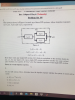
A system is formed by cascading two systems as shown in the figure given below. Given...
5. A system is formed by cascading two systems as shown below. Given that the impu...
 5. A system is formed by cascading two systems as shown below. Given that the impu response of the systems are h,(t)3e-u(t) and h2 (t) (t). Determine: a) The impulse response of the overall system. b) Determine vo (t) if the input is vi(t) 36(t) +2u(t).
The system shown below is formed by connecting two systems in parallel. The impulse responses of...
 The system shown below is formed by connecting two systems in parallel. The impulse responses of the systems are given by: t h, (t) = € 2€ u(t) , h (t) = 2e fu(t) 1) Find the impulse response h(t) of the overall system. 2) Is the overall system stable? h,(t) x vo h(t)
Also, solve the following problem. Consider a system made by cascading two LTI systems. The first...
 Also, solve the following problem. Consider a system made by cascading two LTI systems. The first system is described by y[n] = x [n] – ax (n – 3]. The second has impulse response h (n] = {po aP [n – 3p] with ( < a < 1. Find the impulse response of the overall system.
Problem 5. (20 points) Topic: System interconnections. Given two systems with the impulse responses h:(0) =...
 Problem 5. (20 points) Topic: System interconnections. Given two systems with the impulse responses h:(0) = e (l) and hz(t) = u(t) - ufl-1) (rectangular pulse of duration 1). Find the impulse response h(t) of a new system which is a series interconnection of two mentioned systems. Present mathematical and graphical solution Total 100 points (1) =
LTI Systems. Consider two LTI subsystems that are connected in series
(a) LTI Systems. Consider two LTI subsystems that are connected in series, where system Tl has step response s1(t)=u(t-1)-u(t-5) and system T2 has impulse response h2t = e-3tu(t). Find the overall impulse response h(t). Hint: you will need to find h1(t) first (b)Fourier Series. The input signal r(t) and impulse response h(t) of an LTI system are as follows:x(t) = sin(2t)cos(t)-ej3t +2 and h(t) = sin(2t)/t Use the Fourier Series method to find the output y(t) (c)Parseval's Identity and Theorem. Consider the system in the...
ages/Microsoft.Microsoft Edge_8wekyb3d8bbwe/TempState/Downloads/BEE%20235-HW_4.pdf DEL LJJ LOLLILTUVUS HIC LICA JYSICS Due: 3:00pm of May 6 (Wednesday) Problem Set...
 ages/Microsoft.Microsoft Edge_8wekyb3d8bbwe/TempState/Downloads/BEE%20235-HW_4.pdf DEL LJJ LOLLILTUVUS HIC LICA JYSICS Due: 3:00pm of May 6 (Wednesday) Problem Set #4 The system shown in Figure 4 is made up of three LTI systems, whose impulse responses are hio), ha(t) and h(t), respectively. h(t) halt) re hi(t) y(t) h(t) Figure 4 hi(t) = (t - 2) ha(t) = u(t-1) - ult-2) ha(t) = u(t) - ult-3) Does there exist any single LTI system h(t) which is equivalent to the system shown in (a), i.e.,...
h(t) h(1) + ht) Figure Q2 (a) Q2 (a) Consider the system shown in Figure Q2...
 h(t) h(1) + ht) Figure Q2 (a) Q2 (a) Consider the system shown in Figure Q2 (a). Find the overall impulse response of the system, h(t) with impulse responses given below. h(t) = 3e-Stu(t) hy(t) = et u(t) hg(t) = 2t u(t) (5 marks) (b) Determine whether the system, h(t) obtained in Q2 (a) is: (1) Stable (3 marks) (ii) Causal (2 marks) Q3. (a) Explain the Gibbs phenomenon. (3 marks) (b) Given a signal 3 x(t) = x+7cos (41t+...
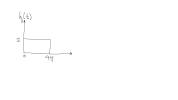
Given to the system with the impulse responses h1(t) and the h2 (t) cos π t,...
 Given to the system with the impulse
responses h1(t) and the h2 (t) cos π t, 0
< t < ∞
Find the impulse response h(t) of a
new system which is a series interconnection of two mentioned
system using the convolutional integral. Present mathematical and
graphical solution.
Given to the system with the impulse
responses h1(t) and the h2 (t) cos π t, 0
< t < ∞
Find the impulse response h(t) of a
new system which is a series interconnection of two mentioned
system using the convolutional integral. Present mathematical and
graphical solution.
2. For the linear time-invariant systems with impulse responses given below, determin if the system is...
 2. For the linear time-invariant systems with impulse responses given below, determin if the system is BIBO stable or BIBO unstable. (a) h)--21-3)lu)-u(t-5)] (b) h(t)--for t > 2 and h(t) = 0 for t < 2 (c) h(t)-cos tu(t) (d) h(t) coste 'u(t) t -1
Create chart or table Consider the system with the impulse response ht)e u(t), as shown in Figure...
 Create chart or table Consider the system with the impulse response ht)e u(t), as shown in Figure 3.2(a). This system's response to an input of x(t) 1) would be y(t) h(r ult 1). as shown in Figure 3.2(b). If the input signal is a sum of weighted, time-shifted impulses as described by (3.10), separated in time by Δ = 0.1 (s) so that xt)01-0.1k), as shown in Figure 3.2(c), then, according to (3.11), the output is This output signal is...
 5. A system is formed by cascading two systems as shown below. Given that the impu response of the systems are h,(t)3e-u(t) and h2 (t) (t). Determine: a) The impulse response of the overall system. b) Determine vo (t) if the input is vi(t) 36(t) +2u(t).
 The system shown below is formed by connecting two systems in parallel. The impulse responses of the systems are given by: t h, (t) = € 2€ u(t) , h (t) = 2e fu(t) 1) Find the impulse response h(t) of the overall system. 2) Is the overall system stable? h,(t) x vo h(t)
 Also, solve the following problem. Consider a system made by cascading two LTI systems. The first system is described by y[n] = x [n] – ax (n – 3]. The second has impulse response h (n] = {po aP [n – 3p] with ( < a < 1. Find the impulse response of the overall system.
 Problem 5. (20 points) Topic: System interconnections. Given two systems with the impulse responses h:(0) = e (l) and hz(t) = u(t) - ufl-1) (rectangular pulse of duration 1). Find the impulse response h(t) of a new system which is a series interconnection of two mentioned systems. Present mathematical and graphical solution Total 100 points (1) =
 ages/Microsoft.Microsoft Edge_8wekyb3d8bbwe/TempState/Downloads/BEE%20235-HW_4.pdf DEL LJJ LOLLILTUVUS HIC LICA JYSICS Due: 3:00pm of May 6 (Wednesday) Problem Set #4 The system shown in Figure 4 is made up of three LTI systems, whose impulse responses are hio), ha(t) and h(t), respectively. h(t) halt) re hi(t) y(t) h(t) Figure 4 hi(t) = (t - 2) ha(t) = u(t-1) - ult-2) ha(t) = u(t) - ult-3) Does there exist any single LTI system h(t) which is equivalent to the system shown in (a), i.e.,...
 h(t) h(1) + ht) Figure Q2 (a) Q2 (a) Consider the system shown in Figure Q2 (a). Find the overall impulse response of the system, h(t) with impulse responses given below. h(t) = 3e-Stu(t) hy(t) = et u(t) hg(t) = 2t u(t) (5 marks) (b) Determine whether the system, h(t) obtained in Q2 (a) is: (1) Stable (3 marks) (ii) Causal (2 marks) Q3. (a) Explain the Gibbs phenomenon. (3 marks) (b) Given a signal 3 x(t) = x+7cos (41t+...
 Given to the system with the impulse
responses h1(t) and the h2 (t) cos π t, 0
< t < ∞
Find the impulse response h(t) of a
new system which is a series interconnection of two mentioned
system using the convolutional integral. Present mathematical and
graphical solution.
Given to the system with the impulse
responses h1(t) and the h2 (t) cos π t, 0
< t < ∞
Find the impulse response h(t) of a
new system which is a series interconnection of two mentioned
system using the convolutional integral. Present mathematical and
graphical solution.
 2. For the linear time-invariant systems with impulse responses given below, determin if the system is BIBO stable or BIBO unstable. (a) h)--21-3)lu)-u(t-5)] (b) h(t)--for t > 2 and h(t) = 0 for t < 2 (c) h(t)-cos tu(t) (d) h(t) coste 'u(t) t -1
 Create chart or table Consider the system with the impulse response ht)e u(t), as shown in Figure 3.2(a). This system's response to an input of x(t) 1) would be y(t) h(r ult 1). as shown in Figure 3.2(b). If the input signal is a sum of weighted, time-shifted impulses as described by (3.10), separated in time by Δ = 0.1 (s) so that xt)01-0.1k), as shown in Figure 3.2(c), then, according to (3.11), the output is This output signal is...
Most questions answered within 3 hours.
-
Where is the error in this code sequence?
String s1 = "Hello";
String s2 = "ello";...
asked 10 months ago -
Financial data for Joel de Paris, Inc., for last year
follow:
Joel de Paris, Inc.
Balance...
asked 10 months ago -
Consider this reaction:
Al2(SO4)3 (aq)+ BaCl3
(aq) Al2Cl6 (aq)- +
3BaSO4(s) . What is the...
asked 10 months ago -
Suppose that Savneet is considering increasing her
recent random sample from 20 car rentals to 40...
asked 10 months ago -
Trucks arrive at an unloading terminal at an average rate of 120
per hour.
Trucks arrive...
asked 10 months ago -
Why are methanol and ethanol completely soluble in water while
octanol is not very little soluble....
asked 10 months ago -
A facilities manager at a university reads in a research report
that the mean amount of...
asked 10 months ago -
When the CuSO4 is rehydrated by adding water to the anhydrous
compound, is this an endothermic...
asked 10 months ago -
A ray of sunlight is passing from diamond into crown glass; the
angle of incidence is...
asked 10 months ago -
A block of mass 0.249 kg is placed on top of a light, vertical
spring of...
asked 10 months ago -
how do the kidneys compensate in the presences of acidosis
a) trigger hyperventilate
b) reserve acid...
asked 10 months ago -
Question 501 pts
The rental rate of capital to the firm increases. Which of the
following...
asked 10 months ago