
Homework Answers
Add Answer to:
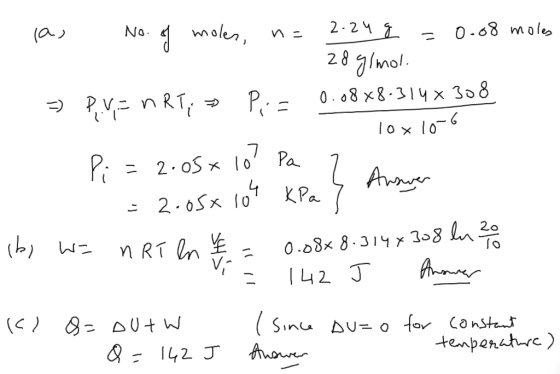
7. At constant temperature (308.0K), a 2.24g sample of pure N2 gas expands from 10.0cm to...
An ideal monatomic gas expands isothermally from 0.540 m3 to 1.25 m3 at a constant temperature...
An ideal monatomic gas expands isothermally from 0.540 m3 to 1.25 m3 at a constant temperature of 570 K. If the initial pressure is 1.20 ✕ 105 Pa find the following. (a) the work done on the gas J (b) the thermal energy transfer Q J (c) the change in the internal energy J
An isolated gas (nitrogen, N2), at initial temperature of 22.7 degrees Celsius, is expanded from as...
An isolated gas (nitrogen, N2), at initial temperature of 22.7 degrees Celsius, is expanded from as initial volume of 0.750L to 1.450L at constant pressure, P=132kPa. During this process the gas absorbs 318.5J of heat. i. Calculate the work output by the system during this expansion ii. Estimate the specific heat capacity of the gas for this process. Express your answer in J/kg*K.
An ideal monatomic gas expands isothermally from 0.520 m3 to 1.25 m3 at a constant temperature of 690 K. If the initial...
An ideal monatomic gas expands isothermally from 0.520 m3 to 1.25 m3 at a constant temperature of 690 K. If the initial pressure is 1.30 ✕ 105 Pa find the following. (a) the work done on the gas J (b) the thermal energy transfer Q J (c) the change in the internal energy J
(1) An ideal monatomic gas expands isothermally from 0.600 m3 to 1.25 m3 at a constant...
(1) An ideal monatomic gas expands isothermally from 0.600 m3 to 1.25 m3 at a constant temperature of 640 K. If the initial pressure is 1.01 ✕ 105 Pa find the following. (a) the work done on the gas J (b) the thermal energy transfer Q J (c) the change in the internal energy J (2) Gas in a container is at a pressure of 1.2 atm and a volume of 5.0 m3. (a) What is the work done on...
A sample of nitrogen gas expands in volume from 1.4 to 6.2 L at constant temperature....
 A sample of nitrogen gas expands in volume from 1.4 to 6.2 L at constant temperature. Calculate the work done in joules if the gas expands (a) against a vacuum: (b) against a constant pressure of 0.64 atm: 10 Enter your answer in scientific notation. (c) against a constant pressure of 4.3 atm: Enter your answer in scientific notation.
A 0.450-mol sample of an ideal diatomic gas at 372 kPa and 312 K expands quasi-statically
A 0.450-mol sample of an ideal diatomic gas at 372 kPa and 312 K expands quasi-statically until the pressure decreases to 147 kPa. Find the final temperature and volume of the gas, the work done by the gas, and the heat absorbed by the gas if the expansion is the following. (a) Isothermal final temperature _______ volume of the gas _______ work done by the gas _______ heat absorbed _______ (b) adiabatic final temperature _______ volume of the gas _______ work done by the gas _______ heat absorbed _______
7) A 1.20 mole sample of an ideal gas at 28.0°C expands isothermally from an initial...
 7) A 1.20 mole sample of an ideal gas at 28.0°C expands isothermally from an initial volume of 24 dm to a final volume of 75 dm3. Calculate w for the following processes: (a) an expansion against an external pressure of 0.5x 10⁵ Pa (b) a reversible expansion. Please give these quantities in joules. This may involve unit conversion(s).
With the pressure held constant at 230 kPa, 44 mol of a monatomic ideal gas expands from an initial volume of 0.80 m3 to a final volume of 1.9 m3. Review PartA With the pressure held constant at 230 k...
 With the pressure held constant at 230 kPa, 44 mol of a
monatomic ideal gas expands from an initial volume of 0.80 m3 to a
final volume of 1.9 m3.
Review PartA With the pressure held constant at 230 kPa, 44 mol of a monatomic ideal gas expands from an initial volume of 0.80 m3 to a final volume of 1.9 m3 How much work was done by the gas during the expansion? Express your answer using two significant figures....
With the pressure held constant at 230 kPa, 44 mol of a
monatomic ideal gas expands from an initial volume of 0.80 m3 to a
final volume of 1.9 m3.
Review PartA With the pressure held constant at 230 kPa, 44 mol of a monatomic ideal gas expands from an initial volume of 0.80 m3 to a final volume of 1.9 m3 How much work was done by the gas during the expansion? Express your answer using two significant figures....
Constant Pressure Process Oxygen (molar mass 32 kg/kmol) expands reversibly in a cylinder behind a piston...
 Constant Pressure Process Oxygen (molar mass 32 kg/kmol) expands reversibly in a cylinder behind a piston at a constant pressure of 3 bar. The volume initially is o.o1 m2 and finally is o.o3 m3, the initial temperature is 17 C. Calculate the work output and the heat supplied during the expansion. Assume Oxygen to be a perfect gas and take Cp o.g17 kJ/kgK. 2.
A sample of 1.00 mol of N2 gas is expanded adiabatically from a volume of 10.00...
A sample of 1.00 mol of N2 gas is expanded adiabatically from a volume of 10.00 dm3 and a temperature of 400 K to a volume of 20.00 - 3 -dm3. Assume that nitrogen is ideal, with Cv,m = 5R/2. (i) Find the final temperature if the expansion is carried out reversibly. (ii) Calculate the final temperature if the expansion is carried out with a constant external pressure of 1.00 atm. (iii) Find the final temperature if the gas expands...
 A sample of nitrogen gas expands in volume from 1.4 to 6.2 L at constant temperature. Calculate the work done in joules if the gas expands (a) against a vacuum: (b) against a constant pressure of 0.64 atm: 10 Enter your answer in scientific notation. (c) against a constant pressure of 4.3 atm: Enter your answer in scientific notation.
 7) A 1.20 mole sample of an ideal gas at 28.0°C expands isothermally from an initial volume of 24 dm to a final volume of 75 dm3. Calculate w for the following processes: (a) an expansion against an external pressure of 0.5x 10⁵ Pa (b) a reversible expansion. Please give these quantities in joules. This may involve unit conversion(s).
 With the pressure held constant at 230 kPa, 44 mol of a
monatomic ideal gas expands from an initial volume of 0.80 m3 to a
final volume of 1.9 m3.
Review PartA With the pressure held constant at 230 kPa, 44 mol of a monatomic ideal gas expands from an initial volume of 0.80 m3 to a final volume of 1.9 m3 How much work was done by the gas during the expansion? Express your answer using two significant figures....
With the pressure held constant at 230 kPa, 44 mol of a
monatomic ideal gas expands from an initial volume of 0.80 m3 to a
final volume of 1.9 m3.
Review PartA With the pressure held constant at 230 kPa, 44 mol of a monatomic ideal gas expands from an initial volume of 0.80 m3 to a final volume of 1.9 m3 How much work was done by the gas during the expansion? Express your answer using two significant figures....
 Constant Pressure Process Oxygen (molar mass 32 kg/kmol) expands reversibly in a cylinder behind a piston at a constant pressure of 3 bar. The volume initially is o.o1 m2 and finally is o.o3 m3, the initial temperature is 17 C. Calculate the work output and the heat supplied during the expansion. Assume Oxygen to be a perfect gas and take Cp o.g17 kJ/kgK. 2.
Most questions answered within 3 hours.
-
Where is the error in this code sequence?
String s1 = "Hello";
String s2 = "ello";...
asked 10 months ago -
Financial data for Joel de Paris, Inc., for last year
follow:
Joel de Paris, Inc.
Balance...
asked 10 months ago -
Consider this reaction:
Al2(SO4)3 (aq)+ BaCl3
(aq) Al2Cl6 (aq)- +
3BaSO4(s) . What is the...
asked 10 months ago -
Suppose that Savneet is considering increasing her
recent random sample from 20 car rentals to 40...
asked 10 months ago -
Trucks arrive at an unloading terminal at an average rate of 120
per hour.
Trucks arrive...
asked 10 months ago -
Why are methanol and ethanol completely soluble in water while
octanol is not very little soluble....
asked 10 months ago -
A facilities manager at a university reads in a research report
that the mean amount of...
asked 10 months ago -
When the CuSO4 is rehydrated by adding water to the anhydrous
compound, is this an endothermic...
asked 10 months ago -
A ray of sunlight is passing from diamond into crown glass; the
angle of incidence is...
asked 10 months ago -
A block of mass 0.249 kg is placed on top of a light, vertical
spring of...
asked 10 months ago -
how do the kidneys compensate in the presences of acidosis
a) trigger hyperventilate
b) reserve acid...
asked 10 months ago -
Question 501 pts
The rental rate of capital to the firm increases. Which of the
following...
asked 10 months ago