You mix a 140.0 −mL sample of a solution that is 0.0146 M in NiCl2 with...
|
You mix a 140.0 −mL sample of a solution that is 0.0146 M in NiCl2 with a 175.0 −mL sample of a solution that is 0.250 M in NH3. |
Part A After the solution reaches equilibrium, what concentration of Ni2+(aq) remains? The value of Kf for Ni(NH3)62+ is 2.0×10^8 Express the concentration to two significant figures and include the appropriate units. |
Homework Answers
Request Answer!
We need at least 10 more requests to produce the answer.
0 / 10 have requested this problem solution
The more requests, the faster the answer.
Add Answer to:
You mix a 140.0 −mL sample of a solution that is 0.0146 M in
NiCl2 with...
You mix a 105.0 −mL sample of a solution that is 0.0130 M in NiCl2 with...
You mix a 105.0 −mL sample of a solution that is 0.0130 M in NiCl2 with a 185.0 −mL sample of a solution that is 0.300 M in NH3. After the solution reaches equilibrium, what concentration of Ni2+(aq) remains? The value of Kf for Ni(NH3)62+ is 2.0×10⁸.
You mix a 110.0 −mL sample of a solution that is 0.0142 M in NiCl2 with...
You mix a 110.0 −mL sample of a solution that is 0.0142 M in NiCl2 with a 180.0 −mL sample of a solution that is 0.500 M in NH3. After the solution reaches equilibrium, what concentration of Ni2+(aq) remains? The value of Kf for Ni(NH3)62+ is 2.0×10⁸.
1. You mix a 115.0 −mL sample of a solution that is 0.0133 M in NiCl2...
1. You mix a 115.0 −mL sample of a solution that is 0.0133 M in NiCl2 with a 200.0 −mL sample of a solution that is 0.350 M in NH3. After the solution reaches equilibrium, what concentration of Ni2+(aq) remains? The value of Kf for Ni(NH3)62+is 2.0×10⁸.
You mix a 120.0 −mL − m L sample of a solution that is 0.0123 M...
You mix a 120.0 −mL − m L sample of a solution that is 0.0123 M M in NiCl2 N i C l 2 with a 185.0 −mL − m L sample of a solution that is 0.300 M M in NH3 N H 3 . After the solution reaches equilibrium, what concentration of Ni2+(aq)Ni2+(aq) remains? The value of KfKf for Ni(NH3)62+Ni(NH3)62+ is 2.0×1082.0×108.
Review Constants Periodic Table You mix a 120.0-ml sample of a solution that is 0.0134 M...
 Review Constants Periodic Table You mix a 120.0-ml sample of a solution that is 0.0134 M in NiCl, with a 195.0-ml sample of a solution that is 0.500 Min NH You may want to reference Pages 778 - 783) Section 17.7 while completing this problem Part A After the solution reaches equilibrium, what concentration of Ni2+ (aq) remains? The value of K for Ni(NH4)2 | 2.0 x 10*. Express the concentration to two significant figures and include the appropriate units....
2. You mix a 105.0 mL sample of a solution that is 0.0114 M in Ni(NO3)2...
 2. You mix a 105.0 mL sample of a solution that is 0.0114 M in Ni(NO3)2 with a 190.0 mL sample of a solution that is 0.300 M in NH3. After the solution reaches equilibrium, what concentration of Ni2+ remains? The value of Kr for [Ni(NH3)6]2+ is 2.0x10⁸.
Part A A 110.0-mL sample of a solution that is 2.7 x 10- M in AgNO,...
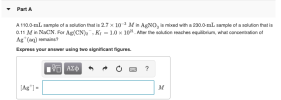 Part A A 110.0-mL sample of a solution that is 2.7 x 10- M in AgNO, is mixed with a 230.0-mL sample of a solution that is 0.11 M in NaCN. For Ag(CN)2,Kf = 1.0 x 10²¹ After the solution reaches equilibrium, what concentration of Ag+ (aq) remains? Express your answer using two significant figures. IVO ACV O O ? [Ag +) =
A 130.0 −mL sample of a solution that is 2.7×10⁻³M in AgNO3 is mixed with a...
A 130.0 −mL sample of a solution that is 2.7×10⁻³M in AgNO3 is mixed with a 220.0 −mL sample of a solution that is 0.11 M in NaCN. After the solution reaches equilibrium, what concentration of Ag+(aq) remains? The Kf value of Ag(CN)2− is 1×10²¹. Express your answer using two significant figures.
you mix a 200.0 ml sample of a solution that is 1.5x10^-3 M in Cu(NO3)2 with...
you mix a 200.0 ml sample of a solution that is 1.5x10^-3 M in Cu(NO3)2 with a 250.0 ml sample of a solution that is .20 M in NH3. After the solution reaches equilibrium, what concentration of cu2+ remains?
From the value of Kf listed in Table 17.1, calculate the concentration of Ni2+(aq) and Ni(NH3)62+...
From the value of Kf listed in Table 17.1, calculate the concentration of Ni2+(aq) and Ni(NH3)62+ that are present at equilibrium after dissolving 1.25 g NiCl2 in 100.0 mL of 0.20 M NH3(aq). Kf Ni(NH3)6 = 1.2x10^9
 Review Constants Periodic Table You mix a 120.0-ml sample of a solution that is 0.0134 M in NiCl, with a 195.0-ml sample of a solution that is 0.500 Min NH You may want to reference Pages 778 - 783) Section 17.7 while completing this problem Part A After the solution reaches equilibrium, what concentration of Ni2+ (aq) remains? The value of K for Ni(NH4)2 | 2.0 x 10*. Express the concentration to two significant figures and include the appropriate units....
 2. You mix a 105.0 mL sample of a solution that is 0.0114 M in Ni(NO3)2 with a 190.0 mL sample of a solution that is 0.300 M in NH3. After the solution reaches equilibrium, what concentration of Ni2+ remains? The value of Kr for [Ni(NH3)6]2+ is 2.0x10⁸.
 Part A A 110.0-mL sample of a solution that is 2.7 x 10- M in AgNO, is mixed with a 230.0-mL sample of a solution that is 0.11 M in NaCN. For Ag(CN)2,Kf = 1.0 x 10²¹ After the solution reaches equilibrium, what concentration of Ag+ (aq) remains? Express your answer using two significant figures. IVO ACV O O ? [Ag +) =
Most questions answered within 3 hours.
-
Where is the error in this code sequence?
String s1 = "Hello";
String s2 = "ello";...
asked 11 months ago -
Financial data for Joel de Paris, Inc., for last year
follow:
Joel de Paris, Inc.
Balance...
asked 11 months ago -
Consider this reaction:
Al2(SO4)3 (aq)+ BaCl3
(aq) Al2Cl6 (aq)- +
3BaSO4(s) . What is the...
asked 11 months ago -
Suppose that Savneet is considering increasing her
recent random sample from 20 car rentals to 40...
asked 11 months ago -
Trucks arrive at an unloading terminal at an average rate of 120
per hour.
Trucks arrive...
asked 11 months ago -
Why are methanol and ethanol completely soluble in water while
octanol is not very little soluble....
asked 11 months ago -
A facilities manager at a university reads in a research report
that the mean amount of...
asked 11 months ago -
When the CuSO4 is rehydrated by adding water to the anhydrous
compound, is this an endothermic...
asked 11 months ago -
A ray of sunlight is passing from diamond into crown glass; the
angle of incidence is...
asked 11 months ago -
A block of mass 0.249 kg is placed on top of a light, vertical
spring of...
asked 11 months ago -
how do the kidneys compensate in the presences of acidosis
a) trigger hyperventilate
b) reserve acid...
asked 11 months ago -
Question 501 pts
The rental rate of capital to the firm increases. Which of the
following...
asked 11 months ago