
Homework Answers
Add Answer to:
Given the discrete uniform population 32 f(x) = x = 2, 4, 6, 10, elsewhere, find...
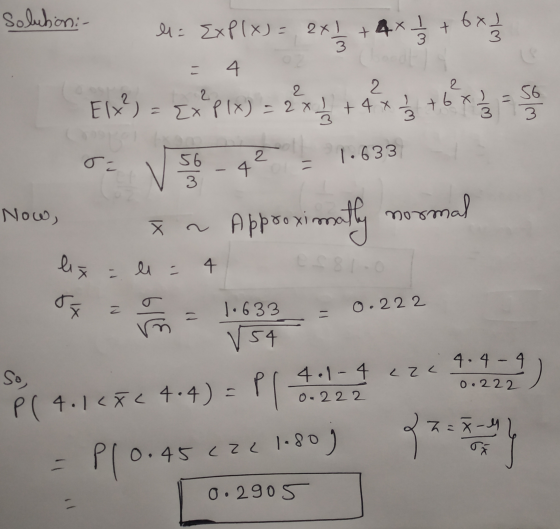
3 19. Given discrete uniform population f(x)= x-2,4,6 o otherwise Find probability thata random sample af...
 3 19. Given discrete uniform population f(x)= x-2,4,6 o otherwise Find probability thata random sample af 54 is selected with replacement will produce a sample mean greater than 4.1 but less than Assume means are measured to nearest 10th value
8.4.20 Given the discrete uniform population shown to the right find the probability that a random sample of size 9...
 8.4.20 Given the discrete uniform population shown to the right find the probability that a random sample of size 96, selected with replacement, will yield a sample mean greater than 9.2 but less than 9.9. Assume the means are measured to the nearest tenth. x 1, 9, 17 f(x)= 3 0, elsewhere Click here to view page 1 of the standard normal distribution table Click here to view page 2 of the standard normal distribution table The probability is (Round...
Given the discrete uniform population with parameter N = 8, find the probability that a random...
Given the discrete uniform population with parameter N = 8, find the probability that a random sample of size 36, selected with replacement, will produce a sample mean greater than 5. Answer using 4 decimals.
Given the discrete uniform population with parameter N = 8, find the probability that a random...
Given the discrete uniform population with parameter N = 8, find the probability that a random sample of size 36, selected with replacement, will produce a sample mean greater than 5. Write the answer with 4 decimals.
Assume that the probability mass function of X is given by P(X = 1) = P(X...
Assume that the probability mass function of X is given by P(X = 1) = P(X = 2) = P(X = 3) = 1/3 A random sample of n = 36 is selected from this population. Find the probability that the sample mean is greater than 2.1 but less than 2.5, assuming that the sample mean would be measured to the nearest tenth.
Suppose that the random variable X has the discrete uniform distribution f(x) = { 1/4, r=...
 Suppose that the random variable X has the discrete uniform distribution f(x) = { 1/4, r= 5, 6, 7, 8. 0, otherwise. A random sample of n = 45 is selected from this distribution. Find the probability that the sample mean is greater than 6.7. Round your answer to two decimal places (e.g. 98.76). P= the absolute tolerance is +/-0.01
1. Given the probability distribution shown for an infinite population with the discrete random variable, x:...
1. Given the probability distribution shown for an infinite population with the discrete random variable, x: X: 0 1 2 3 P(X) .2 .05 .3 .45 a. Determine the mean and standard deviation of x. b. For the sample size, n=2, determine the mean for each possible simple random sample from this population. c. For each simple random sample identified in part b, what is the probability that this particular sample will be selected? d. Combining the results of parts...
1. A population is known to have a mean of 10 and a standard deviation of 1.1....
1. A population is known to have a mean of 10 and a standard deviation of 1.1. A sample of size 32 is randomly selected from the population. a. What is the probability that the sample mean is less than 9.9? b. What percent of the population is greater than 10.2? c. What’s the probability that the sample mean is greater than 10.5?
A population consists of the following five values: 6, 6, 24, 31, 32. a. Not available...
A population consists of the following five values: 6, 6, 24, 31, 32. a. Not available in Connect. b. By listing all samples of size 3, compute the mean of the distribution of the sample mean and the population mean. Compare the two values. (Round the final answer to the nearest whole number.) Sample means Population mean Both means are (Click to select) equal not equal c. Compare the dispersion in the population with that of the sample means. Hint:...
A normally distributed population has a mean of 600 and a standard deviation of 60. a....
 A normally distributed population has a mean of 600 and a standard deviation of 60. a. Determine the probability that a random sample of size 25 selected from this population will have a sample mean less than 579. b. Determine the probability that a random sample of size 16 selected from the population will have a sample mean greater than or equal to 636.
 3 19. Given discrete uniform population f(x)= x-2,4,6 o otherwise Find probability thata random sample af 54 is selected with replacement will produce a sample mean greater than 4.1 but less than Assume means are measured to nearest 10th value
 8.4.20 Given the discrete uniform population shown to the right find the probability that a random sample of size 96, selected with replacement, will yield a sample mean greater than 9.2 but less than 9.9. Assume the means are measured to the nearest tenth. x 1, 9, 17 f(x)= 3 0, elsewhere Click here to view page 1 of the standard normal distribution table Click here to view page 2 of the standard normal distribution table The probability is (Round...
 Suppose that the random variable X has the discrete uniform distribution f(x) = { 1/4, r= 5, 6, 7, 8. 0, otherwise. A random sample of n = 45 is selected from this distribution. Find the probability that the sample mean is greater than 6.7. Round your answer to two decimal places (e.g. 98.76). P= the absolute tolerance is +/-0.01
 A normally distributed population has a mean of 600 and a standard deviation of 60. a. Determine the probability that a random sample of size 25 selected from this population will have a sample mean less than 579. b. Determine the probability that a random sample of size 16 selected from the population will have a sample mean greater than or equal to 636.
Most questions answered within 3 hours.
-
Where is the error in this code sequence?
String s1 = "Hello";
String s2 = "ello";...
asked 10 months ago -
Financial data for Joel de Paris, Inc., for last year
follow:
Joel de Paris, Inc.
Balance...
asked 10 months ago -
Consider this reaction:
Al2(SO4)3 (aq)+ BaCl3
(aq) Al2Cl6 (aq)- +
3BaSO4(s) . What is the...
asked 10 months ago -
Suppose that Savneet is considering increasing her
recent random sample from 20 car rentals to 40...
asked 10 months ago -
Trucks arrive at an unloading terminal at an average rate of 120
per hour.
Trucks arrive...
asked 10 months ago -
Why are methanol and ethanol completely soluble in water while
octanol is not very little soluble....
asked 10 months ago -
A facilities manager at a university reads in a research report
that the mean amount of...
asked 10 months ago -
When the CuSO4 is rehydrated by adding water to the anhydrous
compound, is this an endothermic...
asked 10 months ago -
A ray of sunlight is passing from diamond into crown glass; the
angle of incidence is...
asked 10 months ago -
A block of mass 0.249 kg is placed on top of a light, vertical
spring of...
asked 10 months ago -
how do the kidneys compensate in the presences of acidosis
a) trigger hyperventilate
b) reserve acid...
asked 10 months ago -
Question 501 pts
The rental rate of capital to the firm increases. Which of the
following...
asked 10 months ago