 please show processes
Homework Answers

Add Answer to:
please show processes
Problem. In an oscmaung mass - spring system, the object's mass is 3.0...
PHY152 Problem Assignment #1 SHOW YOUR WORK 1. A3 kg object attached to a spring oscillates...
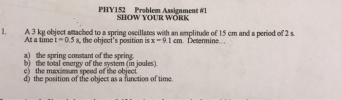 PHY152 Problem Assignment #1 SHOW YOUR WORK 1. A3 kg object attached to a spring oscillates with an amplitude of 15 cm and a period of 2s. At a time t0.5 s, the object's position is x - 9.1 cm. Determine... a) the spring constant of the spring b) the total energy of the system (in joules). maximum speed of the object d) the position of the object as a function of time.
A 0.40-kg mass is attached to a spring with a force constant of k = 207...
 A 0.40-kg mass is attached to a spring with
a force constant of k = 207 N/m, and the mass–spring
system is set into oscillation with an amplitude of A =
2.0 cm. Determine the following.
(a) mechanical energy of the system
_____ J
(b) maximum speed of the oscillating mass
_____ m/s
(c) magnitude of the maximum acceleration of the oscillating
mass
_____ m/s2
A 0.40-kg mass is attached to a spring with a force constant of k =...
A 0.40-kg mass is attached to a spring with
a force constant of k = 207 N/m, and the mass–spring
system is set into oscillation with an amplitude of A =
2.0 cm. Determine the following.
(a) mechanical energy of the system
_____ J
(b) maximum speed of the oscillating mass
_____ m/s
(c) magnitude of the maximum acceleration of the oscillating
mass
_____ m/s2
A 0.40-kg mass is attached to a spring with a force constant of k =...
A mass-spring system oscillates with an amplitude of 3.50 cm. If the spring constant is 263...
A mass-spring system oscillates with an amplitude of 3.50 cm. If the spring constant is 263 N/m and the mass is 406 g, determine the mechanical energy of the system. Determine the maximum speed of the object. Determine the maximum acceleration.
Help with these 2 questions An object of mass 0.67 kg is attached to a spring...
 Help with these 2 questions
An object of mass 0.67 kg is attached to a spring with spring onstant 15 N/m. If the object is pulled 14 cm from the equilibrium position and released. What is the maximum speed of the object? The displacement of an object is given by y (4.7 cm) sin 20T. What are the object's (a) amplitude, (b) frequency, and (o) period of oscillation?
Help with these 2 questions
An object of mass 0.67 kg is attached to a spring with spring onstant 15 N/m. If the object is pulled 14 cm from the equilibrium position and released. What is the maximum speed of the object? The displacement of an object is given by y (4.7 cm) sin 20T. What are the object's (a) amplitude, (b) frequency, and (o) period of oscillation?
A.) A mass-spring system oscillates with an amplitude of 4.80 cm. If the spring constant is...
A.) A mass-spring system oscillates with an amplitude of 4.80 cm. If the spring constant is 269 N/m and the mass is 534 g, determine the mechanical energy of the system. B.) Determine the maximum speed of the object. C.)Determine the maximum acceleration .
2) An 0.80-kg object is attached to one end of a spring and the system is...
 2) An 0.80-kg object is attached to one end of a spring and the system is set into simple harmonic motion. The displacement x of the object as a function of time is shown in the drawing. With the aid of these data, determine (a) the amplitude A of the motion, (b) the angular frequency o , (c) the spring constant k, (d) the speed of the object at t = 1.0 s, and (e) the magnitude of the object's...
A 20 g mass-spring system is suspended vertically. If 20 g is added, it stretches 5...
 A 20 g mass-spring system is suspended vertically. If 20 g is
added, it stretches 5 cm. (Assume the mass of the spring is
negligible)
A) The spring constant is
________ N/m.
From equilibrium position give mass-spring a speed of
1.2 m/s.
B1) Period of oscillation is ______ s
B2) Maximum speed of the the spring-mass system is _______
m/s.
B3) The equation of motion of the oscillating spring is
_______.
B4) The maximum kinetic energy of the spring is...
A 20 g mass-spring system is suspended vertically. If 20 g is
added, it stretches 5 cm. (Assume the mass of the spring is
negligible)
A) The spring constant is
________ N/m.
From equilibrium position give mass-spring a speed of
1.2 m/s.
B1) Period of oscillation is ______ s
B2) Maximum speed of the the spring-mass system is _______
m/s.
B3) The equation of motion of the oscillating spring is
_______.
B4) The maximum kinetic energy of the spring is...
Problem #1: 10 points A spring having a spring constant k is placed on a smooth...
 Problem #1: 10 points A spring having a spring constant k is placed on a smooth horizontal table and the left end is fixed. A mass of 200 g is attached to the other end of the spring. The mass is pushed 10.0 cm (to the left) against the spring, then released. A student with a stopwatch finds that 10 oscillations take 12.0 s. Draw a neat diagram showing the spring, mass, amplitude, equilibrium position, and both ends of the...
5. A mass-spring system oscillates with an amplitude of 3.5 cm. If the spring constant is...
 5. A mass-spring system oscillates with an amplitude of 3.5 cm. If the spring constant is 250 N/m and the mass is 0.50 kg, a) Write an equation for the position, velocity, and acceleration for the mass as a function of time b) find the maximum speed of the mass, and the maximum acceleration of the mass. c) Sketch a plot of the position of the mass vs time by labelling the values for amplitude and period.
A mass-spring system oscillates with an amplitude of 3.60 cm. If the spring constant is 276...
A mass-spring system oscillates with an amplitude of 3.60 cm. If the spring constant is 276 N/m and the mass is 499 g, determine the mechanical energy of the system. Tries 0/20 Determine the maximum speed of the object. Tries 0/20 Determine the maximum acceleration. Tries 0/20
 PHY152 Problem Assignment #1 SHOW YOUR WORK 1. A3 kg object attached to a spring oscillates with an amplitude of 15 cm and a period of 2s. At a time t0.5 s, the object's position is x - 9.1 cm. Determine... a) the spring constant of the spring b) the total energy of the system (in joules). maximum speed of the object d) the position of the object as a function of time.
 A 0.40-kg mass is attached to a spring with
a force constant of k = 207 N/m, and the mass–spring
system is set into oscillation with an amplitude of A =
2.0 cm. Determine the following.
(a) mechanical energy of the system
_____ J
(b) maximum speed of the oscillating mass
_____ m/s
(c) magnitude of the maximum acceleration of the oscillating
mass
_____ m/s2
A 0.40-kg mass is attached to a spring with a force constant of k =...
A 0.40-kg mass is attached to a spring with
a force constant of k = 207 N/m, and the mass–spring
system is set into oscillation with an amplitude of A =
2.0 cm. Determine the following.
(a) mechanical energy of the system
_____ J
(b) maximum speed of the oscillating mass
_____ m/s
(c) magnitude of the maximum acceleration of the oscillating
mass
_____ m/s2
A 0.40-kg mass is attached to a spring with a force constant of k =...
 Help with these 2 questions
An object of mass 0.67 kg is attached to a spring with spring onstant 15 N/m. If the object is pulled 14 cm from the equilibrium position and released. What is the maximum speed of the object? The displacement of an object is given by y (4.7 cm) sin 20T. What are the object's (a) amplitude, (b) frequency, and (o) period of oscillation?
Help with these 2 questions
An object of mass 0.67 kg is attached to a spring with spring onstant 15 N/m. If the object is pulled 14 cm from the equilibrium position and released. What is the maximum speed of the object? The displacement of an object is given by y (4.7 cm) sin 20T. What are the object's (a) amplitude, (b) frequency, and (o) period of oscillation?
 2) An 0.80-kg object is attached to one end of a spring and the system is set into simple harmonic motion. The displacement x of the object as a function of time is shown in the drawing. With the aid of these data, determine (a) the amplitude A of the motion, (b) the angular frequency o , (c) the spring constant k, (d) the speed of the object at t = 1.0 s, and (e) the magnitude of the object's...
 A 20 g mass-spring system is suspended vertically. If 20 g is
added, it stretches 5 cm. (Assume the mass of the spring is
negligible)
A) The spring constant is
________ N/m.
From equilibrium position give mass-spring a speed of
1.2 m/s.
B1) Period of oscillation is ______ s
B2) Maximum speed of the the spring-mass system is _______
m/s.
B3) The equation of motion of the oscillating spring is
_______.
B4) The maximum kinetic energy of the spring is...
A 20 g mass-spring system is suspended vertically. If 20 g is
added, it stretches 5 cm. (Assume the mass of the spring is
negligible)
A) The spring constant is
________ N/m.
From equilibrium position give mass-spring a speed of
1.2 m/s.
B1) Period of oscillation is ______ s
B2) Maximum speed of the the spring-mass system is _______
m/s.
B3) The equation of motion of the oscillating spring is
_______.
B4) The maximum kinetic energy of the spring is...
 Problem #1: 10 points A spring having a spring constant k is placed on a smooth horizontal table and the left end is fixed. A mass of 200 g is attached to the other end of the spring. The mass is pushed 10.0 cm (to the left) against the spring, then released. A student with a stopwatch finds that 10 oscillations take 12.0 s. Draw a neat diagram showing the spring, mass, amplitude, equilibrium position, and both ends of the...
 5. A mass-spring system oscillates with an amplitude of 3.5 cm. If the spring constant is 250 N/m and the mass is 0.50 kg, a) Write an equation for the position, velocity, and acceleration for the mass as a function of time b) find the maximum speed of the mass, and the maximum acceleration of the mass. c) Sketch a plot of the position of the mass vs time by labelling the values for amplitude and period.
Most questions answered within 3 hours.
-
Where is the error in this code sequence?
String s1 = "Hello";
String s2 = "ello";...
asked 10 months ago -
Financial data for Joel de Paris, Inc., for last year
follow:
Joel de Paris, Inc.
Balance...
asked 10 months ago -
Consider this reaction:
Al2(SO4)3 (aq)+ BaCl3
(aq) Al2Cl6 (aq)- +
3BaSO4(s) . What is the...
asked 10 months ago -
Suppose that Savneet is considering increasing her
recent random sample from 20 car rentals to 40...
asked 10 months ago -
Trucks arrive at an unloading terminal at an average rate of 120
per hour.
Trucks arrive...
asked 10 months ago -
Why are methanol and ethanol completely soluble in water while
octanol is not very little soluble....
asked 10 months ago -
A facilities manager at a university reads in a research report
that the mean amount of...
asked 10 months ago -
When the CuSO4 is rehydrated by adding water to the anhydrous
compound, is this an endothermic...
asked 10 months ago -
A ray of sunlight is passing from diamond into crown glass; the
angle of incidence is...
asked 10 months ago -
A block of mass 0.249 kg is placed on top of a light, vertical
spring of...
asked 10 months ago -
how do the kidneys compensate in the presences of acidosis
a) trigger hyperventilate
b) reserve acid...
asked 10 months ago -
Question 501 pts
The rental rate of capital to the firm increases. Which of the
following...
asked 10 months ago