The bus arrives every 15 minutes starting at 8:00am and leaves
immediately. You arrive at the bus stop with a uniform distribution
between 8:05am and 8:30am and can be described as  . Given that the bus arrival
time and the time that you arrive at the bus stop are independent,
what is the PDF of your
. Given that the bus arrival
time and the time that you arrive at the bus stop are independent,
what is the PDF of your
wait time?
Homework Answers
The waiting time here ranges from 0 to 15 as we are given here that the bus arrives every 15 minutes here. From 8:05 to 8:10, the waiting time ranges from 0 to 10 minutes with a probability 10/25 = 0.4
Also from time 8:15 to 8:30, the waiting time ranges from 0 to 15, therefore, the probability of this happening is 1 - 0.4 = 0.6
Therefore the PDF for waiting time here is given as:

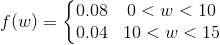
This is the required PDF for waiting time here.
Add Answer to:
The bus arrives every 15 minutes starting at 8:00am and leaves
immediately. You arrive at the...
The bus arrives every 15 minutes starting at 8:00am and leaves immediately. You arrive at the...
The bus arrives every 15 minutes starting at 8:00am and leaves immediately. You arrive at the bus stop with a uniform distribution between 8:05am and 8:30am. Given that the bus arrival time and the time that you arrive at the bus stop are independent, what is the PDF of your wait time? Graph the PDF of your wait time.
need help with C and D questions thank you 1. A bus leaves every 25 minutes....
 need help with C and D questions thank you
1. A bus leaves every 25 minutes. Let X be the number of minutes you have to wait at a bus stop, which is written as X U[0,25). (a) Using the definition formula,E[X] = **fx(r)dt, show that the mean of the length of time that you have to wait until catching a bus is 12.5. (20 pts) Note: fx(x) denotes the PDF of X. 1fx(x)dx, show that the mean (c) Using...
need help with C and D questions thank you
1. A bus leaves every 25 minutes. Let X be the number of minutes you have to wait at a bus stop, which is written as X U[0,25). (a) Using the definition formula,E[X] = **fx(r)dt, show that the mean of the length of time that you have to wait until catching a bus is 12.5. (20 pts) Note: fx(x) denotes the PDF of X. 1fx(x)dx, show that the mean (c) Using...
A city bus arrives at your bus stop every 8 minutes and follows a uniform distribution....
A city bus arrives at your bus stop every 8 minutes and follows a uniform distribution. The average wait time is 1 minute. 2 minutes. 3 minutes. 4 minutes. 5 minutes. None of the above.
A bus arrives at a stop every 15 minutes exactly, in a very consistent way, very...
A bus arrives at a stop every 15 minutes exactly, in a very consistent way, very easily drawn. A passenger is not aware of the schedule, and arrives randomly at the stop. Let X represent the number of minutes they wait for the bus to arrive. What type of random variable is X, if the passenger arrives completely randomly at the stop? Circle the correct answer: Discrete Normal Uniform Sketch a picture for X based upon your answer to part...
You are waiting at the bus stop for a bus, which arrives every X minutes, where...
You are waiting at the bus stop for a bus, which arrives every X minutes, where X is a random variable with an exponential PDF, and a mean of 30 minutes. You have been already waiting for 10 minutes. What is the probability that you will wait for 20 more minutes, given that you have already been waiting for 10 minutes?
2. The 46A bus leaves the terminus every 10 minutes exactly. For this reason, for any individual who arrives at a bus s...
 2. The 46A bus leaves the terminus every 10 minutes exactly. For this reason, for any individual who arrives at a bus stop on the route, his minimum waiting time is 0 minutes and his maximum waiting time is 10 minutes, and between these two times, all possible waiting times are equally likely. Write down the probability density function for waiting times on the bus route and draw the distribution. What is the expected waiting time? What is the standard...
A bus comes by every 15 minutes. The times from when a person arives at the...
A bus comes by every 15 minutes. The times from when a person arives at the busstop until the bus arrives follows a Uniform distribution from 0 to 15 minutes. A person arrives at the bus stop at a randomly selected time. Round to 4 decimal places where possible. a. The mean of this distribution is b. The standard deviation is c. The probability that the person will wait more than 5 minutes is d. Suppose that the person has...
5. Let X be a random variable with PDF 30 20 f(x)- 20 < x <...
 5. Let X be a random variable with PDF 30 20 f(x)- 20 < x < 40 0 otherwise. (a) Find P(X 20) and P(X >20) (b) Suppose that buses go past my stop at exactly twenty minutes past the hour and forty every hour. I arrive at my stop at a completely random time during the day. What is the expected value of the length of time I'll have to wait for a bus?
Section 2.1 Uniform Motion 1. I Alan leaves Los Angeles at 8:00 a.m. to drive to...
 Section 2.1 Uniform Motion 1. I Alan leaves Los Angeles at 8:00 a.m. to drive to San Fran- cisco, 400 mi away. He travels at a steady 50 mph. Beth leaves Los Angeles at 9:00 a.m. and drives a steady 60 mph. a. Who gets to San Francisco first? b. How long does the first to arrive have to wait for the second? 2. I Larry leaves home at 9:05 and runs at constant speed to the lamppost seen in...
Please show all your work. I need step by step. How did you solve? Please help...
 Please show all your work. I need step by step. How did
you solve? Please help me both part or both question. Please help
me with all question. Will give you thumbs up.
3. According to government data, 25% of employed women have never been married. If 20 employed women are selected at random, what is the probability that two or fewer of them have never been married? (Note: set up a numerical expression only, but you do not have...
Please show all your work. I need step by step. How did
you solve? Please help me both part or both question. Please help
me with all question. Will give you thumbs up.
3. According to government data, 25% of employed women have never been married. If 20 employed women are selected at random, what is the probability that two or fewer of them have never been married? (Note: set up a numerical expression only, but you do not have...
 need help with C and D questions thank you
1. A bus leaves every 25 minutes. Let X be the number of minutes you have to wait at a bus stop, which is written as X U[0,25). (a) Using the definition formula,E[X] = **fx(r)dt, show that the mean of the length of time that you have to wait until catching a bus is 12.5. (20 pts) Note: fx(x) denotes the PDF of X. 1fx(x)dx, show that the mean (c) Using...
need help with C and D questions thank you
1. A bus leaves every 25 minutes. Let X be the number of minutes you have to wait at a bus stop, which is written as X U[0,25). (a) Using the definition formula,E[X] = **fx(r)dt, show that the mean of the length of time that you have to wait until catching a bus is 12.5. (20 pts) Note: fx(x) denotes the PDF of X. 1fx(x)dx, show that the mean (c) Using...
 2. The 46A bus leaves the terminus every 10 minutes exactly. For this reason, for any individual who arrives at a bus stop on the route, his minimum waiting time is 0 minutes and his maximum waiting time is 10 minutes, and between these two times, all possible waiting times are equally likely. Write down the probability density function for waiting times on the bus route and draw the distribution. What is the expected waiting time? What is the standard...
 5. Let X be a random variable with PDF 30 20 f(x)- 20 < x < 40 0 otherwise. (a) Find P(X 20) and P(X >20) (b) Suppose that buses go past my stop at exactly twenty minutes past the hour and forty every hour. I arrive at my stop at a completely random time during the day. What is the expected value of the length of time I'll have to wait for a bus?
 Section 2.1 Uniform Motion 1. I Alan leaves Los Angeles at 8:00 a.m. to drive to San Fran- cisco, 400 mi away. He travels at a steady 50 mph. Beth leaves Los Angeles at 9:00 a.m. and drives a steady 60 mph. a. Who gets to San Francisco first? b. How long does the first to arrive have to wait for the second? 2. I Larry leaves home at 9:05 and runs at constant speed to the lamppost seen in...
 Please show all your work. I need step by step. How did
you solve? Please help me both part or both question. Please help
me with all question. Will give you thumbs up.
3. According to government data, 25% of employed women have never been married. If 20 employed women are selected at random, what is the probability that two or fewer of them have never been married? (Note: set up a numerical expression only, but you do not have...
Please show all your work. I need step by step. How did
you solve? Please help me both part or both question. Please help
me with all question. Will give you thumbs up.
3. According to government data, 25% of employed women have never been married. If 20 employed women are selected at random, what is the probability that two or fewer of them have never been married? (Note: set up a numerical expression only, but you do not have...
Most questions answered within 3 hours.
-
Where is the error in this code sequence?
String s1 = "Hello";
String s2 = "ello";...
asked 11 months ago -
Financial data for Joel de Paris, Inc., for last year
follow:
Joel de Paris, Inc.
Balance...
asked 11 months ago -
Consider this reaction:
Al2(SO4)3 (aq)+ BaCl3
(aq) Al2Cl6 (aq)- +
3BaSO4(s) . What is the...
asked 11 months ago -
Suppose that Savneet is considering increasing her
recent random sample from 20 car rentals to 40...
asked 11 months ago -
Trucks arrive at an unloading terminal at an average rate of 120
per hour.
Trucks arrive...
asked 11 months ago -
Why are methanol and ethanol completely soluble in water while
octanol is not very little soluble....
asked 11 months ago -
A facilities manager at a university reads in a research report
that the mean amount of...
asked 11 months ago -
When the CuSO4 is rehydrated by adding water to the anhydrous
compound, is this an endothermic...
asked 11 months ago -
A ray of sunlight is passing from diamond into crown glass; the
angle of incidence is...
asked 11 months ago -
A block of mass 0.249 kg is placed on top of a light, vertical
spring of...
asked 11 months ago -
how do the kidneys compensate in the presences of acidosis
a) trigger hyperventilate
b) reserve acid...
asked 11 months ago -
Question 501 pts
The rental rate of capital to the firm increases. Which of the
following...
asked 11 months ago