What is the equation for work? 1/ 2mv2 KE U Sinθ=H/L ΔK E or Fd mgh
What is the equation for work?
|
1/ 2mv2 |
||
|
KE |
||
|
U |
||
|
Sinθ=H/L |
||
|
ΔK E or Fd |
||
|
mgh |
Homework Answers
It's answer is,
∆KE or Fd
This is so because according to work energy theorem,
Change in kinetic energy is equal to work done.
Also, work done = force× displacement
Please ONLY work parts a, d, e 4.4. Consider the standard equilibrium heat equation with a source u (D 1, cp on x E [0,...
 Please ONLY work parts a, d, e
4.4. Consider the standard equilibrium heat equation with a source u (D 1, cp on x E [0, L]. Given the following parameter values and boundary condi tions, determine (1) the equilibrium solution and draw a graph, and (2) compute the flux and indicate on the solution graph the direction and magnitude of the flux. Alternatively specify if the solution does not exist, or detail how it is not fully determined 0 uxxR(x)...
Please ONLY work parts a, d, e
4.4. Consider the standard equilibrium heat equation with a source u (D 1, cp on x E [0, L]. Given the following parameter values and boundary condi tions, determine (1) the equilibrium solution and draw a graph, and (2) compute the flux and indicate on the solution graph the direction and magnitude of the flux. Alternatively specify if the solution does not exist, or detail how it is not fully determined 0 uxxR(x)...
6. Solve the heat equation (5.17) with initial condition u(x, 0) = H(x)e-x. Write the solution...
 6. Solve the heat equation (5.17) with initial condition u(x, 0) = H(x)e-x. Write the solution of the Cauchy problem for the heat equation u = kuyx - < x <®, t> 0, (5.17) with initial condition u(t,0) = {(H(x + 1) - H (1 - x)) in terms of the error function Erf () = * e ** dy.
(b) What is the general form of the solution to the Schroedinger Equation where a) E>U...
 (b) What is the general form of the solution to the Schroedinger Equation where a) E>U and b) E<U 2 marks] A particle is confined in a 1-D box of length L such that U=0 for 0〈x〈 and U is infinite elsewhere. Find an expression for the wavefunction inside the box which meets these boundary conditions, and show that it satisfies the Schroedinger equation. 2 marks] If the potential outside the box is Uo> O instead of infinite, describe with...
prove first equation by details please (82) = z1, li(3+1) – e(l + 1) +s(8+1)]ħ...
 prove first equation by details
please
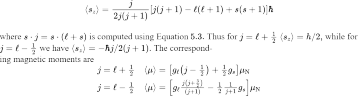
(82) = z1, li(3+1) – e(l + 1) +s(8+1)]ħ where s. j = s. (l+s) is computed using Equation 5.3. Thus for j = [+] (sz) = h/2, while for j=[ - ] we have (sz) = -ħj/2(3 + 1). The correspond- ing magnetic moments are j= l + } (u) = [gelj – 1) + £ 98] un j=l-} (de) = [ge *G+1 - 1 19un
prove first equation by details
please
(82) = z1, li(3+1) – e(l + 1) +s(8+1)]ħ where s. j = s. (l+s) is computed using Equation 5.3. Thus for j = [+] (sz) = h/2, while for j=[ - ] we have (sz) = -ħj/2(3 + 1). The correspond- ing magnetic moments are j= l + } (u) = [gelj – 1) + £ 98] un j=l-} (de) = [ge *G+1 - 1 19un
1. An LTI system has the transfer function (or frequency response) H(u)- a) What is the...
 1. An LTI system has the transfer function (or frequency response) H(u)- a) What is the magnitude of H()? b) What is the phase of H(u)? c) Determine the impulse response of this system. d) Find the differential equation between the input and output of this system. e) What is the output of the system to the input x()c
Determine the system response y(t) for h(t)=u(t)+u(t-2) and x(t)=u(t). [Hint: use Laplace Transform multiplication: L[x(t)h(t)) =...
 Determine the system response y(t) for h(t)=u(t)+u(t-2) and x(t)=u(t). [Hint: use Laplace Transform multiplication: L[x(t)h(t)) = x(s)H(s). Useful Formula: Fourier Transform: F[f(t)] = F(w) sof(t)e-jw dt Inverse Fourier Transform: F-1[F(w)] = f (t) = 24., F(w)ejwidw Time Transformation property of Fourier Transform: f(at – to). FC)e=itoch Laplace Transform: L[f(t)] = F(s) = $© f(t)e-st dt Shifting property: L[f(t – to)u(t – to)] = e-toSF(s) e [tuce) = 1 and c [u(e) = )
b-a e-ylu f(y)= e for y > 0 and L* (u ) c=constant U 1=1 i=1...
 b-a e-ylu f(y)= e for y > 0 and L* (u ) c=constant U 1=1 i=1 Prove the likelihood for u can be expressed as: tulo: D-ring 9: 1-9 Then derive the log-likelihood for u.
thank you for the help :) Question Question 17 (2 marks) Attempt 1 f(t) satisfies the integral equation: f(t)-5 | f(t-u) e-liu H(u) du=12 sgn(t-2) Find the solution of the integral equation using...
 thank you for the help :)
Question Question 17 (2 marks) Attempt 1 f(t) satisfies the integral equation: f(t)-5 | f(t-u) e-liu H(u) du=12 sgn(t-2) Find the solution of the integral equation using Fourier transforms. Your answer should be expressed as a function of t using the correct syntax f() Skipped
Question Question 17 (2 marks) Attempt 1 f(t) satisfies the integral equation: f(t)-5 | f(t-u) e-liu H(u) du=12 sgn(t-2) Find the solution of the integral equation using Fourier transforms....
thank you for the help :)
Question Question 17 (2 marks) Attempt 1 f(t) satisfies the integral equation: f(t)-5 | f(t-u) e-liu H(u) du=12 sgn(t-2) Find the solution of the integral equation using Fourier transforms. Your answer should be expressed as a function of t using the correct syntax f() Skipped
Question Question 17 (2 marks) Attempt 1 f(t) satisfies the integral equation: f(t)-5 | f(t-u) e-liu H(u) du=12 sgn(t-2) Find the solution of the integral equation using Fourier transforms....
1. Consider the insulated heat equation up = cum, 0 <r<L, t > 0 u (0,t)...
 1. Consider the insulated heat equation up = cum, 0 <r<L, t > 0 u (0,t) = u (L, t) = 0, t > 0 u(x,0) = f(2). What is the steady-state solution? 2. Solve the two-dimensional wave equation (with c=1/) on the unit square (i.e., [0, 1] x [0,1) with homogeneous Dirichlet boundary conditions and initial conditions: (2, y,0) = sin(x) sin(y) (,y,0) = sin(x). 3. Solve the following PDE: Uzr + Uyy = 0, 0<<1,0 <y < 2...
What is the difference between two problems? Ex 14.9 has -mgh and F14-13 has +mgh... 14.6...
 What is the difference between two problems?
Ex 14.9 has -mgh and F14-13 has +mgh...
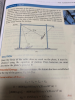
14.6 CONSERVATION OF E XAMPLE 14.9 The gantry struch airplane during of & Me is cable AC is release the plane just befon the maximum tens motion? Neglect suructure in the photo is used to test the response of an ng a crash. As shown in Fig. 14-21a, the plane, having a is hoisted back until - 60, and then the pull-back eleased when the...
What is the difference between two problems?
Ex 14.9 has -mgh and F14-13 has +mgh...
14.6 CONSERVATION OF E XAMPLE 14.9 The gantry struch airplane during of & Me is cable AC is release the plane just befon the maximum tens motion? Neglect suructure in the photo is used to test the response of an ng a crash. As shown in Fig. 14-21a, the plane, having a is hoisted back until - 60, and then the pull-back eleased when the...
 Please ONLY work parts a, d, e
4.4. Consider the standard equilibrium heat equation with a source u (D 1, cp on x E [0, L]. Given the following parameter values and boundary condi tions, determine (1) the equilibrium solution and draw a graph, and (2) compute the flux and indicate on the solution graph the direction and magnitude of the flux. Alternatively specify if the solution does not exist, or detail how it is not fully determined 0 uxxR(x)...
Please ONLY work parts a, d, e
4.4. Consider the standard equilibrium heat equation with a source u (D 1, cp on x E [0, L]. Given the following parameter values and boundary condi tions, determine (1) the equilibrium solution and draw a graph, and (2) compute the flux and indicate on the solution graph the direction and magnitude of the flux. Alternatively specify if the solution does not exist, or detail how it is not fully determined 0 uxxR(x)...
 6. Solve the heat equation (5.17) with initial condition u(x, 0) = H(x)e-x. Write the solution of the Cauchy problem for the heat equation u = kuyx - < x <®, t> 0, (5.17) with initial condition u(t,0) = {(H(x + 1) - H (1 - x)) in terms of the error function Erf () = * e ** dy.
 (b) What is the general form of the solution to the Schroedinger Equation where a) E>U and b) E<U 2 marks] A particle is confined in a 1-D box of length L such that U=0 for 0〈x〈 and U is infinite elsewhere. Find an expression for the wavefunction inside the box which meets these boundary conditions, and show that it satisfies the Schroedinger equation. 2 marks] If the potential outside the box is Uo> O instead of infinite, describe with...
 prove first equation by details
please
(82) = z1, li(3+1) – e(l + 1) +s(8+1)]ħ where s. j = s. (l+s) is computed using Equation 5.3. Thus for j = [+] (sz) = h/2, while for j=[ - ] we have (sz) = -ħj/2(3 + 1). The correspond- ing magnetic moments are j= l + } (u) = [gelj – 1) + £ 98] un j=l-} (de) = [ge *G+1 - 1 19un
prove first equation by details
please
(82) = z1, li(3+1) – e(l + 1) +s(8+1)]ħ where s. j = s. (l+s) is computed using Equation 5.3. Thus for j = [+] (sz) = h/2, while for j=[ - ] we have (sz) = -ħj/2(3 + 1). The correspond- ing magnetic moments are j= l + } (u) = [gelj – 1) + £ 98] un j=l-} (de) = [ge *G+1 - 1 19un
 1. An LTI system has the transfer function (or frequency response) H(u)- a) What is the magnitude of H()? b) What is the phase of H(u)? c) Determine the impulse response of this system. d) Find the differential equation between the input and output of this system. e) What is the output of the system to the input x()c
 Determine the system response y(t) for h(t)=u(t)+u(t-2) and x(t)=u(t). [Hint: use Laplace Transform multiplication: L[x(t)h(t)) = x(s)H(s). Useful Formula: Fourier Transform: F[f(t)] = F(w) sof(t)e-jw dt Inverse Fourier Transform: F-1[F(w)] = f (t) = 24., F(w)ejwidw Time Transformation property of Fourier Transform: f(at – to). FC)e=itoch Laplace Transform: L[f(t)] = F(s) = $© f(t)e-st dt Shifting property: L[f(t – to)u(t – to)] = e-toSF(s) e [tuce) = 1 and c [u(e) = )
 b-a e-ylu f(y)= e for y > 0 and L* (u ) c=constant U 1=1 i=1 Prove the likelihood for u can be expressed as: tulo: D-ring 9: 1-9 Then derive the log-likelihood for u.
 thank you for the help :)
Question Question 17 (2 marks) Attempt 1 f(t) satisfies the integral equation: f(t)-5 | f(t-u) e-liu H(u) du=12 sgn(t-2) Find the solution of the integral equation using Fourier transforms. Your answer should be expressed as a function of t using the correct syntax f() Skipped
Question Question 17 (2 marks) Attempt 1 f(t) satisfies the integral equation: f(t)-5 | f(t-u) e-liu H(u) du=12 sgn(t-2) Find the solution of the integral equation using Fourier transforms....
thank you for the help :)
Question Question 17 (2 marks) Attempt 1 f(t) satisfies the integral equation: f(t)-5 | f(t-u) e-liu H(u) du=12 sgn(t-2) Find the solution of the integral equation using Fourier transforms. Your answer should be expressed as a function of t using the correct syntax f() Skipped
Question Question 17 (2 marks) Attempt 1 f(t) satisfies the integral equation: f(t)-5 | f(t-u) e-liu H(u) du=12 sgn(t-2) Find the solution of the integral equation using Fourier transforms....
 1. Consider the insulated heat equation up = cum, 0 <r<L, t > 0 u (0,t) = u (L, t) = 0, t > 0 u(x,0) = f(2). What is the steady-state solution? 2. Solve the two-dimensional wave equation (with c=1/) on the unit square (i.e., [0, 1] x [0,1) with homogeneous Dirichlet boundary conditions and initial conditions: (2, y,0) = sin(x) sin(y) (,y,0) = sin(x). 3. Solve the following PDE: Uzr + Uyy = 0, 0<<1,0 <y < 2...
 What is the difference between two problems?
Ex 14.9 has -mgh and F14-13 has +mgh...
14.6 CONSERVATION OF E XAMPLE 14.9 The gantry struch airplane during of & Me is cable AC is release the plane just befon the maximum tens motion? Neglect suructure in the photo is used to test the response of an ng a crash. As shown in Fig. 14-21a, the plane, having a is hoisted back until - 60, and then the pull-back eleased when the...
What is the difference between two problems?
Ex 14.9 has -mgh and F14-13 has +mgh...
14.6 CONSERVATION OF E XAMPLE 14.9 The gantry struch airplane during of & Me is cable AC is release the plane just befon the maximum tens motion? Neglect suructure in the photo is used to test the response of an ng a crash. As shown in Fig. 14-21a, the plane, having a is hoisted back until - 60, and then the pull-back eleased when the...
Most questions answered within 3 hours.
-
Where is the error in this code sequence?
String s1 = "Hello";
String s2 = "ello";...
asked 10 months ago -
Financial data for Joel de Paris, Inc., for last year
follow:
Joel de Paris, Inc.
Balance...
asked 10 months ago -
Consider this reaction:
Al2(SO4)3 (aq)+ BaCl3
(aq) Al2Cl6 (aq)- +
3BaSO4(s) . What is the...
asked 10 months ago -
Suppose that Savneet is considering increasing her
recent random sample from 20 car rentals to 40...
asked 10 months ago -
Trucks arrive at an unloading terminal at an average rate of 120
per hour.
Trucks arrive...
asked 10 months ago -
Why are methanol and ethanol completely soluble in water while
octanol is not very little soluble....
asked 10 months ago -
A facilities manager at a university reads in a research report
that the mean amount of...
asked 10 months ago -
When the CuSO4 is rehydrated by adding water to the anhydrous
compound, is this an endothermic...
asked 10 months ago -
A ray of sunlight is passing from diamond into crown glass; the
angle of incidence is...
asked 10 months ago -
A block of mass 0.249 kg is placed on top of a light, vertical
spring of...
asked 10 months ago -
how do the kidneys compensate in the presences of acidosis
a) trigger hyperventilate
b) reserve acid...
asked 10 months ago -
Question 501 pts
The rental rate of capital to the firm increases. Which of the
following...
asked 10 months ago