
Homework Answers
Answer -1
Given,


And


Now,
The sum ov V1 and V2 is,





Hence, option (c) is correct.
Add Answer to:
Question 1 What is the resultant sum of the voltages V1= 100V Z 0° and V2...
1. Under dc conditions, for Figure 1 (a) Calculate the voltages v1 and v2 of the...
 1. Under dc conditions, for Figure 1 (a) Calculate the voltages v1
and v2 of the circuit capacitors and their respective stored
energy. What power does the voltage source deliver (60 V).
10 Ω 50 Ω 20 Ω + + 40 Ω C +0, 2 C, (+1) 60 V Figura 1 (a)
1. Under dc conditions, for Figure 1 (a) Calculate the voltages v1
and v2 of the circuit capacitors and their respective stored
energy. What power does the voltage source deliver (60 V).
10 Ω 50 Ω 20 Ω + + 40 Ω C +0, 2 C, (+1) 60 V Figura 1 (a)
Problem 6.4-26 93 kOhm 45 kOhm >20 kOhm The values of the node voltages V1, V2...
 Problem 6.4-26 93 kOhm 45 kOhm >20 kOhm The values of the node voltages V1, V2 and Vo, are V1 = 8 V, V2 = 0.8 V and v. = -2.8 V. Determine the values of the resistances R1, R2 and R3: R2 = K2, R2 = C k 2 and R3 = kl. Click if you would like to Show Work for this question: Open Show Work
15 points) Consider the following vectors in R3 0 0 2 V1 = 1 ; V2...
 15 points) Consider the following vectors in R3 0 0 2 V1 = 1 ; V2 = 3 ; V3 = 1] ; V4 = -1;V5 = 4 1 2 3 = a) Are V1, V2, V3, V4, V5 linearly independent? Explain. b) Let H (V1, V2, V3, V4, V5) be a 3 x 5 matrix, find (i) a basis of N(H) (ii) a basis of R(H) (iii) a basis of C(H) (iv) the rank of H (v) the nullity...
In the circuit below V1=(100∠0∘) V and V2=(100∠90∘) V. Find the complex power absorbed by: (a)...
 In the circuit below V1=(100∠0∘) V and V2=(100∠90∘) V. Find the
complex power absorbed by:
(a) V1
(b) V2
(c) 6Ω
(d) j4Ω
(e) −j10Ω
(f) 5Ω
(a) SV1 = +j VA
(b) SV2 = +j VA
(c) S6Ω = +j VA
(c) Sj4Ω = +j VA
(d) S−j10Ω = +j VA
(e) S5Ω = +j VA
Please do not round. Thanks in advance.
5Ω 6Ω V2 V1 -j1OQ
In the circuit below V1=(100∠0∘) V and V2=(100∠90∘) V. Find the
complex power absorbed by:
(a) V1
(b) V2
(c) 6Ω
(d) j4Ω
(e) −j10Ω
(f) 5Ω
(a) SV1 = +j VA
(b) SV2 = +j VA
(c) S6Ω = +j VA
(c) Sj4Ω = +j VA
(d) S−j10Ω = +j VA
(e) S5Ω = +j VA
Please do not round. Thanks in advance.
5Ω 6Ω V2 V1 -j1OQ
1. Find the Voltages at Nodes V1 and V2 2. Find Current through R1 3. Find...
 1. Find the Voltages at Nodes V1 and V2
2. Find Current through R1
3. Find The Power Delivered/Sunk by I1
4. Find the current with direction through R2
R2 W 90 15A R3 Dron 10A 30 3120
1. Find the Voltages at Nodes V1 and V2
2. Find Current through R1
3. Find The Power Delivered/Sunk by I1
4. Find the current with direction through R2
R2 W 90 15A R3 Dron 10A 30 3120
Answer Q2 Q1. Use MATLAB to calculate sum of the AC voltages. Plot all three voltages...
 Answer Q2
Q1. Use MATLAB to calculate sum of the AC voltages. Plot all three voltages in the same figure using the inbuilt function subplot(). The frequency of the signal is 10 Hz. Vary the time, t, so that you can view few cycles of the AC voltage. vi(t) = 10 V sin(wt +T/2) vz(t) =15 V sin(wt+1/3) vs(t) = (t) + v2(t) Q2. Use voltage vi(t) from Q1 and impedance, Z = 50 L 30°, and find phasor current...
Answer Q2
Q1. Use MATLAB to calculate sum of the AC voltages. Plot all three voltages in the same figure using the inbuilt function subplot(). The frequency of the signal is 10 Hz. Vary the time, t, so that you can view few cycles of the AC voltage. vi(t) = 10 V sin(wt +T/2) vz(t) =15 V sin(wt+1/3) vs(t) = (t) + v2(t) Q2. Use voltage vi(t) from Q1 and impedance, Z = 50 L 30°, and find phasor current...
1) Determine if w is in the subspace spanned by v1, v2, v3 2) Are the...
 1) Determine if w is in the subspace spanned by v1, v2,
v3
2) Are the vectors v1, v2, v3 linearly dependent or
independent? justify your answer
Question 2. (15 pts) Let vi=(-3 0 6)", v2= (-2 2 3]", V3= (0 - 6 37, and w= [1 11 9". (1). Determine if w is in the subspace spanned by V1, V2, V3. (2). Are the vectors V1, V2, V3 linearly dependent or independent? Justify your answer
1) Determine if w is in the subspace spanned by v1, v2,
v3
2) Are the vectors v1, v2, v3 linearly dependent or
independent? justify your answer
Question 2. (15 pts) Let vi=(-3 0 6)", v2= (-2 2 3]", V3= (0 - 6 37, and w= [1 11 9". (1). Determine if w is in the subspace spanned by V1, V2, V3. (2). Are the vectors V1, V2, V3 linearly dependent or independent? Justify your answer
P5.6 Calculate the DC voltages V1-V6 in the circuit of Fig. P5.6 under the assumption that...
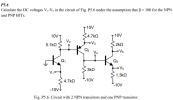 P5.6
Calculate the DC voltages V1-V6 in the circuit of Fig. P5.6
under the assumption that β = 100 for the NPN and PNP BJTs.
P5.6 Calculate the DC voltages V-V in the circuit of Fig. P5.6 under the assumption that B = 100 for the NPN and PNP BJTs. 110V 10V 1 34.7k12 10V 5.160 L V2 LK Q2 VA V3م 32 Love Q3 V. 33k2 Lovs 1.3k2 34.751 -10V -10V Fig. P5.6. Circuit with 2 NPN transistors and...
P5.6
Calculate the DC voltages V1-V6 in the circuit of Fig. P5.6
under the assumption that β = 100 for the NPN and PNP BJTs.
P5.6 Calculate the DC voltages V-V in the circuit of Fig. P5.6 under the assumption that B = 100 for the NPN and PNP BJTs. 110V 10V 1 34.7k12 10V 5.160 L V2 LK Q2 VA V3م 32 Love Q3 V. 33k2 Lovs 1.3k2 34.751 -10V -10V Fig. P5.6. Circuit with 2 NPN transistors and...
V1 = 8 (V) Problem 1 R1 = 8 (0) V2 = 26 (V) VA =...
 V1 = 8 (V) Problem 1 R1 = 8 (0) V2 = 26 (V) VA = 28 (V) V3 = 20 (V) Using Kirchhoff's rules in the circuit of image, A- Calculate the current in the circuit. B- Show the direction current in the circuit. C- Calculate the voltage across resistor R1 D- Calculate the power delivered to R2 E After 15 minutes of working of circuit, how much energy is delivered to resistor Rı? R2 = 7(0)
Problem 5: Let V and W be vector spaces and let B = {V1, V2, ...,...
 Problem 5: Let V and W be vector spaces and let B = {V1, V2, ..., Un} CV be a basis for V. Let L :V + W be a linear transformation, and let Ker L = {2 € V: L(x)=0}. (a) If Ker L = {0}, show that C = {L(v1), L(02), ..., L(vn) } CW is a linearly independent set in W. (b) If C = {L(01), L(V2),..., L(Un)} C W is a linearly independent set in W,...
 1. Under dc conditions, for Figure 1 (a) Calculate the voltages v1
and v2 of the circuit capacitors and their respective stored
energy. What power does the voltage source deliver (60 V).
10 Ω 50 Ω 20 Ω + + 40 Ω C +0, 2 C, (+1) 60 V Figura 1 (a)
1. Under dc conditions, for Figure 1 (a) Calculate the voltages v1
and v2 of the circuit capacitors and their respective stored
energy. What power does the voltage source deliver (60 V).
10 Ω 50 Ω 20 Ω + + 40 Ω C +0, 2 C, (+1) 60 V Figura 1 (a)
 Problem 6.4-26 93 kOhm 45 kOhm >20 kOhm The values of the node voltages V1, V2 and Vo, are V1 = 8 V, V2 = 0.8 V and v. = -2.8 V. Determine the values of the resistances R1, R2 and R3: R2 = K2, R2 = C k 2 and R3 = kl. Click if you would like to Show Work for this question: Open Show Work
 15 points) Consider the following vectors in R3 0 0 2 V1 = 1 ; V2 = 3 ; V3 = 1] ; V4 = -1;V5 = 4 1 2 3 = a) Are V1, V2, V3, V4, V5 linearly independent? Explain. b) Let H (V1, V2, V3, V4, V5) be a 3 x 5 matrix, find (i) a basis of N(H) (ii) a basis of R(H) (iii) a basis of C(H) (iv) the rank of H (v) the nullity...
 In the circuit below V1=(100∠0∘) V and V2=(100∠90∘) V. Find the
complex power absorbed by:
(a) V1
(b) V2
(c) 6Ω
(d) j4Ω
(e) −j10Ω
(f) 5Ω
(a) SV1 = +j VA
(b) SV2 = +j VA
(c) S6Ω = +j VA
(c) Sj4Ω = +j VA
(d) S−j10Ω = +j VA
(e) S5Ω = +j VA
Please do not round. Thanks in advance.
5Ω 6Ω V2 V1 -j1OQ
In the circuit below V1=(100∠0∘) V and V2=(100∠90∘) V. Find the
complex power absorbed by:
(a) V1
(b) V2
(c) 6Ω
(d) j4Ω
(e) −j10Ω
(f) 5Ω
(a) SV1 = +j VA
(b) SV2 = +j VA
(c) S6Ω = +j VA
(c) Sj4Ω = +j VA
(d) S−j10Ω = +j VA
(e) S5Ω = +j VA
Please do not round. Thanks in advance.
5Ω 6Ω V2 V1 -j1OQ
 1. Find the Voltages at Nodes V1 and V2
2. Find Current through R1
3. Find The Power Delivered/Sunk by I1
4. Find the current with direction through R2
R2 W 90 15A R3 Dron 10A 30 3120
1. Find the Voltages at Nodes V1 and V2
2. Find Current through R1
3. Find The Power Delivered/Sunk by I1
4. Find the current with direction through R2
R2 W 90 15A R3 Dron 10A 30 3120
 Answer Q2
Q1. Use MATLAB to calculate sum of the AC voltages. Plot all three voltages in the same figure using the inbuilt function subplot(). The frequency of the signal is 10 Hz. Vary the time, t, so that you can view few cycles of the AC voltage. vi(t) = 10 V sin(wt +T/2) vz(t) =15 V sin(wt+1/3) vs(t) = (t) + v2(t) Q2. Use voltage vi(t) from Q1 and impedance, Z = 50 L 30°, and find phasor current...
Answer Q2
Q1. Use MATLAB to calculate sum of the AC voltages. Plot all three voltages in the same figure using the inbuilt function subplot(). The frequency of the signal is 10 Hz. Vary the time, t, so that you can view few cycles of the AC voltage. vi(t) = 10 V sin(wt +T/2) vz(t) =15 V sin(wt+1/3) vs(t) = (t) + v2(t) Q2. Use voltage vi(t) from Q1 and impedance, Z = 50 L 30°, and find phasor current...
 1) Determine if w is in the subspace spanned by v1, v2,
v3
2) Are the vectors v1, v2, v3 linearly dependent or
independent? justify your answer
Question 2. (15 pts) Let vi=(-3 0 6)", v2= (-2 2 3]", V3= (0 - 6 37, and w= [1 11 9". (1). Determine if w is in the subspace spanned by V1, V2, V3. (2). Are the vectors V1, V2, V3 linearly dependent or independent? Justify your answer
1) Determine if w is in the subspace spanned by v1, v2,
v3
2) Are the vectors v1, v2, v3 linearly dependent or
independent? justify your answer
Question 2. (15 pts) Let vi=(-3 0 6)", v2= (-2 2 3]", V3= (0 - 6 37, and w= [1 11 9". (1). Determine if w is in the subspace spanned by V1, V2, V3. (2). Are the vectors V1, V2, V3 linearly dependent or independent? Justify your answer
 P5.6
Calculate the DC voltages V1-V6 in the circuit of Fig. P5.6
under the assumption that β = 100 for the NPN and PNP BJTs.
P5.6 Calculate the DC voltages V-V in the circuit of Fig. P5.6 under the assumption that B = 100 for the NPN and PNP BJTs. 110V 10V 1 34.7k12 10V 5.160 L V2 LK Q2 VA V3م 32 Love Q3 V. 33k2 Lovs 1.3k2 34.751 -10V -10V Fig. P5.6. Circuit with 2 NPN transistors and...
P5.6
Calculate the DC voltages V1-V6 in the circuit of Fig. P5.6
under the assumption that β = 100 for the NPN and PNP BJTs.
P5.6 Calculate the DC voltages V-V in the circuit of Fig. P5.6 under the assumption that B = 100 for the NPN and PNP BJTs. 110V 10V 1 34.7k12 10V 5.160 L V2 LK Q2 VA V3م 32 Love Q3 V. 33k2 Lovs 1.3k2 34.751 -10V -10V Fig. P5.6. Circuit with 2 NPN transistors and...
 V1 = 8 (V) Problem 1 R1 = 8 (0) V2 = 26 (V) VA = 28 (V) V3 = 20 (V) Using Kirchhoff's rules in the circuit of image, A- Calculate the current in the circuit. B- Show the direction current in the circuit. C- Calculate the voltage across resistor R1 D- Calculate the power delivered to R2 E After 15 minutes of working of circuit, how much energy is delivered to resistor Rı? R2 = 7(0)
 Problem 5: Let V and W be vector spaces and let B = {V1, V2, ..., Un} CV be a basis for V. Let L :V + W be a linear transformation, and let Ker L = {2 € V: L(x)=0}. (a) If Ker L = {0}, show that C = {L(v1), L(02), ..., L(vn) } CW is a linearly independent set in W. (b) If C = {L(01), L(V2),..., L(Un)} C W is a linearly independent set in W,...
Most questions answered within 3 hours.
-
Where is the error in this code sequence?
String s1 = "Hello";
String s2 = "ello";...
asked 11 months ago -
Financial data for Joel de Paris, Inc., for last year
follow:
Joel de Paris, Inc.
Balance...
asked 11 months ago -
Consider this reaction:
Al2(SO4)3 (aq)+ BaCl3
(aq) Al2Cl6 (aq)- +
3BaSO4(s) . What is the...
asked 11 months ago -
Suppose that Savneet is considering increasing her
recent random sample from 20 car rentals to 40...
asked 11 months ago -
Trucks arrive at an unloading terminal at an average rate of 120
per hour.
Trucks arrive...
asked 11 months ago -
Why are methanol and ethanol completely soluble in water while
octanol is not very little soluble....
asked 11 months ago -
A facilities manager at a university reads in a research report
that the mean amount of...
asked 11 months ago -
When the CuSO4 is rehydrated by adding water to the anhydrous
compound, is this an endothermic...
asked 11 months ago -
A ray of sunlight is passing from diamond into crown glass; the
angle of incidence is...
asked 11 months ago -
A block of mass 0.249 kg is placed on top of a light, vertical
spring of...
asked 11 months ago -
how do the kidneys compensate in the presences of acidosis
a) trigger hyperventilate
b) reserve acid...
asked 11 months ago -
Question 501 pts
The rental rate of capital to the firm increases. Which of the
following...
asked 11 months ago